Upper Limb Prosthetics Market Size, Share & Industry Analysis, By Component (Prosthetic Wrist, Prosthetic Arm), By Product Type (Passive Prosthetic Devices, Body Powered Prosthetic Devices), By End-user and Regional Forecast, 2026-2034
 Download Free Sample
Upper Limb Prosthetics Market Overview
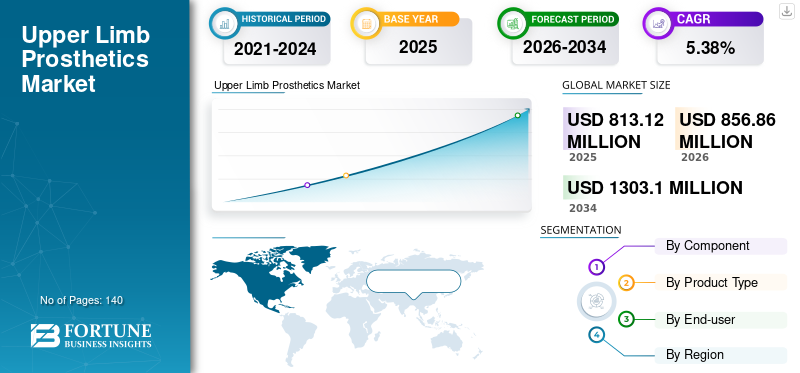
The upper limb prosthetics market size was valued at USD 813.12 million in 2025. The market is projected to grow from USD 856.86 million in 2026 to USD 1303.10 million by 2034, exhibiting a CAGR of 5.38% during the forecast period.

The upper limb prosthetics market is experiencing strong expansion due to rising cases of traumatic injuries, congenital limb deficiencies, and increasing adoption of advanced prosthetic technologies. Upper limb prosthetic devices are widely utilized to improve mobility, independence, and quality of life for patients with upper extremity amputations. The upper limb prosthetics market Report highlights growing demand for myoelectric prosthetics, lightweight prosthetic materials, and AI-integrated limb control systems. Rehabilitation centers and prosthetic clinics are increasingly adopting customized prosthetic solutions with enhanced grip functionality and sensory feedback technologies. upper limb prosthetics market Analysis also indicates increasing utilization of 3D printing and robotic technologies in advanced upper limb prosthetic manufacturing.
The USA upper limb prosthetics market is expanding steadily due to advanced rehabilitation infrastructure, increasing healthcare expenditure, and strong adoption of technologically advanced prosthetic devices. Veterans, accident survivors, and individuals with congenital limb loss represent major patient groups utilizing upper limb prosthetics in the United States. The Upper Limb Prosthetics Industry Report highlights growing demand for myoelectric prosthetic arms and AI-assisted control systems capable of improving movement precision and patient comfort. Prosthetic clinics and rehabilitation hospitals are increasingly investing in personalized prosthetic fitting technologies and digital rehabilitation programs. Continuous innovation in robotic prosthetics and wearable medical devices continues supporting the upper limb prosthetics market Outlook in the country.
Download Free sample to learn more about this report.
Upper Limb Prosthetics Market Key Takeaways
 Global Market Size & Forecast
- 2025 Market Size: USD 813.11 Million
- 2026 Market Size: USD 856.86 Million
- 2034 Forecast Market Size: USD 1,303.10 Million
- CAGR: 5.38% from 2026-2034
 Market Share
- North America dominated with a revenue share of 39% in 2025.
- Prosthetic arms accounted for approximately 59% of the market share.
- Body powered prosthetic devices held approximately 64% of the market share.
 Key Regional Highlights
North America
North America led the market with a 39% share, supported by advanced prosthetic technologies and rehabilitation infrastructure.
North America
Europe accounted for 28% of the market, driven by increasing adoption of advanced prosthetic devices and rehabilitation services.
Asia-Pacific
Asia-Pacific held a 24% share, supported by rising healthcare investments and growing awareness of prosthetic solutions.
U.S.
The U.S. market is supported by strong demand for technologically advanced prosthetic devices and comprehensive rehabilitation services.
Japan
Japan accounted for 27% of the Asia-Pacific market, supported by advanced healthcare infrastructure and increasing adoption of innovative prosthetic technologies.
Read More

Upper Limb Prosthetics Market Latest Trends
The upper limb prosthetics market trends indicate increasing adoption of myoelectric prosthetic systems equipped with artificial intelligence, machine learning algorithms, and advanced sensor technologies. These next-generation prosthetic devices allow users to perform more natural and precise hand movements through muscle signal recognition and adaptive control systems. The upper limb prosthetics market Research Report highlights growing use of lightweight carbon fiber materials and 3D-printed prosthetic components designed to improve comfort, customization, and durability. Manufacturers are also integrating wireless connectivity and mobile application compatibility into upper limb prosthetic systems for real-time performance monitoring and personalized adjustment settings.
Download Free sample to learn more about this report.
Another major trend in the upper limb prosthetics market Analysis is the expansion of bionic prosthetic technologies capable of delivering sensory feedback and improved motion control. Rehabilitation centers are increasingly utilizing virtual reality and robotic training systems to support prosthetic adaptation and physical therapy programs. Pediatric prosthetics are also witnessing innovation through modular and adjustable designs that accommodate patient growth and changing mobility requirements. The upper limb prosthetics market Insights further reveal rising investments in affordable prosthetic technologies targeting underserved patient populations in emerging healthcare markets. Technological collaboration between robotics companies and prosthetic manufacturers continues creating new upper limb prosthetics market Opportunities globally.
Upper Limb Prosthetics Market Dynamics
DRIVER
Increasing Prevalence of Limb Amputations and Traumatic Injuries
The major driver supporting upper limb prosthetics market Growth is the increasing number of traumatic injuries, workplace accidents, congenital limb deficiencies, and medical amputations worldwide. Road accidents, industrial injuries, military combat injuries, and chronic diseases such as diabetes are contributing significantly to rising upper limb amputation cases globally. Prosthetic devices are increasingly utilized to restore mobility, independence, and functional capabilities among amputees. Healthcare providers and rehabilitation specialists are emphasizing early prosthetic intervention and advanced rehabilitation therapies to improve patient outcomes and quality of life.
The upper limb prosthetics market Forecast is also strengthened by growing awareness regarding advanced prosthetic technologies and rehabilitation support services. Myoelectric prosthetics and robotic arm systems are becoming more accessible due to technological innovation and improved manufacturing processes. Rehabilitation hospitals and prosthetic clinics are increasingly offering customized prosthetic fitting and digital rehabilitation programs tailored to individual patient needs. Continuous advancements in sensor technology, AI-powered control systems, and lightweight prosthetic materials are further supporting long-term expansion within the global Upper Limb Prosthetics Industry Analysis landscape.
RESTRAINT
High Cost of Advanced Prosthetic Systems
A major restraint affecting the upper limb prosthetics market is the high cost associated with technologically advanced prosthetic devices and rehabilitation services. Myoelectric prosthetic arms, robotic prosthetics, and AI-integrated systems often require substantial financial investment for device procurement, customization, maintenance, and patient training. Many patients in low-income and developing regions face affordability challenges due to limited insurance reimbursement and healthcare funding support. Advanced prosthetic devices also require regular upgrades and servicing, increasing long-term treatment expenses.
The upper limb prosthetics market Analysis further highlights challenges related to limited accessibility of specialized prosthetic care and rehabilitation infrastructure. Rural and underserved healthcare regions often lack experienced prosthetists, rehabilitation specialists, and advanced fitting technologies. Patients may also experience adaptation difficulties and discomfort while adjusting to complex prosthetic systems. Additionally, technological limitations involving battery life, movement precision, and device durability continue influencing patient satisfaction and long-term adoption rates within the upper limb prosthetics industry.
OPPORTUNITY
Expansion of Robotic Prosthetics and Ai Integrtioan
The increasing integration of artificial intelligence and robotic technologies presents substantial upper limb prosthetics market Opportunities worldwide. Manufacturers are developing advanced prosthetic devices capable of delivering more natural hand movements, grip control, and sensory feedback through AI-assisted muscle signal interpretation. Robotic prosthetics with adaptive learning systems are improving user experience and functional independence among amputees. The growing popularity of smart wearable medical technologies is also supporting innovation in upper limb prosthetic systems.
The upper limb prosthetics market Report highlights strong opportunities in pediatric prosthetics, military rehabilitation programs, and personalized rehabilitation technologies. 3D printing is enabling cost-effective customization and rapid production of prosthetic components designed for individual patient requirements. Emerging economies are increasingly investing in rehabilitation infrastructure and prosthetic accessibility programs to improve healthcare inclusion. Collaboration between robotics companies, healthcare providers, and prosthetic manufacturers continues accelerating product innovation and creating long-term upper limb prosthetics market Growth opportunities globally.
CHALLENGE
Technical Limitations and Patient Adaptation Difficulties
One of the key challenges within the upper limb prosthetics market involves technical limitations associated with advanced prosthetic systems and patient adaptation complexity. Myoelectric prosthetic devices require accurate muscle signal detection and calibration to deliver smooth and responsive movement control. Patients may experience difficulties learning to operate sophisticated robotic prosthetics, particularly during the initial rehabilitation stages. Device weight, battery performance, and limited sensory feedback may also influence long-term usability and patient satisfaction.
The Upper Limb Prosthetics Industry Report further identifies challenges related to maintenance requirements, component durability, and ongoing rehabilitation support. Frequent servicing and software updates may increase operational expenses for prosthetic users. Healthcare providers must also invest significantly in patient training programs and rehabilitation technologies to improve prosthetic adaptation outcomes. Regulatory approval processes and clinical testing requirements for next-generation robotic prosthetics continue adding complexity to product development and commercialization strategies within the global upper limb prosthetics market.
Upper Limb Prosthetics Market Segmentation
By Component
Prosthetic wrist systems account for approximately 41% of the upper limb prosthetics market Share because they play a critical role in improving hand positioning, rotation, and movement flexibility during daily activities. Prosthetic wrists are increasingly integrated into myoelectric and body-powered prosthetic devices to enhance functionality and user comfort. Rehabilitation centers and prosthetic clinics are adopting advanced wrist systems with multi-axis movement capabilities and lightweight materials to improve patient mobility and task performance. The upper limb prosthetics market Research Report highlights rising demand for modular wrist components designed for pediatric and adult amputees requiring customized prosthetic configurations. The increasing adoption of robotic and sensor-enabled prosthetic wrists is also supporting segment expansion globally. Manufacturers are developing wrist systems with enhanced torque control, wireless connectivity, and adaptive movement technologies to improve natural arm motion and dexterity. Prosthetic wrists are widely utilized across military rehabilitation programs, sports rehabilitation centers, and occupational therapy applications. Continuous advancements in carbon fiber materials and compact actuator technologies are expected to strengthen long-term growth opportunities within the prosthetic wrist segment.
Prosthetic arms contribute nearly 59% of the upper limb prosthetics market Size because they provide comprehensive functional restoration for patients with partial or complete upper limb amputations. Myoelectric prosthetic arms equipped with advanced grip systems, AI-assisted controls, and sensory feedback technologies are becoming increasingly popular among amputees seeking improved independence and mobility. Hospitals and rehabilitation clinics are increasingly recommending customized prosthetic arms designed according to patient activity levels, occupational requirements, and physical capabilities. The upper limb prosthetics market Analysis indicates strong demand for robotic prosthetic arms capable of delivering multi-grip functionality and precise movement coordination. Technological advancements involving electromyography sensors, machine learning algorithms, and lightweight structural materials are improving device performance and user comfort significantly. Prosthetic manufacturers are also introducing modular arm systems that allow flexible component replacement and easier maintenance. Growing investment in rehabilitation robotics and wearable medical technologies continues supporting long-term market expansion within the prosthetic arm segment.
By Product Type
Passive prosthetic devices account for approximately 36% of the upper limb prosthetics market Share because they offer lightweight, affordable, and cosmetically appealing solutions for amputees requiring basic functionality. These devices are primarily designed to restore appearance and provide support during daily non-intensive activities. Passive prosthetics are widely utilized by pediatric patients, elderly individuals, and users preferring low-maintenance prosthetic options. The upper limb prosthetics market Report highlights increasing demand for silicone-based cosmetic prosthetics with realistic skin tones and anatomical detailing. Manufacturers are introducing customized passive prosthetic devices designed using 3D scanning and printing technologies to improve comfort and personalization. Passive devices also provide psychological and social confidence benefits for amputees seeking natural appearance restoration. Rehabilitation specialists often recommend passive prosthetics during early adaptation stages before transitioning patients to more advanced functional systems. Growing affordability and easier maintenance continue supporting demand for passive prosthetic devices across developing healthcare markets.
Body powered prosthetic devices contribute nearly 64% of the upper limb prosthetics market Size because they provide reliable mechanical functionality and durability for physically active users. These devices utilize cable and harness systems controlled by body movement to operate prosthetic hands and hooks. Body powered systems are highly preferred in industrial work environments, military rehabilitation programs, and occupational therapy applications due to their durability, affordability, and lower maintenance requirements. The upper limb prosthetics market Forecast highlights increasing adoption of lightweight harness materials and ergonomic mechanical designs to improve comfort and reduce user fatigue. Prosthetic clinics are increasingly integrating modular components and customizable grip systems into body powered devices to enhance performance. Manufacturers are also improving cable mechanisms and mechanical joint flexibility to deliver smoother movement control. Strong demand from rehabilitation hospitals and cost-sensitive healthcare systems continues supporting long-term growth within the body powered prosthetic segment.
By End-user
Hospitals and rehabilitation centers account for approximately 62% of the upper limb prosthetics market Share because they provide comprehensive prosthetic fitting, rehabilitation therapy, and post-amputation care services. These healthcare institutions play a critical role in evaluating patient mobility requirements, customizing prosthetic devices, and supporting rehabilitation training programs. Advanced rehabilitation centers are increasingly adopting robotic therapy systems, virtual reality rehabilitation technologies, and AI-assisted prosthetic training solutions to improve patient outcomes. The upper limb prosthetics market Insights indicate rising investment in multidisciplinary rehabilitation programs integrating prosthetists, physiotherapists, occupational therapists, and psychological support specialists. Hospitals are also collaborating with prosthetic manufacturers to improve device customization and patient adaptation strategies. Growing demand for technologically advanced prosthetics and digital rehabilitation infrastructure continues supporting strong market growth across hospitals and rehabilitation centers globally.
Upper Limb Prosthetics Market Regional Outlook
North America
North America accounts for approximately 39% of the upper limb prosthetics market Share due to advanced rehabilitation infrastructure, high adoption of myoelectric prosthetics, and strong healthcare reimbursement systems. The United States remains the largest contributor because hospitals and prosthetic clinics are increasingly utilizing AI-assisted prosthetic technologies and robotic rehabilitation systems. Military rehabilitation programs and rising traumatic injury cases are also supporting market demand across the region. The upper limb prosthetics market Outlook for North America remains strong because healthcare providers continue investing in digital rehabilitation platforms and personalized prosthetic technologies.
Europe
Europe holds nearly 28% of the upper limb prosthetics market Share because of increasing healthcare modernization, strong rehabilitation infrastructure, and rising adoption of advanced prosthetic technologies. Countries such as Germany, the United Kingdom, France, and Italy are major contributors to regional market expansion. Healthcare systems across Europe are increasingly emphasizing patient-centered rehabilitation and technologically advanced prosthetic fitting solutions.
Germany Upper Limb Prosthetics Market
Germany contributes approximately 31% of Europe’s upper limb prosthetics market because of advanced healthcare infrastructure, strong medical technology adoption, and increasing rehabilitation investments. Hospitals and prosthetic clinics across Germany are increasingly implementing robotic prosthetics and AI-assisted rehabilitation systems to improve patient outcomes. The upper limb prosthetics market Trends in Germany indicate rising utilization of 3D printing technologies and customized prosthetic manufacturing processes.
The country’s rehabilitation sector is also investing heavily in pediatric prosthetic care and occupational rehabilitation programs. Research institutions and prosthetic manufacturers continue collaborating to improve prosthetic comfort, mobility, and sensory feedback capabilities throughout Germany’s healthcare system.
United Kingdom Upper Limb Prosthetics Market
The United Kingdom accounts for approximately 24% of Europe’s upper limb prosthetics market due to increasing awareness regarding prosthetic rehabilitation and growing adoption of myoelectric prosthetic systems. Hospitals and prosthetic clinics are increasingly utilizing digital scanning technologies and AI-powered fitting systems to improve device customization and patient comfort. Government healthcare initiatives supporting rehabilitation services and disability inclusion continue strengthening market demand across the country.
The upper limb prosthetics market Research Report highlights rising investments in sports rehabilitation programs and pediatric prosthetic technologies within the United Kingdom healthcare sector. Growing collaboration between rehabilitation specialists and prosthetic manufacturers is also supporting technological innovation and market expansion.
Asia-Pacific
Asia-Pacific represents approximately 24% of the upper limb prosthetics market Share because of improving healthcare accessibility, rising traumatic injury cases, and increasing rehabilitation infrastructure development. Countries such as China, Japan, India, and South Korea are increasingly adopting advanced prosthetic technologies across hospitals and rehabilitation centers. Growing awareness regarding prosthetic rehabilitation and technological accessibility continues supporting regional market growth.
Japan Upper Limb Prosthetics Market
Japan contributes approximately 27% of the Asia-Pacific upper limb prosthetics market due to advanced robotics expertise, strong healthcare infrastructure, and increasing adoption of technologically advanced prosthetic devices. Japanese prosthetic clinics and rehabilitation centers are increasingly utilizing robotic prosthetic systems and AI-assisted rehabilitation technologies. The upper limb prosthetics market Insights indicate growing demand for lightweight prosthetic materials and personalized prosthetic fitting solutions across the country.
The country’s aging population and strong rehabilitation programs are also supporting increased prosthetic adoption rates. Continuous investment in wearable robotics and rehabilitation innovation continues strengthening long-term market development throughout Japan.
China Upper Limb Prosthetics Market
China accounts for approximately 41% of the Asia-Pacific upper limb prosthetics market because of expanding healthcare infrastructure, increasing traumatic injury cases, and rising accessibility of rehabilitation services. Hospitals and prosthetic clinics across China are increasingly adopting advanced prosthetic manufacturing technologies and digital rehabilitation systems. Government healthcare initiatives focused on disability support and rehabilitation accessibility are significantly contributing to market expansion.
The upper limb prosthetics market Forecast for China remains highly positive because domestic manufacturers are increasing investment in affordable robotic prosthetic systems and customized prosthetic technologies. Rising healthcare expenditure and growing awareness regarding rehabilitation services continue driving strong demand for upper limb prosthetic devices across the country.
Rest of World
Rest of World accounts for approximately 9% of the upper limb prosthetics market Share because of improving rehabilitation accessibility and increasing adoption of prosthetic technologies across Latin America, the Middle East, and Africa. Governments and non-profit healthcare organizations are investing in rehabilitation infrastructure and disability support programs to improve prosthetic accessibility within emerging healthcare markets.
The upper limb prosthetics market Opportunities within these regions are increasing due to rising awareness regarding advanced prosthetic rehabilitation and growing collaboration between healthcare providers and international prosthetic manufacturers. Expanding prosthetic training initiatives and digital rehabilitation technologies are also supporting long-term market growth across developing economies.
List of Top Upper Limb Prosthetics Companies
- Össur
- Ottobock
- Steeper Group.
- Fillauer LLC
- Open Bionics
- Comprehensive Prosthetics & Orthotics
- COAPT LLC.
- Mobius Bionics.
- Protunix
- Motorica
Top Two Companies by Market Share
- Ottobock – 26%
- Össur – 18%
Investment Analysis and Opportunities
The upper limb prosthetics market is attracting substantial investment due to increasing demand for robotic prosthetics, AI-powered rehabilitation systems, and personalized prosthetic technologies. Healthcare providers and prosthetic manufacturers are investing heavily in 3D printing technologies, advanced sensor systems, and lightweight prosthetic materials designed to improve mobility and patient comfort. The upper limb prosthetics market Opportunities are especially strong in pediatric prosthetics, military rehabilitation programs, and affordable prosthetic technologies for emerging healthcare markets.
Technology companies and medical device manufacturers are increasingly collaborating to develop smart prosthetic systems capable of delivering improved sensory feedback and movement precision. Venture capital investment in wearable robotics and digital rehabilitation technologies is also increasing significantly. The upper limb prosthetics market Report highlights growing interest in AI-integrated myoelectric prosthetics and cloud-connected rehabilitation platforms capable of supporting long-term patient monitoring and adaptive prosthetic control.
New Product Development
Manufacturers in the upper limb prosthetics market are focusing heavily on robotic prosthetic arms, AI-powered control systems, and advanced prosthetic customization technologies. Companies are introducing myoelectric prosthetics equipped with adaptive grip functionality, wireless connectivity, and machine learning algorithms capable of improving movement precision and user experience. Lightweight carbon fiber structures and 3D-printed components are also improving prosthetic durability and patient comfort.
The upper limb prosthetics market Trends indicate increasing development of sensory feedback technologies designed to provide amputees with more natural movement control and touch perception. Manufacturers are also integrating mobile application compatibility and cloud-based monitoring systems into prosthetic devices for remote adjustments and rehabilitation tracking. Continuous research in robotics, electromyography sensors, and neuroprosthetic interfaces is expected to strengthen future upper limb prosthetics market Growth opportunities globally.
Five Recent Developments (2023-2025)
- Major prosthetic manufacturers introduced AI-powered myoelectric prosthetic arms in 2023 with improved gesture recognition and adaptive grip functionality.
- Several rehabilitation centers adopted virtual reality prosthetic training systems in 2024 to improve patient adaptation and rehabilitation outcomes.
- Prosthetic companies expanded use of 3D printing technologies during 2024 for rapid customization and lightweight prosthetic production.
- Manufacturers launched advanced sensory feedback prosthetic systems in 2025 designed to improve touch perception and movement precision.
- Healthcare providers increased investment in robotic rehabilitation programs and digital prosthetic monitoring platforms during 2025 to support long-term patient care.
Report Coverage of Upper Limb Prosthetics Market
The upper limb prosthetics market report provides comprehensive analysis of prosthetic technologies, rehabilitation trends, product innovations, and global healthcare infrastructure developments. The report covers major market segments including prosthetic wrists, prosthetic arms, passive prosthetic devices, body powered prosthetics, hospitals, rehabilitation centers, and prosthetic clinics.
Request for Customization to gain extensive market insights.
The upper limb prosthetics market analysis within the report evaluates market drivers, restraints, opportunities, and technological advancements influencing industry expansion. Detailed segmentation analysis includes product type, end-user applications, and regional rehabilitation infrastructure developments. Regional assessments cover North America, Europe, Asia-Pacific, and Rest of World markets with country-level insights for major rehabilitation healthcare economies. The report further examines investment activities, robotic prosthetic innovation strategies, digital rehabilitation trends, and competitive positioning among leading upper limb prosthetics manufacturers.
Frequently Asked Questions
Fortune Business Insights says that the global market value stood at USD 813.12 million in 2025 and is projected to reach USD 1,303.10 million by 2034.
The market is expected to exhibit a CAGR of 5.38% during the forecast period of 2026-2034.
Body powered prosthetic devices were the leading product type segment, accounting for nearly 64% of the market share, driven by their durability, affordability, and reliable mechanical functionality.
Key players include Ottobock, Össur, Steeper Group, Fillauer LLC, Open Bionics, and Comprehensive Prosthetics & Orthotics.
Major trends include increasing adoption of AI-powered myoelectric and bionic prosthetics and growing use of lightweight carbon fiber and 3D-printed components. North America led the market with a 39% regional share.



- 2021-2034
- 2025
- 2021-2024
- 140
-

(Offer valid till 30th Sep 2026)
Get 30-60 hrs Free Customization
Expand Regional and Country Coverage, Segments Analysis, Company Profiles, Competitive Benchmarking, and End-user Insights.













.webp)






-
US +1 833 909 2966 ( Toll Free )
-
Get In Touch With Us