Urinary Tract Infection Testing Market Size, Share & Industry Analysis, By Type (Urethritis, Cystitis, Pyelonephritis), By End Use (Reference Laboratories, General Practitioners, Urologists, Urgent Care), and Regional Forecast, 2026-2034
 Download Free Sample
Urinary Tract Infection Testing Market Overview
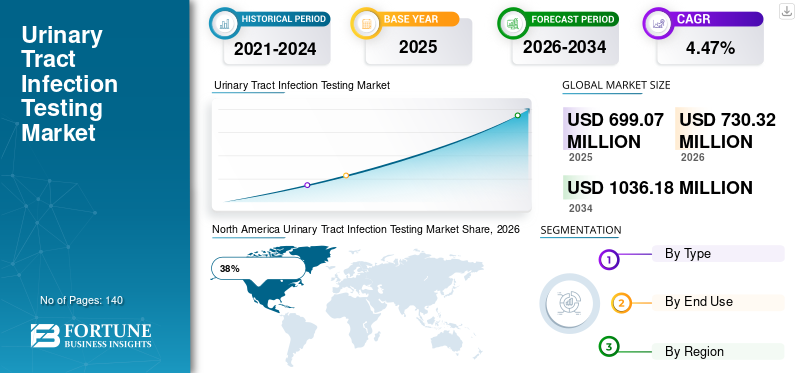
The global urinary tract infection testing market size was valued at USD 699.07 billion in 2025. The market is projected to grow from USD 730.32 billion in 2026 to USD 1036.18 billion by 2034, exhibiting a CAGR of 4.47% during the forecast period. The market in North America dominated with a revenue share of 38% in 2025.

The urinary tract infection testing market is experiencing steady expansion due to the growing incidence of bacterial infections, increasing diagnostic awareness, and wider adoption of laboratory-based and point-of-care testing solutions. Healthcare providers are emphasizing early infection detection to reduce complications associated with untreated urinary tract infections. The market is supported by technological improvements in molecular diagnostics, automated urine analyzers, and rapid testing platforms. Hospitals, diagnostic laboratories, and outpatient centers continue to increase testing volumes as patient screening becomes more routine. The urinary tract infection testing market Report indicates that rising healthcare access, growing elderly populations, and increased demand for accurate diagnostic procedures are strengthening overall market penetration across developed and emerging healthcare systems.
The United States accounts for a significant share of the urinary tract infection testing market due to high diagnostic testing volumes and extensive healthcare infrastructure. More than 8 million physician visits annually are associated with urinary tract infections, creating sustained demand for urine culture testing, dipstick analysis, and molecular diagnostic solutions. The presence of advanced clinical laboratories and strong reimbursement systems encourages widespread adoption of sophisticated testing technologies. Growing awareness regarding antimicrobial resistance has increased demand for pathogen identification and susceptibility testing. Healthcare providers are focusing on rapid diagnosis to improve treatment outcomes and reduce unnecessary antibiotic prescriptions. Continuous investment in diagnostic innovation further strengthens the position of the USA within the global Urinary Tract Infection Testing Industry Analysis.
Download Free sample to learn more about this report.
Urinary Tract Infection Testing Market Key Takeaways
 Global Market Size & Forecast
- 2025 Market Size: USD 699.07 Billion
- 2026 Market Size: USD 730.32 Billion
- 2034 Forecast Market Size: USD 1,036.18 Billion
- CAGR: 4.47% from 2026-2034
 Market Share
- The market in North America dominated with a revenue share of 38% in 2025.
- Cystitis dominated by type with a market share of approximately 47%.
- Reference laboratories dominated by end use with a market share of approximately 39%.
 Key Regional Highlights
North America
North America led the market with a 38% share, supported by advanced healthcare infrastructure and strong demand for diagnostic testing.
Europe
Europe accounted for 29% of the market, driven by established diagnostic facilities and increasing adoption of advanced testing technologies.
Asia-Pacific
Asia-Pacific held a 24% share, supported by expanding healthcare infrastructure and growing awareness of urinary tract infection diagnosis.
U.S
The U.S. remains a key market, supported by advanced diagnostic infrastructure and strong demand for urinary tract infection testing.
Japan
Japan accounted for approximately 19% of the Asia-Pacific market, supported by advanced healthcare facilities and growing adoption of diagnostic technologies.
Read More

Urinary Tract Infection Testing Market Latest Trends
The urinary tract infection testing market trends indicate a strong shift toward rapid and automated diagnostic technologies. Healthcare facilities are increasingly implementing automated urine analyzers capable of processing large sample volumes while minimizing manual intervention. Molecular diagnostic methods are gaining popularity because of their ability to identify pathogens faster than conventional culture techniques. Point-of-care testing has emerged as a significant trend within the urinary tract infection testing market Research Report. Clinics and urgent care facilities are adopting portable testing platforms that provide results within shorter timeframes, enabling immediate clinical decisions. Artificial intelligence integration into diagnostic workflows is also becoming more common, improving interpretation accuracy and reducing laboratory workload.
Download Free sample to learn more about this report.
Another notable trend is the growing emphasis on antimicrobial stewardship. Healthcare providers are increasingly utilizing advanced testing systems that identify antibiotic resistance patterns, helping physicians select appropriate treatment options. Digital laboratory management systems are enhancing data tracking and reporting efficiency. Rising demand for home-based healthcare services has encouraged development of user-friendly diagnostic kits. These innovations collectively contribute to the expansion of the urinary tract infection testing market Size and support evolving healthcare requirements across multiple care settings.
Urinary Tract Infection Testing Market Dynamics
DRIVER
Rising Prevalence of Urinary Tract Infections and Growing Demand for Early Diagnosis
The primary driver supporting urinary tract infection testing market growth is the increasing prevalence of urinary tract infections among women, elderly individuals, diabetic patients, and catheterized patients. Healthcare systems worldwide are prioritizing early disease detection to prevent severe kidney complications and recurrent infections. The growing burden of hospital-acquired infections has encouraged healthcare providers to implement routine screening programs. Increased awareness campaigns conducted by healthcare organizations have improved patient willingness to undergo diagnostic testing. Rising healthcare expenditures on infectious disease management have further accelerated adoption of advanced testing technologies. Diagnostic laboratories are expanding their testing capabilities to accommodate growing sample volumes. These factors collectively contribute to stronger demand for accurate and rapid urinary tract infection testing solutions, supporting positive urinary tract infection testing market outlook.
RESTRAINT
Limited Accessibility of Advanced Diagnostics in Developing Regions
Despite significant advancements, limited accessibility to sophisticated diagnostic infrastructure remains a key restraint. Many developing healthcare systems continue to rely on conventional urine culture methods because advanced molecular diagnostics require substantial investment and specialized laboratory personnel. Budget constraints within smaller healthcare facilities restrict adoption of automated analyzers and high-throughput testing platforms. Delays in diagnosis due to limited testing resources can affect patient outcomes and reduce overall market penetration. Regulatory complexities associated with diagnostic product approvals may also slow market expansion. Furthermore, reimbursement limitations in certain regions discourage healthcare providers from investing in premium diagnostic technologies. These challenges create barriers to uniform adoption and can affect the pace of Urinary Tract Infection Testing Industry Growth.
OPPORTUNITY
Expansion of Rapid Molecular Diagnostic Technologies
Rapid molecular diagnostics present substantial opportunities within the urinary tract infection testing market opportunities landscape. Healthcare providers increasingly seek solutions that deliver accurate results within hours rather than days. Molecular testing platforms can detect specific bacterial strains and resistance markers, improving treatment precision and reducing inappropriate antibiotic use. Growing investments in biotechnology research are accelerating development of innovative diagnostic products. Emerging economies are expanding healthcare infrastructure and creating new demand for advanced infectious disease testing solutions. Collaborations between diagnostic manufacturers and healthcare institutions are supporting broader commercialization of novel technologies. Expansion of telemedicine and remote healthcare services also increases demand for portable diagnostic systems capable of supporting decentralized testing environments.
CHALLENGE
Antimicrobial Resistance and Diagnostic Complexity
One of the major challenges affecting the urinary tract infection testing market analysis is the increasing prevalence of antimicrobial-resistant pathogens. Resistant bacterial strains complicate diagnosis and treatment selection, requiring more sophisticated testing procedures. Healthcare providers need highly accurate diagnostic tools capable of identifying resistance patterns while maintaining rapid turnaround times. Diagnostic complexity increases laboratory workload and operational costs. Variability in infection presentation among different patient populations can further complicate clinical assessment. Maintaining testing accuracy while reducing turnaround times remains a critical challenge for diagnostic manufacturers. Additionally, ongoing updates to clinical guidelines require continuous adaptation of testing protocols, increasing operational demands across healthcare facilities and diagnostic laboratories.
Urinary Tract Infection Testing Market Segmentation
By Type
Urethritis testing accounts for approximately 28% of the urinary tract infection testing market share. This segment benefits from growing awareness regarding sexually transmitted infections and bacterial urinary tract disorders. Diagnostic procedures commonly include urine analysis, nucleic acid amplification tests, and microbial culture methods. Healthcare providers increasingly emphasize early detection because untreated urethritis may lead to complications involving reproductive and urinary systems. Rising screening initiatives among sexually active populations contribute to testing demand. Advanced molecular diagnostics have improved pathogen identification accuracy and reduced diagnostic delays.
Cystitis represents the largest segment with approximately 47% market share. The high prevalence of bladder infections, particularly among women, supports significant testing volumes globally. Diagnostic evaluation commonly includes urinalysis, urine culture testing, and rapid screening procedures. Healthcare providers prioritize cystitis diagnosis to prevent recurrent infections and associated complications. Rising healthcare awareness and routine clinical evaluations contribute to continued market expansion. Increasing elderly populations and growing prevalence of chronic conditions such as diabetes further strengthen demand.
Pyelonephritis testing accounts for approximately 25% of the global market. This segment addresses kidney infections that require comprehensive diagnostic assessment due to potential severity. Healthcare providers utilize urine culture testing, blood testing, imaging procedures, and molecular diagnostics to confirm infection presence and determine treatment strategies. Rising awareness regarding severe urinary tract complications supports increased diagnostic utilization. Hospitals and specialized healthcare centers represent major users of pyelonephritis testing services. The demand for accurate pathogen identification.
To know how our report can help streamline your business, Speak to Analyst
By End Use
Reference Laboratories Reference laboratories account for approximately 39% of the urinary tract infection testing market share. These facilities process large testing volumes and offer advanced diagnostic capabilities unavailable in many smaller healthcare centers. Automated analyzers, molecular diagnostic platforms, and comprehensive microbiology testing services support their dominant position. Healthcare providers frequently rely on reference laboratories for complex infection diagnosis and antimicrobial resistance assessment. Increasing demand for accurate laboratory results and growing adoption of centralized testing models continue to strengthen segment performance.
General practitioners represent approximately 24% of the market. Primary care physicians frequently serve as the first point of contact for patients experiencing urinary tract infection symptoms. Routine urine testing and preliminary diagnostic assessments are commonly conducted within primary care settings. Growing public awareness regarding infection symptoms has increased consultation rates. Rapid testing technologies enable practitioners to initiate treatment decisions more efficiently. Rising patient preference for early diagnosis and accessible healthcare services supports demand within this application segment.
Urologists account for approximately 21% market share. These specialists manage complex and recurrent urinary tract infections requiring detailed diagnostic evaluation. Advanced testing procedures, including pathogen identification and resistance profiling, are frequently utilized in specialized urology practices. Increasing prevalence of chronic urinary disorders and recurrent infections contributes to segment growth. Urologists often collaborate with diagnostic laboratories to optimize treatment strategies and reduce infection recurrence. Adoption of sophisticated molecular diagnostic technologies supports more precise clinical management.
Urgent care facilities represent approximately 16% of the market. These centers provide convenient access to diagnostic services for patients seeking immediate medical attention. Rapid urine testing technologies play a critical role in supporting same-day diagnosis and treatment initiation. Increasing patient preference for walk-in healthcare services has expanded testing demand within urgent care environments. Healthcare providers utilize point-of-care diagnostic tools to improve turnaround times and enhance patient satisfaction. Expansion of urgent care networks and growing emphasis on accessible healthcare delivery continue to support segment growth within the Urinary Tract Infection Testing Industry Report.
Urinary Tract Infection Testing Market Regional Outlook
North America Urinary Tract Infection Testing Market Share, 2026 (%)
To get more information on the regional analysis of this market, Download Free sample
North America
North America remains the leading regional market for urinary tract infection testing with approximately 38% share. The region benefits from advanced healthcare infrastructure, widespread laboratory automation, and strong awareness regarding infectious disease management. Healthcare providers emphasize rapid diagnosis and targeted treatment strategies, encouraging adoption of sophisticated testing platforms. High prevalence of urinary tract infections among women and elderly populations continues to generate substantial testing demand. Hospitals and diagnostic laboratories throughout the region have expanded implementation of molecular diagnostic technologies capable of identifying pathogens with greater speed and accuracy. Increasing concerns regarding antimicrobial resistance have further strengthened demand for susceptibility testing solutions. The presence of major diagnostic manufacturers and ongoing investment in research and development contribute to market expansion.
Europe
Europe accounts for approximately 29% of the global urinary tract infection testing market share. The region benefits from well-established healthcare systems, comprehensive diagnostic networks, and increasing awareness regarding infection prevention and management. Countries across Europe continue to invest in laboratory modernization initiatives that support adoption of automated urine analysis systems and molecular diagnostics. Healthcare authorities emphasize antimicrobial stewardship programs, creating sustained demand for accurate pathogen identification and antibiotic resistance testing. Diagnostic laboratories are increasingly utilizing advanced technologies to improve turnaround times and clinical outcomes. Rising elderly populations across several European countries v8contribute to higher incidence rates of urinary tract infections and associated diagnostic procedures. Academic institutions and healthcare organizations actively support research activities related to infectious disease diagnostics. Growing demand for personalized treatment approaches further encourages adoption of advanced testing platforms. Public healthcare systems provide broad access to diagnostic services, supporting consistent testing volumes across the region.
Germany Urinary Tract Infection Testing Market
Germany represents approximately 23% of the European urinary tract infection testing market. The country benefits from highly developed laboratory infrastructure and strong healthcare expenditure on diagnostic services. Hospitals and specialized diagnostic centers increasingly utilize automated testing platforms to manage growing patient volumes efficiently. Awareness regarding antimicrobial resistance has encouraged broader adoption of pathogen identification technologies. Healthcare providers emphasize early diagnosis and evidence-based treatment decisions, supporting demand for advanced testing methods. Continuous investment in healthcare digitization and laboratory automation strengthens market performance. Germany remains a key innovation hub for diagnostic technologies and contributes significantly to European urinary tract infection testing market Growth.
United Kingdom Urinary Tract Infection Testing Market
The United Kingdom accounts for approximately 18% of the European urinary tract infection testing market. Demand is supported by widespread healthcare access and increasing focus on infectious disease diagnostics. Healthcare institutions continue to implement advanced laboratory systems that improve testing efficiency and accuracy. National initiatives aimed at reducing inappropriate antibiotic use encourage utilization of diagnostic confirmation before treatment decisions. Rising awareness among patients regarding urinary tract infection symptoms has increased testing volumes. Expansion of community healthcare services and urgent care facilities further supports diagnostic demand. Technological advancements and healthcare modernization initiatives continue to strengthen the United Kingdom's position within the regional market.
Asia-Pacific
Asia-Pacific represents approximately 24% of the global urinary tract infection testing market share and is among the fastest expanding regional markets. Rapid healthcare infrastructure development, increasing healthcare spending, and growing awareness regarding infectious disease management are driving demand across the region. Large population bases create substantial testing requirements in both urban and rural healthcare settings. Governments throughout the region are investing in laboratory modernization programs and expanding access to diagnostic services. Growing prevalence of diabetes, aging populations, and increasing hospitalization rates contribute to rising incidence of urinary tract infections. Healthcare providers are gradually adopting automated urine analyzers and molecular diagnostic technologies to improve clinical outcomes. Private diagnostic laboratory networks continue to expand, increasing accessibility to advanced testing services. Rising health awareness among consumers has encouraged earlier diagnosis and treatment-seeking behavior. Technological collaborations between regional healthcare providers and diagnostic manufacturers are accelerating market development.
Japan Urinary Tract Infection Testing Market
Japan accounts for approximately 19% of the Asia-Pacific urinary tract infection testing market. The country's advanced healthcare system supports widespread utilization of sophisticated diagnostic technologies. Aging demographics contribute significantly to testing demand due to increased susceptibility to urinary tract infections among elderly populations. Healthcare institutions emphasize accurate diagnosis and antimicrobial stewardship, supporting adoption of molecular testing solutions. Automated laboratory systems are widely implemented, enhancing testing efficiency and reducing turnaround times. Continuous innovation in healthcare technology and strong clinical research activity strengthen market development. Japan remains one of the most technologically advanced contributors to the regional urinary tract infection testing landscape.
China Urinary Tract Infection Testing Market
China holds approximately 40% of the Asia-Pacific urinary tract infection testing market. Rapid healthcare expansion and increasing diagnostic awareness support significant testing volumes. Government initiatives focused on healthcare accessibility have improved diagnostic service availability across multiple regions. Large patient populations create substantial demand for laboratory testing and infection screening programs. Hospitals and diagnostic centers are increasingly adopting automated analysis systems and molecular diagnostic platforms. Growing investment in biotechnology and healthcare innovation continues to strengthen domestic diagnostic capabilities. Rising awareness regarding infectious diseases and preventive healthcare contributes to sustained demand, making China a major force within the regional urinary tract infection testing market Size.
Rest of World
The Rest of World region accounts for approximately 9% of the global urinary tract infection testing market share. This segment includes Latin America, the Middle East, and Africa, where healthcare infrastructure continues to improve steadily. Increasing government investment in healthcare modernization and disease management programs supports growth in diagnostic testing demand. Many countries are expanding laboratory networks and improving access to infectious disease diagnostics. Rising urbanization and growing healthcare awareness contribute to increased utilization of urinary tract infection testing services. International healthcare partnerships and technology transfer initiatives are facilitating adoption of advanced diagnostic systems. Private healthcare providers play an important role in expanding testing accessibility. Demand for rapid and accurate diagnostic solutions continues to rise as healthcare systems seek to improve patient outcomes. Although market penetration remains lower than in developed regions, ongoing healthcare development creates significant long-term opportunities for diagnostic manufacturers and service providers.
List of Top Urinary Tract Infection Testing Companies
- QIAGEN
- Accelerate Diagnostics, Inc.
- Bio-Rad Laboratories, Inc.
- F. Hoffmann-La Roche Ltd.
- Danaher
- Siemens Healthcare GmbH
- Randox Laboratories Ltd.
- Thermo Fisher Scientific, Inc.
- BIOMÉRIEUX
- T2 Biosystems, Inc.
Top Two Companies with Highest Market Share
- F. Hoffmann-La Roche Ltd. – 16%
- Danaher – 13%
Investment Analysis and Opportunities
The urinary tract infection testing market presents significant investment opportunities driven by increasing demand for rapid diagnostics, molecular testing technologies, and automated laboratory systems. Investors are focusing on companies developing innovative solutions capable of delivering faster and more accurate pathogen detection. Expansion of healthcare infrastructure in emerging economies is creating additional opportunities for diagnostic equipment manufacturers and service providers. Funding activity continues to support research into antimicrobial resistance detection technologies. Venture capital firms and strategic investors are increasingly targeting diagnostic startups specializing in molecular biology, artificial intelligence-assisted diagnostics, and point-of-care testing platforms. Growing emphasis on personalized medicine further strengthens demand for advanced testing solutions.
Healthcare providers are investing in laboratory automation to improve operational efficiency and reduce diagnostic turnaround times. Partnerships between biotechnology companies and healthcare organizations are accelerating commercialization of innovative products. Increasing prevalence of urinary tract infections among aging populations and chronic disease patients supports long-term market potential. The urinary tract infection testing market Opportunities landscape remains favorable for investors seeking exposure to infectious disease diagnostics and healthcare technology innovation.
New Product Development
Innovation remains a major focus within the urinary tract infection testing market. Manufacturers are introducing next-generation molecular diagnostic platforms capable of detecting multiple pathogens simultaneously. These systems improve diagnostic accuracy while significantly reducing result delivery times. Automated urine analysis technologies continue to evolve with enhanced imaging capabilities and artificial intelligence-assisted interpretation. Point-of-care diagnostic devices represent an important area of product development. Companies are designing compact testing platforms suitable for outpatient clinics, urgent care centers, and decentralized healthcare environments. Improved connectivity features enable seamless integration with electronic health record systems and laboratory information management platforms.
Research efforts are also focused on antimicrobial resistance detection. Advanced diagnostic assays now provide detailed susceptibility information, supporting more precise treatment decisions. Multiplex testing technologies capable of identifying numerous infection-causing organisms from a single sample are gaining attention. Manufacturers continue investing in user-friendly solutions that enhance workflow efficiency and reduce manual processing requirements. These innovations contribute significantly to the ongoing evolution of the Urinary Tract Infection Testing Industry Report.
Five Recent Developments (2023–2025)
- Multiple leading diagnostic manufacturers expanded molecular testing portfolios for rapid urinary pathogen identification in 2023.
- Advanced automated urine analyzer systems with artificial intelligence-assisted interpretation capabilities were introduced during 2024.
- Several diagnostic companies launched enhanced antimicrobial resistance detection assays in 2024.
- Partnerships between healthcare providers and diagnostic developers accelerated commercialization of multiplex infection testing platforms during 2025.
- New point-of-care urinary tract infection testing solutions designed for outpatient and urgent care settings entered commercial markets in 2025.
Report Coverage
The urinary tract infection testing market Report provides comprehensive analysis of industry structure, technological developments, competitive landscape, and market opportunities across major regions. The report evaluates testing methods including urine culture, molecular diagnostics, dipstick testing, and automated urine analysis technologies. It examines demand patterns across hospitals, diagnostic laboratories, urology clinics, primary care facilities, and urgent care centers.
Request for Customization to gain extensive market insights.
The study covers market segmentation by type, application, and geography while assessing factors influencing adoption of diagnostic technologies. Detailed analysis of healthcare infrastructure development, infection prevalence trends, and antimicrobial resistance concerns is included. The report also evaluates competitive positioning of major manufacturers and highlights strategic developments influencing industry dynamics.
Frequently Asked Questions
Fortune Business Insights says that the global market value stood at USD 699.07 billion in 2025 and is projected to reach USD 1,036.18 billion by 2034.
The market is expected to exhibit a CAGR of 4.47% during the forecast period of 2026-2034.
Cystitis led the type segment with approximately 47% market share, supported by its high prevalence, particularly among women, and the resulting demand for diagnostic testing.
Key players include QIAGEN, Accelerate Diagnostics, Inc., Bio-Rad Laboratories, Inc., F. Hoffmann-La Roche Ltd., Danaher, and Siemens Healthcare GmbH.
Major trends include the adoption of rapid, automated, and molecular diagnostics and growing use of point-of-care testing and AI-assisted diagnostic workflows. North America led with approximately 38% market share.



- 2021-2034
- 2025
- 2021-2024
- 140
-

(Offer valid till 15th Oct 2026)
Get 30-60 hrs Free Customization
Expand Regional and Country Coverage, Segments Analysis, Company Profiles, Competitive Benchmarking, and End-user Insights.













.webp)






-
US +1 833 909 2966 ( Toll Free )
-
Get In Touch With Us