Utility App Market Size, Share & Industry Analysis, By Marketplace (Google Play Store, Apple iOS Store), and Regional Forecast, 2026-2034
 Download Free Sample
Utility App Market Overview
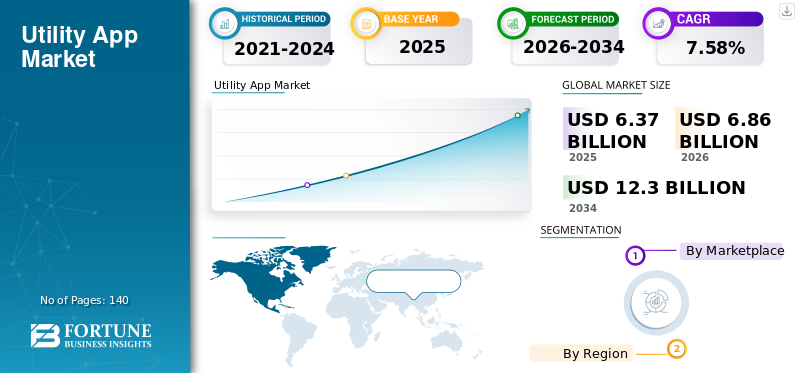
The global utility app market size was valued at USD 6.37 billion in 2025. The market is projected to grow from USD 6.85 billion in 2026 to USD 12.30 billion by 2034, exhibiting a CAGR of 7.58% during the forecast period.

The utility app market is experiencing substantial expansion due to increasing smartphone penetration, rising dependence on mobile productivity tools, and growing demand for device optimization applications. Utility apps include file management tools, battery optimization software, cloud storage applications, VPN services, security utilities, cleaning tools, and productivity enhancement platforms. Businesses and consumers are increasingly using utility applications to improve operational efficiency, cybersecurity, and device performance. utility app market analysis highlights that artificial intelligence integration, cloud synchronization, and cross-platform compatibility are becoming critical competitive differentiators. Developers are focusing on user-friendly interfaces, subscription-based monetization models, and enhanced data privacy features to strengthen long-term market positioning.
The United States utility app market is witnessing strong growth due to high smartphone usage, increasing remote work adoption, and growing reliance on cloud-connected mobile ecosystems. American consumers and enterprises actively utilize utility apps for data backup, cybersecurity, password management, storage optimization, and digital collaboration. Utility App Industry Report findings indicate that rising concerns regarding digital privacy and cyber threats are accelerating demand for VPN and antivirus utility applications. The U.S. market is also benefiting from rapid innovation in AI-Powered productivity tools and automation-based device management applications. App developers are continuously enhancing subscription offerings and enterprise integrations to improve customer retention and user engagement.
Download Free sample to learn more about this report.
Utility App Market Key Takeaways
 Global Market Size & Forecast
- 2025 Market Size: USD 6.37 Billion
- 2026 Market Size: USD 6.85 Billion
- 2034 Forecast Market Size: USD 12.30 Billion
- CAGR: 7.58% from 2026-2034
 Market Share
- North America dominated with a revenue share of 38% in 2025.
- Google Play Store accounted for approximately 67% of the market share.
- Apple iOS Store held approximately 33% of the market share.
 Key Regional Highlights
North America
North America led the market with a 38% share, supported by high smartphone penetration and strong demand for advanced utility applications.
North America
Europe accounted for 27% of the market, driven by increasing adoption of cybersecurity, productivity, and cloud-based utility apps.
Asia-Pacific
Asia-Pacific held a 26% share, supported by expanding smartphone adoption and demand for affordable localized applications.
U.S.
The U.S. market is supported by strong consumer spending on premium utility apps and growing adoption of AI-powered digital services.
Japan
Japan accounted for 19% of the Asia-Pacific market, supported by high smartphone penetration and demand for advanced, secure utility applications.
Read More

utility app market Latest Trends
The utility app market trends landscape is evolving rapidly with the integration of artificial intelligence, machine learning, and cloud-based synchronization technologies. Utility app developers are increasingly introducing AI-Powered features such as predictive storage management, automated file categorization, and smart battery optimization to improve user experience. Privacy-focused utility apps are also gaining popularity due to increasing concerns regarding data tracking and cybersecurity threats. VPN applications, encrypted cloud storage platforms, and password management tools are witnessing strong adoption among both enterprise and consumer users.
Download Free sample to learn more about this report.
Another major trend shaping the utility app market outlook is the growing demand for cross-device functionality and integrated digital ecosystems. Users increasingly expect seamless synchronization between smartphones, tablets, laptops, and wearable devices. App developers are investing in cloud infrastructure and automation technologies to support real-time data access and enhanced productivity. The emergence of low-code and no-code utility applications is also enabling small businesses to manage workflows more efficiently. Additionally, lightweight applications optimized for low-storage devices are becoming increasingly important in emerging markets where budget smartphones dominate.
utility app market Dynamics
DRIVER
Increasing Smartphone Usage and Rising Digital Dependency.
The utility app market growth is strongly driven by the rapid expansion of smartphone adoption and increasing reliance on digital platforms for communication, productivity, and entertainment. Consumers are using utility applications to optimize device performance, manage files, secure online activities, and enhance productivity. The widespread use of cloud computing, remote work environments, and digital collaboration tools has significantly increased the demand for utility apps that support seamless connectivity and efficient device management. Businesses are also integrating utility applications into enterprise mobility strategies to improve workforce productivity and data accessibility.
utility app market insights indicate that rising concerns regarding cybersecurity and data privacy are further strengthening demand for antivirus software, VPN services, and password management applications. The growing popularity of subscription-based digital ecosystems has encouraged developers to continuously improve app functionality through regular updates and premium features. In addition, increased internet penetration and 5G connectivity are supporting higher app usage across developed and emerging economies. Utility applications designed for battery optimization, storage cleanup, and performance enhancement are particularly popular among users with multiple connected devices.
RESTRAINT
Intense Competition and App Saturation.
The utility app market faces significant restraints due to intense competition and the oversaturation of mobile application marketplaces. Thousands of utility applications are available across major app stores, making it difficult for new developers to achieve visibility and user acquisition. Free applications with basic functionality create pricing pressure for premium app providers, limiting monetization opportunities. Utility App Industry Analysis also highlights that frequent updates and evolving operating system requirements increase development and maintenance costs for app companies.
Another major restraint involves concerns regarding data privacy and unauthorized access to user information. Some utility applications require extensive device permissions, leading to consumer skepticism regarding data security practices. Regulatory frameworks related to digital privacy and cross-border data storage create compliance challenges for developers operating globally. In addition, app uninstall rates remain high when users perceive limited value or experience intrusive advertising. Compatibility issues across different operating systems and device models can also negatively affect user experience and retention. These challenges collectively impact the scalability and profitability of many companies operating within the utility app market Forecast landscape.
OPPORTUNITY
Expansion of AI-Powered Productivity and Cybersecurity Solutions.
The utility app market opportunities landscape is expanding rapidly due to increasing demand for intelligent productivity tools and cybersecurity-focused applications. Businesses and consumers are seeking utility apps capable of automating repetitive tasks, managing workflows, and improving device efficiency. Artificial intelligence technologies are enabling developers to create advanced features such as predictive maintenance alerts, automated backup scheduling, and personalized performance optimization. Enterprise demand for secure remote work solutions is also driving adoption of encrypted file-sharing and device management applications.
Another major opportunity lies in emerging markets where smartphone penetration and internet connectivity are increasing significantly. Developers are introducing lightweight utility apps optimized for low-storage devices and limited bandwidth environments. utility app market research report findings indicate that cloud-based subscription services and freemium monetization models are creating new revenue opportunities for developers. Partnerships between utility app providers and smartphone manufacturers are further expanding market reach through pre-installed applications. Additionally, growing awareness regarding digital wellness and device management is supporting demand for screen-time monitoring, parental control, and productivity-enhancing utility applications.
CHALLENGE
Maintaining User Trust and Long-Term Engagement.
One of the biggest challenges in the utility app market is maintaining user trust while handling sensitive data and device permissions. Utility applications often require access to storage systems, browsing activities, location data, and system-level controls, increasing consumer concerns regarding privacy and misuse of information. utility app market size expansion can be negatively affected if developers fail to implement transparent data policies and robust cybersecurity measures.
Another major challenge involves sustaining user engagement in a highly competitive digital ecosystem. Consumers frequently switch between applications based on interface quality, pricing, and performance efficiency. Developers must continuously release updates, optimize compatibility, and improve customer support to maintain market relevance. Advertising-heavy monetization strategies can negatively impact user experience and increase uninstall rates.
Utility App Market Segmentation
By Marketplace
Applications distributed through the Google Play Store account for approximately 67% of the utility app market Share due to the extensive global adoption of Android devices. The Android ecosystem supports a diverse range of utility applications including antivirus software, file managers, cloud storage tools, battery optimization apps, and VPN services. The affordability of Android smartphones across emerging economies significantly contributes to the dominance of this segment. The segment is also benefiting from increased demand for lightweight and localized utility applications designed for budget-friendly devices. Developers are integrating AI-driven features and cloud synchronization capabilities to improve functionality and user engagement. Subscription-based premium services are becoming increasingly common, especially for cybersecurity and productivity applications.
The Apple iOS Store represents nearly 33% of the utility app market Share and remains highly profitable due to strong consumer spending on premium applications and subscription services. iOS users typically prioritize data privacy, seamless ecosystem integration, and high-quality user experiences, encouraging developers to introduce advanced utility applications optimized for Apple devices. Common utility app categories within the iOS ecosystem include password management, cloud storage synchronization, productivity enhancement tools, and device security solutions. utility app market insights reveal that enterprise users and premium consumers are major contributors to growth within the iOS segment. Developers are increasingly introducing AI-Powered automation features and advanced encryption technologies to attract privacy-conscious users. The strong integration between Apple devices, including smartphones, tablets, laptops, and smartwatches, supports seamless utility app functionality across multiple platforms.
Utility App Market Regional Outlook
North America
North America accounts for approximately 38% of the utility app market Share due to high smartphone penetration, advanced digital infrastructure, and strong consumer spending on premium mobile applications. The region benefits from widespread adoption of cloud computing, remote work technologies, and cybersecurity solutions. The United States and Canada remain key contributors to market expansion as businesses and consumers increasingly rely on utility applications for productivity, storage management, and online security.
utility app market trends in North America are strongly influenced by growing awareness regarding digital privacy and data protection. Enterprise adoption of mobile device management solutions and cloud-based productivity tools is accelerating across multiple industries. The region is also characterized by significant investment in AI-driven software development and cybersecurity innovation. Subscription-based monetization models remain highly successful due to strong consumer willingness to pay for premium digital services. The presence of leading technology companies and app developers further strengthens the region’s competitive position within the Utility App Industry Analysis landscape.
Europe
Europe captures approximately 27% of the utility app market Share and remains a highly regulated yet innovation-driven digital market. Consumers across Europe increasingly prioritize secure communication, encrypted storage, and privacy-focused utility applications due to stringent data protection regulations. Germany, the United Kingdom, France, and the Netherlands are among the leading markets driving regional growth. utility app market research report insights show that remote work trends and digital transformation initiatives are accelerating enterprise demand for productivity and device management applications.
The European market is also witnessing increased adoption of sustainable digital solutions designed to optimize device energy consumption and improve operational efficiency. App developers are focusing on multilingual interfaces and compliance-oriented security features to address regional regulatory requirements. Subscription-based cloud productivity tools and secure collaboration platforms are particularly popular among small and medium-sized enterprises. Continuous innovation in AI-Powered workflow automation and cybersecurity technologies is expected to further support long-term utility app market growth across Europe.
Germany utility app market
Germany represents approximately 25% of Europe’s utility app market Share and serves as a major hub for enterprise software adoption and digital innovation. German consumers and businesses place strong emphasis on cybersecurity, operational efficiency, and regulatory compliance, driving demand for secure utility applications. Productivity tools, encrypted storage platforms, and enterprise device management applications are particularly popular across the country.
utility app market insights indicate that Germany’s advanced industrial sector and strong digital infrastructure are supporting adoption of AI-Powered workflow optimization solutions. Businesses increasingly rely on utility applications to manage remote workforces, secure sensitive data, and improve productivity. German consumers are also highly responsive to subscription-based cloud storage and password management platforms. The market benefits from strong government support for digital transformation initiatives and cybersecurity awareness programs, encouraging continuous innovation among utility app developers.
United Kingdom utility app market
The United Kingdom accounts for approximately 22% of Europe’s utility app market Share and remains one of the most digitally connected markets in the region. Consumers and enterprises actively utilize utility applications for file management, online privacy, remote collaboration, and device optimization. The rapid adoption of hybrid work environments has increased demand for productivity and cloud synchronization tools.
utility app market analysis highlights that British consumers are highly receptive to subscription-based digital services and premium mobile applications. Data privacy concerns and rising cyber threats are driving strong demand for VPNs, antivirus software, and encrypted communication tools. Developers are increasingly integrating artificial intelligence and automation features to improve user convenience and operational efficiency. The United Kingdom also benefits from a vibrant startup ecosystem focused on mobile software innovation and enterprise productivity solutions.
Asia-Pacific
Asia-Pacific accounts for approximately 26% of the utility app market Share and represents one of the fastest-expanding regions due to rapid smartphone adoption, growing internet connectivity, and increasing digitalization. China, Japan, India, South Korea, and Southeast Asian countries are witnessing strong demand for utility applications across consumer and enterprise segments. utility app market Forecast findings indicate that affordable Android devices and expanding 5G infrastructure are accelerating mobile app usage throughout the region.
Regional developers are focusing on lightweight applications optimized for budget smartphones and low-bandwidth environments. Cloud-based productivity tools, cybersecurity applications, and storage optimization software are particularly popular among young digital consumers. Businesses across Asia-Pacific are increasingly adopting enterprise mobility solutions and remote collaboration platforms to improve operational efficiency. Government investments in digital infrastructure and smart city initiatives are further supporting Utility App Industry Report expansion across the region.
Japan utility app market
Japan represents approximately 19% of the Asia-Pacific utility app market Share and remains a technologically advanced market with strong demand for high-performance digital solutions. Japanese consumers prioritize application quality, data security, and seamless cross-device functionality. Utility applications focused on productivity enhancement, cloud synchronization, and digital privacy are widely adopted across both enterprise and consumer segments.
utility app market opportunities in Japan are supported by the country’s advanced telecommunications infrastructure and strong culture of digital innovation. Businesses increasingly implement mobile device management solutions and encrypted communication platforms to support hybrid work environments. Japanese developers are integrating artificial intelligence and automation technologies to improve app functionality and efficiency. Demand for premium subscription-based services remains high due to consumer willingness to invest in secure and reliable digital tools.
China utility app market
China accounts for approximately 9% of the Asia-Pacific utility app market Share and remains one of the largest mobile application markets globally. The country’s rapidly expanding smartphone user base and digital economy are creating significant demand for productivity, storage management, and cybersecurity utility applications. Younger consumers and urban professionals are increasingly using utility apps to manage digital lifestyles and improve device performance.
utility app market trends in China indicate that local developers are focusing heavily on AI-Powered optimization tools, cloud storage platforms, and integrated mobile ecosystems. E-commerce growth and digital payment adoption are further increasing the importance of cybersecurity applications and privacy-focused software solutions. Government initiatives promoting technological innovation and digital transformation are supporting investment in advanced utility app development. Chinese consumers also demonstrate strong engagement with multifunctional applications that combine productivity, communication, and device management capabilities.
Rest of World
The Rest of World region accounts for approximately 9% of the utility app market Share and includes Latin America, the Middle East, and Africa. Rising smartphone adoption and increasing internet accessibility are gradually supporting demand for utility applications across these regions. Consumers are increasingly utilizing file management, device optimization, and mobile security applications to improve smartphone functionality and digital accessibility.
utility app market research report findings suggest that affordable Android devices and expanding mobile broadband infrastructure are key drivers of market growth in emerging economies. Businesses are also adopting utility applications to improve communication, cloud storage, and workforce productivity. International app developers are entering these markets through localized content strategies and partnerships with telecom providers. Although infrastructure limitations and lower consumer spending remain challenges, growing digital awareness and government-led connectivity initiatives are expected to create long-term opportunities within the regional Utility App Industry Analysis ecosystem.
List of Top Utility App Companies
- Acer Inc.
- Apple Inc.
- Microsoft Corporation
- Mobibiz
- Magneto IT Solutions
- LogMeIn, Inc
- Glasswire Inc
- NeatBytes
- Proton Technologies AG
- MiXplorer
Top two companies with the highest market share
- Apple Inc. – 18%
- Microsoft Corporation – 15%
Investment Analysis and Opportunities
The utility app market is attracting significant investment from technology firms, venture capital groups, and enterprise software providers seeking to capitalize on rising digital dependency and mobile productivity demand. Investors are particularly focused on companies developing AI-Powered optimization tools, cloud-based collaboration applications, and cybersecurity-focused utility solutions. utility app market opportunities are expanding as enterprises increasingly adopt remote work technologies and secure mobile device management systems. Subscription-based monetization models and recurring revenue streams are making utility app businesses attractive investment targets.
Developers are also receiving funding to improve artificial intelligence capabilities, cloud integration technologies, and cross-platform synchronization features. Emerging markets in Asia-Pacific and Latin America are becoming important investment destinations due to rising smartphone penetration and expanding internet infrastructure. Strategic partnerships between telecom providers, smartphone manufacturers, and app developers are supporting broader market reach and customer acquisition. Investors are additionally prioritizing privacy-focused utility applications as regulatory scrutiny surrounding digital security continues to intensify. The growing use of wearable devices and connected ecosystems is expected to create additional opportunities for utility app developers and enterprise software providers.
New Product Development
Innovation remains central to the utility app market, with developers continuously introducing advanced applications designed to improve device performance, productivity, and cybersecurity. Artificial intelligence integration is transforming utility applications through features such as automated storage management, predictive battery optimization, and smart workflow automation. utility app market trends also show rising demand for encrypted cloud storage platforms, privacy-focused browsers, and AI-driven password management solutions.
Developers are increasingly launching lightweight applications optimized for low-storage smartphones and emerging market users. Cross-platform synchronization and real-time cloud collaboration features are becoming standard offerings across productivity utility apps. Subscription-based premium services with enhanced cybersecurity protections and ad-free user experiences are gaining popularity among enterprise and consumer users. In addition, utility app providers are integrating biometric authentication and blockchain-inspired encryption technologies to strengthen digital security. New product development strategies are heavily focused on improving user retention, reducing energy consumption, and enhancing compatibility across multiple devices and operating systems.
Five Recent Developments (2023-2025)
- Apple Inc. expanded advanced privacy protection features across its utility and cloud synchronization applications.
- Microsoft Corporation introduced AI-Powered productivity optimization tools for enterprise mobile users.
- Proton Technologies AG launched enhanced encrypted cloud storage services with expanded cross-platform integration.
- Glasswire Inc developed advanced mobile network monitoring features designed to improve cybersecurity awareness.
- LogMeIn, Inc expanded remote access and device management capabilities for hybrid workforce environments.
Report Coverage of utility app market
The utility app market Report provides comprehensive analysis of market dynamics, segmentation trends, regional outlooks, competitive landscapes, and technological innovations influencing the global industry. The report evaluates application categories including productivity tools, cybersecurity solutions, cloud storage platforms, and device optimization software. utility app market analysis coverage includes consumer adoption patterns, subscription monetization models, and enterprise mobility trends shaping market expansion.
Request for Customization to gain extensive market insights.
The report also examines the impact of artificial intelligence integration, cloud computing, and data privacy regulations on utility app development strategies. Regional analysis covers North America, Europe, Asia-Pacific, and Rest of World markets while highlighting country-level demand trends and competitive positioning. In addition, the report profiles major industry participants and evaluates their investments, partnerships, product launches, and innovation strategies. Utility App Industry Report findings support strategic decision-making for app developers, investors, technology providers, and enterprise users seeking to capitalize on evolving digital productivity and cybersecurity requirements.
Frequently Asked Questions
Fortune Business Insights says that the global market value stood at USD 6.37 billion in 2025 and is projected to reach USD 12.30 billion by 2034.
The market is expected to exhibit a CAGR of 7.58% during the forecast period of 2026-2034.
Google Play Store was the leading marketplace segment, accounting for approximately 67% of the market share, driven by widespread global adoption of Android devices.
Key players include Apple Inc., Microsoft Corporation, Acer Inc., Mobibiz, Magneto IT Solutions, and LogMeIn, Inc.
Major trends include growing integration of AI and cloud synchronization technologies and rising demand for privacy-focused utility apps such as VPNs and encrypted storage. North America led the market with a 38% regional share.



- 2021-2024
- 2025
- 2021-2024
- 140
-

(Offer valid till 15th Sep 2026)
Get 30-60 hrs Free Customization
Expand Regional and Country Coverage, Segments Analysis, Company Profiles, Competitive Benchmarking, and End-user Insights.




















-
US +1 833 909 2966 ( Toll Free )
-
Get In Touch With Us