UV LED Market Size, Share & Industry Analysis, By Technology (UV-A, UV-B), By Power Output (Less than 1W, 1W -5W), By Application (UV Curing, Medical Light Therapy), By End Use (Industrial, Commercial), and Regional Forecast, 2026-2034
 Download Free Sample
UV LED Market Overview
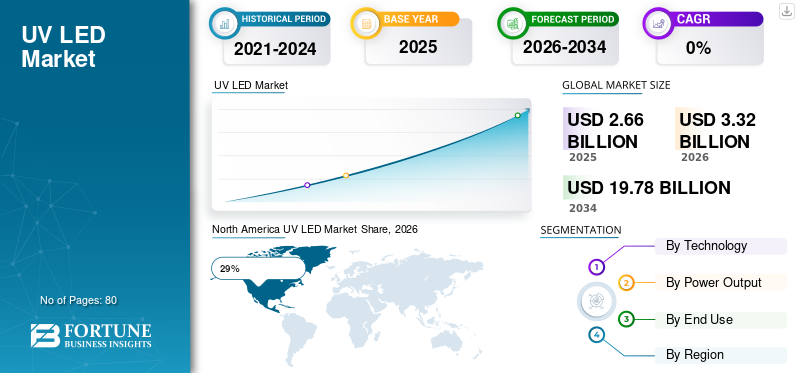
The global UV LED market size was valued at USD 2.66 billion in 2025. The market is projected to grow from USD 3.32 billion in 2026 to USD 19.78 billion by 2034, exhibiting a CAGR of 25.00% during the forecast period.

The global UV LED market is experiencing strong growth due to the increasing adoption of energy-efficient ultraviolet lighting solutions across industrial curing, medical sterilization, water purification, printing, and electronics manufacturing applications. UV LEDs provide advantages such as lower power consumption, longer operational life, compact design, and reduced environmental impact compared to conventional mercury lamps. The UV LED market report highlights rising demand from healthcare facilities, semiconductor production units, and industrial automation sectors. Technological advancements in wavelength precision and thermal management systems are improving product efficiency and reliability. Growing emphasis on sustainable manufacturing practices and stricter environmental regulations are further accelerating the growth of the UV LED market worldwide.
The United States UV LED market is experiencing significant growth due to increasing adoption of advanced sterilization technologies, industrial curing systems, and semiconductor manufacturing applications. Rising demand for UV-C disinfection systems in healthcare facilities, laboratories, and commercial buildings continues to support market expansion. The UV LED industry analysis indicates strong investment in next-generation ultraviolet technologies by electronics manufacturers and medical equipment providers across the United States. Industrial automation, additive manufacturing, and digital printing industries are increasingly utilizing UV LED systems for high-speed curing applications. Growing environmental awareness regarding mercury-free lighting solutions and increasing research activities in photonics technologies continue to strengthen the long-term outlook of the USA UV LED market.
Download Free sample to learn more about this report.
UV LED Market Key Takeaways
 Global Market Size & Forecast
- 2025 Market Size: USD 2.66 Billion
- 2026 Market Size: USD 3.32 Billion
- 2034 Forecast Market Size: USD 19.78 Billion
- CAGR: 25.00% from 2026-2034
 Market Share
- Asia-Pacific dominated with a 36% market share in 2025.
- UV-A LEDs led by technology with a 62% market share.
- UV curing led by application with a 64% market share.
 Key Regional Highlights
Asia-Pacific
Asia-Pacific held the largest regional share at 36%.
North America
North America accounted for 29% of the global market.
Europe
Europe represented 25% of the global market.
U.S.
The U.S. market is supported by rising adoption of UV LEDs in industrial curing, healthcare, and disinfection.
Japan
Japan accounted for 24% of the Asia-Pacific market, driven by advanced electronics manufacturing and UV LED applications.
Read More

UV LED market Latest Trends
The UV LED market is evolving rapidly with innovations focused on higher efficiency, compact form factors, and advanced wavelength customization. One of the most significant UV LED market trends is the growing adoption of UV-C LED systems for air, water, and surface disinfection applications. Hospitals, pharmaceutical facilities, and food processing industries are increasingly integrating UV LED sterilization technologies to enhance hygiene standards and reduce microbial contamination risks. Another important trend in the UV LED market research report is the increasing use of UV LEDs in industrial curing applications such as printing inks, adhesives, coatings, and electronics assembly.
Miniaturization of UV LED components is also driving integration into portable medical devices, wearable electronics, and compact purification systems. The UV LED industry report further highlights growing investment in semiconductor materials including aluminum gallium nitride technologies to improve light output and wavelength stability. Smart manufacturing systems, AI-integrated curing equipment, and IoT-enabled UV monitoring solutions are shaping the future UV LED market outlook across multiple industrial sectors.
Download Free sample to learn more about this report.
UV LED Market Dynamics
DRIVER
Increasing Demand for Energy-Efficient and Mercury-Free Ultraviolet Technologies.
The growing shift toward environmentally sustainable technologies is a major factor driving UV LED market growth globally. Traditional mercury-based UV lamps are facing stricter environmental regulations due to hazardous material concerns, encouraging industries to transition toward safer UV LED alternatives. UV LEDs consume less energy, generate lower heat output, and provide longer operational lifespans, making them highly attractive for industrial and commercial applications. The UV LED market analysis indicates increasing demand from water treatment facilities, healthcare institutions, and manufacturing industries seeking energy-efficient sterilization and curing solutions. Rapid growth in semiconductor manufacturing and advanced electronics production is also boosting the need for precision UV LED systems. In addition, rising awareness regarding infection prevention and hygiene standards has accelerated adoption of UV-C LED disinfection systems in public infrastructure and transportation sectors. Technological improvements in optical performance, wavelength control, and thermal efficiency continue to expand the application range of UV LEDs.
RESTRAINT
High Initial Installation Costs and Limited Deep Uv Efficiency.
Despite growing adoption, the UV LED market faces restraints associated with high upfront equipment costs and technological limitations in deep ultraviolet wavelengths. Advanced UV LED systems require sophisticated semiconductor materials and precision manufacturing processes, increasing production costs compared to traditional lighting technologies. Small and medium-sized enterprises often hesitate to adopt UV LED curing and sterilization systems due to capital investment concerns. The UV LED market research report also highlights efficiency challenges associated with deep UV-C LEDs used in disinfection applications. Lower optical output and thermal management complexities can limit performance consistency in certain industrial environments. Some industries continue relying on mercury lamps because of established infrastructure and lower short-term replacement costs. In addition, limited awareness regarding long-term operational savings and environmental benefits may slow market penetration in developing economies. Supply chain dependency on specialized semiconductor substrates and raw materials can also create pricing volatility and production delays. These factors continue to influence adoption rates across several end-use sectors within the UV LED industry.
OPPORTUNITY
Expansion of Uv-C Disinfection and Smart Industrial Applications.
The rapid expansion of UV-C disinfection technologies presents major growth opportunities for the UV LED market. Increasing focus on public health safety, infection control, and indoor air quality is driving demand for UV LED sterilization systems across hospitals, airports, schools, and commercial facilities. The UV LED market forecast indicates strong future demand for portable UV sterilization devices, autonomous robotic disinfection systems, and integrated HVAC purification technologies. Industrial automation also creates substantial opportunities for UV LED manufacturers. Smart curing systems equipped with AI-based process control and IoT monitoring capabilities are gaining popularity in electronics assembly, automotive coatings, and digital printing applications. Rising investments in semiconductor miniaturization and wearable electronics further expand UV LED application possibilities. The UV LED industry analysis additionally highlights opportunities in advanced agriculture, horticulture lighting, and medical phototherapy systems.
CHALLENGE
Technical Limitations and Intense Market Competition.
One of the key challenges in the UV LED market is achieving higher efficiency and stability across various ultraviolet wavelength ranges. Deep UV LEDs used for sterilization applications often experience reduced light output and thermal degradation, requiring continuous technological improvements. Manufacturers must invest heavily in research and development to enhance semiconductor materials, heat dissipation systems, and optical performance. The UV LED industry report identifies strong competition among global semiconductor and photonics companies as another major challenge. Rapid technological evolution can shorten product life cycles and increase pricing pressure across industrial markets. Smaller companies may struggle to compete with large multinational corporations possessing advanced research capabilities and large-scale manufacturing infrastructure. Another challenge involves educating end users regarding the operational advantages of UV LED systems over traditional mercury lamps. Industries with established legacy equipment may delay adoption because of transition costs and technical integration requirements. Regulatory compliance standards and quality certification processes also increase commercialization complexity for UV LED manufacturers globally.
UV LED Market Segmentation
By Technology
UV-A LEDs account for approximately 62% of the global UV LED market share and remain the dominant segment due to their broad industrial applicability. These LEDs are widely used in curing inks, adhesives, coatings, and resins across printing, electronics manufacturing, and automotive industries. UV-A LEDs offer high operational efficiency, longer lifespan, and lower maintenance costs compared to conventional ultraviolet lamps. The UV LED market analysis identifies increasing adoption of UV-A systems in digital printing and semiconductor packaging applications because of their ability to deliver fast and uniform curing. Manufacturers are focusing on improving optical power density and thermal stability to support high-speed industrial operations.
UV-B LEDs represent nearly 38% of the UV LED market share and are gaining importance in medical, scientific, and specialty sterilization applications. These LEDs are commonly utilized in phototherapy treatments for skin disorders such as psoriasis and vitiligo, as well as laboratory analysis systems and advanced disinfection technologies. The UV LED market research report highlights increasing investments in UV-B semiconductor development aimed at improving wavelength precision and operational reliability. Research institutions and healthcare organizations are expanding adoption of UV-B LEDs for targeted biological and therapeutic applications. Additionally, agricultural industries are exploring UV-B lighting systems to improve crop resistance and controlled-environment farming efficiency. Manufacturers are developing compact UV-B modules suitable for portable healthcare devices and scientific instrumentation.
To know how our report can help streamline your business, Speak to Analyst
By Power Output
The less than 1W segment holds approximately 44% market share in the UV LED market due to strong integration into portable devices, compact electronics, and low-power sterilization systems. These UV LEDs are commonly used in handheld disinfection tools, wearable medical devices, portable water purification units, and smartphone-integrated sterilization accessories. The UV LED industry report indicates rising demand for compact ultraviolet solutions in consumer electronics and personal healthcare applications.
The 1W–5W segment dominates the UV LED market with around 56% market share because of its extensive use in industrial curing systems, commercial disinfection equipment, and high-performance manufacturing applications. These LEDs provide higher optical output suitable for demanding industrial environments requiring rapid curing and continuous operation. The UV LED market forecast highlights increasing adoption of 1W–5W UV LEDs in automotive coatings, electronics assembly, additive manufacturing, and printing industries. Healthcare facilities and water treatment plants are also integrating higher-power UV LED systems for effective microbial sterilization and contamination control.
By Application
UV curing accounts for approximately 64% of the global UV LED market share and remains the leading application segment due to extensive adoption across printing, coatings, adhesives, electronics assembly, and automotive manufacturing industries. UV LED curing systems provide faster processing speeds, lower energy consumption, and improved production efficiency compared to traditional curing technologies. The UV LED market report highlights increasing demand for mercury-free curing systems in industrial manufacturing environments focused on sustainability and operational optimization. Digital printing companies are rapidly integrating UV LED curing technologies to improve print quality, reduce drying time, and increase production throughput. Electronics manufacturers are also utilizing UV curing systems for semiconductor packaging and circuit board assembly applications.
Medical light therapy represents nearly 36% of the global UV LED market share and is witnessing increasing adoption in dermatology, phototherapy, infection control, and advanced healthcare treatment applications. UV LED medical systems are widely used for treating skin conditions such as psoriasis, eczema, vitiligo, and acne through controlled ultraviolet exposure therapies. The UV LED industry analysis highlights rising investment in compact phototherapy devices designed for hospitals, clinics, and home healthcare applications. Healthcare providers are increasingly adopting UV LED technologies because of their precision wavelength control, low heat generation, and longer operational lifespan. UV-C LED systems are also gaining importance in hospital sterilization and infection prevention programs.
By End Use
The industrial segment dominates the UV LED market with approximately 68% market share due to extensive use in manufacturing, electronics production, automotive coatings, semiconductor fabrication, and industrial curing applications. Industrial facilities are increasingly replacing conventional mercury lamps with energy-efficient UV LED systems to improve operational efficiency and comply with environmental regulations. The UV LED market research report highlights rising deployment of ultraviolet curing technologies in packaging, printing, adhesives, and advanced material processing industries. Smart manufacturing adoption and industrial automation are accelerating demand for AI-integrated UV LED systems capable of delivering precise curing performance and real-time monitoring capabilities. Semiconductor manufacturers are also utilizing UV LEDs for wafer inspection, lithography support, and electronics assembly operations.
The commercial segment accounts for nearly 32% of the global UV LED market share and is growing steadily due to rising adoption of ultraviolet technologies in healthcare facilities, office buildings, retail spaces, hospitality infrastructure, and public transportation systems. Commercial establishments are increasingly implementing UV-C LED disinfection systems to improve hygiene standards and indoor air quality management. The UV LED market outlook highlights growing use of ultraviolet purification technologies in HVAC systems, water dispensers, and public sanitation equipment across commercial environments. Healthcare clinics and diagnostic laboratories are integrating UV LED sterilization systems for infection control and medical equipment disinfection.
UV LED Market Regional Outlook
North America
North America UV LED Market Share, 2026 (%) To get more information on the regional analysis of this market, Download Free sample
North America represents nearly 29% of the global UV LED market share and continues to lead technological innovation in ultraviolet lighting systems. The region benefits from strong semiconductor manufacturing infrastructure, advanced healthcare systems, and increasing adoption of smart industrial automation technologies. The United States remains the largest contributor to regional demand due to widespread use of UV-C LED disinfection systems across hospitals, laboratories, airports, and public transportation facilities. The UV LED market report highlights rising investments in ultraviolet curing systems used in automotive coatings, electronics assembly, and digital printing industries. Industrial manufacturers are rapidly replacing traditional mercury lamps with energy-efficient UV LED solutions to meet environmental sustainability goals. Canada is also contributing significantly through advancements in photonics research and water purification technologies. Government support for green manufacturing and advanced sterilization technologies is further strengthening market expansion. The UV LED industry analysis identifies increasing adoption of AI-integrated curing systems and IoT-enabled ultraviolet monitoring devices throughout North America.
Europe
Europe accounts for approximately 25% of the global UV LED market share and remains a major center for sustainable industrial technologies and photonics innovation. The region is characterized by strict environmental regulations promoting mercury-free lighting systems and energy-efficient industrial production methods. The UV LED market research report highlights strong adoption of UV curing technologies in automotive manufacturing, electronics production, food packaging, and healthcare sterilization applications throughout Europe. Germany, France, and the United Kingdom continue to dominate regional demand due to advanced industrial automation and semiconductor research infrastructure. European manufacturers are investing heavily in wavelength customization, optical efficiency improvements, and compact ultraviolet module development. Healthcare institutions across Europe are increasingly integrating UV-C LED sterilization systems into hospitals, laboratories, and pharmaceutical production facilities. Government-funded innovation programs are supporting collaborations between academic institutions and electronics manufacturers to accelerate ultraviolet semiconductor advancements.
Germany UV LED Market
Germany holds nearly 31% share within the European UV LED market and remains one of the strongest industrial technology hubs in the region. The country’s advanced automotive manufacturing sector, electronics industry, and industrial automation ecosystem are driving significant demand for ultraviolet curing technologies. German manufacturers are increasingly adopting UV LED systems in printing, coating, semiconductor fabrication, and additive manufacturing applications to improve operational efficiency and reduce energy consumption. The UV LED market analysis highlights substantial investment in photonics research and AI-enabled manufacturing systems throughout Germany. Industrial firms are focusing on high-performance ultraviolet technologies with enhanced wavelength precision and thermal stability. Government sustainability regulations encouraging mercury-free industrial solutions are accelerating adoption of UV LED curing systems across manufacturing facilities. Research institutions are collaborating with semiconductor companies to develop next-generation ultraviolet chips with improved optical output. Germany’s healthcare sector is also integrating UV-C LED disinfection systems into hospitals and laboratory environments for advanced infection control.
United Kingdom UV LED Market
The United Kingdom accounts for approximately 21% of the European UV LED market and continues to witness increasing adoption of advanced ultraviolet technologies across healthcare, manufacturing, and infrastructure sectors. Hospitals and pharmaceutical laboratories are implementing UV-C LED sterilization systems to improve infection prevention and contamination control. The UV LED market report highlights rising investments in semiconductor research, photonics innovation, and advanced purification technologies across the United Kingdom. Industrial manufacturers are integrating ultraviolet curing systems into electronics assembly, packaging, and printing operations to improve production speed and sustainability. Growing environmental awareness regarding mercury-free technologies is encouraging businesses to transition toward energy-efficient UV LED solutions. Research institutions are focusing on compact ultraviolet modules, customized wavelength engineering, and AI-integrated sterilization systems. Commercial buildings and transportation facilities are also increasing deployment of UV-C air purification technologies to improve indoor air quality standards. Government support for green manufacturing and clean technology innovation continues to strengthen market development.
Asia-Pacific
Asia-Pacific dominates the global UV LED market with approximately 36% market share due to its massive electronics manufacturing ecosystem and rapidly expanding semiconductor production infrastructure. Countries including China, Japan, South Korea, and Taiwan serve as major global production centers for UV LED chips, photonics components, and advanced semiconductor materials. The UV LED market forecast highlights rising demand for ultraviolet curing systems across printing, automotive coatings, semiconductor packaging, and electronics assembly industries throughout the region. Healthcare facilities are increasingly implementing UV-C LED sterilization technologies for air purification, medical device disinfection, and hospital hygiene management. Strong government support for semiconductor innovation and energy-efficient manufacturing technologies continues to accelerate regional market growth. Manufacturers are heavily investing in chip miniaturization, optical power enhancement, and advanced thermal management systems to improve UV LED performance and competitiveness. Asia-Pacific also benefits from expanding industrial automation adoption and smart factory integration across manufacturing industries. Increasing consumer demand for portable sterilization devices and ultraviolet-enabled electronics is further supporting market expansion.
Japan UV LED Market
Japan holds approximately a 24% share within the Asia-Pacific UV LED market and remains a global leader in semiconductor innovation, photonics technologies, and precision ultraviolet engineering. Japanese companies are focusing heavily on advanced UV-C LED sterilization systems, high-efficiency curing technologies, and compact ultraviolet modules for industrial and healthcare applications. The UV LED market Insights indicate strong demand from automotive electronics, semiconductor fabrication, biotechnology, and medical device industries throughout Japan. Manufacturers are developing highly efficient ultraviolet chips with improved wavelength control, reduced power consumption, and superior thermal stability. Research institutions are actively collaborating with industrial companies to advance semiconductor materials and nanotechnology-based ultraviolet solutions. Government support for sustainable manufacturing and mercury-free industrial systems continues to encourage UV LED adoption across multiple industries. Japanese healthcare facilities are increasingly integrating ultraviolet purification systems into hospitals, laboratories, and pharmaceutical production environments.
China UV LED Market
China accounts for approximately 38% of the Asia-Pacific UV LED market and continues to dominate global ultraviolet semiconductor manufacturing. The country benefits from extensive electronics production capabilities, strong industrial supply chains, and growing investment in advanced semiconductor technologies. Chinese manufacturers are significantly expanding production of UV LED chips, industrial curing systems, and UV-C sterilization equipment to meet rising domestic and international demand. The UV LED industry report highlights increasing adoption of ultraviolet technologies across healthcare, automotive manufacturing, packaging, printing, and water treatment industries throughout China. Government initiatives supporting semiconductor self-sufficiency and advanced manufacturing innovation are accelerating market development. Industrial companies are integrating energy-efficient ultraviolet curing systems into automated production lines to improve operational performance and sustainability. Research institutions are also investing heavily in deep UV semiconductor materials and optical efficiency enhancement technologies.
Rest of World
The Rest of World region contributes approximately 10% market share to the global UV LED market and includes Latin America, the Middle East, and Africa. These regions are witnessing increasing adoption of ultraviolet technologies across healthcare sterilization, industrial curing, and water purification applications. Governments and healthcare organizations are investing in advanced UV-C LED systems to improve public hygiene standards and infection prevention capabilities. The UV LED market outlook highlights rising implementation of ultraviolet purification technologies in municipal water treatment projects throughout water-scarce regions of the Middle East and Africa. Industrial sectors in Latin America are increasingly adopting UV curing technologies in printing, packaging, and automotive coating operations to improve energy efficiency and reduce environmental impact. Commercial buildings and food processing facilities are also integrating ultraviolet disinfection systems to enhance operational hygiene and product safety. Growing awareness regarding sustainable manufacturing practices and mercury-free lighting technologies continues to support market expansion. The UV LED industry analysis identifies increasing investment in healthcare modernization and smart infrastructure development across emerging economies.
List of Top UV LED Companies
- Advanced Optoelectronic Technology, Inc.
- Crystal IS, Inc.
- EPISTAR Corporation
- Excelitas Noblelight
- LG Innotek
- Lumileds Holding B.V.
- NICHIA CORPORATION
- ams-OSRAM AG
- Phoseon Technology
- Semileds Corporation
- Sensor Electronic Technology, Inc. (SETi)
- Seoul Viosys Co., Ltd.
- STANLEY ELECTRIC CO., LTD.
- Ushio, Inc.
- Violumas
Top Two Companies by Market Share
- NICHIA CORPORATION – Approximately 18% market share
- Seoul Viosys Co., Ltd. – Approximately 14% market share
Investment Analysis and Opportunities
The UV LED market is attracting substantial investment from semiconductor manufacturers, healthcare technology providers, industrial automation companies, and photonics research organizations. Increasing demand for mercury-free ultraviolet technologies and energy-efficient curing systems is encouraging expansion of UV LED production facilities worldwide. Investors are particularly focusing on deep UV semiconductor materials, advanced chip packaging technologies, and AI-integrated industrial curing systems.
Asia-Pacific remains a major investment hub due to strong semiconductor manufacturing ecosystems and expanding electronics production. North America and Europe are witnessing rising investment in photonics research and advanced sterilization technologies. Strategic partnerships between semiconductor companies, industrial equipment manufacturers, and healthcare organizations continue to create new commercialization opportunities across the global UV LED market.
New Product Development
New product development in the UV LED market is centered around higher optical efficiency, compact design, improved thermal management, and advanced wavelength customization. Manufacturers are introducing next-generation UV-C LED modules designed for high-performance sterilization applications in healthcare, water treatment, and public infrastructure systems.
Industrial equipment manufacturers are also launching AI-enabled UV curing systems integrated with smart monitoring and automated process optimization features. These systems improve curing precision, production efficiency, and operational consistency across electronics manufacturing and printing industries. Researchers are further exploring flexible UV LED substrates, nanomaterial-enhanced optics, and customized wavelength technologies for specialized biological and industrial applications. Rising demand for sustainable, mercury-free ultraviolet solutions continues to accelerate innovation within the global UV LED industry.
Five Recent Developments (2023-2025)
- Seoul Viosys Co., Ltd. expanded UV-C LED production capacity in 2024 to support rising global demand for sterilization technologies.
- NICHIA CORPORATION introduced advanced high-efficiency UV-A LED chips in 2023 for industrial curing and semiconductor manufacturing applications.
- ams-OSRAM AG launched new compact UV LED modules in 2025 focused on medical sterilization and portable purification systems.
- Phoseon Technology enhanced AI-integrated UV curing systems in 2024 to improve industrial automation efficiency and process monitoring.
- Crystal IS, Inc. increased investment in deep UV semiconductor research during 2025 to improve wavelength stability and optical output performance.
Report Coverage of UV LED market
The UV LED market report provides detailed analysis of industry dynamics, technological advancements, regional trends, competitive landscape, and emerging application opportunities associated with ultraviolet light-emitting diode technologies. The report evaluates key growth factors influencing UV LED market expansion, including increasing adoption of mercury-free lighting systems, industrial automation, healthcare sterilization demand, and semiconductor manufacturing advancements.
Request for Customization to gain extensive market insights.
Regional coverage spans North America, Europe, Asia-Pacific, and Rest of World markets with country-level analysis focused on manufacturing infrastructure, research capabilities, and industrial demand patterns. The UV LED industry report also evaluates competitive strategies adopted by leading manufacturers, including partnerships, product launches, production expansion, and semiconductor technology development. Emerging innovations such as AI-integrated curing systems, portable UV sterilization devices, and next-generation deep UV semiconductor materials are extensively analyzed to provide strategic insights for investors, manufacturers, and industrial stakeholders.
Frequently Asked Questions
Fortune Business Insights says that the global market value stood at USD 2.66 billion in 2025 and is projected to reach USD 19.78 billion by 2034.
The market is expected to exhibit a CAGR of 25.00% during the forecast period of 2026-2034.
UV curing was the leading application segment, accounting for approximately 64% of the market, due to widespread use in printing, coatings, adhesives, electronics assembly, and automotive manufacturing.
Key players include NICHIA CORPORATION, Seoul Viosys Co., Ltd., ams-OSRAM AG, Phoseon Technology, Crystal IS, Inc., and EPISTAR Corporation.
Major trends include rising adoption of UV-C LED disinfection systems and industrial UV curing, alongside growing use of AI-integrated curing and IoT-enabled monitoring solutions. Asia-Pacific dominated the market with approximately 36% share.



- 2021-2034
- 2025
- 2021-2024
- 80
-

(Offer valid till 15th Oct 2026)
Get 30-60 hrs Free Customization
Expand Regional and Country Coverage, Segments Analysis, Company Profiles, Competitive Benchmarking, and End-user Insights.




















-
US +1 833 909 2966 ( Toll Free )
-
Get In Touch With Us