VCSEL Market Size, Share & Industry Analysis, By Type (Single-mode and Multi-mode), By Wavelength (Red, Near Infrared, and Shortwave Infrared), By Material (Gallium Nitride and Gallium Arsenide), By Application (Data Communication, 3D Sensing, LiDAR Systems, Industrial Heating & Laser Printing, Infrared Illuminations, and Others), By End-user (Consumer Electronics, Automotive, Industrial, Healthcare, Military & Defense, and Others), and Regional Forecast, 2026-2034
 Download Free Sample
VCSEL Market Size
 Listen to Audio Version
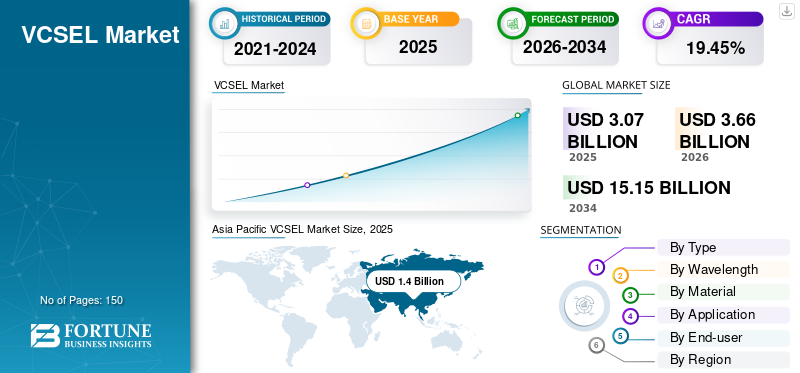
The global VCSEL market size was valued at USD 3.07 billion in 2025 and is projected to grow from USD 3.66 billion in 2026 to USD 15.15 billion by 2034, exhibiting a CAGR of 19.45% during the forecast period. Asia Pacific dominated the global market with a share of 45.48% in 2025.
A Vertical Cavity Surface Emitting Laser (VCSEL) is a semiconductor-based laser diode that produces light perpendicular to the surface of the fabricated wafer rather than parallel as in edge-emitting lasers. These devices can be implemented in smaller surface mount packages than conservative edge-emitting semiconductor lasers, which radiate from surfaces designed by cleaving the chip. They can also increase the density of the laser beam in a smaller space than conventional edge-type laser diodes. Moreover, these devices are used in several applications, such as optical communication, sensing, and 3D imaging applications, including facial recognition technology in smartphones, data communication, and LiDAR systems in autonomous vehicles.
The COVID-19 pandemic had a significant impact on the market due to a surge in the use of consumer electronics as people spent more time at home. Devices, such as smartphones, laptops, and tablets, witnessed increased demand, which, in turn, boosted the demand for vertical cavity surface emitting lasers used in 3D sensing, facial recognition, and augmented reality features. Moreover, as remote work and online activities increased, there was a higher demand for data centers and faster communication networks. Vertical Cavity Surface Emitting Laser, which is used in optical communication systems, benefitted from this trend as companies invest in upgrading their infrastructure.
Download Free sample to learn more about this report.
VCSEL MARKET KEY Takeaways
 Market Size & Forecast
- 2025 Market Size: USD 3.07 billion
- 2026 Market Size: USD 3.66 billion
- 2034 Forecast Market Size: USD 15.15 billion
- CAGR: 19.45% from 2026–2034
 Market Share
- Asia Pacific dominated the VCSEL market with a 45.48% share in 2025.
- The Multi-mode segment accounted for the largest market share of 60.31% in 2026.
- The Near Infrared (NIR) wavelength segment is projected to hold a 47.31% share in 2026.
 Key Regional Highlights
Asia Pacific
Asia Pacific reached USD 1.40 billion in 2025 and is projected to reach USD 1.70 billion in 2026, driven by strong consumer electronics manufacturing and 5G adoption.
Europe
Europe captured 24.11% of the global market in 2025, reaching USD 0.74 billion, driven by rising demand for IT and telecom equipment.
North America
North America accounted for USD 0.59 billion in 2025 (19.37% share), supported by advanced wireless connectivity and data communication.
U.S.
The market is projected to reach USD 0.41 billion by 2026, fueled by growing demand for VCSEL technologies.
Japan
The market is projected to reach USD 0.47 billion by 2026, supported by strong consumer electronics manufacturing.
Read More

Generative AI Impact
Increase in Demand for Generative AI in Vertical Cavity Surface Emitting Laser Applications to Drive Market Growth
Generative AI models require substantial computational power and high-speed data processing, leading to increased investments in data centers. Vertical Cavity Surface Emitting Lasers play a critical role in high-speed optical interconnects within data centers, thus driving demand for these lasers to support the growing needs of the AI-driven infrastructure. Generative AI can significantly improve 3D sensing and imaging technologies, which are major applications of Vertical Cavity Surface Emitting Laser. Therefore, AI’s ability to optimize and innovate in these areas leads to more sophisticated Vertical Cavity Surface Emitting Laser applications and greater market demand.
VCSEL Market Trends
Increase in Adoption of Vertical Cavity Surface Emitting Laser into Medical Imaging and Biomedical Applications to Boost Market Growth
Vertical cavity surface emitting laser offer numerous advantages, such as high beam quality, precise wavelength control, and compact size, making them ideal for various biomedical and medical applications. As the healthcare sector constantly seeks cutting-edge technologies to boost patient and diagnostic accuracy, the implementation of layers in these areas is set to increase quickly. These lasers provide significant advantages for biomedical sensing and medical imaging applications, mostly in pulse and tissue oximetry. Conventionally, these applications have used LEDs at precise wavelengths to calculate blood oxygenation. On the other hand, these layers present enhancements, such as smaller wavelength modifications with temperature changes, narrower spectral linewidth emission, and expressively reduced power consumption, which is especially helpful for developing home monitoring and wireless medical devices. Therefore, these trends are expected to drive market growth.
Download Free sample to learn more about this report.
VCSEL Market Growth Factors
Increasing Demand for Facial Recognition and Biometric Systems among Several Applications to Drive Market Growth
The increasing demand for biometric security systems and facial recognition is a significant driver of the market. Vertical cavity surface emitting laser are critical modules in these advanced security technologies due to their capability to produce precise, coherent light, which is used to generate comprehensive 3D maps of faces and objects. As confidentiality and security concerns become progressively prominent in both enterprise and consumer sectors, the demand for accurate and reliable biometric systems continues to increase, driving the market growth. Additionally, security breaches and identity theft are the main concerns for which facial recognition and biometric security systems bid robust solutions.
RESTRAINING FACTORS
Higher Deployment Costs and Low Adoption of InP-based VCSELs to Restrain Market Growth
Vertical Cavity Surface Emitting Laser production can be more costly than that of conservative edge-emitting lasers owing to the compound fabrication processes involved in its manufacture, such as lithography, wafer bonding, and epitaxial growth. Adoption may be considerably hampered by this increased cost, especially in applications where expenses are critical, such as consumer electronics and data transmission. Moreover, due to their lower dispersion and negligible fiber loss, InP-based VCSELs are commonly selected for applications that include optic communication. However, due to their high reflectivity and low penetration, InP-based VCSELs are incapable of producing large DBR mirrors. The effective cavity length constrains the confinement factor and turning range.
VCSEL Market Segmentation Analysis
By Type Analysis
Adoption of Multi-mode VCSELs among Data Center Applications Propelled Segment Growth
On the basis of type, the market is categorized into single-mode and multi-mode.
The multi-mode segment is expected to hold the largest market share of 60.31% in 2026. The demand for higher data transmission rates in data centers is fueling the adoption of multi-mode VCSELs, which are used in short-reach optical interconnects. Multi-mode VCSELs are capable of supporting high data rates with relatively low power consumption, making them suitable for large-scale data processing environments. These VCSELs are generally more cost-effective to produce than single-mode counterparts due to simpler fabrication processes. This cost advantage makes them more attractive for applications where high volume and low cost are critical.
The single-mode segment is expected to grow at the highest CAGR during the forecast period. These VCSELs are widely adopted in telecommunications due to their ability to maintain a high-quality signal over extended distances. They offer a narrow spectral width and lower divergence, which reduces dispersion and ensures more reliable communication. These are crucial in fiber optic communications, where maintaining signal integrity over long distances is essential. These devices are used in high-speed networks, such as 5G, where low latency and high data throughput are required. Thus, these factors boost the growth of the semiconductor market.
By Wavelength Analysis
Rising Demand for Near Infrared Wavelength Among Healthcare Applications Boosted Segmental Growth
On the basis of the wavelength, the market is categorized into red, near infrared, and shortwave infrared.
The Near Infrared (NIR) wavelength segment held the largest global VCSEL industry share in 2023. The segment is expected to dominate the market share of 47.31% in 2026. The growth is primarily due to the increasing adoption of smartphones for 3D sensing applications, including gesture and facial recognition, automotive in-cabin sensing, and others. Furthermore, NIR VCSELs are increasingly used in medical devices for non-invasive diagnostic procedures. They are used in devices to monitor blood oxygen levels, heart rate, and other vital signs. The NIR light can penetrate skin and tissues more effectively, providing accurate measurements without discomfort to the patient.
The red wavelength segment is expected to grow at the highest CAGR of 22.63% during the forecast period. Red Vertical Cavity Surface Emitting Lasers are used in pico projectors and Augmented Reality (AR) displays. Their ability to produce a sharp, bright red light is essential for high-quality image projection. This is particularly important in devices such as smart glasses, Heads-Up Displays (HUDs), and portable projectors. Moreover, in laser printers and scanners, red Vertical Cavity Surface Emitting Lasers are well-suited for reading and writing data on optical media, such as CDs and DVDs.
By Material Analysis
Growing Adoption of Gallium Arsenide in Several VCSEL Applications Fostered Segment Growth
On the basis of the material, the market is categorized into gallium nitride and gallium arsenide.
The Gallium Arsenide (GaAs) segment held the largest market share in 2023. Gallium arsenide has a direct bandgap, which makes it highly efficient in light emission, especially in the infrared spectrum. This is crucial for VCSELs, which often operate at wavelengths, such as 850 nm, and are widely used in data communication and sensing applications. Moreover, it is compatible with well-established semiconductor manufacturing processes, allowing for the production of high-quality, reliable VCSELs. The use of GaAs also facilitates the growth of high-quality epitaxial layers, which are essential for the performance of vertical cavity surface emitting lasers. The segment is projected to capture 60.57% of the market share in 2026.
The Gallium Nitride (GaN) segment is expected to grow at the highest CAGR of 21.95% during the forecast period. Its wide bandgap allows for the emission of light in the blue, violet, and ultraviolet regions of the spectrum. This makes GaN-based VCSELs ideal for applications requiring short-wavelength lasers, such as high-density optical storage, display technologies, and biological sensing.
By Application Analysis
Surge in Demand for VCSELs in Data Centers Boosted Data Communication Segment Growth
On the basis of application, the market is categorized into data communication, 3D sensing, LiDAR systems, industrial heating & laser printing, infrared illuminations, and others.
The data communication applications held the maximum market share in 2023. Data centers are the main components of the Internet infrastructure, aiding as computing, storage, and data access points. The need for VCSELS in data centers is increasing, fueling the development of the VCSEL for the data communication market. VCSELS are applied in data communication for a variety of purposes, such as high-speed data transfer, optical interconnects, and sensing. They have lower power consumption, faster data speeds, and small size, making them the epitome of data center operations. Several reasons contribute to the augmented demand for VCSELS in data centers. One of the main causes is the development of the internet and the increasing need for data storage and processing capacity.
3D sensing applications are expected to grow at the highest CAGR of 23.29% during the forecast period. The segment is estimated to hold 26.79% of the market share in 2026. These applications are widely used in gesture recognition, facial recognition, proximity sensing, and 3D depth sensing, all of which have become vital features in modern consumer electronics such as smartphones, tablets, and wearables. The rapid adoption of these devices globally has considerably fueled the demand for vertical cavity surface emitting laser-based sensors. For instance,
- In April 2024, Vertilas and TriEye partnered to demonstrate 1.3 um VCSEL-driven SWIR sensing solutions. The collaboration provides cost-effective solutions for both industrial and consumer markets.
- In March 2021, Lumentum Holdings Inc. declared innovative high-power six-junction vertical-cavity surface-emitting laser arrays for innovative automotive LiDAR, consumer, and other 3D sensing applications. The applications and innovative functionality drive the need for higher power and efficiency from smaller form factor devices.
By End-user Analysis
Rise in Demand for Vertical Cavity Surface Emitting Lasers in Consumer Electronics Boosted Market Growth
On the basis of the end-user, the market is categorized into consumer electronics, automotive, industrial, healthcare, military & defense, and others.
The consumer electronics segment held the largest market share in 2023. The segment is expected to capture 26.93% of the market share in 2025. The integration of VCSELs for facial and gesture recognition into devices, such as wearables, has developed predominantly. The increased demand for VCSELs is driven by the customer’s desire for sophisticated features and functionalities in electrical devices, generating a symbiotic relationship between the two parties. Industrialists' incorporation of VCSEL technology into a growing range of consumer goods results in enhanced and novel functionalities for customers, thereby simulating a favorable cycle of demand and adoption.
The automotive segment is expected to grow at the highest CAGR of 23.51% during the forecast period. Automotive manufacturers are gradually integrating advanced driver-assistance systems and LiDAR technology into their vehicles. VCSELs are important components in LiDAR systems, enabling real-time depth sensing and precision for autonomous driving. With the increasing emphasis on vehicle security and the detection of autonomous flexibility, the demand for VCSEL-based LiDAR solutions is composed of substantial escalation.
To know how our report can help streamline your business, Speak to Analyst
REGIONAL ANALYSIS
The global market is geographically segmented into North America, Europe, Asia Pacific, South America, and the Middle East & Africa. They are further divided into countries.
Asia Pacific
Asia Pacific VCSEL Market Size, 2025 To get more information on the regional analysis of this market, Download Free sample
The Asia Pacific region captured 45.48% of the global market in 2025, generating USD 1.4 billion in revenue, and is projected to reach USD 1.7 billion in 2026. The growth can be attributed to a large consumer electronics manufacturing industry in major economies, including China, South Korea, and Japan. China is one of the main consumer electronics manufacturers in the region, followed by South Korea, a key country for manufacturing convenient consumer applications. The region has a strong presence of manufacturers such as Xiaomi, Samsung, OPPO, and others who are already executing VCSELs in their smartphones. In addition, the region has led the implementation of 5G communication technology. Therefore, Asia Pacific holds the largest market share due to the region's increasing development. The market in China is expected to hit USD 0.55 billion in 2026, whereas India is likely to reach USD 0.21 billion and Japan is projected to hit USD 0.47 billion in 2026.
North America
North America contributed approximately USD 0.59 billion to the global market in 2025, accounting for 19.37% share, and is expected to reach USD 0.69 billion in 2026 and to witness a significant CAGR over the forecast period owing to modernizations in advanced technologies and the increase in data communication applications. An upsurge in extensive wireless connectivity and enterprise mobility leads to the growth of the market in the region. Leading businesses in North America, such as Lumentum Operations LLC, Coherent Corp., Broadcom, and MKS Instruments, provide VCSELs to numerous industries. Moreover, the U.S. is the main contributor to the region’s market growth. The U.S. market size is expected to be USD 0.41 billion in 2026.
Europe
In 2025, the Europe market stood at USD 0.74 billion, representing 24.11% of global demand, and is projected to grow to USD 0.89 billion in 2026. This is due to the increasing adoption of devices for energy and power presentations and the need for IT & telecommunication equipment that exploits VCSEL. Furthermore, Germany held the largest market share, and the U.K. was the strongest-growing market in the European region. Thus, this factor boosts the global VCSEL market growth. The market value in U.K. is expected to be USD 0.2 billion in 2026. On the other hand, Germany is projecting to hit USD 0.23 billion in 2026 and France is likely to hold USD 0.15 billion in 2025.
South America
Similarly, South America is witnessing significant growth in the market. Brazil witnessed an increase in investments in the development of data centers, contributing to the introduction of new data centers. Data centers use Vertical Cavity Surface Emitting Laser technologies to improve optical links and attain high-speed data transmission. VCSEL is a consistent key component in low-cost multimode fiber optic interconnects; this factor is driving the need to launch innovative data centers in the region.
Middle East & Africa
Additionally, the Middle East & Africa market is predicted to grow in the coming years owing to improved investment and government funding for digitization. In 2025, Middle East & Africa generated USD 0.2 billion, contributing 6.47% to global market revenue, and is projected to grow to USD 0.22 billion in 2026. The GCC market size is expected to hit USD 0.07 billion in 2025.
Latin America
Latin America recorded a market size of USD 0.14 billion in 2025, capturing 4.57% of the global market share, and is projected to reach USD 0.15 billion in 2026.
KEY INDUSTRY PLAYERS
Leading Companies Implement Partnership and Acquisition Tactics to Boost Their Market Presence
Top firms are launching specialized solutions tailor-made to exact sectors to boost their global presence. They are tactically creating partnerships and purchasing regional businesses to make a mark across regions. They focus on marketing plans and new solution development to maintain and accelerate their market share. Thus, the growing need for VCSELs is anticipated to generate lucrative prospects leading companies.
List of Top VCSEL Companies:
· Coherent Corp. (U.S.)
· Lumentum Operations LLC (U.S.)
· ams OSRAM AG (Austria)
· TRUMPF (Germany)
· Broadcom (U.S.)
· MKS Instruments (U.S.)
· Santec Holdings Corporation (Japan)
· Leonardo Electronics US, Inc. (U.S.)
· Vertilas Gmbh (Germany)
· RP Photonics AG (Switzerland)
KEY INDUSTRY DEVELOPMENTS:
- January 2024: ams OSRAM unveiled the limits of lighting and sensing at the SPIE Photonics West Exhibition. The organization provides innovative technology, including a new, particularly dense near-infrared image sensor that is perfect for Augmented Reality (AR) headsets and other battery-driven processes, as well as an efficient photodiode for vital sign monitoring.
- January 2024: Coherent Corp. introduced a VCSEL-based illumination module platform for mid-range and short LiDAR in industrial robotic vision and automotive security in industrial applications. The increasing adoption of depth sensing in industrial robots and advanced driver assistance systems in automobiles is hastening the demand for flexible and compact LiDAR systems that perform proficiently and reliably, even in the most dangerous environments.
- February 2023: Coherent Corp. declared the launch of photodiode arrays for 800G datacom pluggable transceivers and 100G PAM4 vertical-cavity surface-emitting laser optical cables. These high-speed datacom VCSELs signify the state of the art in the technology.
- April 2022: TRUMPF Photonic Components launched new innovative VCSEL solutions to expand its portfolio for 3D sensing in industrial and consumer applications. The introduction of the latest VCSEL solutions leads to better results in innovative optical applications, such as laser, proximity sensing, autofocus applications, or OLED display sensing.
- October 2021: Lumentum Holdings Inc., a provider of 3D solutions, declared an enterprises-first, 10 W flood illuminator component that integrates a higher presentation three-junction Vertical Cavity Surface Emitting Laser array for industrial and customer 3D sensing applications. The application offers clients a high-power, efficient, integrated solution in an easily combined industry-standard package that can be paired easily with infrared cameras and time-of-flight sensors.
REPORT COVERAGE
The report provides a detailed analysis of the market and focuses on key aspects such as leading companies, product/service types, and leading applications of the product. Besides, the report offers insights into the market trends and highlights key industry developments. In addition to the factors above, the report encompasses several factors that contributed to the growth of the market in recent years.
Request for Customization to gain extensive market insights.
Report Scope & Segmentation
|
ATTRIBUTE |
DETAILS |
|
Study Period |
2021-2034 |
|
Base Year |
2025 |
|
Estimated Year |
2026 |
|
Forecast Period |
2026-2034 |
|
Historical Period |
2021-2024 |
|
Growth Rate |
CAGR of 19.45% from 2026 to 2034 |
|
Unit |
Value (USD Billion) |
|
Segmentation |
By Type
By Wavelength
By Material
By Application
By End-users
By Region
|
Frequently Asked Questions
The market is projected to reach USD 15.15 billion by 2034.
In 2025, the market was valued at USD 3.07 billion.
The market is projected to grow at a CAGR of 19.45% during the forecast period.
By application, the data communication segment captured the largest share in 2025.
Increasing demand for facial recognition and biometric systems among several applications across the globe is the key factor driving the market growth.
Coherent Corp., Lumentum Operations LLC, ams-OSRAM AG, TRUMPF, Broadcom, MKS Instruments, Santec Holdings Corporation, Leonardo Electronics US, Inc., Vertilas Gmbh, and RP Photonics AG are the top major players in the market.
Asia Pacific holds the highest market share.
By end-user, the automotive segment is expected to grow at the highest CAGR during the forecast period.


- 2021-2034
- 2025
- 2021-2024
- 150
Get 30-60 hrs Free Customization
Expand Regional and Country Coverage, Segments Analysis, Company Profiles, Competitive Benchmarking, and End-user Insights.




















-
US +1 833 909 2966 ( Toll Free )
-
Get In Touch With Us