Vegan Cheese Market Size, Share & Industry Analysis, By Product (Mozzarella, Ricotta, Cheddar, Parmesan, Cream Cheese), By Source (Cashew, Soy, Almond, Coconut), By Application (B2C, B2B), By Region, and Regional Forecast, 2026-2034
 Download Free Sample
Vegan Cheese Market Overview
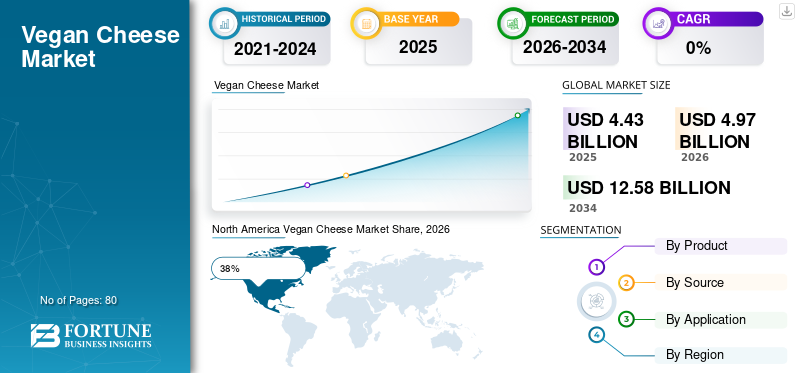
The global vegan cheese market size was valued at USD 4.42 billion in 2025. The market is projected to grow from USD 4.97 billion in 2026 to USD 12.58 billion by 2034, exhibiting a CAGR of 12.30% during the forecast period.

The vegan cheese market is expanding rapidly due to increasing consumer preference for plant-based diets, rising lactose intolerance cases, and growing awareness regarding sustainable food consumption. Vegan cheese products are manufactured using plant-derived ingredients such as cashew, almond, soy, coconut, and oats, offering alternatives to traditional dairy cheese. The vegan cheese market report highlights strong demand for clean-label, allergen-friendly, and cholesterol-free cheese alternatives across retail and foodservice sectors. Manufacturers are increasingly investing in advanced fermentation technologies and flavor enhancement techniques to improve texture, meltability, and taste. vegan cheese market Analysis also shows rising adoption of plant-based foods among flexitarian consumers seeking healthier dietary options.
The United States vegan cheese market continues to witness strong momentum due to increasing vegan lifestyles, expanding plant-based restaurant chains, and rising consumer awareness regarding animal welfare and environmental sustainability. Retail supermarkets, specialty food stores, and online grocery platforms are expanding vegan cheese product availability across the country. Demand for mozzarella, cheddar, cream cheese, and shredded vegan cheese products remains particularly high in pizza, snack, and sandwich applications. Vegan Cheese Industry Analysis indicates that younger consumers and health-conscious households are driving product innovation and premium plant-based cheese demand throughout the USA market. Food manufacturers are also introducing fortified vegan cheese products with improved nutritional value and functional benefits.
Download Free sample to learn more about this report.
Vegan Cheese Market Key Takeaways
 Global Market Size & forecast
- 2025 Market Size: USD 4.43 Billion
- 2026 Market Size: USD 4.97 Billion
- 2034 forecast Market Size: USD 12.58 Billion
- CAGR: 12.30% from 2026-2034
 Market Share
- North America dominated with a 38% market share in 2025.
- Mozzarella led the product segment with nearly 31% market share.
- Cashew-based vegan cheese held approximately 34% market share.
 Key Regional Highlights
North America
North America led the global market with a 38% share.
Europe
Europe accounted for 31% of the global market.
Asia-Pacific
Asia-Pacific held a 23% market share.
U.S.
The U.S. is a major market driven by growing demand for plant-based dairy alternatives.
Japan
Japan accounted for 15% of the Asia-Pacific market, supported by rising interest in plant-based foods.
Read More

Vegan Cheese Market Latest Trends
The vegan cheese market trends are strongly influenced by innovation in plant-based ingredients, clean-label formulations, and premium flavor development. One of the major trends is the increasing use of fermentation technology to replicate the taste and texture of traditional dairy cheese more effectively. Manufacturers are introducing aged vegan cheese varieties, artisanal plant-based cheese blocks, and meltable cheese alternatives suitable for foodservice applications. vegan cheese market insights indicate growing demand for products with minimal processing, organic ingredients, and natural preservatives among health-conscious consumers.
Another important trend shaping the Vegan Cheese Industry report is the rapid expansion of vegan cheese across quick-service restaurants, cafés, and packaged food sectors. Foodservice providers increasingly include vegan pizza toppings, burger slices, cream cheese spreads, and dairy-free sauces in their menus to attract flexitarian and vegan consumers. Sustainable packaging and allergen-free formulations are also becoming important competitive factors. Online grocery sales and direct-to-consumer subscription models continue strengthening market accessibility. vegan cheese market forecast suggests ongoing innovation in protein-rich formulations, nut-free alternatives, and probiotic-enhanced vegan cheese products designed to improve nutritional appeal and consumer acceptance.
Download Free sample to learn more about this report.
Vegan Cheese Market Dynamics
Driver
Rising Adoption of Plant-Based and Dairy-Free Diets
The increasing adoption of vegan, vegetarian, and flexitarian lifestyles is one of the strongest drivers supporting vegan cheese market growth globally. Consumers are becoming more conscious regarding the health and environmental impact of dairy consumption, encouraging a shift toward plant-based alternatives. Vegan cheese products are gaining popularity among lactose-intolerant individuals and consumers seeking cholesterol-free and allergen-friendly dietary solutions. vegan cheese market research report findings indicate strong demand for dairy-free cheese in pizzas, sandwiches, burgers, salads, and packaged snacks.
Health-conscious consumers increasingly prefer products made from natural plant ingredients such as almonds, cashews, soy, and coconut due to perceived digestive and nutritional benefits. Growing awareness regarding animal welfare and sustainable food production practices is also encouraging adoption of vegan cheese products. Retailers and foodservice chains are responding by expanding plant-based product portfolios and increasing shelf space for vegan cheese offerings. Social media influence and celebrity endorsement of vegan lifestyles continue supporting consumer interest and long-term vegan cheese market opportunities.
Restraint
High Product Pricing and Flavor Limitations
One of the key restraints affecting the vegan cheese market outlook is the relatively high price of plant-based cheese products compared to conventional dairy cheese. Specialized ingredients, advanced manufacturing processes, and premium plant proteins contribute to higher production costs, limiting affordability for some consumers. In price-sensitive markets, consumers may hesitate to switch completely from traditional dairy products to vegan cheese alternatives.
Flavor and texture inconsistencies also remain Challenges within the Vegan Cheese Industry Analysis. Some consumers perceive vegan cheese as lacking the authentic taste, stretchability, and creaminess associated with dairy-based cheese products. Manufacturers continue facing difficulties in perfectly replicating traditional cheese textures across different applications such as pizza melting and slicing. Limited availability in rural retail markets and lower consumer awareness in developing economies may also restrict market penetration. Supply chain disruptions affecting plant-based raw materials and rising nut prices further create operational challenges for manufacturers globally.
Opportunity
Expansion of Foodservice and Functional Plant-Based Foods
The rapid expansion of plant-based menus across restaurants, cafés, and quick-service food chains presents major opportunities for the vegan cheese market. Foodservice providers increasingly incorporate vegan cheese into pizzas, burgers, wraps, pasta dishes, and snack products to attract vegan and flexitarian consumers. vegan cheese market Analysis highlights growing opportunities for customized cheese alternatives designed specifically for food manufacturing and commercial kitchen applications.
Functional and fortified vegan cheese products also represent significant business opportunities. Consumers increasingly seek plant-based cheese enriched with protein, calcium, probiotics, vitamins, and omega fatty acids. Manufacturers investing in nutritional innovation and clean-label formulations are expected to gain competitive advantages. Emerging markets with rising urban populations and growing awareness regarding plant-based nutrition offer substantial long-term growth potential. Online grocery expansion and direct-to-consumer subscription services are also improving product accessibility and strengthening vegan cheese market opportunities worldwide.
Challenge
Achieving Authentic Dairy-Like Texture and Consumer Acceptance
One of the biggest challenges in the vegan cheese market is achieving authentic dairy-like texture, flavor, and melting performance while maintaining clean-label and plant-based formulations. Consumers increasingly expect vegan cheese products to closely resemble traditional dairy cheese in cooking applications, particularly for pizzas, sauces, and baked products. Developing products that satisfy these expectations without artificial additives remains a major technological challenge for manufacturers.
Consumer skepticism regarding nutritional value and ingredient transparency also affects market growth. Some vegan cheese products contain starches and processed oils that health-conscious consumers may perceive negatively. vegan cheese market forecast findings indicate that manufacturers must continue improving product formulations and educating consumers regarding nutritional benefits. Competition from traditional dairy producers entering the plant-based segment further intensifies pricing pressure and product differentiation challenges. Maintaining consistent product quality, flavor stability, and efficient cold-chain distribution systems also remains critical for long-term market expansion.
Vegan Cheese Market Segmentation
By Product
Mozzarella dominates the vegan cheese market with nearly 31% market share due to its widespread use in pizza, pasta, sandwiches, and ready-to-eat meals. Consumers increasingly demand dairy-free mozzarella alternatives that offer authentic stretchability, meltability, and creamy texture comparable to traditional cheese. vegan cheese market report findings indicate that foodservice providers and pizza chains are major contributors to demand for vegan mozzarella products across urban markets.
Manufacturers are focusing on fermentation-based technologies and plant protein blends to improve functionality in high-temperature cooking applications. Cashew, coconut oil, and tapioca starch are commonly used ingredients in mozzarella-style vegan cheese formulations. Retail supermarkets increasingly stock shredded, sliced, and block mozzarella alternatives to cater to flexitarian and vegan consumers. Rising popularity of frozen vegan pizzas and plant-based fast-food products continues strengthening demand for mozzarella-type vegan cheese globally.
Ricotta accounts for approximately 14% market share in the vegan cheese market because of increasing demand for dairy-free cheese spreads and Italian-inspired plant-based cuisine. Vegan ricotta products are commonly used in pasta dishes, lasagna, stuffed pastries, and bakery fillings. Vegan Cheese Industry Analysis indicates rising consumer preference for almond-based and tofu-based ricotta alternatives that provide creamy texture and mild flavor characteristics.
Manufacturers are introducing organic and clean-label ricotta products free from preservatives and artificial additives. Health-conscious consumers increasingly prefer ricotta alternatives with high protein content and lower saturated fat levels. The growing popularity of Mediterranean cuisine and vegan home cooking trends are also supporting segment expansion. Foodservice providers are increasingly incorporating vegan ricotta into restaurant menus and packaged meal solutions. Product innovation in spreadable and flavored ricotta varieties continues improving consumer appeal and market competitiveness.
Cheddar holds nearly 27% market share due to its extensive use in burgers, sandwiches, snacks, sauces, and packaged food applications. Vegan cheddar products are among the most recognized plant-based cheese alternatives because of strong flavor familiarity among consumers. vegan cheese market insights show increasing demand for sharp, smoked, and aged cheddar-style vegan cheese products across retail and foodservice sectors.
Manufacturers are focusing on improving slicing performance, flavor depth, and meltability through advanced fermentation and culturing techniques. Soy, coconut, and cashew ingredients are widely utilized in cheddar formulations due to their creamy texture properties. Retail demand for cheddar slices and shredded vegan cheese products remains particularly strong among younger consumers and flexitarian households. The expansion of vegan burger chains and ready-to-eat snack products continues supporting market growth within the cheddar segment globally.
Parmesan represents approximately 12% market share in the vegan cheese market because of increasing consumer demand for dairy-free toppings and seasoning products. Vegan parmesan is commonly used in pasta dishes, salads, soups, and snack applications due to its strong savory flavor profile. vegan cheese market Analysis highlights growing popularity of nut-based parmesan alternatives made from cashews, almonds, and nutritional yeast.
Manufacturers are introducing grated and powdered vegan parmesan products designed for convenience and extended shelf life. The growing trend of home-based cooking and gourmet vegan cuisine continues supporting segment expansion. Health-conscious consumers increasingly prefer parmesan alternatives with natural seasonings and minimal processing. Food manufacturers are also incorporating vegan parmesan into packaged sauces, frozen meals, and snack products to cater to plant-based dietary preferences.
Cream cheese accounts for nearly 16% market share due to rising demand for dairy-free spreads, dips, cheesecakes, and breakfast products. Vegan cream cheese is highly popular among consumers seeking plant-based alternatives for bagels, sandwiches, desserts, and snacks. vegan cheese market research report findings indicate strong demand for flavored cream cheese varieties including herbs, garlic, and fruit-infused options.
Manufacturers are investing in smooth texture enhancement and probiotic fortification to improve product quality and nutritional value. Almond, cashew, and coconut ingredients are commonly used to achieve creamy consistency and mild flavor profiles. Retailers continue expanding shelf space for vegan cream cheese products due to increasing consumer preference for dairy-free breakfast and snack options. Product innovation in whipped and low-fat vegan cream cheese categories is further supporting market growth globally.
To know how our report can help streamline your business, Speak to Analyst
By Source
Cashew-based vegan cheese dominates with approximately 34% market share because cashews provide rich texture, creamy consistency, and neutral flavor characteristics ideal for cheese alternatives. Cashew cheese products are widely used in premium vegan spreads, cream cheese, sauces, and artisanal cheese blocks. vegan cheese market growth within this segment is driven by increasing consumer preference for minimally processed and natural plant-based foods.
Manufacturers favor cashews because they blend easily and support smooth fermentation processes required for aged vegan cheese production. Cashew-based cheese is particularly popular among health-conscious consumers seeking clean-label and organic products. Artisanal vegan cheese brands increasingly utilize fermented cashew formulations to replicate dairy cheese flavor complexity. Foodservice providers also prefer cashew-based cheese products for gourmet vegan menu applications due to superior texture and melting performance.
Soy-based applications account for nearly 29% market share because soy protein provides high nutritional value and cost-efficient manufacturing capabilities. Soy cheese products are widely used in sliced cheese, shredded cheese, spreads, and processed food applications. Vegan Cheese Industry report findings indicate strong demand for soy-based vegan cheese among consumers seeking protein-rich dairy alternatives.
Manufacturers continue improving soy flavor masking and texture optimization to increase consumer acceptance. Soy-based cheese remains highly popular in Asian markets due to familiarity with soy ingredients and established supply chains. Food processing companies also prefer soy because it supports large-scale production efficiency and versatile application development. Increasing innovation in non-GMO and organic soy cheese formulations continues supporting market competitiveness globally.
Almond-based vegan cheese represents approximately 21% market share due to rising demand for premium dairy-free products with mild flavor profiles and nutritional benefits. Almond cheese products are increasingly used in spreads, cream cheese alternatives, and gourmet artisanal cheese applications. vegan cheese market outlook indicates growing consumer interest in almond-based products because of perceived health benefits and clean-label positioning.
Manufacturers are introducing flavored almond cheese varieties and fortified products containing vitamins and probiotics. Almond-based formulations are particularly attractive among consumers avoiding soy allergens and seeking lighter cheese alternatives. The premium positioning of almond cheese products allows manufacturers to target health-conscious and environmentally aware consumer segments. Expanding vegan snack and breakfast categories continue driving demand for almond-based cream cheese and spreadable products.
Coconut-based applications account for nearly 16% market share because coconut oil provides desirable melting properties and creamy texture in vegan cheese formulations. Coconut ingredients are widely used in mozzarella, cheddar, and cream cheese alternatives intended for cooking and baking applications. vegan cheese market forecast findings indicate strong demand for coconut-based cheese in foodservice sectors due to improved stretchability and heat performance.
Manufacturers continue balancing coconut flavor intensity with seasoning and fermentation technologies to improve consumer acceptance. Coconut-based cheese products are highly popular in tropical regions and among consumers seeking nut-free alternatives. Foodservice providers increasingly utilize coconut-derived vegan cheese for pizzas, burgers, and sauces because of its functional cooking characteristics. Product innovation in blended coconut and plant protein formulations is further strengthening segment expansion across global markets.
By Application
The B2C segment dominates the vegan cheese market with approximately 68% market share due to rising consumer adoption of plant-based diets and increasing retail availability of dairy-free cheese products. Individual consumers are purchasing vegan cheese through supermarkets, specialty health stores, convenience outlets, and online grocery platforms for home consumption. vegan cheese market Analysis indicates strong demand for mozzarella, cheddar, cream cheese, and parmesan alternatives among health-conscious consumers, vegans, lactose-intolerant individuals, and flexitarian households.
Consumers in the B2C segment increasingly prioritize clean-label products, organic ingredients, and nutritional value while selecting vegan cheese products. Social media influence, celebrity endorsements, and vegan lifestyle trends continue driving product awareness and retail demand. Ready-to-eat snacks, frozen vegan pizzas, sandwiches, and breakfast applications are also contributing to household consumption growth. Manufacturers are introducing flavored varieties, easy-to-use packaging, and affordable product formats to improve customer engagement. Online subscription services and direct-to-consumer sales channels are further strengthening B2C market penetration globally.
The B2B segment accounts for nearly 32% market share in the vegan cheese market because of rising adoption of plant-based ingredients across foodservice, hospitality, and food manufacturing industries. Restaurants, cafés, quick-service chains, bakeries, catering companies, and packaged food manufacturers increasingly use vegan cheese products to meet growing consumer demand for dairy-free menu options. vegan cheese market research report findings indicate strong B2B demand for mozzarella and cheddar alternatives in pizza, burger, pasta, and ready-meal applications.
Food manufacturers are collaborating with vegan cheese suppliers to develop customized formulations suitable for industrial-scale food production and commercial kitchen requirements. The hospitality industry is expanding vegan menu offerings to attract younger and health-conscious consumers seeking sustainable dining experiences. B2B buyers increasingly prioritize bulk packaging, product consistency, meltability, and shelf-life stability while selecting vegan cheese suppliers. Innovation in foodservice-grade formulations and expansion of plant-based fast-food chains continue creating long-term vegan cheese market opportunities within the B2B segment.
Vegan Cheese Market Regional Outlook
North America
North America Vegan Cheese Market Share, 2026 (%) To get more information on the regional analysis of this market, Download Free sample
North America holds nearly 38% market share in the vegan cheese market due to strong consumer adoption of plant-based diets, advanced retail infrastructure, and growing vegan foodservice penetration. The United States remains the dominant contributor because of increasing awareness regarding dairy alternatives, sustainability, and animal welfare concerns. vegan cheese market trends in North America indicate rising demand for artisanal vegan cheese products, shredded cheese alternatives, and dairy-free snack items.
Foodservice chains across the region increasingly incorporate vegan cheese into pizzas, sandwiches, burgers, and ready-to-eat meals. Retail supermarkets continue expanding plant-based product shelves to meet rising consumer demand. Innovation in clean-label formulations and fermented cheese technologies is also driving regional market growth. Health-conscious consumers and flexitarian eating patterns continue strengthening long-term vegan cheese market opportunities across North America.
Europe
Europe accounts for approximately 31% market share because of increasing vegan lifestyles, strong environmental awareness, and supportive food innovation ecosystems. Countries such as Germany, the United Kingdom, France, and the Netherlands are major contributors to regional market expansion. vegan cheese market Analysis indicates growing demand for organic, allergen-free, and sustainable cheese alternatives across retail and hospitality sectors.
European consumers increasingly prioritize clean-label ingredients and environmentally responsible food products. Food manufacturers are investing heavily in cultured vegan cheese products and premium artisanal offerings tailored to gourmet consumers. Restaurant chains and cafés continue expanding vegan menu options, strengthening foodservice demand throughout the region. Government support for sustainable agriculture and plant-based nutrition initiatives further contributes to market development.
Germany Vegan Cheese Market
Germany represents nearly 26% share within the European vegan cheese market because of strong vegan consumer culture and growing demand for sustainable food products. German consumers increasingly seek dairy-free alternatives with clean ingredients, nutritional benefits, and authentic flavor profiles. Vegan Cheese Industry Analysis in Germany highlights rising popularity of plant-based mozzarella, cheddar, and cream cheese products across supermarkets and specialty stores.
Manufacturers in Germany focus heavily on organic certifications, recyclable packaging, and local ingredient sourcing. Foodservice operators continue introducing vegan pizza toppings, bakery products, and dairy-free snacks to meet changing dietary preferences. The country’s strong retail infrastructure and environmentally conscious consumer base continue supporting long-term vegan cheese market growth. Innovation in fermented and aged vegan cheese products is also strengthening product differentiation across the German market.
United Kingdom Vegan Cheese Market
The United Kingdom holds nearly 21% share within the European vegan cheese market due to rapid adoption of vegan lifestyles and strong retail promotion of plant-based foods. Consumers increasingly prefer dairy-free cheese alternatives for health, ethical, and environmental reasons. vegan cheese market insights indicate rising demand for vegan cheddar slices, cream cheese spreads, and grated mozzarella products across supermarkets and foodservice outlets.
Digital grocery platforms and social media marketing significantly influence purchasing behavior in the UK market. Restaurant chains continue expanding vegan menu offerings featuring dairy-free cheese ingredients. Manufacturers are also investing in innovative formulations with improved texture and meltability to strengthen consumer acceptance. The growing popularity of flexitarian diets and sustainable food consumption continues driving market demand across the United Kingdom.
Asia-Pacific
Asia-Pacific accounts for approximately 23% market share in the vegan cheese market due to increasing urbanization, rising health awareness, and expanding plant-based food consumption. Countries including China, Japan, Australia, and India are witnessing growing interest in dairy alternatives among younger consumers and health-conscious populations. vegan cheese market research report findings indicate rising availability of vegan cheese products across supermarkets, cafés, and online grocery channels.
Manufacturers in the region increasingly focus on soy-based and coconut-based cheese formulations due to ingredient accessibility and consumer familiarity. Foodservice providers continue introducing vegan pizza, pasta, and snack options to attract urban consumers. Expanding e-commerce infrastructure and rising disposable income levels are supporting market accessibility across Asia-Pacific. Innovation in localized flavors and affordable product formulations continues strengthening regional market competitiveness.
Japan Vegan Cheese Market
Japan accounts for nearly 15% share within the Asia-Pacific vegan cheese market because of growing consumer interest in functional foods, clean-label products, and plant-based nutrition. Japanese consumers increasingly prefer vegan cheese products with mild flavors, premium quality, and health-focused ingredients. vegan cheese market outlook in Japan indicates rising demand for cream cheese spreads, snack cheese alternatives, and dairy-free bakery ingredients.
Manufacturers are investing in advanced fermentation technologies and probiotic-enhanced formulations tailored to health-conscious consumers. Convenience stores and specialty food retailers continue expanding vegan product availability across urban regions. Minimalist packaging, premium presentation, and ingredient transparency remain important purchasing factors among Japanese consumers. Growing awareness regarding lactose intolerance and sustainable food consumption is also supporting long-term market growth.
China Vegan Cheese Market
China represents nearly 39% share within the Asia-Pacific vegan cheese market due to expanding middle-class populations, rapid urbanization, and increasing exposure to Western-style food consumption. Younger consumers increasingly adopt plant-based diets and dairy alternatives because of health concerns and evolving lifestyle preferences. vegan cheese market forecast findings indicate rising demand for mozzarella and cream cheese products in pizza chains, cafés, and bakery applications.
Domestic manufacturers are rapidly expanding plant-based food production capabilities while international brands continue entering the Chinese market. Online grocery platforms and digital marketing campaigns play significant roles in improving consumer awareness and accessibility. Foodservice operators increasingly incorporate vegan cheese into fast-food and fusion cuisine offerings. Growing investment in food technology and plant protein innovation continues strengthening China’s competitive position in the vegan cheese industry.
Rest of World
The Rest of World region holds nearly 8% market share in the vegan cheese market due to increasing urbanization, growing health awareness, and gradual adoption of plant-based diets across Latin America, the Middle East, and Africa. Consumers in these regions increasingly seek lactose-free and cholesterol-free food alternatives due to changing dietary preferences and health concerns. vegan cheese market opportunities are expanding through supermarkets, specialty health stores, and online retail channels.
Foodservice operators and café chains are gradually introducing vegan menu options featuring dairy-free cheese ingredients. Manufacturers focus on affordable product formulations and localized flavors to improve consumer acceptance in developing markets. Rising influence of global food trends and social media awareness campaigns is also encouraging plant-based food adoption. Increasing investments in retail infrastructure and cold-chain logistics continue supporting regional market penetration.
List of Top Vegan Cheese Companies
- Daiya Foods.
- Miyoko's Creamery
- Flora Food Group (Violife)
- Kite Hill
- Follow Your Heart
- Treeline Cheese
- Tofutti Brands, Inc.
- Parmela Creamery
- Nush Foods.
- GOOD PLANeT Foods.
Top two companies with the highest market share
- Flora Food Group (Violife) – 16%
- Daiya Foods. – 13%
Investment Analysis and Opportunities
The vegan cheese market continues attracting significant investment due to rising consumer demand for plant-based foods and increasing expansion of vegan product portfolios across retail and foodservice sectors. Investors are heavily supporting fermentation technology, clean-label product development, and sustainable ingredient sourcing to improve product quality and market competitiveness. vegan cheese market opportunities are especially strong in premium artisanal cheese alternatives and protein-fortified formulations designed for health-conscious consumers.
Food manufacturers and venture capital firms increasingly invest in plant protein innovation and dairy-free food startups to strengthen market positioning. Emerging economies in Asia-Pacific and Latin America offer long-term business opportunities due to growing urban populations and rising awareness regarding lactose-free diets. E-commerce expansion and direct-to-consumer subscription models also present strong revenue generation potential for vegan cheese brands. Investments in sustainable packaging and cold-chain distribution systems continue improving operational efficiency and product accessibility worldwide.
New Product Development
Innovation in the vegan cheese market focuses heavily on improving texture, flavor authenticity, and nutritional value. Manufacturers are introducing cultured vegan cheese products using precision fermentation and probiotic technologies to replicate traditional dairy cheese characteristics more effectively. vegan cheese market trends indicate increasing development of clean-label products free from artificial preservatives, starches, and hydrogenated oils.
Companies are also launching allergen-free and nut-free cheese alternatives to expand consumer accessibility. Functional vegan cheese fortified with protein, calcium, vitamins, and probiotics is becoming increasingly popular among health-conscious consumers. Manufacturers continue experimenting with oat-based, chickpea-based, and mixed plant-protein formulations to improve taste and cooking performance. Sustainable packaging solutions and recyclable materials are also becoming major areas of product innovation. Expansion of flavored cheese varieties and gourmet artisanal collections further strengthens product diversification within the vegan cheese industry.
Five Recent Developments (2023-2025)
- Flora Food Group (Violife) expanded its vegan cheese portfolio with improved meltable mozzarella products.
- Miyoko's Creamery introduced cultured oat milk-based cream cheese alternatives.
- Daiya Foods. launched reformulated cheddar slices with enhanced texture and flavor performance.
- Kite Hill expanded distribution of almond-based cream cheese products across retail chains.
- GOOD PLANeT Foods. developed allergen-friendly vegan cheese products for foodservice applications.
Report Coverage of Vegan Cheese Market
The vegan cheese market report provides detailed analysis of market trends, competitive developments, consumer preferences, and product innovations across the global plant-based dairy industry. The report evaluates demand patterns for mozzarella, cheddar, cream cheese, parmesan, and ricotta categories while examining ingredient applications including cashew, soy, almond, and coconut. vegan cheese market Analysis also covers technological advancements in fermentation, flavor development, and nutritional fortification.
Request for Customization to gain extensive market insights.
Regional coverage within the report includes North America, Europe, Asia-Pacific, and Rest of World markets, highlighting evolving dietary trends, retail expansion, and foodservice adoption. The report examines major company strategies, partnerships, product launches, and sustainability initiatives influencing market competition. vegan cheese market insights additionally assess opportunities linked to clean-label products, functional foods, online grocery expansion, and premium artisanal cheese alternatives. Detailed segmentation and competitive profiling support manufacturers, investors, retailers, and foodservice operators in identifying future business opportunities and emerging demand trends across the vegan cheese industry.
Frequently Asked Questions
Fortune Business Insights says that the global market value stood at USD 4.42 billion in 2025 and is projected to reach USD 12.58 billion by 2034.
The market is expected to exhibit a CAGR of 12.30% during the forecast period of 2026-2034.
Mozzarella was the leading product segment, accounting for nearly 31% of the market, driven by its widespread use in pizza, pasta, sandwiches, and ready-to-eat meals.
Key players include Daiya Foods, Miyoko's Creamery, Flora Food Group (Violife), Kite Hill, Follow Your Heart, and Treeline Cheese.
Major trends include growing use of fermentation technology to improve taste and texture and expanding vegan cheese offerings across restaurants, cafés, and packaged foods. North America led the market with a 38% share.



- 2021-2034
- 2025
- 2021-2024
- 80
-

(Offer valid till 31st Oct 2026)
Get 30-60 hrs Free Customization
Expand Regional and Country Coverage, Segments Analysis, Company Profiles, Competitive Benchmarking, and End-user Insights.




















-
US +1 833 909 2966 ( Toll Free )
-
Get In Touch With Us