Plant Based Food Market Size, Share & Industry Analysis, By Type (Fresh Salty Snacks, Spreadables, Soups, Stewed RTE, Bread & Pastries, Non-Milk Beverages, Plant Based Milk Beverages, Fresh Sweet Snacks, Plant based Meat, Plant based Cheese, and Tofu), By Nature (Conventional and Organic), By Functional Claim (Generic and Functional Claim), By Distribution Channel (Foodservice {Full-service Restaurants, Quick Service Restaurants, and Others} and Retail {Supermarkets & Hypermarkets, Convenience Stores, Health & Wellness Stores, Online Stores, and Others), and Regional Forecast, 2026-2034
 Download Free Sample
(Offer valid till 15th Oct 2026)

Plant Based Food Market Size and Future Outlook
 Listen to Audio Version
The global plant based food market size was valued at USD 238.25 billion in 2025. The market is projected to grow from USD 256.64 billion in 2026 to USD 491.24 billion by 2034, exhibiting a CAGR of 8.47% during the forecast period. North America dominated the plant based food market with a market share of 32.70% in 2025.
Plant-based foods come from plants and contain little or no animal products. Instead of being a strict plant based diets, this approach focuses on eating whole, minimally processed foods. Plant-based proteins are the main ingredient in the plant-based food market. They help create products such as meat alternatives, plant based dairy, snacks, and drinks. It can also include plant based alternatives including soy products or meat substitutes. Plant-based or naturally sourced foods have become a preferred option for people seeking allergen-friendly items that offer convenience and taste. The majority of the plant-centric products eliminate/reduce the utilization of egg proteins, lactose, and casein, making them suitable for those managing allergies and sensitivities.
Companies such as Danone S.A., Nestlé S.A., and JBS S.A, among others are some of the key players operating in this market. New product launch and base expansion is the key strategy which is boosting product sales and supporting the market growth.
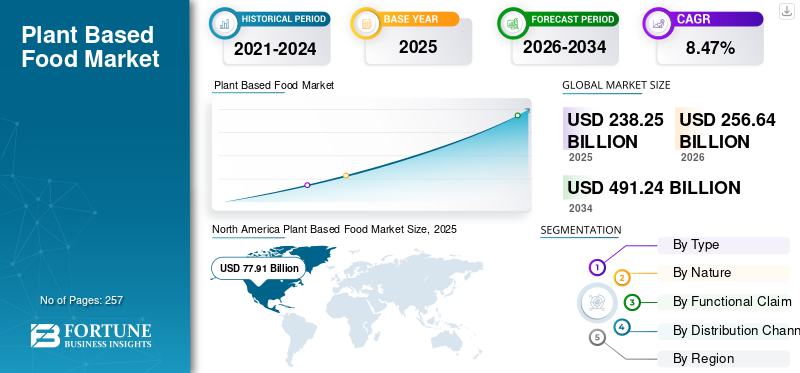
Download Free sample to learn more about this report.
PLANT BASED FOOD MARKET TRENDS
Rising Focus on Kids-Targeted Plant Based Nutrition Products is the Current Trend
The global plant-centric food industry is gravitating toward age-specific products, transitioning from one-size-fits-all items to nutrition-driven segmentation across different life stages. Rather than choosing adult-oriented vegan items for all individuals, manufacturers are aiming at creating formulations that meet the functional and sensory needs of various age groups, including school-age children and toddlers. For instance, in March 2025, Kate Farms, an American plant-based brand, revealed its latest vegan shake for kids. This drink is free from synthetic colors, flavors, and sweeteners, and is USDA organic. This trend shows improved awareness that nutritional requirements, including protein quality and energy needs, vary considerably across all stages of life and are not easily met by generic plant-based foods. Hence the demand for plant based food is expected to increase further in the future.
Plant Based Food Market Key Takeaways
 Market Size & Forecast
- 2025 Market Size: USD 238.25 billion
- 2026 Market Size: USD 256.64 billion
- 2034 Forecast Market Size: USD 491.24 billion
- CAGR: 8.47% from 2026–2034
 Market Share
- North America dominated the plant based food market with a 32.70% share in 2025.
- Plant-based milk beverages led the type segment with a 29.73% share in 2025.
- Generic plant-based foods accounted for 74.17% of the global market share in 2025.
 Key Regional Highlights
North America
North America led the global market with a value of USD 77.91 billion and a 32.70% share in 2025.
Europe
Europe reached USD 71.19 billion in 2025, making it the second-largest regional market.
Asia Pacific
Asia Pacific was valued at USD 66.52 billion in 2025, supported by strong consumption of traditional plant-based foods.
U.S.
The market reached USD 60.65 billion in 2025, driven by strong retail penetration and product innovation.
Japan
The market is projected to reach USD 216.68 billion by 2026.
Read More

MARKET DYNAMICS
MARKET DRIVERS
Download Free sample to learn more about this report.
Rising Veganism and Flexitarian Consumption Bolster Industry’s Growth
Over the past few years, flexitarianism and veganism have witnessed evolving consumer preferences, largely augmented by improved awareness of environmental sustainability and ethical food choices. While the majority of global individuals are not fully committed to veganism, they are still adopting a flexitarian approach by including more plant-based products/components in their diet and cutting back on animal based products. This sudden shift is driven by growing interest in clean-label diets and enhanced consumer education about plant-based nutrition. As these dietary choices influence everyday decisions, most consumers are gravitating toward plant-derived options that mimic the flavors/texture of conventional foods.
MARKET RESTRAINTS
Sensory Gaps in Texture and Taste Inhibit Market’s Momentum
Despite ongoing technological advancements, vegan/natural options still struggle to mimic the texture and flavor of traditional seafood, dairy, and milk products. The majority of the items, especially vegan dairy alternatives, face continuous challenges with off-notes (metallic or beany tones), uneven textures and inadequate melting. These sensory constraints are especially problematic for repeat consumer purchases, as initial item trials rarely convert into long-lasting adoption. Moreover, with respect to mainstream consumers, mostly flexitarians rather than vegans, attaining a similar taste of traditional products is essential, thus making sensory underperformance a main hurdle in the industry.
MARKET OPPORTUNITIES
Introduction of Sustainably-Packaged Plant based Items Pave Growth Prospects
Sustainable packaging presents a phenomenal opportunity for the plant-based food sector, as individuals who prefer plant-centric items are typically aware of the environmental impact. However, most vegan items are still packaged in regular plastics, creating a gap between their sustainability claims and eco-friendly image. Today, recyclable packaging materials and bio-based plastics, such as mono-material plastics and paper-based cartons, are gaining utmost traction across the plant based meal, snacks, and frozen food sectors. These packaging inputs are known for minimizing plastic waste while preserving shelf life. Thus, the plant based food market growth is driven by increasing consumer demand, producers in the market are launching new sustainably packaged items.
- For instance, in September 2024, Marigold Health Foods, a U.K.-based firm, partnered with Sonoco, an American company, to announce the launch of new recyclable packaging for its plant-based products range.
Segmentation Analysis
By Type
Plant based Beverages Led the market to Owing to Higher Consumer Acceptance
On the basis of type, the market is segmented into fresh salty snacks, spreadable, soups, stewed RTE, bread & pastries, non-milk beverages, plant based milk beverages, fresh sweet snacks, plant based meat, plant based cheese, and tofu.
Within the global plant-based food market, plant-based milk beverages represent the leading segment, accounting 29.73% share in 2025, driven by early commercialization, broad consumer acceptance, and strong retail penetration across both developed and emerging markets. The dominance of this segment is further reinforced by structural drivers such as high lactose intolerance prevalence (particularly in Asia, Africa, and parts of Southern Europe), growing awareness of cholesterol and saturated fat reduction, and the scalability of raw materials such as soy, oats, almonds, and rice.
Plant-based cheese is emerging as the fastest-growing segment within the global plant-based food market, with a CAGR of 9.34% during the forecast period. This is due to a confluence of structural, technological, and consumer-driven factors. The high lactose intolerance prevalence and dairy sensitivity have been expanding the addressable consumer base. Globally, an estimated 65–70% of the adult population exhibits some degree of lactose malabsorption, particularly in Asia Pacific, Africa, and parts of Latin America. This creates sustained demand for dairy-free cheese alternatives positioned as digestive-friendly and allergen-conscious solutions.
To know how our report can help streamline your business, Speak to Analyst
By Functional Claim
Generic Segments Is The Leading Due To Lower Regulatory Complexity
Depending on the functional claim, the market is bifurcated into generic and functional claim.
By 2025, generic plant-based foods remain the leading segment, accounting for 74.17% of global plant based food market share and supporting the growth in the plant based food market, primarily due to their broad appeal, simpler formulations, and lower regulatory complexity. Generic products such as plain tofu, unsweetened plant milks, basic meat analogues, and staple RTE foods serve as entry points for flexitarian and price-sensitive consumers.
The plant-based foods with functional claims represent the fastest-growing segment, projected to grow at a CAGR of 8.93% during the study period. Functional claims include high protein, cholesterol-free, gut health, fortified with vitamins/minerals, allergen-free, and heart-health positioning. The growth is driven by urban consumers actively seeking foods that align with preventive health goals.
By Nature
Conventional Segments is the Leading Segments Owing To Price Accessibility and Large-Scale Availability
On the basis of nature, the market is segmented into conventional and organic. .
In 2025, conventional plant-based foods dominate the global market, accounting for 76.18% share in 2025. The leadership of conventional products is driven primarily by price accessibility, large-scale availability, and broader penetration across mass retail and foodservice channels.
However, organic plant-based foods are the fastest-growing sub-segment, expected to register a CAGR of 8.83% during the forecast period, significantly outpacing the conventional segment. Growth is concentrated in North America and Europe, supported by strong organic food ecosystems, regulatory labeling clarity, and higher consumer willingness to pay.
By Distribution Channel
Retail Channel is Leading Segments Owing To Strong Market Penetration
Based on distribution channel, the market is segmented into foodservice and retail.
In 2025, retail channels account for 73.17% of total plant-based food share globally, making them the dominant distribution channel. Within retail, supermarkets and hypermarkets represent the largest share, followed by online stores and health & wellness stores. The dominance of retail is supported by everyday household consumption of plant-based milk, snacks, spreads, bread products, and tofu. Retail leadership is most pronounced in North America and Europe, where cold-chain infrastructure and private-label penetration accelerate mainstream adoption.
Foodservice contributes 26.83% of global sales, with Quick-Service Restaurants (QSRs) emerging as the fastest-growing sub-channel within foodservice at a CAGR of 8.26% during the forecast period. This growth is supported by menu integration of plant-based burgers, wraps, beverages, and breakfast items, often driven by sustainability commitments and menu diversification strategies. Full-service restaurants maintain steady growth but at a slower pace due to higher price sensitivity and operational complexity.
Plant Based Food Market Regional Outlook
By region, the market is categorized into Europe, North America, Asia Pacific, South America, and the Middle East & Africa.
North America
North America Plant Based Food Market Size, 2025 (USD Billion)
To get more information on the regional analysis of this market, Download Free sample
The market in North America reached a valuation of USD 77.91 billion in 2025. The North American plant-based food market stands out for its innovative plant based products, wide availability in stores, and changing consumer habits. The U.S. leads the region, thanks to plant-based foods being easy to find in supermarkets, big retail stores, and fast-food chains. Plant-based milk is still the most established and widely used category. Its popularity stems from more people knowing about lactose intolerance, wanting simple ingredients, and seeking added protein. Plant-based meat alternatives grew quickly from 2019 to 2021. After that, growth slowed as shoppers began seeking for better value rather than just trying something new.
U.S. Plant Based Food Market
In 2025, the U.S. market reached USD 60.65 billion. The U.S. represents one of the most structurally developed and innovation-driven plant-based food markets globally, supported by strong agricultural capacity, advanced food processing infrastructure, and high consumer awareness. Unlike many regions where plant-based foods are driven primarily by tradition or food security, the U.S. market is shaped by a combination of health-driven dietary shifts, sustainability considerations, and protein diversification strategies.
Asia Pacific
The Asia Pacific market was valued at USD 66.52 billion in 2025. The Asia Pacific region is the most diverse in the plant-based food market. In many Asian countries, plant-based foods are part of the culture, especially soy-based products such as tofu and plant-based drinks. This is different from Western markets, where people often choose plant-based foods as substitutes. China, Japan, South Korea, and countries in Southeast Asia make up a large part of the total plant-based food consumption. Still, modern branded meat alternatives are less popular than traditional plant-based protein foods.
Europe
The European market reached a valuation of USD 71.19 billion in 2025. Europe represents one of the most structurally advanced and policy-supported regions for the adoption of plant-based foods, driven by a convergence of environmental policy alignment, dietary transition, agricultural diversification, and consumer awareness around health and sustainability. Unlike other regions where plant-based foods are positioned primarily as niche or premium alternatives, Europe’s market evolution is increasingly embedded within broader food-system transformation goals, including climate neutrality, protein diversification, and reduced dependence on animal agriculture.
France Plant Based Food Market
The market in Germany in 2025 reached around USD 14.96 billion, representing roughly 3.79% of global market revenues. Health considerations, environmental sustainability, and ethical concerns (such as animal welfare) are increasingly cited motivations for reducing animal product intake and integrating more plant proteins into diets. This aligns with broader European nutrition and climate goals and reflects rising flexitarian tendencies among the populace.
U.K. Plant Based Food Market
The U.K. market reached approximately USD 15.15 billion in 2025, equivalent to around 6.35% of global market sales.
South America and Middle East & Africa
Over the forecast period, South America is expected to experience significant growth in this market. The South America market in 2025 recorded USD 11.99 billion. The plant-based food market in South America is growing steadily, with Brazil and Argentina leading the way. Plant-based milk drinks make up the largest part of the market, helped by more people learning about lactose intolerance and more city dwellers choosing these products. Meat alternatives are available, but they still account for a smaller share of the market than dairy substitutes. Economic ups and downs and concerns about price have a big impact on what people buy, making it harder for premium products to gain ground.
Most plant-based foods are sold in stores, especially in modern supermarkets, which account for the largest share of sales. Middle East & Africa region reached a valuation of USD 10.64 billion in 2025. The plant-based food market in the Middle East and Africa is still in its early stages, but it is growing. Among GCC countries, the UAE and Saudi Arabia have the most developed plant-based food markets. This growth is mainly due to large expatriate communities, modern retail options, and high-end grocery stores. Most of the market’s value comes from plant-based milk drinks, while meat substitutes are still a small segment. In Africa, people often eat plant-based foods as part of tradition, but these products are rarely sold under commercial brands. This makes it hard to measure their value in formal retail markets.
COMPETITIVE LANDSCAPE
Key Industry Players
New Product Launch and Base Expansion are Key Strategies Shaping Market Growth
The key players in the plant-based food market are embarking upon two market strategies; new product launches and base expansion. Following this, enterprises are also focusing on partnerships/collaboration/joint ventures, mergers & acquisitions, and promotion to gain a competitive advantage in the market. The global plant-based food sector is experiencing a strong growth trajectory, driven by the rise of veganism and improved product innovation. In response to such consumer demands, companies operating in the global market are introducing new products to strengthen their revenue. More people are choosing plant-based products as they care about health, sustainability, animal welfare, and having more dietary options. This shift is driving new ideas and more plant-based choices across many food and drink categories.
LIST OF PLANT BASED FOOD COMPANIES PROFILED
- HappyVore (France)
- Nestle S.A. (Switzerland)
- Pulse Protein (Belgium)
- PepsiCo, Inc. (U.S.)
- Olga (France)
- Danone S.A. (France)
- Beyond Meat, Inc. (U.S.)
- Monde Nissin Corporation (Philippines)
- Impossible Foods Inc. (U.S.)
- JBS S.A. (Brazil)
- Mars, Incorporated (U.S.)
KEY INDUSTRY DEVELOPMENTS
- January 2026: Danone S.A launched its latest line of plant-based meal-replacement drinks via its brand, Alpro. This beverage is formulated using oats and soy, and offers 20 grams of protein per 500 ml bottle.
- July 2025: Pepsico unveiled Pepsi Prebiotic Cola across the U.S. The product is made up of functional prebiotic fiber and is available in 12-oz single-can packs.
- March 2025: Nestlé S.A.’s research and development is focusing on innovation in Singapore across animal- and dairy-free products, alternative proteins, sustainable packaging, and hybrid products.
- January 2025 : Nestle S.A introduced plant based products such as sensational vegan pulled fillet at Butlin’s seaside resorts and Harvester restaurants in the U.K.
- February 2024: Danone S.A. announced plans to convert a dairy-based yogurt plant into a plant-centric dairy facility in Villecomtal-sur-Arros, France. After conversion, the plant was used to produce oat-based beverages under its Alpro brand. Thus, new plant expansion opens various growth opportunities.
REPORT COVERAGE
The global market research provides an in-depth study of market size & forecast by all the market segments included in the report. The plant based food market analysis includes details on the market dynamics and market trends expected to drive the market during the forecast period. It offers information on the plant-based foods sector, technological advancements, new product launches, key industry developments, and details on partnerships, mergers & acquisitions. The industry also encompasses detailed competitive landscape with information on the market segmentation, market share and profiles of key operating players.
Request for Customization to gain extensive market insights.
Report Scope & Segmentation
| ATTRIBUTE | DETAILS |
| Study Period | 2021-2034 |
| Base Year | 2025 |
| Estimated Year | 2026 |
| Forecast Period | 2026-2034 |
| Historical Period | 2021-2024 |
| Growth Rate | CAGR of 8.47% from 2026-2034 |
| Unit | Value (USD Billion) |
| Segmentation | By Type, By Nature, By Functional Claim, By Distribution Channel, and Region |
| By Type |
|
| By Nature |
|
| By Functional Claim |
|
| By Distribution Channel |
|
| By Region |
|
Frequently Asked Questions
Fortune Business Insights says that the global market value stood at USD 238.25 billion in 2025 and is projected to reach USD 491.24 billion by 2034.
In 2025, the market value stood at USD 77.91 billion.
The market is expected to exhibit a CAGR of 8.47% during the forecast period.
By type, plant based milk beverages segment led the global market in 2025.
The rising veganism and flexitarian consumption bolster the industry’s growth.
Danone S.A., Nestle S.A., and JBS S.A, among others are a few of the players in the market.
North America held the largest market share in 2025.
The rising focus on kids-targeted plant based nutrition products is the current trend .



- 2021-2034
- 2025
- 2021-2024
- 257
-
(Offer valid till 15th Oct 2026)
Get 30-60 hrs Free Customization
Expand Regional and Country Coverage, Segments Analysis, Company Profiles, Competitive Benchmarking, and End-user Insights.




















Related Reports
-
US +1 833 909 2966 ( Toll Free )
-
Get In Touch With Us