Vegan Eggs Market Size, Share & Industry Analysis, By Form (Powder, Liquid, Egg-shaped), By Distribution Channel (Online, Offline), and Regional Forecast, 2026–2034
 Download Free Sample
Vegan Eggs Market Overview
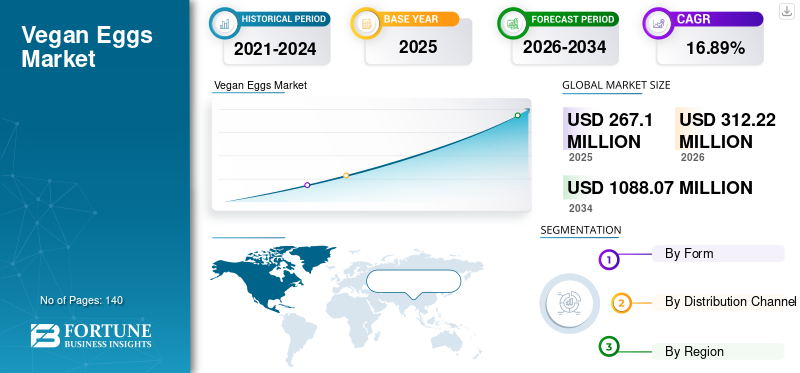
The global vegan eggs market size was valued at USD 267.1 million in 2025. The market is projected to grow from USD 312.22 million in 2026 to USD 1088.07 million by 2034, exhibiting a CAGR of 16.89% during the forecast period.

The vegan eggs market is witnessing strong expansion as food manufacturers, quick-service restaurants, bakery brands, and health-focused consumers increasingly adopt plant-based alternatives to conventional eggs. Vegan egg products are developed using ingredients such as mung bean protein, chickpea flour, soy protein, algae extracts, flaxseed, and pea protein to replicate the texture, binding, and emulsifying properties of traditional eggs. The market is expanding across retail, foodservice, bakery, and packaged food industries due to rising demand for cholesterol-free and sustainable food products. vegan eggs market trends also indicate growing innovation in liquid and powdered formulations designed for commercial baking and industrial food processing applications.
The United States vegan eggs market continues to lead global adoption due to strong consumer awareness regarding plant-based nutrition and sustainable food sourcing. Foodservice operators in major cities are increasingly integrating vegan egg products into breakfast menus, sandwiches, bakery items, and ready-to-cook meals. Retail supermarkets are expanding shelf space for refrigerated liquid vegan eggs and powdered alternatives as consumers seek clean-label and allergen-friendly options. The increasing popularity of flexitarian diets and growing concerns regarding poultry supply disruptions are further strengthening demand.
Download Free sample to learn more about this report.
Vegan Eggs Market Key Takeaways
 Global Market Size & Forecast
- 2025 Market Size: USD 267.10 Million
- 2026 Market Size: USD 312.22 Million
- 2034 Forecast Market Size: USD 1,088.07 Million
- CAGR: 16.89% from 2026-2034
 Market Share
- The market in North America dominated with a revenue share of 39% in 2025.
- Liquid vegan eggs accounted for approximately 56% of the market share.
- Offline retail channels accounted for approximately 58% of the market share.
 Key Regional Highlights
North America led the market with a 39% share, supported by rising demand for plant-based foods and vegan breakfast alternatives.
Europe accounted for 28% of the market, driven by growing vegan and flexitarian consumer preferences.
Asia-Pacific held a 24% share, supported by increasing awareness of plant-based nutrition and expanding foodservice offerings.
U.S.
The U.S. market is supported by strong adoption of plant-based foods and expanding availability of vegan egg products across retail and foodservice channels.
Japan
Japan accounted for 19% of the Asia-Pacific market, supported by growing interest in innovative plant-based foods and convenient meal alternatives.
Read More

vegan eggs market Latest Trends
One of the most significant vegan eggs market trends is the growing preference for liquid vegan eggs formulated from mung bean and pea protein. These products are increasingly used in breakfast applications because they closely replicate the texture and cooking performance of conventional eggs. Foodservice chains and cafes are introducing plant-based breakfast menus to attract vegan and flexitarian consumers, creating stronger commercial demand for ready-to-cook vegan egg solutions. The vegan eggs industry report also indicates that manufacturers are investing in improved foaming and emulsification technologies to enhance product functionality in bakery and confectionery applications.
Download Free sample to learn more about this report.
Another major trend in the vegan eggs market is the expansion of clean-label and allergen-free product positioning. Consumers are actively searching for soy-free, gluten-free, and non-GMO vegan egg alternatives with simplified ingredient lists. Powdered vegan egg products are gaining popularity among bakery manufacturers because of their longer shelf life and ease of transportation. In addition, online retail platforms are accelerating product visibility for emerging brands targeting health-conscious consumers and vegan households.
vegan eggs market Dynamics
DRIVER
Rising Demand for Plant-Based and Sustainable Food Products
The primary growth driver in the vegan eggs market is the increasing consumer preference for plant-based nutrition and sustainable food systems. Consumers across developed and emerging economies are reducing dependence on animal-derived food products due to environmental concerns, ethical considerations, and dietary preferences. Vegan egg products provide an attractive solution for consumers seeking cholesterol-free alternatives while maintaining cooking functionality in baking, scrambling, and food preparation applications. vegan eggs market research report findings indicate that millennials and urban consumers are among the strongest adopters of plant-based breakfast products and vegan protein alternatives.
Commercial food manufacturers are also contributing significantly to market growth. Bakery chains, quick-service restaurants, and packaged food producers are integrating vegan egg ingredients into muffins, sauces, desserts, mayonnaise alternatives, and frozen meals. Foodservice operators value vegan eggs because they reduce exposure to poultry supply volatility and provide consistent shelf stability in processed food manufacturing. Increasing awareness regarding animal welfare and greenhouse gas emissions linked to traditional poultry farming is further accelerating the adoption of vegan egg substitutes. The expansion of retail distribution channels and innovation in texture-enhancing proteins continue to strengthen the vegan eggs market outlook.
RESTRAINT
High Product Pricing Compared to Conventional Eggs
One of the major restraints affecting the vegan eggs market is the comparatively high cost of plant-based egg alternatives. Vegan egg products often require specialized protein extraction technologies, advanced formulation processes, and premium ingredients such as mung bean protein isolate, algae extracts, and pea protein concentrates. These production costs make vegan eggs more expensive than traditional eggs in many retail markets. Price-sensitive consumers in developing economies may hesitate to adopt vegan egg products on a regular basis, particularly where conventional eggs remain widely affordable and accessible.
Another challenge involves limited product awareness in rural and semi-urban regions. Many consumers are still unfamiliar with the functional applications of vegan eggs in cooking and baking. Inconsistent texture and taste performance among certain brands can also reduce repeat purchases. Food manufacturers must continue investing in product development to achieve sensory parity with conventional eggs. Additionally, cold-chain logistics requirements for refrigerated liquid vegan eggs increase operational costs for retailers and distributors. These limitations may slow market penetration in regions lacking advanced food retail infrastructure, thereby restricting broader vegan eggs market growth.
OPPORTUNITY
Expansion of Foodservice and Bakery Applications
The expansion of foodservice and industrial bakery applications presents a major opportunity for the vegan eggs market. Restaurants, cafes, bakeries, and quick-service chains are increasingly introducing vegan menu offerings to attract younger consumers and health-conscious diners. Vegan egg ingredients are widely used in pancakes, muffins, cookies, waffles, and breakfast sandwiches because they provide binding and emulsifying functionality without using animal-based ingredients. vegan eggs market opportunities are particularly strong in metropolitan regions where plant-based eating trends are rapidly growing.
Another major opportunity lies in technological innovation. Companies are developing advanced formulations using fermentation technologies, chickpea protein, algae-based proteins, and precision-textured plant ingredients to improve flavor, aroma, and cooking performance. Manufacturers are also focusing on protein fortification and nutrient enrichment to position vegan eggs as high-protein breakfast alternatives. Online retail growth is creating additional opportunities for direct-to-consumer distribution, enabling emerging brands to expand internationally without relying entirely on traditional retail channels. The increasing popularity of ready-to-cook and convenience-focused vegan products is expected to create strong long-term demand across the Vegan Eggs Industry analysis landscape.
CHALLENGE
Achieving Taste and Texture Parity with Traditional Eggs
One of the biggest challenges in the vegan eggs market is replicating the exact taste, texture, aroma, and cooking behavior of traditional eggs. Consumers expect vegan eggs to deliver similar scrambling consistency, foaming ability, binding performance, and mouthfeel. Achieving these qualities requires advanced food science capabilities and highly specialized ingredient combinations. While significant progress has been made with mung bean and pea protein formulations, some consumers still perceive plant-based eggs as inferior in flavor and texture compared to poultry eggs.
Another challenge involves competitive pressure within the broader plant-based food industry. Vegan egg brands compete not only against conventional eggs but also against tofu-based alternatives, homemade substitutes, and low-cost bakery replacers such as flaxseed mixtures. Supply chain fluctuations in plant proteins and rising raw material costs can also affect profitability. Regulatory labeling standards for plant-based foods continue to evolve in multiple countries, creating compliance challenges for manufacturers entering international markets.
vegan eggs market Segmentation
By Form
Powdered vegan eggs account for approximately 35% of the vegan eggs market share due to their long shelf life, transportation convenience, and wide usage in industrial bakery applications. Powdered formulations are commonly produced using chickpea flour, soy protein, tapioca starch, potato starch, and flaxseed ingredients. Food manufacturers prefer powdered vegan eggs because they can be stored easily and rehydrated according to production requirements. Bakery companies utilize these products in muffins, cakes, cookies, pancakes, and confectionery applications where stable texture and emulsification are essential. The vegan eggs market analysis for powdered products highlights increasing demand from commercial food processing facilities and institutional kitchens. Powdered products are especially attractive in regions with limited refrigerated logistics infrastructure because they reduce spoilage risks and improve inventory management. Manufacturers are also developing fortified powdered vegan eggs enriched with vitamins and proteins to enhance nutritional value.
Liquid vegan eggs hold nearly 56% of the vegan eggs market share and remain the dominant segment due to their strong resemblance to traditional eggs in cooking applications. These products are primarily made using mung bean protein, pea protein, and algae-derived ingredients designed to deliver scrambling, binding, and emulsifying performance. Consumers prefer liquid vegan eggs because they offer convenience and can be directly used in breakfast dishes, omelets, sandwiches, and baking recipes. The segment has gained strong popularity across supermarkets, restaurants, and ready-to-cook meal producers. Vegan Eggs Industry analysis indicates that liquid formulations are highly favored by quick-service restaurants and cafes introducing plant-based breakfast menus. Refrigerated liquid vegan eggs are also benefiting from premium branding and clean-label positioning in developed markets.
Egg-Shaped vegan products represent around 9% of the vegan eggs market share and are emerging as a niche but rapidly developing category. These products are designed to visually replicate boiled eggs and are commonly targeted toward premium vegan consumers seeking realistic plant-based alternatives. Egg-Shaped vegan products use advanced formulations involving algae protein, soy protein, and plant-derived gels to recreate egg whites and yolk textures. Manufacturers are investing heavily in appearance and texture innovation to improve consumer appeal. The vegan eggs market outlook for this segment is positive due to increasing demand for novelty vegan products in urban retail markets and specialty restaurants. Premium vegan food brands are using Egg-Shaped alternatives in salads, ready meals, and gourmet applications. Although the category currently represents a smaller market portion, strong innovation activity and social media visibility are helping improve awareness among younger consumers.
By Distribution Channel
Online distribution channels account for nearly 42% of the vegan eggs market share due to the rapid growth of e-commerce grocery platforms and direct-to-consumer food brands. Consumers increasingly prefer online purchasing because it provides access to a broader range of vegan egg brands, specialty products, and subscription-based delivery services. Online platforms allow manufacturers to educate consumers through product demonstrations, recipes, and nutritional comparisons, improving awareness regarding vegan egg functionality The vegan eggs market research report highlights that online channels are especially important for emerging startups seeking market penetration without relying on large retail chains. Digital marketing campaigns targeting vegan, flexitarian, and health-conscious consumers are strengthening brand visibility. Online channels also enable easier access to premium refrigerated and powdered vegan egg products in regions where physical retail distribution remains limited. The growth of mobile grocery applications and increasing adoption of home-delivery services continue to create strong opportunities for vegan egg companies focused on digital retail expansion.
Offline retail channels hold approximately 58% of the vegan eggs market share and continue to dominate overall distribution due to strong supermarket and foodservice presence. Hypermarkets, specialty health stores, convenience stores, and grocery chains are expanding plant-based food sections to accommodate growing consumer demand. Refrigerated liquid vegan eggs are particularly dependent on offline channels because consumers often prefer purchasing chilled products directly from physical retail outlets. vegan eggs market trends indicate that foodservice establishments are becoming major offline distribution contributors. Restaurants, cafes, hotels, and institutional kitchens are increasingly incorporating vegan eggs into breakfast menus and bakery operations. Retail chains are also introducing in-store promotional campaigns and product sampling initiatives to improve consumer familiarity with vegan egg products. Shelf visibility, premium packaging, and strategic placement in health-food sections are strengthening offline sales performance. As plant-based eating habits continue to enter mainstream consumer culture, offline distribution is expected to remain a crucial growth driver for the industry.
vegan eggs market Regional Outlook
North America
North America accounts for approximately 39% of the vegan eggs market share due to strong plant-based food adoption, advanced retail infrastructure, and high consumer awareness regarding sustainable nutrition. The United States and Canada are leading markets where vegan eggs are widely available across supermarkets, foodservice chains, and online platforms. Increasing demand for cholesterol-free breakfast products and rising concerns regarding poultry supply disruptions are supporting market expansion. Food manufacturers in the region are heavily investing in mung bean and pea protein technologies to improve texture and functionality.
The vegan eggs industry report for North America also highlights the growing role of quick-service restaurants and bakery chains in promoting plant-based menu options. Vegan breakfast sandwiches, scrambles, and bakery products are becoming increasingly common in urban foodservice markets. Consumers in the region are highly responsive to clean-label and allergen-free product claims, encouraging manufacturers to launch soy-free and gluten-free vegan egg alternatives. Strong startup activity and venture capital investment continue to support innovation across the North American vegan eggs market.
Europe
Europe represents nearly 28% of the vegan eggs market share due to strong environmental awareness and increasing demand for sustainable food products. Countries across the region are promoting plant-based diets as part of climate-conscious food strategies. Vegan egg products are widely utilized in bakery manufacturing, confectionery production, and retail breakfast applications. Consumers are increasingly choosing vegan alternatives because of animal welfare concerns and growing interest in healthier food choices.
The vegan eggs market forecast for Europe indicates continued expansion of plant-based foodservice concepts and specialty vegan retail chains. Germany, the United Kingdom, France, and the Netherlands are among the most active markets for vegan product innovation. European consumers are highly attentive to ingredient transparency and nutritional labeling, encouraging companies to develop clean-label vegan egg products with fortified nutrients and minimal additives. Investments in fermentation-based protein technologies are also accelerating across the European food innovation ecosystem.
Germany vegan eggs market
Germany contributes around 26% of the European vegan eggs market share and remains one of the strongest plant-based food markets in the region. German consumers are highly focused on sustainability, organic food consumption, and environmentally responsible dietary habits. Vegan eggs are increasingly used in bakery products, ready meals, and breakfast applications across supermarkets and foodservice establishments. Demand for allergen-free and non-GMO vegan ingredients is also influencing product development strategies.
The vegan eggs market analysis for Germany highlights strong growth in private-label vegan products and premium organic alternatives. Retailers are expanding refrigerated sections dedicated to plant-based products, while local food startups continue introducing innovative formulations based on chickpea and mung bean proteins. Germany’s advanced food manufacturing industry is supporting the integration of vegan eggs into industrial bakery and packaged food production. The growing popularity of flexitarian diets among younger consumers is further strengthening market penetration.
United Kingdom vegan eggs market
The United Kingdom accounts for approximately 22% of the European vegan eggs market share due to increasing consumer adoption of vegan and flexitarian lifestyles. Plant-based breakfast products have become highly popular across urban retail and foodservice sectors. Vegan eggs are increasingly featured in sandwiches, breakfast wraps, bakery items, and prepared meal solutions. Supermarkets in the country are significantly expanding plant-based product offerings to meet changing consumer preferences.
vegan eggs market insights for the United Kingdom show strong demand for convenience-oriented products such as ready-to-cook liquid vegan eggs and frozen breakfast items. The foodservice industry is also playing a major role in expanding market visibility through vegan menus and promotional campaigns. Consumers are actively seeking products with reduced cholesterol and lower environmental impact, creating favorable conditions for vegan egg manufacturers. Product innovation involving pea protein and algae-based ingredients is further enhancing the competitive landscape.
Asia-Pacific
Asia-Pacific holds nearly 24% of the vegan eggs market share and is emerging as one of the fastest-growing regional markets. Rising urbanization, increasing disposable income, and growing awareness regarding plant-based nutrition are driving demand across countries such as China, Japan, India, South Korea, and Australia. Consumers are increasingly experimenting with vegan protein products due to health concerns and changing dietary preferences. Food manufacturers are introducing localized vegan egg formulations designed for regional cuisines and cooking styles.
The vegan eggs market outlook for Asia-Pacific highlights increasing investments in plant-protein processing facilities and food innovation startups. Retailers are expanding plant-based product sections, while online grocery platforms are accelerating access to vegan alternatives. The region’s growing vegan and vegetarian population, particularly in urban centers, is contributing to stronger adoption of vegan breakfast and bakery products. Local manufacturers are also utilizing mung bean and soy-based ingredients due to their availability and cost efficiency.
Japan vegan eggs market
Japan represents approximately 19% of the Asia-Pacific vegan eggs market share and is experiencing increasing demand for premium plant-based food products. Japanese consumers are highly focused on food quality, texture consistency, and nutritional balance, making innovation essential for vegan egg manufacturers. Vegan eggs are increasingly incorporated into convenience meals, sandwiches, and bakery products sold through supermarkets and convenience stores.
The Vegan Eggs Industry analysis for Japan indicates strong interest in clean-label and minimally processed formulations. Food companies are developing vegan egg alternatives tailored to local culinary preferences, including rice-based dishes and packaged ready meals. Advanced food technology capabilities in Japan are supporting innovation in texture enhancement and protein functionality. Growing awareness regarding sustainable food consumption and healthy aging is also influencing market demand among health-conscious consumers.
China vegan eggs market
China contributes nearly 6% of the Asia-Pacific vegan eggs market share and remains a key growth engine for plant-based food products. Rapid urbanization, rising middle-class spending, and increasing health awareness are supporting strong demand for vegan alternatives. Large retail chains and online grocery platforms are introducing more plant-based products to attract younger consumers interested in modern dietary trends.
vegan eggs market research report findings for China indicate significant growth potential within bakery, ready-to-eat meals, and foodservice applications. Domestic manufacturers are investing in pea protein, soy protein, and mung bean processing capabilities to reduce dependence on imported ingredients. The expansion of modern retail infrastructure and food delivery services is improving product accessibility across major cities. Chinese consumers are also showing rising interest in environmentally sustainable food choices, strengthening long-term opportunities for vegan egg brands.
Rest of World
The Rest of World region accounts for approximately 9% of the vegan eggs market share and includes markets across Latin America, the Middle East, and Africa. Growing awareness regarding plant-based diets and sustainable food production is gradually increasing demand for vegan egg products. Urban consumers in countries such as Brazil, the United Arab Emirates, and South Africa are adopting vegan alternatives through premium supermarkets and specialty health-food retailers.
The vegan eggs market growth across these regions is supported by expanding online retail channels and rising international brand penetration. Foodservice establishments and cafes are increasingly introducing vegan breakfast items and bakery products to cater to changing consumer preferences. While adoption remains at an earlier stage compared to North America and Europe, increasing health consciousness and social media influence are contributing to gradual market expansion. Manufacturers are also exploring localized ingredient sourcing to reduce production costs and improve regional accessibility.
List of Top Vegan Eggs Companies
- Eat Just Inc.
- Glanbia plc
- Bob’s Red Mill Natural Foods, Inc.
- EVO Foods
- Orgran Foods
- ProVeg International
- Lovely Day Foods GmbH
- Noblegen Inc
- Grupo Mantiqueira
- Le Papondu
- Atlantic Natural Foods
Top Two Companies with Highest Market Share
- Eat Just Inc. – 24% market share
- Glanbia plc – 11% market share
Investment Analysis and Opportunities
Investment activity within the vegan eggs market is increasing rapidly as venture capital firms, food conglomerates, and alternative protein investors recognize long-term demand for plant-based nutrition products. Companies are investing heavily in protein extraction technologies, fermentation-based ingredients, and advanced food formulation systems designed to improve the texture and taste of vegan eggs. Strategic partnerships between food startups and retail chains are also supporting commercialization and product distribution expansion.
vegan eggs market opportunities are especially strong in foodservice, bakery manufacturing, and convenience meal applications. Investors are targeting companies capable of producing scalable and cost-efficient vegan egg ingredients with improved nutritional profiles. Asia-Pacific and Europe are emerging as attractive investment destinations because of rising vegan populations and government support for sustainable food innovation. Investments in cold-chain logistics, online grocery infrastructure, and premium packaging technologies are further supporting market expansion. Growing consumer demand for allergen-free and cholesterol-free products continues to create strong opportunities for manufacturers entering the Vegan Eggs Industry.
New Product Development
New product development in the vegan eggs market is centered on improving sensory quality, protein content, and cooking functionality. Manufacturers are launching advanced liquid formulations that better replicate the scrambling and binding characteristics of traditional eggs. Innovations involving mung bean protein, chickpea protein, algae-derived ingredients, and fermentation-based proteins are helping companies improve flavor consistency and texture performance.
The vegan eggs market trends also show increasing development of ready-to-cook frozen breakfast products and fortified vegan egg solutions enriched with vitamins and minerals. Companies are introducing clean-label formulations with reduced additives to meet growing consumer demand for minimally processed foods. Egg-Shaped vegan products with realistic yolk textures are also gaining traction in premium retail markets. Packaging innovation, including recyclable containers and extended shelf-life technology, is becoming increasingly important for product differentiation. Manufacturers are additionally focusing on customized formulations for bakery and foodservice industries to strengthen commercial partnerships.
Five Recent Developments (2023-2025)
- Eat Just Inc. expanded distribution of its liquid vegan egg products across multiple supermarket chains and foodservice outlets.
- EVO Foods introduced upgraded plant-based liquid egg formulations designed for commercial bakery applications.
- Several European manufacturers launched algae-based vegan egg products with improved protein functionality and texture.
- Foodservice chains in North America introduced plant-based breakfast sandwiches featuring vegan egg alternatives.
- Asian food technology startups increased investments in mung bean and pea protein processing facilities for vegan egg production.
Report Coverage of vegan eggs market
The vegan eggs market Report provides a comprehensive assessment of industry structure, product innovation, application trends, regional performance, and competitive dynamics. The report evaluates market segmentation based on product type, distribution channel, and regional demand patterns. It also examines the role of plant-based proteins, ingredient sourcing strategies, and food technology advancements influencing industry development.
Request for Customization to gain extensive market insights.
The vegan eggs market research report further analyzes consumer purchasing behavior, foodservice adoption trends, and retail distribution expansion across major regions. Competitive profiling of leading manufacturers highlights innovation strategies, partnership activities, and product development initiatives shaping the market landscape. The report additionally covers investment activity, technological advancements, and emerging opportunities within the alternative protein sector. Regional analysis includes North America, Europe, Asia-Pacific, and Rest of World markets, with specific focus on key countries driving plant-based food adoption and vegan product commercialization.
Frequently Asked Questions
Fortune Business Insights says that the global market value stood at USD 267.1 million in 2025 and is projected to reach USD 1,088.07 million by 2034.
The market is expected to exhibit a CAGR of 16.89% during the forecast period of 2026-2034.
Liquid vegan eggs were the leading form segment, accounting for nearly 56% of the market share, driven by their convenience and strong resemblance to conventional eggs in cooking applications.
Key players include Eat Just Inc., Glanbia plc, Bob’s Red Mill Natural Foods, Inc., EVO Foods, Orgran Foods, and ProVeg International.
Major trends include growing preference for liquid vegan eggs made from mung bean and pea protein and increasing demand for clean-label, allergen-free alternatives. North America led the market with a 39% share.



- 2021-2034
- 2025
- 2021-2024
- 140
-

(Offer valid till 15th Oct 2026)
Get 30-60 hrs Free Customization
Expand Regional and Country Coverage, Segments Analysis, Company Profiles, Competitive Benchmarking, and End-user Insights.




















-
US +1 833 909 2966 ( Toll Free )
-
Get In Touch With Us