Veterinary Telehealth Market Size, Share & Industry Analysis, By Type (Teleradiology, Teleconsulting, Telemonitoring), By Animal type (Canine, Feline, Equine, Bovine, Swine, Others), Delivery Mode, By End Use, By Region, and Regional Forecast, 2026-2034
 Download Free Sample
Veterinary Telehealth Market Overview
The veterinary telehealth market size was valued at USD 370.20 million in 2025. The market is projected to grow from USD 449.87 million in 2026 to USD 2139.31 million by 2034, exhibiting a CAGR of 21.52% during the forecast period.

The veterinary telehealth market covers digital veterinary services that enable remote communication between veterinarians, veterinary professionals, pet owners, livestock operators, and animal-care organizations. Major services include teleradiology, teleconsulting, telemonitoring, virtual triage, remote follow-up, behavioral guidance, chronic-condition management, and digital care coordination. Adoption is increasing as veterinary practices seek to improve access, manage workloads, and provide convenient follow-up care. The market is supported by smartphones, video consultation platforms, connected monitoring devices, cloud-based medical records, artificial intelligence, and digital payment systems. Telehealth is particularly useful for routine questions, chronic-care monitoring, postoperative follow-up, behavioral support, and situations where immediate physical examination is not required.
The USA veterinary telehealth market is the leading regional market because of high pet ownership, strong digital infrastructure, established veterinary networks, and growing consumer demand for convenient animal healthcare. Teleconsulting and virtual triage are increasingly used for non-emergency questions, chronic disease monitoring, behavioral concerns, postoperative follow-up, and determining whether an in-person visit is necessary. Regulatory requirements remain important because veterinary telehealth rules vary by state. Federal requirements also distinguish telemedicine from situations requiring an established veterinarian-client-patient relationship. (fda.gov)
Large pet-care platforms are also expanding virtual services. Chewy currently provides veterinary technician chat broadly while offering veterinarian video visits in selected states, illustrating the continued integration of telehealth with digital pet-care and pharmacy services. (chewy.com)
Download Free sample to learn more about this report.
Veterinary Telehealth Market Key Takeaways
 Global Market Size & Forecast
- 2025 Market Size: USD 370.20 Million
- 2026 Market Size: USD 449.87 Million
- 2034 Forecast Market Size: USD 2,139.31 Million
- CAGR: 21.52% from 2026-2034
 Market Share
- The market in North America dominated with a revenue share of 42% in 2025.
- Video consultations accounted for approximately 48% of the market share.
- Canine services accounted for approximately 43% of the market share.
 Key Regional Highlights
North America led the market with a 42% share, supported by high pet ownership, digital connectivity, and advanced veterinary infrastructure.
Europe accounted for 27% of the market, driven by expanding digital veterinary services and regulatory development.
Asia-Pacific held a 20% share, supported by increasing adoption of telehealth technologies and growing animal healthcare needs.
U.S.
The U.S. market is supported by strong adoption of virtual veterinary consultations and connected pet-care technologies.
Japan
Japan accounted for 28% of the Asia-Pacific market, supported by growing digital veterinary services and demand for convenient animal healthcare.
Read More

Veterinary Telehealth Market Latest Trends
One of the most important veterinary telehealth market Trends is the movement from standalone video consultations toward integrated digital veterinary ecosystems. Providers increasingly combine virtual consultations with scheduling, medical records, prescription management, payment processing, remote monitoring, pet insurance, pharmacy fulfillment, and follow-up communication. This allows telehealth to become part of the broader veterinary workflow rather than an isolated service.
Telemonitoring is also gaining importance as connected collars, activity trackers, cameras, wearable sensors, and home diagnostic devices become more accessible. These technologies can help veterinarians monitor mobility, heart rate, activity, sleep patterns, medication adherence, weight, and behavioral changes between physical appointments.
Download Free sample to learn more about this report.
Artificial intelligence is another important veterinary telehealth market Trend. AI-assisted symptom assessment, image interpretation, appointment triage, clinical documentation, and automated client communication can help veterinary teams manage growing workloads. However, AI is increasingly positioned as a support tool rather than a replacement for veterinary judgment.
The market is also moving toward employer-sponsored pet benefits. Airvet expanded its virtual veterinary service into India in 2025, demonstrating how telehealth companies are pursuing international employer-benefit opportunities. (airvet.com)
Regulatory modernization is another major trend. Several jurisdictions are reviewing how veterinarian-client-patient relationships can be established and maintained through telehealth, potentially expanding the addressable market while preserving clinical safeguards.
Veterinary Telehealth Market Dynamics
DRIVER
Increasing demand for convenient and accessible veterinary care
The strongest driver of the veterinary telehealth market is the growing demand for convenient access to veterinary professionals. Pet owners increasingly expect healthcare services to provide digital communication, flexible scheduling, remote support, and rapid responses. Traditional veterinary appointments can involve travel, waiting periods, transportation difficulties, and scheduling constraints, particularly for households with multiple animals or owners with demanding work schedules.
Telehealth addresses these barriers by allowing veterinarians and veterinary professionals to communicate with clients through video, phone, messaging, and digital platforms. This is especially useful for triage, postoperative questions, nutrition guidance, behavioral concerns, medication reminders, and chronic disease follow-up.
Rural communities provide another important source of demand. Veterinary professionals may be concentrated in urban areas, creating long travel distances for animal owners. Remote consultations can help determine whether an animal needs immediate physical treatment or whether the concern can be managed through advice and monitoring.
Pet humanization is also supporting veterinary telehealth market Growth. Owners increasingly view pets as family members and are willing to invest in preventive and ongoing healthcare. As spending on animal wellness increases, demand for convenient digital services is expanding alongside conventional veterinary care.
The growing prevalence of chronic conditions in companion animals further supports telemonitoring and virtual follow-up. Conditions requiring repeated observation can be managed more efficiently when veterinarians receive regular information from owners and connected devices.
RESTRAINT
Regulatory restrictions and limitations on remote diagnosis and prescribing
A significant restraint in the veterinary telehealth market is the complex regulatory environment surrounding veterinary practice. Rules governing telemedicine, teleadvice, teletriage, prescribing, and veterinarian-client-patient relationships differ among jurisdictions.
In the United States, federal requirements and state veterinary practice laws influence how telehealth can be used. The FDA states that a valid federal veterinarian-client-patient relationship cannot be established solely through telemedicine for certain regulated purposes, while states can impose additional requirements. (fda.gov)
This creates operational complexity for companies serving multiple states. Platforms must determine where veterinarians can practice, what services can be delivered remotely, whether prescriptions are permitted, and when physical examinations are required.
Technical limitations are another restraint. A veterinarian cannot physically palpate an animal, perform a complete physical examination, collect laboratory samples, or conduct many diagnostic procedures through a conventional video call. Poor lighting, camera quality, internet connectivity, and owner uncertainty can further limit remote assessment.
Veterinary practices may also face challenges integrating telehealth into existing workflows. Staff must learn new software, manage virtual appointments, document remote interactions, and understand when clients should be redirected to in-person care.
OPPORTUNITY
Expansion of AI-enabled telemonitoring and integrated digital veterinary platforms
A major veterinary telehealth market Opportunity is the development of integrated platforms combining virtual consultations, remote monitoring, clinical records, pharmacy services, insurance, and digital pet wellness tools.
AI can enhance these platforms by supporting preliminary triage, identifying changes in activity or behavior, summarizing consultations, and helping veterinary professionals prioritize cases. Connected devices can provide continuous information that would not normally be available during occasional clinic visits.
There is also significant opportunity in chronic disease management. Diabetes, arthritis, obesity, kidney disease, cardiac conditions, and other long-term conditions often require repeated monitoring. Digital platforms can enable owners to submit observations, photographs, videos, weight measurements, medication information, and other relevant data.
Livestock represents another major opportunity. Telehealth can support herd monitoring, remote consultations, farm visits, disease surveillance, and specialist access for agricultural operators. Large farms can benefit from centralized digital systems capable of managing multiple animals and connecting field personnel with veterinary specialists.
Employer-sponsored pet benefits are another attractive B2B opportunity. Companies can provide veterinary telehealth as part of employee benefits, helping workers access veterinary advice without leaving work or traveling to a clinic. Airvet's expansion into India in 2025 illustrates the potential for employer-focused international expansion. (airvet.com)
CHALLENGE
Ensuring clinical quality, data security, and seamless integration with in-person veterinary care
The major challenge for the veterinary telehealth market is maintaining clinical quality when veterinarians cannot physically examine an animal. Some conditions require diagnostic testing, imaging, palpation, blood work, surgery, or immediate emergency intervention. Telehealth platforms therefore need strong triage processes that identify situations requiring physical care.
Veterinary telehealth companies must also ensure that clients understand the limitations of remote consultations. Platforms should clearly distinguish between general information, triage, teleadvice, telemedicine, and emergency care.
Data security is another major challenge. Veterinary platforms collect personal information about pet owners as well as medical information about animals. Secure authentication, encryption, access controls, audit trails, and appropriate data-management practices are therefore essential.
Integration with veterinary practice-management software can also be difficult. Clinics may already use established scheduling, medical-record, payment, laboratory, and imaging systems. A telehealth platform that cannot integrate smoothly can create duplicate documentation and additional administrative work.
Veterinary workforce adoption is equally important. Veterinarians must see telehealth as a clinical tool rather than an additional administrative burden. Training, workflow automation, technical support, and appropriate reimbursement structures can improve adoption.
Veterinary Telehealth Market Segmentation
By Type
Teleradiology: Teleradiology accounts for an estimated 28% share of the veterinary telehealth market. It enables veterinary images such as radiographs, ultrasound studies, CT scans, and other diagnostic images to be transmitted electronically to specialists for interpretation.
The segment is particularly valuable for veterinary practices that do not employ full-time imaging specialists. A local clinic can capture diagnostic images and transmit them to a specialist who provides an interpretation remotely. This expands access to expertise without requiring the animal or owner to travel.
Teleradiology is especially important for emergency veterinary care, oncology, orthopedics, neurology, and complex internal medicine cases. Digital image transmission also supports collaboration between general practitioners and specialists.
Veterinary hospitals can use teleradiology to improve turnaround times and expand diagnostic capabilities. The segment is expected to benefit from higher-quality imaging equipment, cloud-based image storage, AI-assisted image analysis, and improved interoperability.
AI-based veterinary imaging is another emerging opportunity. Automated systems can help flag abnormalities or prioritize images for specialist review. However, veterinary professionals remain responsible for clinical interpretation and treatment decisions.
Teleconsulting: Teleconsulting represents approximately 36% of the veterinary telehealth market and is the largest service category. It allows pet owners, farmers, veterinary technicians, and veterinarians to communicate remotely with veterinary professionals.
Teleconsulting is used for general questions, behavioral concerns, nutrition, medication guidance, chronic disease follow-up, postoperative support, and determining whether an animal requires immediate physical attention. It is particularly useful outside conventional clinic hours.
The segment has benefited from smartphone adoption and consumer familiarity with video-based healthcare. Veterinary platforms can offer chat, phone, or video services depending on the clinical situation and regulatory environment.
Chewy's current virtual-care model demonstrates the diversification of teleconsulting, with free veterinary technician chat for general questions and veterinarian video consultations in supported states. (chewy.com)
B2B opportunities include veterinary-practice software, employer pet benefits, insurance-linked services, pharmacy platforms, and integrated digital pet-care ecosystems.
Telemonitoring: Telemonitoring represents approximately 36% share and is becoming increasingly important as connected veterinary technologies improve. It enables continuous or periodic collection of information about an animal between clinical appointments.
Wearable devices, connected cameras, home diagnostic equipment, activity trackers, and smart feeding systems can provide information relating to movement, weight, eating, drinking, sleep, and behavior.
Telemonitoring is particularly valuable for chronic disease management and postoperative recovery. Veterinarians can use longitudinal data to identify changes that might otherwise remain unnoticed until a scheduled appointment.
The segment also provides significant opportunities for AI analytics. Software can identify unusual patterns and notify owners or veterinary teams when a predefined threshold is reached.
By Animal Type
Canine: Canine services account for approximately 43% of the animal-type segment. Dogs represent a major user group for veterinary telehealth because owners frequently seek support for skin problems, gastrointestinal symptoms, behavioral concerns, allergies, nutrition, chronic diseases, and preventive care.
Teleconsultations are useful for situations where the veterinarian needs information from the owner but a complete physical examination may not be immediately necessary. Video can also help veterinarians observe gait, behavior, breathing, skin changes, and other visible symptoms.
Feline: Feline services represent approximately 29% of the animal-type segment. Cats can benefit substantially from telehealth because transporting them to a clinic can be stressful for both animals and owners. Video consultations allow veterinarians to observe behavior in the home environment. Owners can demonstrate feeding behavior, litter-box changes, mobility, grooming, or other concerns.
Equine: Equine telehealth represents approximately 10% of the segment. It is particularly relevant for farms, equestrian centers, trainers, and owners who require access to specialized veterinary expertise. Remote consultation can support wound assessment, lameness discussions, nutrition management, postoperative follow-up, and coordination with specialists.
Bovine: Bovine services account for approximately 8%. Telehealth can help livestock operators communicate with veterinarians regarding herd health, disease surveillance, nutrition, reproduction, and individual animal concerns. Large-scale farms can benefit from centralized monitoring and rapid access to specialists.
Swine: Swine services represent approximately 5%. Remote veterinary support can help producers monitor herd health, investigate disease patterns, and coordinate responses with specialists.
Others: Other animals represent approximately 5%, including birds, reptiles, rabbits, exotic pets, and other species. Specialized teleconsulting can be particularly valuable when local expertise is limited.
By Delivery Mode
Video consultations represent approximately 48% of delivery modes. They allow veterinarians to visually assess animals and communicate directly with owners. Chat and messaging account for approximately These services are useful for basic questions, triage, follow-up communication, and sharing photographs and videos. Telephone and other channels represent approximately They remain useful where internet access is limited or where a quick discussion is sufficient.
By End Use
Patients and pet owners account for approximately 55% of end use. They use telehealth for convenient access to veterinary advice, triage, behavioral support, chronic-care monitoring, and follow-up. Veterinary clinics and hospitals represent approximately These organizations use telehealth to extend specialist access, manage follow-ups, and improve client communication. Livestock farms, shelters, breeders, and other animal organizations account for approximately Their use is driven by the need to manage multiple animals efficiently and access veterinary expertise remotely.
By Region
Regional demand is influenced by pet ownership, veterinary infrastructure, digital connectivity, regulations, insurance penetration, veterinary workforce availability, and investment in animal healthcare technology. North America leads the market, while Europe and Asia-Pacific are expanding through digital veterinary services and regulatory development.
Veterinary Telehealth Market Regional Outlook
North America
North America represents approximately 42% of the veterinary telehealth market. The region benefits from high pet ownership, strong veterinary infrastructure, widespread smartphone use, advanced digital services, and increasing consumer willingness to access veterinary advice remotely.
The United States accounts for the majority of regional demand. Veterinary telehealth is increasingly integrated with pet pharmacies, insurance, veterinary practice software, employer benefits, and online pet-care platforms.
The regulatory environment remains one of the most important factors shaping market development. State-level VCPR requirements influence whether veterinarians can diagnose, treat, prescribe, or establish relationships remotely. Federal requirements also influence prescribing and certain animal-drug activities. (fda.gov)
Regulatory modernization is occurring in several states. Washington adopted amendments in 2025 clarifying telehealth terminology and circumstances under which telehealth may be used within veterinary practice. (lawfilesext.leg.wa.gov)
Consumer-facing platforms are also strengthening regional adoption. Chewy reports more than one million consultations through its Connect with a Vet service, demonstrating significant consumer engagement with virtual veterinary support. (chewy.com)
Europe
Europe accounts for approximately 27% of the veterinary telehealth market. The region has a diverse regulatory environment, with individual countries developing different frameworks for virtual veterinary care.
Germany, the United Kingdom, France, Spain, Italy, Sweden, Denmark, Switzerland, and other markets have established or evolving frameworks addressing veterinary virtual care. European veterinary organizations are increasingly tracking these regulatory differences as telehealth becomes more widely adopted. (fecava.org)
The region has strong demand for teleradiology, teleconsulting, telemonitoring, and digital veterinary practice management. Companion animals represent an important source of demand, while livestock applications provide additional opportunities.
European veterinary practices are increasingly interested in technology that can reduce administrative workloads and provide convenient follow-up services. Cloud-based medical records and digital communication tools can improve continuity between veterinarians and clients.
The region also offers opportunities for specialist teleconsultation. Smaller veterinary clinics can access experts in oncology, cardiology, dermatology, neurology, imaging, and internal medicine without employing every specialist internally.
Germany veterinary telehealth market
Germany represents approximately 30% of the European veterinary telehealth market. The country has a strong veterinary healthcare infrastructure, advanced digital capabilities, and significant demand for companion-animal services.
Veterinary telehealth in Germany is increasingly relevant for follow-up care, specialist consultation, teleradiology, behavioral support, and chronic disease monitoring. The regulatory environment emphasizes professional standards and responsible digital care, creating demand for platforms that provide secure documentation and compliant workflows.
Veterinary clinics can benefit from telehealth by extending consultation capacity without expanding physical facilities. Specialists can also support general practices remotely, improving access to expertise.
Digitalization of veterinary practices creates opportunities for integrated platforms that connect appointment scheduling, electronic records, video consultation, billing, imaging, and communication.
Germany also has opportunities in livestock telemonitoring, where remote technologies can support herd health management and early identification of animal health problems.
United Kingdom Veterinary Telehealth Market
The United Kingdom accounts for approximately 24% of Europe's veterinary telehealth market. The market benefits from high levels of digital adoption, strong pet ownership, established veterinary practices, and increasing demand for convenient veterinary services.
Teleconsulting and telemonitoring are relevant to companion animals, particularly for chronic conditions, behavior, nutrition, and postoperative follow-up. Veterinary practices are also using remote communication to improve client engagement and reduce unnecessary physical visits.
The UK has an established framework for veterinary practice that influences how remote services can be provided. This makes regulatory compliance and clear clinical boundaries important for telehealth platforms.
Specialist services represent another opportunity. Remote access to radiologists, dermatologists, cardiologists, and other specialists can help smaller practices provide advanced support.
Digital platforms that integrate telehealth with appointment systems and veterinary records can improve operational efficiency while creating a more connected customer experience.
Asia-Pacific
Asia-Pacific represents approximately 20% of the veterinary telehealth market. The region includes highly developed veterinary markets such as Japan and Australia alongside rapidly developing markets such as China and India.
Increasing pet ownership, urbanization, smartphone use, and rising awareness of animal healthcare are supporting digital veterinary adoption. Telehealth can help overcome geographical limitations where veterinary specialists are concentrated in major cities.
China and India provide significant long-term opportunities because of their large populations and rapidly developing digital ecosystems. Japan and Australia offer opportunities for more sophisticated telemonitoring and specialist services.
Livestock is also strategically important across Asia-Pacific. Remote veterinary consultation and herd monitoring can support agricultural productivity and improve access to specialists in rural areas.
B2B opportunities include veterinary practice software, telemonitoring devices, employer pet benefits, insurance partnerships, specialist consultation networks, and integrated animal-health platforms.
Japan Veterinary Telehealth Market
Japan represents approximately 28% of the Asia-Pacific veterinary telehealth market. The country has advanced digital infrastructure and a mature companion-animal healthcare sector.
Telehealth opportunities include chronic disease monitoring, behavioral support, postoperative communication, nutrition, and specialist consultations. Connected devices can support monitoring of older pets, particularly those requiring regular observation.
Japanese consumers are accustomed to digital services, creating favorable conditions for mobile veterinary platforms. However, services must align with local veterinary regulations and professional standards.
Veterinary hospitals can also use teleconsulting to connect with external specialists. This model may improve access to advanced expertise without requiring every hospital to maintain a full specialist workforce.
China veterinary telehealth market
China accounts for approximately 35% of the Asia-Pacific veterinary telehealth market. The country has a rapidly expanding pet-care industry, strong mobile technology adoption, and increasing interest in professional animal healthcare.
Digital platforms can provide remote veterinary advice, appointment coordination, education, and follow-up support. Large urban populations create strong demand for convenient services, while telehealth can also extend specialist access beyond major metropolitan centers.
The market offers opportunities for mobile-first veterinary platforms, AI-assisted triage, connected pet devices, digital records, and veterinary e-commerce integration.
Livestock applications also provide substantial potential. Remote monitoring can support farm operators and connect them with veterinary professionals, particularly where specialist access is limited.
Rest of World
Rest of World accounts for approximately 11% of the veterinary telehealth market and includes Latin America, the Middle East, and Africa. These regions have diverse veterinary infrastructure and varying levels of digital healthcare adoption.
Telehealth can address geographical gaps by connecting rural animal owners and livestock producers with veterinarians located in larger cities. Mobile platforms are especially promising because smartphone access can expand faster than physical veterinary infrastructure.
Livestock telehealth represents an important opportunity because agricultural operators may manage large numbers of animals over wide geographic areas. Remote monitoring, disease alerts, specialist consultation, and digital recordkeeping can improve operational efficiency.
Companion-animal telehealth is also expanding in urban markets where consumers increasingly expect convenient veterinary services.
Challenges include internet connectivity, affordability, regulatory development, digital literacy, payment infrastructure, and limited veterinary availability. Partnerships with local veterinary organizations, telecommunications providers, insurers, agricultural businesses, and technology companies can support sustainable market expansion.
List of Top Veterinary Telehealth Companies
- AirVet
- Vetlive
- GuardianVets
- PetCoach
- WhiskerDocs LLC
- Vetster
- TeleVet
- Pets at Home Group Plc
- Activ4Pets
- VitusVet
- FirstVet
- Petriage
- BabelBark
- Chewy Inc.
- VetCT
- VetRad
Top Two Companies by Market Share
- AirVet: 8%
- Vetster: 7%
- Investment Analysis and Opportunities
Investment activity in the veterinary telehealth market is increasingly focused on platforms that combine veterinary consultations with broader pet-care ecosystems. Investors are looking beyond basic video calls toward recurring digital services, chronic-care monitoring, connected devices, pet insurance, pharmacy integration, and employer-sponsored benefits.
AirVet raised an oversubscribed Series B-2 financing round of $11 million in 2025 to support expansion, demonstrating continuing investor interest in scalable virtual veterinary services. (airvet.com)
The B2B opportunity is particularly attractive because employers can provide virtual veterinary care as an employee benefit, while insurers can use telehealth to improve customer engagement. Veterinary groups can also use technology to extend specialist access.
Investment opportunities are emerging in AI-assisted triage, connected pet monitoring, teleradiology, livestock telehealth, veterinary workflow software, and digital pharmacy integration. Companies that can combine technology with licensed veterinary professionals and compliant clinical workflows are positioned to address multiple revenue-independent commercial opportunities.
New Product Development
New product development is focused on making veterinary telehealth more connected, personalized, and clinically useful. Platforms are increasingly combining video consultation with chat, digital records, prescription management, appointment scheduling, follow-up messaging, and educational resources.
Connected pet devices represent another important development area. Wearables and home-monitoring technologies can generate information about activity, mobility, sleep, weight, and behavior. Future platforms can use this data to identify trends and notify veterinary teams.
AI-enabled products are also being developed for symptom triage, image analysis, documentation, and client communication. The objective is to reduce repetitive administrative work while allowing veterinarians to focus on clinical decision-making.
Chewy's current service illustrates the movement toward integrated virtual veterinary care, combining video consultations with personalized action plans and prescription fulfillment where regulations permit. (chewy.com)
AirVet has also continued adding digital capabilities and international access, including French and Spanish telehealth and expansion into India, reflecting the industry's emphasis on multilingual and geographically scalable products. (airvet.com)
Five Recent Developments (2023-2025)
- 2023 – AirVet expands VCPR-compliant telemedicine: AirVet reported completing a VCPR-compliant telemedicine visit in California, highlighting the growing importance of state-specific regulatory compliance in virtual veterinary care. (airvet.com)
- 2024 – AirVet adds multilingual telehealth: AirVet introduced French and Spanish telehealth capabilities, strengthening its ability to serve multilingual pet-owner populations. (airvet.com)
- 2024 – Expansion of digital pet-care integration: Chewy continued integrating Connect with a Vet into its broader pet-health ecosystem, connecting virtual veterinary support with its pharmacy and pet-care services. (investor.chewy.com)
- 2025 – AirVet raises Series B-2 funding: AirVet announced an oversubscribed $11 million Series B-2 financing round to support further expansion of its virtual veterinary platform. (airvet.com)
- 2025 – International expansion into India: AirVet expanded its virtual veterinary services to India, extending its employer-supported telehealth model outside North America. (airvet.com)
Report Coverage of Veterinary Telehealth Market
The veterinary telehealth market Report covers teleradiology, teleconsulting, telemonitoring, animal types, delivery modes, end-use categories, regional markets, competitive companies, investments, product development, regulatory developments, and emerging technology trends.
The veterinary telehealth market Analysis evaluates adoption across canine, feline, equine, bovine, swine, and other animal categories. It also examines how telehealth is being applied to preventive care, chronic disease management, behavioral support, specialist consultation, remote monitoring, postoperative follow-up, triage, and livestock health management.
Request for Customization to gain extensive market insights.
The veterinary telehealth market Research Report provides B2B-oriented insights for veterinary clinics, hospitals, technology providers, pet-care companies, insurers, employers, pharmaceutical businesses, animal-health organizations, livestock operators, and investors. The Veterinary Telehealth Industry Report evaluates opportunities associated with connected devices, AI, digital records, teleradiology, telemonitoring, mobile applications, and integrated pet-care platforms.
The veterinary telehealth market Forecast and veterinary telehealth market Outlook are influenced by regulatory modernization, pet ownership, veterinary workforce availability, digital infrastructure, consumer expectations, chronic animal diseases, and investment in animal healthcare technology.
The veterinary telehealth market Insights also assess regional expansion opportunities and competitive positioning. The Veterinary Telehealth Industry Analysis highlights the importance of compliant virtual-care models, specialist access, integrated veterinary workflows, multilingual services, secure data management, and technology-enabled continuity between virtual and physical veterinary care.
Frequently Asked Questions
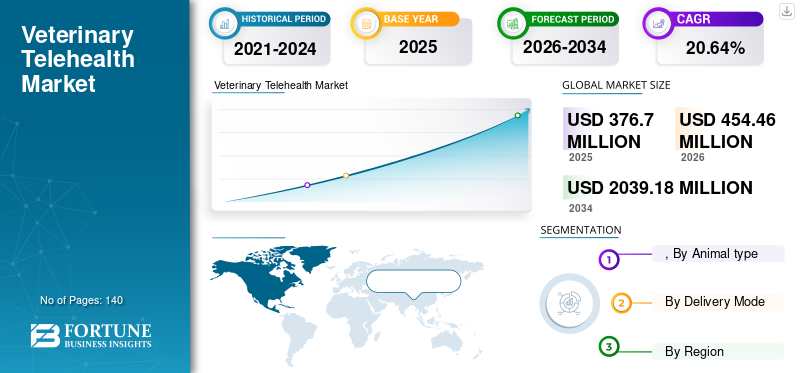
Fortune Business Insights says that the global market value stood at USD 376.70 million in 2025 and is projected to reach USD 2,039.17 million by 2034.
The market is expected to exhibit a CAGR of 20.64% during the forecast period of 2026-2034.
Video consultation was the leading delivery mode segment, accounting for approximately 63% of the market share, driven by real-time interaction and convenient remote veterinary care.
Key players include AirVet, Vetlive, GuardianVets, PetCoach, whiskerDocs LLC., and Vetster.
Major trends include increasing adoption of AI-powered veterinary platforms and video consultation technologies, along with growing use of wearable monitoring devices. North America led the market with a 39% share.



- 2021-2034
- 2025
- 2021-2024
- 140
-

(Offer valid till 30th Sep 2026)
Get 30-60 hrs Free Customization
Expand Regional and Country Coverage, Segments Analysis, Company Profiles, Competitive Benchmarking, and End-user Insights.













.webp)






-
US +1 833 909 2966 ( Toll Free )
-
Get In Touch With Us