Vibration Monitoring Equipment Market Size, Share & Industry Analysis, By Equipment Type (Vibration Sensors, Vibration Monitoring Systems, Vibration Analyzers & Meters, and Others), By Monitoring Mode (Online Monitoring, Portable Monitoring, and Wireless Monitoring), By End User (Oil & Gas, Power Generation, Manufacturing, Metals & Mining, Chemical & Petrochemical, and Others), and Regional Forecast, 2026–2034
 Download Free Sample
Vibration Monitoring Equipment Market Size and Future Outlook
 Listen to Audio Version
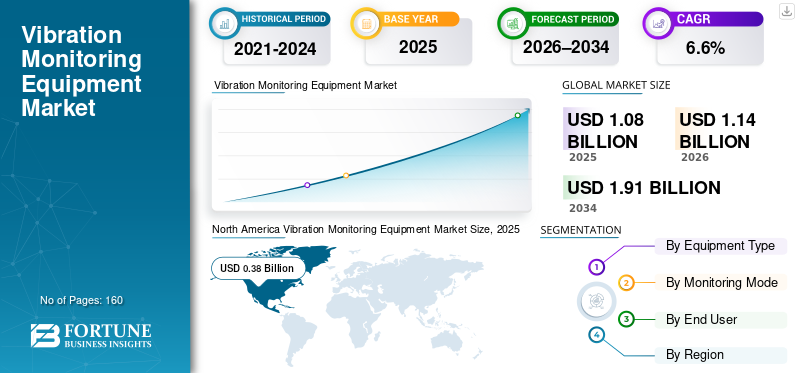
The global vibration monitoring equipment market size was valued at USD 1.08 billion in 2025. The market is projected to grow from USD 1.14 billion in 2026 to USD 1.91 billion by 2034, exhibiting a CAGR of 6.6% during the forecast period. North America dominated the vibration monitoring equipment market with a market share of 35.18% in 2025.
The vibration monitoring industry is experiencing steady growth, driven by the rising demand for equipment that enables condition monitoring and predictive maintenance across industrial operations. Vibration monitoring equipment includes hardware such as vibration sensors, vibration monitoring systems, and analyzers that use wireless technologies, wireless sensors, and MEMS accelerometer-based devices to capture vibration signals and deliver real time data on machine health. These solutions support early fault detection and improved asset reliability across asset-intensive industries.
Market growth is further supported by increasing adoption of remote monitoring, data analytics, and cloud based infrastructure, which enable long term monitoring and analysis of machinery performance. The market by monitoring mode includes online monitoring, portable monitoring, and wireless monitoring, while the market by equipment type includes vibration sensors, vibration monitoring systems, vibration analyzers and meters, and others. The market by end user spans manufacturing, oil & gas, power generation, and other industries, where vibration monitoring solutions account for a critical role in improving operational efficiency. Key players in the market include Emerson Electric Co., SKF, Honeywell International Inc., Siemens AG, and Baker Hughes. These players continue to expand their vibration monitoring equipment portfolios through innovation in sensing technologies and integrated monitoring solutions.
Download Free sample to learn more about this report.
Vibration Monitoring Equipment Market Key Takeaways
 Global Market Size & Forecast
- 2025 Market Size: USD 1.08 billion
- 2026 Market Size: USD 1.14 billion
- 2034 Forecast Market Size: USD 1.91 billion
- CAGR: 6.6% (2026–2034)
 Market Share
- North America dominated the market with a 35.18% share in 2025.
- The vibration sensors segment accounted for the largest market share in 2025.
- The vibration monitoring systems segment is projected to register a CAGR of 7.1% during the forecast period.
 Key Regional Highlights
Asia Pacific
Asia Pacific is projected to reach USD 0.36 billion by 2026, emerging as the fastest-growing regional market.
North America
North America generated USD 0.38 billion in 2025, maintaining its leading market position.
Europe
Europe is projected to reach USD 0.31 billion by 2026.
U.S.
U.S. market is projected to reach USD 0.33 billion by 2026.
Japan
Japan market is projected to reach USD 0.06 billion by 2026.
Read More

VIBRATION MONITORING EQUIPMENT MARKET TRENDS
Rising Shift toward Wireless and Continuous Vibration Monitoring is a Key Market Trend
The increasing shift from periodic, portable vibration measurement toward wireless and continuous vibration monitoring equipment has emerged as a key trend in the global market. Industrial operators are increasingly deploying permanently installed sensors and online monitoring systems to enable real-time condition assessment of rotating machinery. Wireless vibration sensors, in particular, are gaining traction as they reduce installation complexity, eliminate extensive cabling requirements, and enable scalable monitoring across a broader range of assets, including semi-critical and non-critical equipment.
- For instance, Emerson has highlighted the increasing adoption of wireless vibration sensors to support continuous asset health monitoring in industrial facilities.
Download Free sample to learn more about this report.
MARKET DYNAMICS
MARKET DRIVERS
Increasing Focus on Predictive Maintenance and Asset Reliability Driving Market Growth
The growing emphasis on predictive maintenance (PdM) and asset reliability is a primary driver of the market. Industries such as oil & gas, power generation, manufacturing, and mining are increasingly investing in vibration monitoring equipment to detect early signs of mechanical failure in rotating machinery. Unplanned equipment downtime results in significant production losses, safety risks, and maintenance costs, driving the need for continuous vibration monitoring solutions. These equipment play a critical role in predictive maintenance strategies by enabling early fault detection in motors, pumps, compressors, turbines, and gearboxes.
- For example, SKF has emphasized the importance of these equipment in reducing unplanned downtime and improving machinery reliability across industrial applications.
MARKET RESTRAINTS
High Initial Equipment Costs and Installation Complexity May Limit Adoption
High initial investment requirements restrain vibration monitoring equipment market growth, particularly among small and medium-sized industrial operators. The cost of deploying vibration sensors, online monitoring systems, and related hardware can be substantial, especially in applications requiring permanent installation across multiple assets. In addition, installation complexity in legacy industrial environments, where machinery may lack standardized mounting interfaces or compatible infrastructure, can further increase deployment costs. As a result, the adoption rate may vary across regions depending on capital expenditure cycles, industrial modernization levels, and budget constraints.
MARKET OPPORTUNITIES
Expansion of Condition Monitoring to Semi-Critical Assets Creates New Growth Opportunities
The expansion of vibration monitoring beyond critical assets to semi-critical and auxiliary machinery is expected to create significant growth opportunities in the market. Traditionally, vibration monitoring machines were primarily deployed on high-value or mission-critical machinery. However, advancements in wireless vibration sensors and cost-efficient monitoring hardware are enabling industrial operators to extend monitoring coverage to a larger number of assets. This broader adoption is particularly relevant in large manufacturing plants, mining operations, and process industries, where even minor equipment failures can disrupt production flow. Equipment manufacturers have the opportunity to address this expanding demand by offering scalable, modular vibration monitoring solutions designed for widespread deployment across industrial facilities.
Segmentation Analysis
By Equipment Type
Broad Industrial Deployment Drives Dominance of Vibration Sensors
Based on equipment type, the market is divided into vibration sensors, vibration monitoring systems, vibration analyzers & meters, and others.
In 2025, the vibration sensors segment held the highest vibration monitoring equipment market share. The leading position of this segment is driven by the widespread use of vibration sensors as the foundational component across both online and portable monitoring solutions. These sensors are extensively deployed on motors, pumps, compressors, gearboxes, and other rotating machinery across industries. Additionally, advancements in compact, wireless, and industrial-grade sensor technologies have enabled cost-effective, large-scale deployment, reinforcing the strong market position of vibration sensors within the equipment landscape.
- For example, SKF has emphasized the role of vibration sensors as a core element of machinery condition monitoring, supporting large-scale deployment across industrial plants to improve reliability and maintenance efficiency.
The vibration monitoring systems segment is anticipated to rise with a CAGR of 7.1% over the forecast period.
To know how our report can help streamline your business, Speak to Analyst
By Monitoring Mode
Growing Emphasis on Real-Time Asset Health Monitoring Strengthens Online Monitoring Adoption
Based on monitoring mode, the market is segmented into online monitoring, portable monitoring, and wireless monitoring.
In 2025, the online monitoring segment accounted for the highest share of the market. The dominance of this segment is attributed to the growing demand for continuous, real-time monitoring of critical rotating machinery in asset-intensive industries. Online equipment enables early fault detection, reduces unplanned downtime, and supports predictive maintenance strategies by continuously tracking machine condition. The rising cost of equipment failure, coupled with safety and regulatory considerations, has accelerated the adoption of online monitoring solutions over periodic inspection-based approaches.
- For instance, Emerson has highlighted the growing use of permanently installed equipment to support real-time asset health monitoring in industrial facilities as part of reliability and predictive maintenance programs.
The wireless monitoring segment is projected to grow at a CAGR of 7.2% over the forecast period.
By End User
High Machinery Density and Automation Initiatives Drive Manufacturing Segment Leadership
Based on end user, the market is segmented into oil & gas, power generation, manufacturing, metals & mining, chemical & petrochemical, and others.
In 2025, the manufacturing segment accounted for the highest share of the market. The dominance of this segment is attributed to the high concentration of rotating machinery across manufacturing facilities and the increasing adoption of predictive maintenance and industrial automation practices. Manufacturing plants rely heavily on motors, conveyors, pumps, and gear-driven systems, making vibration monitoring machines essential for maintaining operational continuity. Manufacturers are increasingly investing in online and portable vibration monitoring equipment to reduce downtime, optimize maintenance schedules, and improve overall equipment effectiveness.
- For instance, Siemens has highlighted the increasing integration of these equipment in manufacturing environments to support predictive maintenance and improve production reliability as part of digital factory initiatives.
The metals & mining segment is projected to grow at a CAGR of 7.0% over the forecast period.
Vibration Monitoring Equipment Market Regional Outlook
By region, the market is categorized into Europe, North America, Asia Pacific, South America, and the Middle East & Africa.
North America
North America Vibration Monitoring Equipment Market Size, 2025 (USD Billion)
To get more information on the regional analysis of this market, Download Free sample
North America held a dominant position in the market in 2024 and continued to maintain its leading share in 2025, with a market valuation of USD 0.38 billion. Market growth in the region is supported by the high concentration of asset-intensive industries, widespread adoption of predictive maintenance practices, and early deployment of online and wireless vibration monitoring equipment. Industries such as oil & gas, power generation, and advanced manufacturing across the region actively invest in vibration monitoring equipment to reduce unplanned downtime and improve equipment reliability.
U.S. Vibration Monitoring Equipment Market
Based on North America’s strong contribution and the dominance of the U.S. within the region, the U.S. market is analytically estimated at around USD 0.33 billion in 2026. The country’s extensive installed base of rotating machinery, high maintenance spending, and widespread implementation of predictive maintenance programs are key factors supporting market growth.
Europe
Europe recorded a market valuation of USD 0.31 billion in 2026. The regional market is driven by a strong industrial manufacturing base, stringent operational safety standards, and increasing focus on equipment efficiency and lifecycle management. European industries increasingly deploy vibration monitoring equipment to support condition-based maintenance and compliance with reliability and safety regulations.
U.K. Vibration Monitoring Equipment Market
The U.K. market in 2026 is estimated at around USD 0.05 billion, representing roughly 4.4% of global revenues.
Germany Vibration Monitoring Equipment Market
Germany’s market is projected to reach USD 0.07 billion in 2026, equivalent to around 6.2% of global sales.
Asia Pacific
Asia Pacific is expected to reach a market valuation of USD 0.36 billion in 2026, emerging as the fastest-growing region in the market. Rapid industrial expansion, increasing investments in manufacturing capacity, and rising awareness of predictive maintenance benefits are supporting market growth across the region. Industrial operators in Asia Pacific are increasingly adopting vibration monitoring equipment to improve asset reliability and reduce downtime, particularly in manufacturing, metals & mining, and power generation industries.
Japan Vibration Monitoring Equipment Market
The Japan market in 2026 is estimated at around USD 0.06 billion, accounting for roughly 5.0% of global revenue.
China Vibration Monitoring Equipment Market
The China market in 2026 is estimated at around USD 0.12 billion, accounting for roughly 10.3% of the global market.
India Vibration Monitoring Equipment Market
The India market in 2026 is estimated at around USD 0.03 billion, accounting for roughly 3.0% of the global market.
South America and Middle East & Africa
South America and the Middle East & Africa regions are expected to witness moderate growth in this market space during the forecast period. South America is projected to reach a market valuation of USD 0.04 billion in 2026. Market growth in the region is supported by mining activities, energy infrastructure development, and increasing adoption of condition monitoring equipment in industrial facilities. The Middle East & Africa market is expected to reach a valuation of USD 0.06 billion in 2026. Strong demand from oil & gas operations, power generation facilities, and large-scale industrial projects supports the adoption of vibration monitoring equipment across the region.
GCC Vibration Monitoring Equipment Market
The GCC market is projected to reach around USD 0.03 billion in 2026, representing roughly 2.8% of the global market.
COMPETITIVE LANDSCAPE
Key Industry Players
Focus on Expanding Wireless and Online Monitoring Capabilities to Strengthen Market Position
The industrial equipment market displays moderate consolidation, including large multinational producers and niche suppliers of condition monitoring and sensing technology. As a result of having large, diverse products across wider areas, established relationships with industrial users, a global manufacturing footprint, and a portfolio of technology platforms that address specific industrial user needs, leading manufacturers in this space maintain leadership positions. Among the leading companies in terms of brand awareness, Emerson Electric Co., SKF, Honeywell International Inc., and Siemens AG are able to capitalize on a combination of extensive experience in designing and manufacturing products that solve various types of industrial challenges (e.g., vibration sensors, remote monitoring systems, portable vibration analyzers) and an ongoing commitment to new products.
LIST OF KEY VIBRATION MONITORING EQUIPMENT COMPANIES PROFILED
- Emerson Electric Co. (U.S.)
- SKF (Sweden)
- Honeywell International Inc. (U.S.)
- Siemens AG (Germany)
- Rockwell Automation, Inc. (U.S.)
- Baker Hughes Company (U.S.)
- General Electric (U.S.)
- Analog Devices, Inc. (U.S.)
- National Instruments (NI) (U.S.)
- Schneider Electric SE (France)
KEY INDUSTRY DEVELOPMENTS
- October 2025: Petasense publicly introduced its Vibration Mote Model 4 (VM4) wireless vibration sensor designed for real-time machine health monitoring in industrial environments.
- June 2025: Baker Hughes introduced GuardVibe, a new drill-string vibration mitigation technology designed to reduce high-frequency torsional vibrations during drilling operations.
- March 2025: TE Connectivity announced the availability of its 85x1N and 89x1N IoT wireless vibration sensors through Mouser Electronics. These sensors provide enhanced stability, long battery life, and high-bandwidth performance (up to 10 kHz), enabling industrial customers to deploy wireless vibration monitoring and remote condition monitoring at scale.
- June 2024: Baker Hughes launched a new portfolio of hydrogen measurement sensor technologies, including XMTCpro, HygroPro XP, and T5MAX Transducer, designed to improve accuracy, reliability, and durability in harsh industrial environments.
- November 2023: SKF expanded its condition monitoring equipment portfolio with the SKF Enlight Collect IMx-1-EX wireless sensor solution, designed to enable automated machine monitoring in hazardous areas.
REPORT COVERAGE
Request for Customization to gain extensive market insights.
Report Scope & Segmentation
|
ATTRIBUTE |
DETAILS |
|
Study Period |
2021-2034 |
|
Base Year |
2025 |
|
Estimated Year |
2026 |
|
Forecast Period |
2026-2034 |
|
Historical Period |
2021-2024 |
|
Growth Rate |
CAGR of 6.6% from 2026-2034 |
|
Unit |
Value (USD Billion) |
|
Segmentation |
By Monitoring Mode, Equipment Type, End User, and Region |
|
By Equipment Type |
· Vibration Sensors · Vibration Monitoring Systems · Vibration Analyzers & Meters · Others |
|
By Monitoring Mode |
· Online Monitoring · Portable Monitoring · Wireless Monitoring |
|
By End User |
· Oil & Gas · Power Generation · Manufacturing · Metals & Mining · Chemical & Petrochemical · Others |
|
By Region |
· North America (By Monitoring Mode, Equipment Type, End User, and Country) o U.S. (By Monitoring Mode) o Canada (By Monitoring Mode) o Mexico (By Monitoring Mode) · Europe (By Monitoring Mode, Equipment Type, End User, and Country) o Germany (By Monitoring Mode) o U.K. (By Monitoring Mode) o France (By Monitoring Mode) o Italy (By Monitoring Mode) o Rest of Europe · Asia Pacific (By Monitoring Mode, Equipment Type, End User, and Country) o China (By Monitoring Mode) o Japan (By Monitoring Mode) o India (By Monitoring Mode) o South Korea (By Monitoring Mode) o Rest of Asia Pacific · South America (By Monitoring Mode, Equipment Type, End User, and Country) o Brazil (By Monitoring Mode) o Argentina (By Monitoring Mode) o Rest of South America · Middle East & Africa (By Monitoring Mode, Equipment Type, End User, and Country) o GCC (By Monitoring Mode) o South Africa (By Monitoring Mode) o Rest of the Middle East & Africa |
Frequently Asked Questions
According to Fortune Business Insights, the global market value stood at USD 1.08 billion in 2025 and is projected to reach USD 1.91 billion by 2034.
In 2025, the market value stood at USD 0.38 billion.
The market is expected to exhibit a CAGR of 6.6% during the forecast period.
By monitoring mode, the online monitoring segment is expected to lead the market.
Rising adoption of predictive maintenance is boosting demand for vibration monitoring solutions to reduce downtime and improve asset reliability.
Emerson Electric Co., SKF, Honeywell International Inc., and Siemens AG are the major players in the global market.
North America dominated the market in 2025.



- 2021-2034
- 2025
- 2021-2024
- 160
Get 30-60 hrs Free Customization
Expand Regional and Country Coverage, Segments Analysis, Company Profiles, Competitive Benchmarking, and End-user Insights.















Related Reports
-
US +1 833 909 2966 ( Toll Free )
-
Get In Touch With Us