 Download Free Sample



Get a Quote
Receive a tailored pricing based on your needs.
- Choose license type
- Multiple user options
- Custom scope & coverage
- Fast turnaround
"Smart Strategies, Giving Speed to your Growth Trajectory"
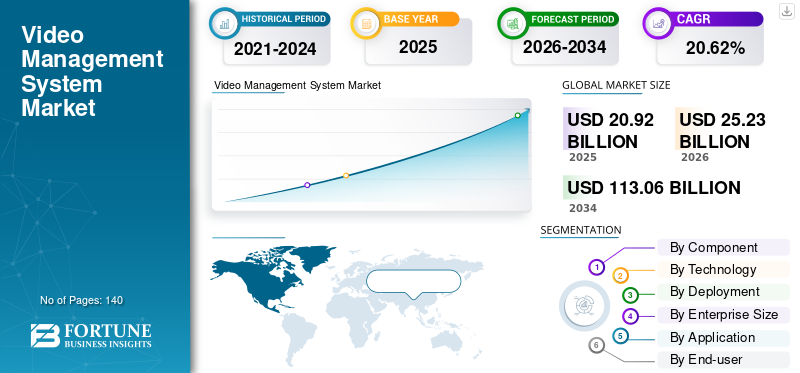
The global video management system market size was valued at USD 20.92 billion in 2025. The market is projected to grow from USD 25.23 billion in 2026 to USD 113.06 billion by 2034, exhibiting a CAGR of 20.62% during the forecast period.

The video management system market is experiencing significant expansion as organizations increasingly prioritize advanced surveillance, security monitoring, and video analytics capabilities across commercial, industrial, and public-sector environments. Video management systems enable centralized control, storage, retrieval, and analysis of video data collected from network cameras and surveillance devices. Growing concerns regarding public safety, asset protection, regulatory compliance, and operational efficiency are encouraging enterprises to invest in sophisticated video management solutions. The video management system market report highlights increasing adoption of cloud-enabled platforms, artificial intelligence-powered analytics, and integrated security ecosystems. Organizations are seeking scalable solutions that support real-time monitoring, intelligent event detection, and seamless management of large surveillance networks.
The United States represents one of the most mature and technologically advanced markets for video management systems. Organizations across government, transportation, healthcare, education, retail, and industrial sectors are increasingly deploying sophisticated surveillance infrastructure to improve security, operational visibility, and risk management. The growing emphasis on public safety, workplace security, and critical infrastructure protection continues to drive adoption of advanced video management platforms. Businesses are investing in integrated security ecosystems that combine video management systems with access control, artificial intelligence analytics, and cloud-based monitoring solutions. The increasing use of intelligent video surveillance for operational insights, customer behavior analysis, and incident management is expanding application opportunities.
Download Free sample to learn more about this report.
 Global Market Size & Forecast
 Market Share
 Key Regional Highlights
North America led the market with a 37% share, supported by strong adoption of advanced surveillance and video analytics solutions.
Europe accounted for 28% of the market, driven by increasing investments in security infrastructure and intelligent video technologies.
Asia-Pacific held a 26% share, supported by rapid urbanization and growing deployment of surveillance systems.
U.S.
The U.S. market is supported by increasing investments in AI-powered video surveillance and advanced security infrastructure.
Japan
Japan accounted for 18% of the Asia-Pacific market, supported by growing adoption of intelligent surveillance and video management technologies.
Read More

The video management system market is being transformed by rapid technological innovation and evolving security requirements. One of the most important video management system market trends is the growing integration of artificial intelligence and machine learning into video surveillance platforms. Advanced analytics capabilities now enable automatic object recognition, facial identification, behavioral analysis, license plate recognition, and anomaly detection. These intelligent functions improve security effectiveness while reducing manual monitoring requirements.
Download Free sample to learn more about this report.
Cloud-based video management solutions are also gaining significant momentum. Organizations increasingly prefer cloud deployment models because they offer scalability, remote accessibility, centralized management, and reduced infrastructure complexity. Cloud-enabled systems allow security teams to monitor multiple locations through unified platforms while simplifying software updates and maintenance activities. The increasing use of mobile applications, predictive analytics, and data-driven security management continues to influence video management system market outlook and long-term industry development.
Rising Demand for Advanced Security and Surveillance Solutions
The primary driver supporting video management system market growth is the increasing demand for advanced security and surveillance capabilities across public and private sectors. Organizations face growing concerns related to physical security threats, asset protection, workplace safety, and regulatory compliance requirements. As a result, businesses are investing heavily in video management systems that provide centralized monitoring, intelligent analytics, and rapid incident response capabilities.
Modern video management platforms enable organizations to monitor large numbers of cameras across multiple locations while improving operational efficiency. Artificial intelligence-powered analytics help security teams identify potential threats, detect unusual activities, and automate surveillance processes. Government agencies, transportation networks, educational institutions, healthcare facilities, and commercial enterprises are increasingly deploying these technologies to strengthen security operations. The expansion of smart city initiatives and critical infrastructure protection programs further contributes to market growth. Urban authorities are utilizing intelligent video management systems to enhance public safety, traffic management, and emergency response coordination. As security requirements continue to evolve, demand for advanced video management solutions is expected to remain strong across multiple industries.
High Implementation and Infrastructure Costs
A significant restraint affecting the video management system market is the substantial investment required for system deployment and infrastructure integration. Large-scale video management implementations often involve costs associated with cameras, storage systems, networking equipment, software licensing, and professional services. These expenses can be challenging for small and medium-sized organizations with limited technology budgets.
Storage requirements represent another important cost consideration. High-resolution video recording generates significant volumes of data that require reliable storage infrastructure and long-term retention capabilities. Organizations must also invest in cybersecurity measures to protect video data from unauthorized access and cyber threats. Integration challenges may further increase implementation complexity. Many organizations operate legacy surveillance infrastructure that may not be fully compatible with modern video management platforms. These technical and financial barriers can slow adoption, particularly in cost-sensitive sectors and emerging markets where budget constraints remain significant.
Expansion of Artificial Intelligence and Cloud-Based Video Analytics
The increasing adoption of artificial intelligence and cloud computing technologies presents significant opportunities for video management system market participants. AI-powered video analytics enable organizations to extract valuable insights from surveillance footage while improving threat detection accuracy and operational efficiency. Advanced capabilities such as facial recognition, crowd monitoring, behavior analysis, and automated incident detection are creating new value propositions for customers.
Cloud-based video management platforms offer substantial opportunities by reducing infrastructure requirements and improving system scalability. Organizations can deploy surveillance solutions across multiple locations while maintaining centralized control and remote accessibility. Subscription-based service models further enhance affordability and flexibility. Emerging applications beyond traditional security functions are also creating market opportunities. Businesses increasingly use video analytics for operational intelligence, customer behavior analysis, workplace safety monitoring, and process optimization. As organizations recognize the broader value of video data, demand for intelligent video management solutions is expected to expand significantly.
Managing Data Privacy and Cybersecurity Risks
One of the most significant challenges facing the video management system market is ensuring data privacy and cybersecurity protection. Modern video management platforms collect and process large volumes of sensitive visual information, creating concerns regarding unauthorized access, misuse, and regulatory compliance. Organizations must implement robust security measures to protect surveillance data from cyber threats and privacy breaches.
Regulatory requirements related to data protection continue to evolve across global markets. Organizations operating surveillance systems must comply with privacy regulations governing data collection, storage, retention, and usage practices. Failure to meet these requirements can result in legal and reputational risks. The increasing use of cloud-based platforms and connected devices further expands the cybersecurity attack surface. Security providers must continuously enhance encryption capabilities, access controls, and threat detection mechanisms to maintain customer trust. Balancing security effectiveness with privacy protection remains a critical challenge influencing Video Management System industry analysis and future market development.
The Solution segment accounts for approximately 72% of the video management system market share and represents the largest category within the industry. Video management solutions provide centralized platforms that enable organizations to manage, monitor, record, analyze, and retrieve video data from multiple surveillance devices. These solutions are widely adopted across commercial buildings, transportation hubs, government facilities, industrial sites, healthcare institutions, and educational campuses where comprehensive surveillance management is essential. Organizations increasingly require scalable platforms capable of supporting thousands of cameras while maintaining high operational efficiency and security performance. Modern video management solutions incorporate artificial intelligence, machine learning, facial recognition, license plate recognition, and intelligent video analytics to improve threat detection and incident response capabilities.
Services segment represents approximately 28% of the video management system market and includes consulting, installation, integration, maintenance, technical support, and managed security services. As video surveillance ecosystems become increasingly sophisticated, organizations require specialized expertise to ensure successful deployment and ongoing system optimization. Service providers play a critical role in helping customers design surveillance architectures, integrate video management platforms with existing infrastructure, and maintain system performance over time. The increasing complexity of cloud-based video management systems, artificial intelligence analytics, and multi-site surveillance operations is driving demand for professional services. Organizations often rely on experienced service providers to address cybersecurity concerns, ensure regulatory compliance, and implement best practices for data management and system administration.
The By Technology segment accounts for approximately 24% of the video management system market and plays a vital role in advancing surveillance capabilities across industries. This segment includes artificial intelligence, machine learning, deep learning analytics, facial recognition, object detection, license plate recognition, and video intelligence technologies. Organizations are increasingly adopting advanced technologies to improve security monitoring, automate threat detection, and enhance operational efficiency. These solutions enable security teams to identify suspicious activities in real time, reducing response times and improving overall situational awareness.
The growing adoption of edge computing and cloud-based analytics is further driving the demand for technology-enabled video management solutions. Businesses are utilizing predictive analytics and automated alerts to strengthen security operations while minimizing manual intervention. Government agencies, transportation authorities, retail companies, and industrial facilities continue to invest in advanced surveillance technologies to improve public safety and operational visibility.
The By Deployment segment represents approximately 21% of the video management system market and includes on-premise, cloud-based, and hybrid deployment models. Organizations select deployment models based on security requirements, scalability needs, budget considerations, and operational preferences. Cloud-based deployment has emerged as a popular option due to its flexibility, centralized management capabilities, and reduced infrastructure requirements. Businesses benefit from remote accessibility, automatic software updates, and simplified system maintenance, making cloud solutions attractive for multi-site operations.
Hybrid deployment models are also gaining momentum as organizations seek to balance security, compliance, and operational efficiency. These models combine local storage and processing capabilities with cloud-based management functions, providing greater flexibility and control over video data. Industries such as government, healthcare, banking, and critical infrastructure often prefer hybrid environments to meet regulatory requirements while leveraging cloud benefits.
The By Enterprise Size segment accounts for approximately 18% of the video management system market and reflects adoption across large enterprises, medium-sized businesses, and small organizations. Large enterprises remain major contributors to market demand due to extensive surveillance requirements, multiple facility locations, and complex security infrastructures. These organizations require centralized video management systems capable of handling thousands of cameras, advanced analytics, and integrated security operations.
Small and medium-sized enterprises are increasingly adopting video management solutions as cloud technology reduces deployment complexity and infrastructure costs. Subscription-based pricing models and managed services make advanced surveillance systems more accessible to businesses with limited resources. These organizations recognize the value of video management systems for protecting assets, improving employee safety, and enhancing operational visibility. The growing availability of scalable solutions tailored to different business sizes continues to expand market penetration and strengthen demand across enterprise segments within the Video Management System industry analysis.
The By Application segment holds approximately 20% of the video management system market and encompasses a broad range of use cases extending beyond traditional surveillance functions. Organizations increasingly utilize video management platforms for security monitoring, traffic management, workplace safety, customer analytics, operational intelligence, and compliance management. The ability to analyze video data and generate actionable insights has significantly expanded the role of video management systems across industries.
Retail organizations use video analytics to study customer behavior and optimize store layouts, while transportation authorities employ video management systems for traffic monitoring and incident response. Manufacturing facilities utilize surveillance technologies to ensure workplace safety and monitor production activities. Educational institutions and healthcare providers also rely on video management platforms to improve security and operational oversight.
The By End-user segment represents approximately 17% of the video management system market and includes government agencies, transportation organizations, healthcare facilities, educational institutions, retail businesses, industrial enterprises, and commercial establishments. Government organizations remain among the largest adopters due to increasing public safety requirements and investments in critical infrastructure protection. Video management systems enable authorities to monitor public spaces, improve emergency response capabilities, and strengthen security operations. Transportation hubs such as airports, rail stations, and transit centers also rely heavily on advanced surveillance technologies to ensure passenger safety and operational efficiency.
Healthcare institutions deploy video management solutions to improve patient safety, monitor facility operations, and protect sensitive areas. Educational institutions use surveillance platforms to enhance campus security and safeguard students and staff. Industrial facilities benefit from video analytics for workplace safety monitoring, regulatory compliance, and operational oversight. Retail organizations utilize video management systems to prevent theft and improve customer experience. The diverse requirements of end users across multiple industries continue to support broad adoption and long-term video management system market growth.
North America accounts for approximately 37% of the video management system market share and remains the largest regional market due to extensive deployment of advanced surveillance infrastructure across public and private sectors. Organizations throughout the region increasingly utilize video management systems to improve security monitoring, incident response, operational efficiency, and regulatory compliance. The adoption of intelligent video analytics, cloud-based surveillance platforms, and artificial intelligence-powered monitoring solutions continues to accelerate market development.
Government agencies, transportation authorities, educational institutions, healthcare facilities, and commercial enterprises are investing heavily in advanced video management solutions capable of supporting large-scale surveillance operations. The increasing focus on public safety, critical infrastructure protection, and smart city development is creating strong demand for integrated video management platforms. Organizations are also leveraging video data for operational intelligence and business analytics beyond traditional security applications. Technological advancements in edge computing, facial recognition, and real-time analytics further strengthen market adoption. The presence of leading technology providers and robust digital infrastructure continues to position North America as a dominant contributor to the global Video Management System Industry.
Europe represents approximately 28% of the video management system market share and continues to demonstrate strong adoption of advanced surveillance technologies across multiple industries. Governments and private organizations are increasingly implementing intelligent security solutions to enhance public safety, protect critical infrastructure, and improve operational visibility. The growing complexity of security threats has encouraged widespread deployment of video management systems capable of integrating cameras, analytics platforms, and access control technologies.
The region benefits from strong investments in transportation modernization, smart city initiatives, and public safety infrastructure. Airports, railway networks, government facilities, educational institutions, and commercial buildings increasingly utilize centralized video management systems to monitor operations and improve situational awareness. Cloud-based deployment models and artificial intelligence-enabled analytics are becoming increasingly popular among organizations seeking scalable surveillance solutions. Additionally, increasing emphasis on cybersecurity and data governance is encouraging vendors to develop secure and compliant video management platforms. These factors continue to support long-term growth within the European video management system market outlook.
Germany accounts for approximately 25% of the European video management system market and remains one of the region's most significant contributors. The country's strong industrial base, advanced technological infrastructure, and emphasis on security modernization support widespread adoption of video management solutions. Manufacturing facilities, transportation networks, government agencies, and commercial organizations increasingly deploy advanced surveillance platforms to enhance operational security and improve asset protection.
The integration of industry 4.0 technologies and intelligent automation systems is creating additional opportunities for video management system providers. Organizations are leveraging video analytics to improve workplace safety, monitor production processes, and strengthen security operations. Smart city initiatives and transportation infrastructure upgrades are further driving demand for centralized video monitoring solutions. German enterprises increasingly prefer scalable and interoperable systems capable of supporting long-term digital transformation strategies. Continued investments in public safety and infrastructure protection contribute to sustained market development across the country.
The United Kingdom represents approximately 19% of Europe's video management system market and continues to experience strong demand for advanced surveillance technologies. Public sector organizations, transportation authorities, financial institutions, and commercial enterprises are increasingly investing in video management systems to improve security operations and enhance situational awareness. The country's extensive surveillance infrastructure creates favorable conditions for continued technology upgrades and system modernization.
Artificial intelligence-powered video analytics and cloud-based management platforms are becoming increasingly common within the United Kingdom market. Organizations seek solutions capable of delivering real-time monitoring, automated threat detection, and efficient incident management. The growing importance of cybersecurity and regulatory compliance is also influencing purchasing decisions. Smart city projects, transportation modernization initiatives, and critical infrastructure protection programs continue to generate new opportunities for market participants. These factors collectively support the expansion of the Video Management System industry within the United Kingdom.
Asia-Pacific accounts for approximately 26% of the global video management system market share and represents one of the fastest-growing regional markets. Rapid urbanization, expanding infrastructure projects, and increasing investments in public safety are driving adoption of advanced surveillance technologies throughout the region. Governments and enterprises are implementing intelligent monitoring systems to address security challenges and improve operational efficiency.
The region's strong focus on smart city development is creating significant demand for integrated video management platforms capable of supporting large-scale surveillance networks. Transportation hubs, industrial facilities, educational institutions, and commercial complexes increasingly utilize video analytics and centralized monitoring systems. The growing availability of high-speed communication networks and cloud infrastructure further supports market expansion. As organizations seek more sophisticated security solutions, demand for artificial intelligence-enabled video management technologies continues to rise. These factors position Asia-Pacific as a key growth region within the global video management system market.
Japan contributes approximately 18% of the Asia-Pacific video management system market and remains a technologically advanced market for intelligent surveillance solutions. The country emphasizes public safety, infrastructure security, and disaster preparedness, creating strong demand for advanced video management platforms. Transportation systems, government facilities, commercial buildings, and manufacturing plants increasingly deploy integrated surveillance technologies to enhance monitoring capabilities.
Artificial intelligence, robotics, and automation technologies are influencing the evolution of video management systems within Japan. Organizations are increasingly adopting intelligent analytics capable of detecting unusual activities, improving operational efficiency, and supporting decision-making processes. Smart city projects and transportation modernization initiatives further contribute to market growth. Japan's commitment to technological innovation continues to create opportunities for providers offering advanced surveillance and video management solutions.
China accounts for approximately 38% of the Asia-Pacific video management system market and represents the region's largest market. Rapid urbanization, extensive infrastructure development, and strong government investments in public security systems have contributed significantly to market expansion. The country has implemented large-scale surveillance networks that utilize advanced video management platforms to support public safety and urban management objectives.
Organizations across transportation, manufacturing, retail, healthcare, and government sectors increasingly rely on intelligent video management systems to enhance security and operational efficiency. Artificial intelligence-enabled analytics, facial recognition technologies, and cloud-based monitoring platforms are widely adopted throughout the market. Smart city development programs continue to drive investment in surveillance infrastructure and integrated monitoring systems. China's strong technological capabilities and large-scale deployment initiatives support its leading position within the Asia-Pacific Video Management System Industry.
The Rest of World region accounts for approximately 9% of the video management system market share and includes Latin America, the Middle East, and Africa. These regions are increasingly investing in surveillance technologies to address security concerns, improve public safety, and support infrastructure development projects. Governments and private organizations are deploying video management systems across transportation networks, commercial facilities, educational institutions, and critical infrastructure sites.
The growing adoption of smart city initiatives and digital transformation programs is creating favorable conditions for market growth. Improvements in communication infrastructure and cloud technology availability are enabling broader adoption of advanced surveillance solutions. Organizations are increasingly recognizing the value of video analytics and centralized monitoring capabilities for enhancing security operations and operational efficiency. As investment in infrastructure modernization continues, the Rest of World region is expected to generate significant opportunities for video management system providers.
The video management system market continues to attract strong investment activity from technology companies, security solution providers, infrastructure developers, and institutional investors. Increasing concerns regarding public safety, asset protection, and operational monitoring have encouraged organizations to invest in advanced video surveillance and management technologies. Investment is particularly concentrated in artificial intelligence-powered analytics, cloud-based video management platforms, edge computing solutions, and integrated security ecosystems. These technologies enable organizations to improve threat detection, automate monitoring processes, and generate actionable insights from video data.
The growing adoption of cloud computing and subscription-based service models is also attracting investor attention. Companies offering software-as-a-service video management platforms benefit from recurring revenue opportunities and greater customer retention. Emerging economies present significant opportunities due to expanding infrastructure investments and increasing security requirements. Organizations that focus on artificial intelligence, cybersecurity integration, and real-time analytics are expected to benefit from continued investment activity across the Video Management System Industry.
Innovation remains a major competitive factor within the video management system market. Manufacturers are increasingly developing advanced platforms that combine artificial intelligence, machine learning, cloud computing, and intelligent analytics to enhance surveillance effectiveness. Modern video management systems are evolving beyond traditional recording and monitoring functions to provide automated threat detection, facial recognition, object tracking, behavioral analysis, and predictive security capabilities.
Artificial intelligence-powered analytics continue to transform the industry. New solutions can automatically identify suspicious activities, recognize vehicles, detect unauthorized access, and generate real-time alerts. Edge-based video processing technologies are also gaining popularity as they reduce bandwidth requirements and improve response times. Vendors are integrating cybersecurity protections directly into video management platforms to address growing concerns regarding data security and privacy.
The video management system market report provides comprehensive analysis of market dynamics, technological advancements, competitive landscape, regional developments, and emerging business opportunities across the global industry. The report evaluates key factors influencing market adoption, including increasing security requirements, smart city development initiatives, cloud technology integration, and artificial intelligence deployment. It offers detailed insights into industry trends affecting surveillance infrastructure and video management system implementation across multiple sectors.
Request for Customization to gain extensive market insights.
Regional analysis covers North America, Europe, Asia-Pacific, and Rest of World markets, highlighting country-level developments and investment opportunities. Competitive analysis assesses major industry participants, product innovation strategies, partnerships, and expansion initiatives. The report further explores investment trends, technological innovation, regulatory considerations, and future growth opportunities. This Video Management System industry report serves as a valuable strategic resource for technology providers, investors, system integrators, security professionals, and decision-makers seeking actionable market intelligence.
Fortune Business Insights says that the global market value stood at USD 20.92 billion in 2025 and is projected to reach USD 113.06 billion by 2034.
The market is expected to exhibit a CAGR of 20.62% during the forecast period of 2026-2034.
Solutions were the leading component segment, accounting for approximately 72% of the market share, driven by demand for centralized video monitoring, recording, management, and analytics.
Key players include Robert Bosch GmbH, Honeywell International Inc., Schneider Electric SE, Axis Communications AB, Johnson Controls, and Hangzhou Hikvision Digital Technology Co., Ltd.
Major trends include growing integration of artificial intelligence and machine learning and rising adoption of cloud-based video management solutions. North America led the market with a 37% share.


(Offer valid till 31st Oct 2026)
Get 30-60 hrs Free Customization
Expand Regional and Country Coverage, Segments Analysis, Company Profiles, Competitive Benchmarking, and End-user Insights.




















Get In Touch With Us
US +1 833 909 2966 ( Toll Free )
Receive a tailored pricing based on your needs.
Discuss your questions with our industry experts.
Have questions? Get quick answers before you purchase.

