 Download Free Sample



Get a Quote
Receive a tailored pricing based on your needs.
- Choose license type
- Multiple user options
- Custom scope & coverage
- Fast turnaround
"Smart Strategies, Giving Speed to your Growth Trajectory"
 Listen to Audio Version
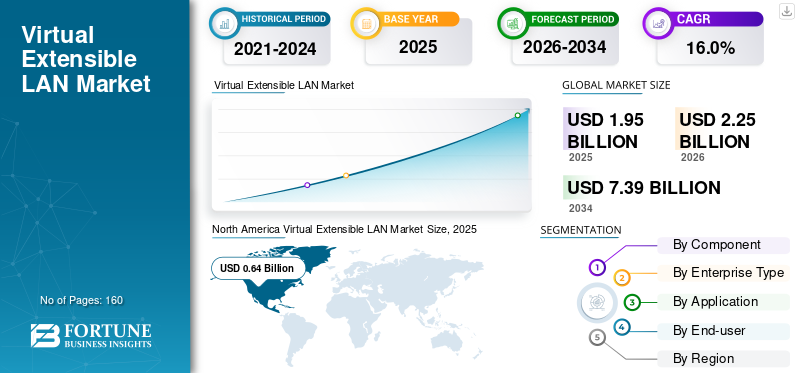
The global virtual extensible LAN market size was valued at USD 1.95 billion in 2025. The market is projected to grow from USD 2.25 billion in 2026 to USD 7.39 billion by 2034, exhibiting a CAGR of 16.0% during the forecast period. North America dominated the virtual extensible lan market with a market share of 32.82% in 2025.
The global market encompasses hardware, software, and services that enable virtualization and network overlay in data center environments. Virtual Extensible LAN (VXLAN) is an Internet Engineering Task Force (IETF) network virtualization technology standard and network protocol that extends Layer 2 over Layer 3 network infrastructure. VXLAN solutions are mainly adopted by large enterprises, including cloud service providers and telecom operators. These companies integrate VXLAN solutions to leverage workload mobility, multi-tenancy, Network Function Virtualization (NFV), Software Defined Networking (SDN) Overlays, and other applications. The market growth is primarily propelled by the growing demand for 5G core network virtualization, expansion of hyperscaler data centers, and government-backed digital infrastructure development initiatives.
Cisco Systems, Inc., Broadcom Inc. (VMware), Arista Networks, Hewlett Packard Enterprise (Juniper Networks), and Huawei Technologies are the top players in the market. These players are engaged in providing advanced virtualization technology integrated with AI capabilities. They also focus on expanding their product offerings through strategic acquisitions, mergers, collaborations, and new innovations to drive the adoption of VXLAN-based solutions.
Download Free sample to learn more about this report.
 Global Market Size & Forecast
 Market Share
 Key Regional Highlights
Asia Pacific
Asia Pacific is projected to reach USD 0.69 billion in 2026 and is expected to register the highest growth at an 18.8% CAGR during the forecast period.
North America
North America generated USD 0.64 billion in 2025, maintaining its leading market position.
Europe
Europe held a significant market share, supported by enterprise IT modernization and increasing investments in data center capacity.
U.S.
U.S. market reached USD 0.53 billion in 2025.
Japan
Japan market reached USD 0.07 billion in 2025.
Read More

Adoption of Generative AI to Transform VXLAN Network Operations and Enhance Automation in Data Centers
Generative AI is transforming VXLAN-based network operations through automation, where it helps in automating complex network design tasks, configuration, and performance optimization. Traditionally, network operations rely on scripting expertise to monitor and respond to fabric-level anomalies. With the advent of generative AI, this approach has been replaced by language interfaces, enabling engineers to perform in complex VXLAN environments. Additionally, AI helps in generating predictive and autonomous networking reports and helps the engineers to resolve the associated issues in a fraction of the time. The convergence of AI with network management is driving the investment from large enterprises for AI-powered orchestration platforms, integration services, and intelligent assurance tools that communicate with AI models for network telemetry, policy frameworks, and governance systems throughout the forecast period.
Ongoing Standardization of Data Center Networking Architecture to Drive VXLAN Adoption
The growing trend of standardizing the data center networks from traditional to modern and standards-based networking architecture is expected to influence the virtual extensible LAN market growth in the coming years. Multiple hyperscaler data centers and modern enterprises are focusing on transitioning from traditional Spanning Tree Protocol (STP) architectures to EVPN-VXLAN fabrics as it offers multi-vendor interoperability, high scalability, and loop-free topology. These enterprises are focused on adopting flexible and software-driven networking approaches to scale their business operations. Additionally, the solutions are advanced protocols allowing enterprises of all sizes to secure traffic isolation, high-performance network overlays, and disaster recovery, further driving product adoption in the modern networking ecosystem.
Key market players, including Cisco, Arista, Huawei, and Juniper (HPE), have established their own data center networking product portfolios integrated with the VXLAN standard networking protocol. This implies that large enterprises are aligned to invest in a technology that provides strong long-term support, multi-vendor compatibility, and a clear growth roadmap making it a reliable choice for enterprise IT decision-makers.
Download Free sample to learn more about this report.
Soaring Investment Activities to Support Digital Infrastructure Programs to Drive Market Growth
Regional governments and data center companies across the globe are focusing on expanding their digital infrastructure through continuous investment and innovations, creating growth opportunities for market players. Companies such as Amazon, Microsoft, and Google are focusing on the continuous expansion of their large-scale cloud platforms, enabling more businesses to move their operations and data to cloud infrastructure. This cloud infrastructure requires highly advanced data centers equipped with VXLAN technologies to manage, share, and secure the data completely. The rising efforts for data center expansion will directly impact the growth of the market.
Rising Utilization of Open-Source and Low-Cost Networking Alternatives May Limit Market Growth
The availability of multiple open-source alternatives that provide VXLAN networking capabilities without the need for a commercial license may limit revenue generation. Platforms such as SONiC, Microsoft’s open source network operating system, are widely adopted by enterprises, which allows them to integrate the VXLAN networking protocol into their existing architecture free of cost. Additionally, mid-size enterprises also focus on adopting low-cost networking hardware alternatives, which directly creates pricing pressure on established vendors. The cost differences in the established players' offerings and local regional service providers are estimated to negatively impact the market growth. The major players operating in the market should focus on demonstrating the value they offer, including automation capabilities as well as managed solutions, to justify their premium pricing.
Proliferation of AI-based Infrastructure to Improve Network Security to Drive Product Adoption
The soaring adoption of AI-driven infrastructure to address multiple network security challenges associated with modern, distributed, and complex data center environments is expected to drive growth opportunities for market players during the forecast period. Major enterprises are inclined toward the integration of AI-powered security automation architecture, enabling VXLAN protocol to provide scalability, micro-segmentation, and protection against cyber threats such as phishing and ransomware. Additionally, several government agencies, such as the U.S. NIST, and regional government directives have mandated the security framework in data transmission across public organizations through network segmentation. Such mandates are expected to propel the demand for VXLAN in government and defense organizations during the forecast period.
Rising Demand for Physical Networking Infrastructure to Drive Hardware Segment Dominance
Based on component, the market is divided into hardware, software, and services.
The hardware segment dominated the market with a 55.2% share in 2025 as the deployment of the VXLAN protocol requires physical networking equipment, including switches, routers, gateways, and tunnel endpoints. This equipment allows data centers to support high tunnel density with the ability to handle massive data traffic of up to 800G speed as well as reducing the overall operation cost. Enterprises’ strategies to build, expand, and upgrade the networking architecture will fuel the need to procure hardware components and will further drive the market growth.
The software segment is expected to grow at the highest CAGR of 19.3% during the forecast period, due to the growing investment from large enterprises to automate their network management and enforce security policies. Customers are shifting toward subscription-based software licensing, further allowing the vendors to generate a recurring revenue stream. This VXLAN software allows organizations to provide intelligent traffic routing, anomaly detection, centralized monitoring, and agile deployment. Additionally, the continuous upgradation in software features, including predictive analytics, automated positioning, and zero-trust compliance, is expected to support the market to gain a competitive edge.
To know how our report can help streamline your business, Speak to Analyst
Rapid Adoption and Growing Complexity of Advanced Data Center to Fuel Large Enterprises Segment Leadership
Based on enterprise type, the market is divided into large enterprises and small and medium enterprises (SMEs).
The large enterprises segment dominated the market with a share of 71.0% in 2025. This growth is driven by the rapid adoption of advanced data center infrastructure for its complex networking requirements. Enterprises such as global banks, government agencies, healthcare systems, and telecommunication operators are operating through a huge networking architecture, which often supports thousands of applications and business units with data isolation and security. This makes VXLAN capabilities the perfect fit to manage their networking architecture and offer advanced threat prevention, further fueling the market growth in the coming years.
The SMEs segment is expected to grow at the highest CAGR of 19.1% during the projection period. This market growth is owing to the emergence of cloud-based networking platforms and managed service providers that offer integrated VXLAN solutions as a service. The moving trend from small and medium-sized enterprises to operate from cloud-first infrastructure creates a significant growth opportunity for providers of VXLAN networking solutions.
Accelerating Cloud Infrastructure Adoption to Propel Multi-Tenancy Segment Leadership
Based on application, the market is segmented into multi-tenancy, workload mobility, Software-Defined Networking (SDN) overlays, Network Function Virtualization (NFV), disaster recovery, and others.
The multi-tenancy segment accounted for a dominant virtual extensible LAN market share of 26.7% in 2025, as they allow different organizations or departments in the same organization to share the data through the same physical network while maintaining isolation and security from one another. The rising adoption of cloud infrastructure will act as the largest growing driver for the market. As organizations engaged in offering cloud services through shared hardware to multiple customers require separate networking to manage sensitive workloads.
The software defined networking (SDN) overlays segment is expected to grow at the highest CAGR of 19.3% during the forecast period. Such growth is fueled by the increased reliance of the modern application on containerized software solutions. These solutions are small and independent components, which can be deployed and scaled quickly through overlay technologies. The growing adoption of SDN-based modern applications by enterprises across the globe will drive the demand for VXLAN during the analysis period.
Continuous 5G Network Expansion to Drive IT & Telecom Segment Dominance
By end-user, the market is segmented into BFSI, healthcare, IT & telecom, government, retail, manufacturing, and others.
The IT & telecom segment held the largest market share of 29.1% in 2025. This is due to the growing demand for flexible, software-controlled networks that support millions of users and rapidly evolving service demand. Additionally, the rapid expansion of 5G networks to support the modernization of core network infrastructure to serve advanced mobile services is encouraging key players to adopt flexible and virtual networking solutions, further supporting market growth.
The healthcare segment is expected to witness the highest CAGR of 20.2% during the analysis period. This is due to the rapid digitalization of the firms operating in the healthcare sector to maintain patient records on the cloud, connecting digital devices to the hospital network, as well as expanding the telemedicine services. Firms operating in the healthcare sector are engaged in handling sensitive data and information and need to comply with strict privacy regulations. This creates a significant growth opportunity for network segmentation and isolation, driving the need for VXLAN solutions.
By geography, the market is categorized into North America, South America, Europe, the Middle East and Africa, and Asia Pacific.
North America Virtual Extensible LAN Market Size, 2025 (USD Billion)
To get more information on the regional analysis of this market, Download Free sample
North America held the largest market share in 2024, valuing at USD 0.56 billion, and also maintained the leading share in 2025, with a valuation of USD 0.64 billion. This is due to the vast presence of competitive cloud solution providers, data centers, and a strong network of technology providers. Organizations operating in industries such as healthcare, financial services, telecommunication, and government operations are primary integrators of advanced networking solutions, driving the product demand.
The U.S. market can be analytically approximated at a value of around USD 0.53 billion in 2025, accounting for roughly 27.2% of global sales. The U.S. has a strong presence of the largest cloud providers and networking technology vendors globally. In addition, rising government initiatives to strengthen cybersecurity policies and network architecture are driving the growth of the market in the coming years.
To know how our report can help streamline your business, Speak to Analyst
Europe holds a significant share in the global market due to strong enterprise IT modernization and increasing investments in data center capacity across key countries. The growing regional association efforts to establish strong data privacy regulations for network isolation and segmentation, supported by government initiatives to improve cloud infrastructure, will drive the need for advanced data center architecture, boosting the market growth. Moreover, the presence of major data centers in countries including Germany, the U.K., the Netherlands, and France also serves as a significant opportunity for the Europe market growth.
The U.K. market reached a value of around USD 0.07 billion in 2025, representing roughly 3.6% of global revenues.
The Germany market reached approximately USD 0.08 billion in 2025, equivalent to around 4.1% of global sales.
The Asia Pacific region is estimated to reach USD 0.69 billion in 2026 and is expected to grow at the highest CAGR of 18.8% during the forecast period. This is due to growing 5G deployment programs, regional government initiatives for digital transformation, as well as constant cloud adoption in emerging economies such as India, China, South Korea, and others. Additionally, the region has a large population of businesses at earlier stages of their digital transformation journey, driving significant growth across all VXLAN application segments.
The China market touched a value of approximately USD 0.2 billion in 2025, representing roughly 10.2% of global revenues, the largest market after the U.S. A major national initiative to redistribute data center capacity from crowded coastal cities to less developed inland regions is driving one of the largest coordinated infrastructure buildouts in the world, with domestic networking vendors benefiting from strong government support and investment.
The Japanese market reached a value of around USD 0.07 billion in 2025, accounting for roughly 3.5% of global revenues.
The India market touched a valuation of around USD 0.1 billion in 2025, accounting for roughly 5.1% of global revenues.
The Middle East & Africa region is expected to grow at the second-fastest CAGR of 18.8% during the forecast period. This is due to the accelerating investment activities to strengthen digital infrastructure adoption in the region, including GCC countries. The Gulf countries are planning huge investments in data centers and smart city projects, creating significant opportunities for networking technologies. Moreover, the growing penetration of cloud providers in the region is stimulating enterprise and government demand for modern networking VXLAN based solutions.
The GCC market hit a value of around USD 0.07 billion in 2025, representing roughly 3.5% of global revenues.
The South America market is projected to grow at a CAGR of 15.2% during the forecast period, led by Brazil's expanding digital economy, growing fintech sector, and strengthening data protection regulatory environment. The region's financial services industry, anchored by some of largest regional banking institutions, is a primary driver of product adoption, alongside telecommunications operators modernizing networks to support next-generation mobile services.
The Brazilian market touched a value of around USD 0.06 billion in 2025, accounting for roughly 3.3% of global revenues.
Key Players are Strengthening Market Positions through Innovation, Acquisitions, and Strategic Partnerships
The global VXLAN market is noticing multiple strategic activities, where companies are engaged in expanding and strengthening their networking portfolio as well as focusing on innovation. This is supported by organic product development and signing strategic agreements for partnerships and acquisitions. Such strategic efforts enable networking companies to maintain and expand their LAN market share in a rapidly evolving landscape.
The global virtual extensible LAN market analysis provides an in-depth study of the size and forecast by all the market segments included in the report. It includes details on the market dynamics and market trends expected to drive the market over the forecast period. It offers information on technological advancements, key application developments, and details on partnerships, mergers, and acquisitions. The market research report also includes a detailed competitive landscape, providing market share and profiles of key players.
Request for Customization to gain extensive market insights.
| ATTRIBUTE | DETAILS |
| Study Period | 2021-2034 |
| Base Year | 2025 |
| Estimated Year | 2026 |
| Forecast Period | 2026-2034 |
| Historical Period | 2021-2024 |
| Growth Rate | CAGR of 16.0% from 2026-2034 |
| Unit | Value (USD Billion) |
| Segmentation | By Component, By Enterprise Type, By Application, By End-user, and By Region |
| By Component |
|
| By Enterprise Type |
|
| By Application |
|
| By End-user |
|
| By Region |
|
Fortune Business Insights says that the global market value stood at USD 1.95 billion in 2025 and is projected to reach USD 7.39 billion by 2034.
In 2025, the North America market value stood at USD 0.64 billion.
The market is expected to grow at a CAGR of 16.0% over the forecast period.
By application, the multi-tenancy segment led the market in 2025.
The market is primarily driven by continued global investment in cloud data center infrastructure, the worldwide rollout of 5G networks, increasing focus on cybersecurity and network segmentation, and government-led digital infrastructure programs across major economies.
Cisco Systems, Broadcom (VMware), Arista Networks, Hewlett Packard Enterprise (Juniper Networks), and Huawei Technologies are the prominent players in the market.
North America dominated the market in 2025.
Rapid cloud expansion, increasing AI workloads, rising data center virtualization, and the need to improve infrastructure efficiency are major factors expected to favor product adoption.

Get 30-60 hrs Free Customization
Expand Regional and Country Coverage, Segments Analysis, Company Profiles, Competitive Benchmarking, and End-user Insights.




















Related Reports
Get In Touch With Us
US +1 833 909 2966 ( Toll Free )
Receive a tailored pricing based on your needs.
Discuss your questions with our industry experts.
Have questions? Get quick answers before you purchase.

