Virtual Goods Market Size, Share & Industry Analysis, By Type (In-Game Virtual Goods, Digital Collectibles, Virtual Fashion & Accessories, and Others), By Platform (Mobile Platforms, PC Platforms, Console Platforms, and AR/VR Platforms), By Monetization Model (In-App Purchases, Subscription/Season Pass, Advertising Linked Rewards, and Others), By Distribution Channel (Platform-Owned Marketplaces, Third Party Marketplaces, Direct-to-Consumer (D2C), and Others), and Regional Forecast, 2026-2034
 Download Free Sample
(Offer valid till 15th Oct 2026)

KEY MARKET INSIGHTS
 Listen to Audio Version
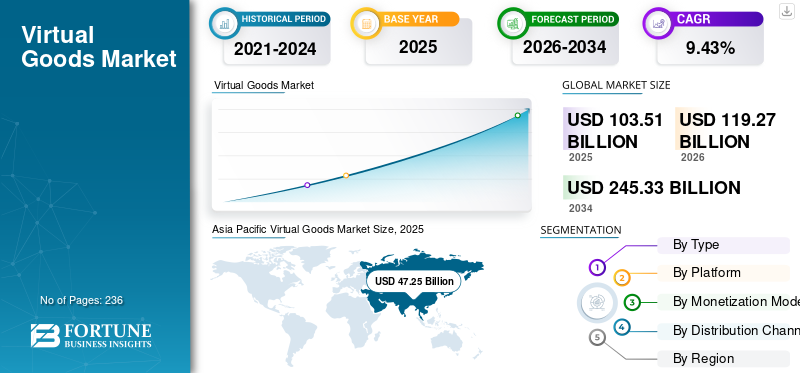
The global virtual goods market size was valued at USD 103.51 billion in 2025. The market is projected to grow from USD 119.27 billion in 2026 to USD 245.33 billion by 2034, exhibiting a CAGR of 9.43% during the forecast period. Asia Pacific dominated the global market with a market share of 45.64% in 2025.
Virtual goods are non-physical items that are traded within online environments, including social platforms, online games, and other digital experiences. Consumers purchase these digital assets to customize their gameplay experiences. Consistent efforts by digital content publishers to deliver online business models that enable customers to conduct microtransactions and personalize their gameplay experiences are frequently driving market growth.
Key players operating in the global market include Tencent Holdings Ltd., Sony Group Corporation, Microsoft Corporation, NetEase, Inc., and Nintendo Co., Ltd.
Download Free sample to learn more about this report.
Virtual Goods Market Key Takeaways
 Market Size & Forecast
- 2025 Market Size: USD 103.51 billion
- 2026 Market Size: USD 119.27 billion
- 2034 Forecast Market Size: USD 245.33 billion
- CAGR: 9.43% from 2026-2034
 Market Share
- Asia Pacific dominated the virtual goods market with a 45.64% share in 2025.
- The in-game virtual goods segment held the largest share of 67.87% in 2025.
- The mobile platforms segment accounted for a 53.30% share in 2025.
 Key Regional Highlights
Asia Pacific
Asia Pacific dominated the market in 2025 and is projected to reach USD 54.72 billion in 2026.
Europe
Europe is expected to maintain the third-largest market share during the forecast period.
North America
North America remains a key market due to strong digital infrastructure and high gaming engagement.
U.S.
The market reached USD 24.71 billion in 2025, supported by strong spending on mobile and PC gaming.
Japan
High adoption of mobile gaming and digital entertainment continues to drive market growth.
Read More

VIRTUAL GOODS MARKET TRENDS
Publishers Integrating Digital Goods with Live and Social Experiences to Favor Growth
The growing number of publishers providing access to influential digital goods in their live experiences, including in-game concerts, e-sports tournaments, seasonal festivals, and virtual brand launches, pushes revenue. Additionally, the increasing number of players and spectators willing to purchase event-exclusive goods, including limited-edition skins, emotes, accessories, badges, and virtual passes, is driving the publishers’ business revenue growth.
Download Free sample to learn more about this report.
MARKET DYNAMICS
MARKET DRIVERS
Rising Number of Mobile Gamers and Smartphone Penetration to Drive Market Growth
The increasing number of mobile gamers spending on virtual goods, including in-game clothing, real estate, skins, vehicles, virtual houses, and other items, is driving the global virtual goods market growth. In addition, increasing smartphone penetration is leading to an increased installation of gaming and social media applications, uplifting virtual items sales revenues. According to the Entertainment Software Association (ESA), the number of people playing games on mobile devices in the U.S. increased from 33% of the total in 2012 to 78% in 2024.
MARKET RESTRAINTS
High Third-Party Platform Commission Fees to Restrain Market Growth
Virtual goods developers and game publishers rely significantly on platform-owned ecosystems, including mobile app stores, gaming platforms, and multiverse environments to distribute and monetize their products. A high platform commission fee is reducing profit margins for developers and independent creators, thereby restraining market growth. In addition, consistent policy changes imposed by social media platforms are creating operational challenges for digital goods environments, hampering operational efficiency.
MARKET OPPORTUNITIES
Rising Demand for Building Digital Identity and Self-Expression to Create New Opportunities
Consumers use avatars and digital personas to create a digital identity across games, social platforms, and virtual worlds. The growing number of youngsters buying suits, accessories, skins, and other virtual fashion goods to create a personal character identity within games is creating new opportunities. In addition, the rising demand for cosmetic virtual goods, which allows major players to personalize their digital avatars, is favoring market growth. Additionally, the emergence of digital payment systems that support the purchase of virtual goods fulfill the self-expression needs of digital users, is driving demand for virtual goods.
MARKET CHALLENGES
Regulatory Scrutiny and Compliance Complexities to Challenge Key Players’ Business Expansion
Government and regulatory authority oversight of digital transactions, virtual asset ownership, and digital transactions. The growing concerns of loot boxes, gambling-like mechanics, and randomized rewards that are restricted within particular geographies are posing challenges to the key players’ business expansion across several countries. In addition, the changing consumer data protection and digital ownership laws, which lack clear legal definitions, restrict international business expansion activities for companies.
Segmentation Analysis
By Type
Broader Consumer Base and Frequent In-App Purchases Led Dominance of In-Game Virtual Goods
By type, the market is divided into in-game virtual goods, digital collectibles, virtual fashion & accessories, and others. The in-game virtual goods segment exhibited a leading global virtual goods market share of 67.87% in 2025. The segment’s leading share is attributed to the broader consumer base of gaming applications and in-game purchases to personalize their gameplay experiences. In addition, the consistent occurrence of pop-ups displaying attractive player skins, characters, and other items drive microtransactions for goods.
To know how our report can help streamline your business, Speak to Analyst
The virtual fashion & accessories segment is projected to grow at the fastest CAGR of 10.40% from 2026 to 2034 owing to the increasing consumer spending on virtual fashion goods emphasizing building players’ aesthetic value, individuality, and social signaling.
By Platform
Mobile Platforms Lead Due to Widespread Smartphone Adoption and High Demand for Mobile Games
Based on platform, the market is segmented into mobile platforms, PC platforms, console platforms, and AR/VR platforms.
The mobile platforms segment exhibited a leading global market share of 53.30% in 2025 due to widespread adoption of smartphones, high demand for playing mobile games, and greater consumer accessibility to the freemium and micro-transaction-driven mobile gaming apps. Furthermore, the segment’s growth is also led by an increasing number of mobile gaming apps supporting multiplayer interaction, leaderboards, and social gifting is driving revenue growth in this segment.
The AR/VR platforms segment is projected to grow at the fastest rate of 13.01% from 2026 to 2034 due to the proliferation of VR headsets and mixed reality devices among early adopters worldwide.
By Monetization Model
Increasing In-App Purchases Owing to Multiple Virtual Items Favor Segment Growth
By monetization model, the market is divided into in-app purchases, subscription/season pass, advertising linked rewards, and others. The in-app purchases segment exhibited a leading share of 63.68% in 2025 as the market witnessed wide adoption of in-game purchases of fashion and other goods by consumers across mobile, PC, and console gaming platforms worldwide. In addition, increasing purchases of digital collectibles and virtual currencies is creating a recurring revenue stream from in-app purchases.
The subscription/season pass segment is projected to grow at the fastest rate of 10.21% from 2026 to 2034. Subscriptions incentivize players to log in regularly, collect rewards, and unlock challenges. These models enhance user engagement, positively contributing to the segment’s revenue growth.
By Distribution Channel
Smooth Browsing and Direct Access to Goods Led Dominance of Platform-owned Marketplaces Segment
Based on distribution channel, the market is segmented into platform-owned marketplaces, third party marketplaces, direct-to-consumer (D2C), and others.
The platform-owned marketplaces segment held a leading share of 61.27% in 2025. A greater number of publisher-owned platforms offering direct access to digital goods with smooth browsing, purchasing, and consumption is generating significant revenues from platform-owned marketplaces. They support in-app purchases, subscriptions, seasonal passes, and digital collectibles under one roof, enabling publishers to deploy multiple monetization strategies.
The third party marketplaces segment is projected to grow at the fastest rate of 10.54% from 2026 to 2034 due to the rising number of digital content creators and the emergence of decentralized trading platforms across many countries.
Virtual Goods Market Regional Outlook
By geography, the market is categorized into North America, Europe, Asia Pacific, South America, and the Middle East & Africa.
Asia Pacific
Asia Pacific Virtual Goods Market Size, 2025 (USD Billion)
To get more information on the regional analysis of this market, Download Free sample
Asia Pacific exhibited a leading global market share of 45.65% in 2025 with an anticipated market size of USD 54.72 billion in 2026. The regional market is projected to grow at the fastest rate of 9.97% from 2026 to 2034. Strong gaming systems and exponentially rising smartphone adoption are driving the demand for in-app product purchases and virtual customizations among consumers across China, India, and Southeast Asia. Furthermore, advancements in the development of video games, designed with innovative technologies and immersive experiences, are positively contributing to product consumption.
North America
North America is projected to exhibit second leading position throughout the forecast period of 2026-2034. Significant spending on premium digital content, accompanied by sophisticated app ecosystems and seamless payment integration, is generating substantial product revenues across the U.S. and Canada. The rise of subscription models, virtual collectibles, and seasonal passes is favoring recurring revenues across the region.
The U.S. market size reached USD 24.71 billion in 2025 as robust digital infrastructure and a high number of mobile & PC gamers spending on gaming is generating considerable product revenue. Furthermore, the growing number of digital creators and publishers designing innovative digital solutions is positively contributing to the U.S. market growth.
Europe
Europe is estimated to hold a third-leading global market share from 2026 to 2034. High demand for virtual cosmetic items, skins, downloadable content, and digital passes, enable users to personalize their gaming experiences, favoring product revenues across Western Europe. On the other hand, increasing console and PC penetrations are driving product consumption across Eastern Europe.
South America
The market in South America and the Middle East & Africa is expected to witness moderate growth. The South American market in 2025 achieved USD 3.45 billion as the region observes a rising number of social media users spending on avatars and emojis to build their digital profiles.
Middle East & Africa
The rising smartphone penetration and the growing number of mobile gamers spending on in-app purchases are driving market growth across the Middle East & Africa. In this region, South Africa reached a market value of USD 1.40 billion in 2025.
COMPETITIVE LANDSCAPE
Key Industry Players
Consistent Focus on Creating AI-based Immersive Experiences to Help Key Players Maintain Market Position
The key players operating in the global market include Tencent Holdings Ltd., Sony Group Corporation, Microsoft Corporation, NetEase, Inc., and Nintendo Co., Ltd. These players focus on creating immersive AI/VR experiences by integrating live sports with digital goods systems, favoring their business revenues. For instance, in August 2025, Tencent Holdings Ltd. launched VISVISE, an AI-powered game creation and production tool for game development, including major industry events such as Gamescom. The tool allows producers to automate character and asset creation.
LIST OF KEY VIRTUAL GOODS COMPANIES PROFILED
- Tencent Holdings Ltd. (China)
- Sony Group Corporation (Japan)
- Microsoft Corporation (U.S.)
- NetEase, Inc. (China)
- Nintendo Co., Ltd. (Japan)
- Electronic Arts Inc. (U.S.)
- Epic Games, Inc. (U.S.)
- Take-Two Interactive Software, Inc. (U.S.)
- Roblox Corporation (U.S.)
- Valve Corporation (U.S.)
KEY INDUSTRY DEVELOPMENTS
- August 2025: Appcharge, a global payment and commerce platform, invested USD 58.0 million to expand its direct-to-consumer (D2C) payment platform for digital goods transactions within mobile games.
- May 2025: Roblox launched its Commerce APIs to enable creators and brand partners to develop gaming products, allowing users to purchase products directly from Roblox experiences.
- May 2025: Roblox expanded its commerce platform with Shopify integration, enabling the sale of virtual goods alongside physical products within experiences.
- May 2025: Sony Corporation developed an engagement platform that leverages the PlayStation Network (PSN) payment system, data, and user infrastructure across a broader range of entertainment devices.
- March 2025: Xsolla introduced an enhanced commerce and monetization tool at GDC 2025 to support game development studios in better selling virtual items, currency, in-game content, and digital bundles. These tools feature upgraded Web Shop personalization features and loyalty programs, enabling developers to sell in-game content outside traditional storefronts.
REPORT COVERAGE
Request for Customization to gain extensive market insights.
Report Scope & Segmentation
|
ATTRIBUTE |
DETAILS |
|
Study Period |
2021-2034 |
|
Base Year |
2025 |
|
Estimated Year |
2026 |
|
Forecast Period |
2026-2034 |
|
Historical Period |
2021-2024 |
|
Growth Rate |
CAGR of 9.43% from 2026-2034 |
|
Unit |
Value (USD Billion) |
|
Segmentation |
By Type, Platform, Monetization Model, Distribution Channel, and Region |
|
By Type |
· In-Game Virtual Goods · Digital Collectibles · Virtual Fashion & Accessories · Others |
|
By Platform |
· Mobile Platforms · PC Platforms · Console Platforms · AR/VR Platforms |
|
By Monetization Model |
· In-App Purchases · Subscription/Season Pass · Advertising Linked Rewards · Others |
|
By Distribution Channel |
· Platform-Owned Marketplaces · Third Party Marketplaces · Direct-to-Consumer (D2C) · Others |
|
By Geography |
· North America (By Type, Platform, Monetization Model, Distribution Channel, and Country) o U.S. (By Type) o Canada (By Type) o Mexico (By Type) · Europe (By Type, Platform, Monetization Model, Distribution Channel, and Country) o Germany (By Type) o France (By Type) o Italy (By Type) o Spain (By Type) o U.K. (By Type) o Russia (By Type) o Rest of Europe (By Type) · Asia Pacific (By Type, Platform, Monetization Model, Distribution Channel, and Country) o China (By Type) o India (By Type) o Japan (By Type) o Australia (By Type) o Rest of Asia Pacific (By Type) · South America (By Type, Platform, Monetization Model, Distribution Channel, and Country) o Brazil (By Type) o Argentina (By Type) o Rest of South America (By Type) · Middle East & Africa (By Type, Platform, Monetization Model, Distribution Channel, and Country) o South Africa (By Type) o UAE (By Type) o Rest of the Middle East & Africa (By Type) |
Frequently Asked Questions
Fortune Business Insights says that the global market value stood at USD 103.51 billion in 2025 and is projected to reach USD 245.33 billion by 2034.
In 2025, Asia Pacifics market value stood at USD 47.25 billion.
The global market is forecast to grow at a CAGR of 9.43% over 2026-2034.
By type, the in-game virtual goods segment is projected to hold the leading market share throughout the forecast period of 2026-2034.
The rising number of mobile gamers and smartphone penetration is set to enhance the eyewear experience and drive the global market.
Tencent Holdings Ltd., Sony Group Corporation, Microsoft Corporation, NetEase, Inc., and Nintendo Co., Ltd. are among the prominent players in the market.
Asia Pacific dominated the market in 2025 by holding the largest share.
The rising demand for building digital identities and self-expression is expected to favor the adoption rate of these products.



- 2021-2034
- 2025
- 2021-2024
- 236
-
(Offer valid till 15th Oct 2026)
Get 30-60 hrs Free Customization
Expand Regional and Country Coverage, Segments Analysis, Company Profiles, Competitive Benchmarking, and End-user Insights.



















Related Reports
-
US +1 833 909 2966 ( Toll Free )
-
Get In Touch With Us