Virtual Surgical Prehabilitation Services Market Size, Share & Industry Analysis, By Service Type (Physical Conditioning & Exercise Programs, Nutritional Optimization Services, Psychological & Behavioral Support Services, and Others), By Program Type (Unimodal and Multimodal), By Surgery (Orthopedic Surgery, Oncologic Surgery, Cardiovascular Surgery, and Others), By End User (Hospitals & ASCs, Specialty Clinics, and Others), and Regional Forecast, 2026-2034
 Download Free Sample
Virtual Surgical Prehabilitation Services Market Size and Future Outlook
 Listen to Audio Version
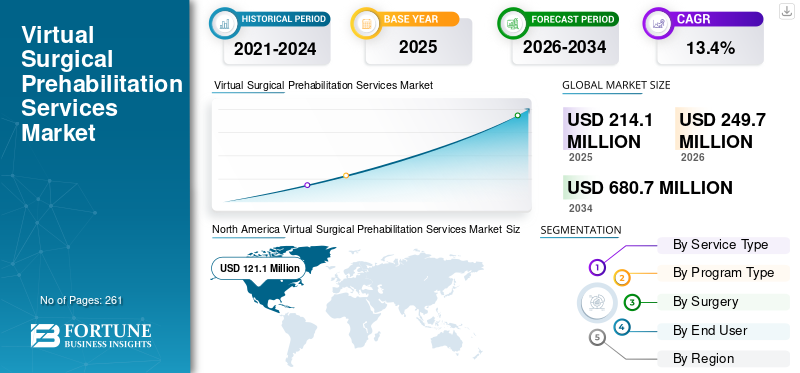
The global virtual surgical prehabilitation services market size was valued at USD 214.1 million in 2025 and is projected to grow from USD 249.7 million in 2026 to USD 680.7 million by 2034, exhibiting a CAGR of 13.4% during the forecast period. North America dominated the virtual surgical prehabilitation services market with a market share of 56.56% in 2025.
Virtual surgical prehabilitation services are remote, telehealth-based programs used to prepare patients for surgical procedures. The increasing number of surgical procedures, growing adoption of telehealth programs, and the expansion of healthcare infrastructure are resulting in a growing penetration rate of these services in the market. The increasing aging population is further boosting the adoption of virtual surgical prehabilitation services.
- For instance, according to the 2020 data published by the National Center for Biotechnology Information (NCBI), about 310 million major surgical procedures are performed every year globally.
The rising focus on the development of advanced telehealth programs among the major companies, such as QuestPrehab and PreActiv, among others, is further contributing to the demand for these services in the market.
Download Free sample to learn more about this report.
Virtual Surgical Prehabilitation Services Market KEY TAKEAWAYS
 Global Market Size & Forecast
- 2025 Market Size: USD 214.1 million
- 2026 Market Size: USD 249.7 million
- 2034 Forecast Market Size: USD 680.7 million
- CAGR: 13.4% from 2026-2034
 Market Share
- North America dominated the global market with a 56.56% share in 2025.
- Physical Conditioning & Exercise Programs held the largest service type share in 2025.
- Orthopedic Surgery held the largest surgery share at 36.7% in 2025.
 Key Regional Highlights
North America
North America dominated the market with USD 121.1 million in 2025.
Europe
Europe is projected to reach USD 61.1 million in 2026.
Asia Pacific
Asia Pacific is estimated to reach USD 31.5 million in 2026.
U.S.
The market is analytically approximated at around USD 125.4 million in 2026.
Japan
The market is estimated at around USD 6.5 million in 2026.
Read More

Virtual Surgical Prehabilitation Services Market Trends
Increased Service Demand Due to Rapid Adoption of Artificial Intelligence is a Key Market Trend
AI-based personalization is emerging as a key trend in the market, as providers are shifting from generic pre-surgery programs toward personalized, data-driven care pathways. Artificial intelligence-enabled platforms analyze patient-specific factors, including comorbidities, age, baseline mobility, surgical risk, nutrition status, activity levels, and behavioral patterns, to provide personalized exercise, diet, smoking cessation, mental health, and education plans. Moreover, this trend is especially relevant as prehabilitation is not a one-size-fits-all procedure.
A younger orthopedic surgery patient may need movement-focused conditioning and adherence coaching. In contrast, a frail aged patient undergoing colorectal surgery may require low-intensity strength training, protein optimization, and fall-risk reduction. Artificial intelligence and digital tools improve these programs based on patient progress, app engagement, wearable data, reported symptoms, and surgery timelines. Therefore, all the above advantages associated with artificial intelligence and digital tools are expected to fuel the adoption rate of these services in the market.
- For instance, according to 2025 data published by Nature, it was reported that the rapid increase in real-time health information collected from wearable devices has allowed digital biomarkers to emerge as a promising tool to support perioperative care, including surgical prehabilitation.
Market Dynamics
Market Drivers
Download Free sample to learn more about this report.
Increasing Number of Surgical Procedures to Drive Market Growth
The increasing prevalence of chronic diseases, including cardiovascular disorders, cancer, and others, is resulting in the rising number of surgeries among the patient population, consequently driving the virtual surgical prehabilitation services market growth.
- For instance, according to 2024 statistics published by the Centers for Disease Control & Prevention (CDC), approximately 1 in 20 adults has coronary artery disease in the U.S.
This, along with an expansion of healthcare infrastructure and a growing shift toward value-based care and outcome-based reimbursement, is further augmenting the adoption rate of these services in the market. Therefore, the factors above, along with the rising focus of prominent companies on introducing novel telehealth programs and personalized services, are expected to boost the adoption rate of these services.
|
Rank |
Market Drivers |
Overall Impact Rank |
CAGR Contribution (2026-2034) |
Impact 2026-2028 |
Impact 2029-2031 |
Impact 2032-2034 |
|
1 |
Increasing adoption of telehealth and digital healthcare platforms |
High |
+4.2% |
High |
High |
High |
|
2 |
Growing volume of elective and complex surgical procedures |
High |
+3.6% |
High |
High |
Medium |
|
3 |
Rising implementation of ERAS (Enhanced Recovery After Surgery) protocols |
High |
+3.2% |
Medium |
High |
High |
|
4 |
Increasing burden of chronic diseases and aging surgical population |
Medium |
+2.8% |
Medium |
Medium |
High |
|
5 |
Expansion of remote patient monitoring and AI-enabled care platforms |
Medium |
+2.3% |
Medium |
High |
High |
|
6 |
Others (increasing healthcare expenditure, growing awareness of preoperative optimization, expansion of value-based healthcare models, rising adoption of digital therapeutics, favorable government initiatives for telehealth, increasing collaborations between hospitals and digital health providers, and technological advancements in virtual care platforms, etc.) |
Low |
+2.1% |
Low |
Low |
Medium |
|
|
Total Positive Growth Contribution |
|
+18.2% |
|
|
|
Market Restraints
Limited Reimbursement and Funding Models to Hinder Market Growth
Limited reimbursement and less-developed funding models are one of the major restraints in the global market. The clinical evidence increasingly supports prehabilitation programs for improving surgical readiness and reducing postoperative complications among patients; however, limited reimbursement policies among healthcare systems are hampering the adoption rate of these services in the market.
Reimbursement systems are usually structured around traditional clinical visits, procedures, or disease-specific care rather than multidisciplinary digital preoperative optimization. As a result, providers may need to bill through fragmented codes including telehealth, physical therapy, remote therapeutic monitoring, or hospital bundled-payment pathways, which may not fully cover program costs, thereby hindering the adoption rate of these services in the market.
|
Rank |
Market Restraints |
Overall Impact Rank |
Negative CAGR Contribution (2026-2034) |
Impact 2026-2028 |
Impact 2029-2031 |
Impact 2032-2034 |
|
1 |
Limited reimbursement and unclear funding models |
High |
-2.0% |
High |
High |
Medium |
|
2 |
Low adoption among smaller hospitals and healthcare providers |
Medium |
-1.3% |
High |
Medium |
Low |
|
3 |
Patient Digital Literacy and Technology Accessibility Challenges |
Medium |
-0.9% |
Medium |
Medium |
Low |
|
4 |
Others (data privacy and cybersecurity concerns, shortage of trained multidisciplinary prehabilitation professionals, limited patient adherence to virtual programs, interoperability challenges between digital platforms and hospital EHR systems, regulatory variations across countries, and organizational resistance to digital transformation, etc.) |
Low |
-0.6% |
Low |
Low |
Low |
|
|
Total Negative Growth Impact |
|
-4.8% |
|
|
|
Market Opportunities
Expansion of Virtual Surgical Prehabilitation Service Programs in Emerging Markets to Create Growth Opportunities
The expansion of virtual surgical prehabilitation service programs in developing countries presents a lucrative opportunity in the market. Countries across Asia Pacific, Latin America, the Middle East & Africa are witnessing ongoing improvements in healthcare infrastructure, internet connectivity, smartphone adoption, surgical capacity, and digital health investments. Similarly, these regions are also experiencing a growing prevalence of chronic diseases, including cancer and cardiovascular disorders, which is further increasing the demand for these services in the market.
This, along with rising healthcare expenditure, is creating substantial opportunities for hospitals, digital health companies, insurers, and perioperative care providers to establish early market presence and address the rising demand for cost-effective surgical optimization solutions.
- According to 2025 statistics published by the International Trade Administration (ITA), healthcare expenditure is about USD 135.0 in Brazil.
Market Challenges
Limited Healthcare Access in Emerging Countries to Hamper the Market Growth
There is a growing demand for innovative virtual surgical prehabilitation services among the patient population. However, limited healthcare access and integration complexities with hospital care pathways in developing countries remain a key challenge for the global market. The limited availability of developed healthcare infrastructure, internet connectivity, surgical referral pathways, digital literacy, rehabilitation professionals, and coordinated perioperative care systems is hampering the adoption of these services in the market.
- For instance, according to 2023 statistics published by The World Bank Group (WBG), approximately 4.5 billion people lack full access to essential health services globally.
Other Prominent Challenges
- Data privacy concerns and unequal access to digital health technologies impact market growth.
SEGMENTATION ANALYSIS
By Service Type
Rise in Surgical Procedures Among Patients Boosted Physical Conditioning & Exercise Programs Segment Growth
Based on the service type, the market is classified into physical conditioning & exercise programs, nutritional optimization services, psychological & behavioral support services, and others.
The physical conditioning & exercise programs segment held the largest revenue share in 2025 due to the growing number of surgical procedures among patients. This, along with rising awareness about the benefits of these services, is also augmenting segment growth.
- For instance, according to 2023 data published by the American College of Surgeons (ACS), more than 7,500 daily steps before surgery is associated with a lower risk of postoperative complications.
The nutritional optimization services segment is expected to grow at a CAGR of 13.7% over the forecast period.
To know how our report can help streamline your business, Speak to Analyst
By Program Type
Improving Results with Multimodal Prehab Programs Led to Its Dominance
Based on the program type, the market is segmented into unimodal and multimodal.
The multimodal segment dominated the global market in 2025 due to the rising prevalence of chronic conditions and improvement in multimodal services.
- For instance, according to 2023 statistics published by the American Medical Association (AMA), a randomized trial of 251 adults found that a 4-week supervised multimodal prehabilitation program before colorectal cancer surgery significantly reduced severe and medical complications.
The unimodal segment is set to flourish with a growth rate of 13.3% over the forecast period.
By Surgery
Growing Number of Orthopedic Surgeries Boosted Segment Growth
Based on surgery, the market is segmented into orthopedic surgery, oncologic surgery, cardiovascular surgery, and others.
The orthopedic surgery segment dominated the global market, with a 36.7% share in 2025. The segment growth is attributed to the growing prevalence of chronic conditions, including arthritis and others, resulting in an increasing number of surgical procedures globally.
- For instance, according to the 2026 data published by SingleCare, it was reported that nearly 1 in 5 American adults have arthritis in the U.S.
The cardiovascular surgery segment is set to flourish with a growth rate of 13.7% over the forecast period.
By End User
Hospitals & ASCs Led Market Due to Rising Development of Healthcare Infrastructure
Based on end user, the market is divided into hospitals & ASCs, specialty clinics, and others.
The hospitals & ASCs segment dominated the virtual surgical prehabilitation services market share in 2025. The increasing number of surgical procedures in hospitals, the growing number of hospitals, and the rising development of healthcare infrastructure, among others, are some of the key factors contributing to the growth of the segment in the market. Furthermore, the segment is set to hold a 73.9% share in 2026.
- For instance, according to 2025 data published by Statistisches Bundesamt, there are about 1,874 hospitals in Germany.
The specialty clinics segment is projected to grow at a 14.2% CAGR during the forecast period.
Virtual Surgical Prehabilitation Services Market Regional Outlook
Based on region, the market has been studied across North America, Europe, Asia Pacific, Latin America, and the Middle East & Africa.
North America
North America Virtual Surgical Prehabilitation Services Market Size, 2025 (USD Million)
To get more information on the regional analysis of this market, Download Free sample
The North America market held the dominant share in 2024, valued at USD 107.6 million, and also took the leading share in 2025 with USD 121.1 million. The increasing adoption of digital healthcare solutions, rising focus on improving surgical outcomes, growing demand for remote patient preparation programs, increasing healthcare spending, among others, are some of the factors contributing to market growth.
- For instance, according to 2024 statistics published by the Centers for Medicare & Medicaid Services (CMS), it was reported that the healthcare expenditure is about USD 5.3 trillion in the U.S.
U.S. Virtual Surgical Prehabilitation Services Market
Based on North America’s strong contribution and the U.S. dominance within the region, the U.S. market can be analytically approximated at around USD 125.4 million in 2026, accounting for roughly 50.2% of global sales.
Europe
Europe is projected to record a growth rate of 13.2% in the coming years, which is the second highest among all regions, and reach a valuation of USD 61.1 million in 2026. The increasing utilization of virtual prehabilitation services to improve patient readiness, fitness, nutrition, and mental readiness before surgery through telehealth platforms and personalized care programs is likely to support the market growth.
U.K. Virtual Surgical Prehabilitation Services Market
The U.K. market in 2026 is estimated at around USD 11.0 million, representing roughly 4.4% of global revenues.
Germany Virtual Surgical Prehabilitation Services Market
Germany’s market is projected to reach approximately USD 13.6 million in 2026, equivalent to around 5.4% of global sales.
Asia Pacific
Asia Pacific is estimated to reach USD 31.5 million in 2026 and secure the position of the third-largest region in the market. The expanding hospital capacity and increasing healthcare access are likely to support the growth of the market. In the region, India and China are both estimated to reach USD 4.0 million and USD 9.2 million, respectively, in 2026.
Japan Virtual Surgical Prehabilitation Services Market
The Japan market in 2026 is estimated at around USD 6.5 million, accounting for roughly 2.6% of global revenues. Japan has historically reported a relatively high prevalence of chronic diseases, with a great demand for virtual surgical prehabilitation services.
China Virtual Surgical Prehabilitation Services Market
China’s market is projected to be one of the largest globally, with 2026 revenues estimated at around USD 9.2 million, representing roughly 3.7% of global sales.
India Virtual Surgical Prehabilitation Services Market
The India market size in 2026 is estimated at around USD 4.0 million, accounting for roughly 1.6% of global revenues.
Latin America and Middle East & Africa
The Latin America and Middle East & Africa regions are expected to witness moderate growth in this market space during the forecast period. The Latin America market is set to reach a valuation of USD 9.7 million in 2026. The growth is due to the gradual growth in the public healthcare investment sector in the region. The Middle East & Africa region is also expected to grow at a considerable rate due to the growing number of key companies focusing on providing services to enhance patient engagement in the market. In the Middle East & Africa, the GCC is set to reach a value of USD 2.7 million in 2026.
South Africa Virtual Surgical Prehabilitation Services Market
The South Africa market is projected to reach around USD 1.4 million in 2026, representing roughly 0.6% of global revenues.
Competitive Landscape
Key Industry Players
Growing Investments in Strategic Initiatives Sustain Market Leadership
Leading companies maintain their market dominance through comprehensive service portfolios and a strong emphasis on inorganic growth strategies, including partnerships, acquisitions, and collaborations. Major players such as QuestPrehab and PreActiv continue to expand their market presence by investing in innovation and evidence-based solutions. Additionally, the increasing focus on clinical studies to validate the effectiveness of digital prehabilitation platforms is reinforcing their competitive position.
- For instance, in July 2024, PreActiv conducted a clinical trial of its digital prehabilitation platform to evaluate the feasibility and strengthen awareness of their product in the market.
Other prominent participants, including Alvie Health and others, are enhancing their competitive edge through collaborative partnerships that strengthen brand awareness and extend their presence across the healthcare ecosystem.
List of Key Virtual Surgical Prehabilitation Service Companies Profiled
- Sword Health, Inc. (U.K.)
- Alvie Health (U.K.)
- QuestPrehab (U.K.)
- PreActiv (U.K.)
- Prehab4Life (U.K.)
- Huma (U.K.)
- Kaia Health (Germany)
- Teladoc Health, Inc. (U.S.)
- BLOOM⁴³ (U.K.)
- Perci Health (U.K.)
KEY INDUSTRY DEVELOPMENTS:
- June 2026: Huma collaborated with Samsung Electronics Co., Ltd., to transform how biosensor data is collected, managed, and analyzed in clinical trials.
- November 2025: Huma, a global digital health company, collaborated with Merck KGaA, a science and technology company, to develop a digital solution that aims to help cancer patients better understand and manage their conditions and treatment.
- June 2025: Net Health acquired Limber Health, a digital health company focused on hybrid musculoskeletal (MSK) solutions. The acquisition leverages complementary strengths that support clinicians and patients from “hospital to home,” creating more effective hybrid care models and advancing value-based outcomes.
- March 2025: Omada Health, a virtual-first healthcare provider specializing in chronic conditions, received the URAC telehealth accreditation for its musculoskeletal (MSK) program.
- March 2025: East London NHS Trust launched the digital surgery clinic to radically improve outcomes and prevent operation cancellations among the patient population.
- January 2025: Sword Health, a global company in AI Care, acquired Surgery Hero, a U.K.-based innovator in prehabilitation digital health with an aim to strengthen investment in the U.K.
- January 2025: Huma partnered with Wheel and launched end-to-end, digital-first care solutions directly to consumers. This collaboration combined the distinct strengths of both companies into a single, vertically integrated platform to deliver personalized, convenient, and high-quality virtual care at scale.
REPORT COVERAGE
The report provides a detailed global virtual surgical prehabilitation services market analysis and focuses on key aspects such as leading companies and market segmentation, including service type, program type, surgery, and end user. Besides this, the global report offers insights into the market growth trends and highlights key industry developments. In addition to the aforementioned factors, the report encompasses several factors that have contributed to the growth and advancement of the market over recent years.
Request for Customization to gain extensive market insights.
Report Scope & Segmentation
| ATTRIBUTE | DETAILS |
| Study Period | 2021-2034 |
| Base Year | 2025 |
| Estimated Year | 2026 |
| Forecast Period | 2026-2034 |
| Historical Period | 2021-2024 |
| Growth Rate | CAGR of 13.4% from 2026 to 2034 |
| Unit | Value (USD Million) |
| Segmentation | By Service Type, Program Type, Surgery, End User, and Region |
| By Service Type |
|
| By Program Type |
|
| By Surgery |
|
| By End User |
|
| By Region |
|
Frequently Asked Questions
Fortune Business Insights says that the global market size was USD 214.1 million in 2025 and is projected to reach USD 680.7 million by 2034.
In 2025, the North America regional market value stood at USD 121.1 million.
Growing at a CAGR of 13.4%, the market will exhibit steady growth over the forecast period (2026-2034).
By service type, the physical conditioning & exercise programs segment led the market.
Increasing number of surgical procedures is driving market growth.
QuestPrehab and PreActiv are the major players in the global market.
North America dominated the market share in 2025.
The growing prevalence of chronic conditions and rising demand for digital programs are expected to boost the adoption of these products.



- 2021-2034
- 2025
- 2021-2024
- 261
Get 30-60 hrs Free Customization
Expand Regional and Country Coverage, Segments Analysis, Company Profiles, Competitive Benchmarking, and End-user Insights.













.webp)






Related Reports
-
US +1 833 909 2966 ( Toll Free )
-
Get In Touch With Us