Voice Commerce Market Size, Share & Industry Analysis, By Device Type (Smart Speakers, Smartphones), By Industry Vertical (Consumer Goods & Retail, Healthcare, Automotive), and Regional Forecast, 2026-2034
 Download Free Sample
Voice Commerce Market Overview
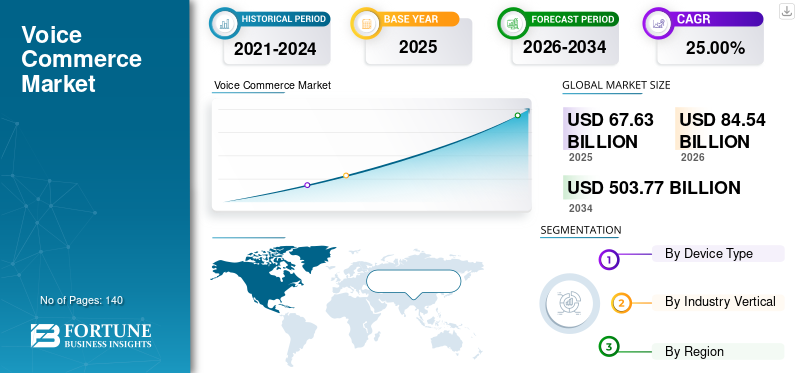
The global voice commerce market size was valued at USD 67.63 billion in 2025. The market is projected to grow from USD 84.54 billion in 2026 to USD 503.77 billion by 2034, exhibiting a CAGR of 25.00% during the forecast period.

The voice commerce market is experiencing rapid growth due to the rising adoption of artificial intelligence-enabled shopping assistants, smart home ecosystems, and voice-enabled digital payment systems. Businesses are integrating voice search, conversational commerce, and multilingual voice interfaces to improve customer engagement and accelerate transaction speed. Retailers are increasingly deploying voice-enabled ordering systems across mobile applications, connected speakers, and automotive infotainment systems. The voice commerce market Report indicates that consumer preference for hands-free shopping and rapid product discovery continues to reshape digital commerce infrastructure. Voice recognition accuracy exceeded 95% across several enterprise platforms in 2025, improving customer confidence and increasing transaction completion rates in the Voice Commerce Industry Analysis.
The United States voice commerce market holds nearly 34% market share due to high penetration of smart speakers, advanced cloud infrastructure, and widespread digital payment adoption. More than 142 million consumers in the country actively used voice assistants for shopping-related activities during 2025. Retail chains and e-commerce operators are integrating conversational AI into omnichannel sales strategies to strengthen customer retention and personalized recommendations. The voice commerce market Research Report highlights that smartphone-based voice purchasing increased by 29% in the U.S. market during 2025. Expansion of connected vehicles, smart televisions, and wearable devices also supports the voice commerce market Growth across consumer retail and subscription-based digital services.
Download Free sample to learn more about this report.
Voice Commerce Market Key Takeaways
 Global Market Size & Forecast
- 2025 Market Size: USD 67.63 Billion
- 2026 Market Size: USD 84.54 Billion
- 2034 Forecast Market Size: USD 503.77 Billion
- CAGR: 25.00% from 2026–2034
 Market Share
- The market in North America dominated with a revenue share of 38% in 2025.
- Smart speakers accounted for a 58% market share by device type.
- Consumer Goods & Retail held a 48% market share by industry vertical.
 Key Regional Highlights
North America
North America led the market with a 38% share in 2025.
Europe
Europe accounted for 27% of the global market, supported by rising digital commerce adoption.
Asia-Pacific
Asia-Pacific held a 28% market share, driven by expanding smartphone and voice assistant usage.
U.S
The U.S. is witnessing strong voice commerce adoption across retail, consumer services, and connected devices.
Japan
Japan accounted for 23% of the Asia-Pacific market, supported by advanced digital and smart-device adoption.
Read More

Voice Commerce Market Latest Trends
Voice commerce market Trends reveal growing adoption of generative artificial intelligence, multilingual speech processing, and contextual recommendation engines. Enterprises are deploying advanced conversational AI systems capable of understanding regional accents, purchasing intent, and behavioral preferences. Voice-enabled subscription ordering increased by 31% during 2025 as businesses optimized recurring purchase systems for groceries, healthcare products, and household essentials. The voice commerce market Analysis also highlights increasing integration between voice assistants and digital wallets, reducing checkout friction for online purchases.
Download Free sample to learn more about this report.
Retail companies are investing heavily in personalized voice interactions supported by predictive analytics and cloud computing infrastructure. Smart speaker manufacturers introduced advanced far-field microphones and noise-filtering technologies that improved command accuracy in crowded environments. The automotive sector is becoming a significant contributor to the Voice Commerce Industry Report as connected vehicles now support in-car product searches, fuel payments, restaurant bookings, and retail purchases through voice commands.
Voice Commerce Market Dynamics
DRIVER
Rising Adoption of Smart Speakers and Ai-Powered Digital Assistants
The increasing deployment of smart speakers and intelligent virtual assistants is the primary driver accelerating the voice commerce market Growth. More than 420 million smart speakers were actively connected worldwide during 2025, creating a large ecosystem for voice-enabled transactions. Consumers increasingly prefer voice-based shopping due to convenience, reduced search time, and personalized recommendations. Retailers are integrating conversational AI into e-commerce platforms to simplify product discovery and improve customer satisfaction. Voice commerce market Insights indicate that voice-assisted grocery ordering expanded by 27% during 2025 as users increasingly relied on automated shopping lists and repeat purchasing systems. Enterprise investment in natural language processing technologies improved voice recognition precision across multilingual environments.
RESTRAINT
Data Privacy and Cybersecurity Concerns
Security concerns remain a major restraint impacting the voice commerce market Size. Consumers remain cautious regarding unauthorized recordings, biometric data misuse, and financial fraud associated with voice-enabled transactions. Voice authentication systems require access to personal data, shopping history, and behavioral analytics, increasing concerns regarding privacy compliance and cyber risks. The Voice Commerce Industry Analysis indicates that nearly 41% of users remain hesitant to complete high-value transactions through voice-enabled platforms. Businesses are investing significantly in encrypted voice recognition systems and multi-factor authentication technologies to address consumer concerns. Regulatory frameworks across Europe and North America are also becoming stricter regarding data collection and digital privacy. Smaller enterprises often struggle with compliance costs associated with cybersecurity upgrades.
OPPORTUNITY
Expansion of Multilingual and Regional Language Commerce Platforms
The growing demand for multilingual digital commerce systems presents major opportunities for the voice commerce market Opportunities segment. Emerging economies across Asia-Pacific, Latin America, and the Middle East are witnessing rising smartphone penetration and internet accessibility, encouraging adoption of regional language voice assistants. Businesses are investing in localized conversational commerce systems capable of supporting dialect-specific shopping interactions. The voice commerce market Forecast highlights strong growth potential in India, Indonesia, Brazil, and Southeast Asian countries where regional language voice interfaces significantly improve digital accessibility. Voice-enabled customer service systems are also helping businesses expand into underserved rural markets. Retailers are using AI-powered speech analytics to deliver localized product recommendations and improve engagement.
CHALLENGE
Limited Contextual Understanding and Transaction Accuracy
One of the major challenges in the voice commerce market is maintaining accurate contextual understanding during complex purchasing interactions. Voice assistants still face difficulties interpreting multiple commands, accents, background noise, and emotionally nuanced speech. Transaction errors, incorrect product selection, and accidental purchases continue to affect consumer confidence. The voice commerce market Research Report indicates that nearly 24% of users experienced at least one transaction-related error while using voice-enabled shopping systems during 2025. Businesses are investing heavily in advanced machine learning models and contextual analytics to improve intent recognition and conversational continuity. However, maintaining real-time response accuracy across millions of product categories remains technically demanding.
Voice Commerce Market Segmentation
By Device Type
Smart speakers account for nearly 58% of the market share within the voice commerce market due to strong household adoption and integration with connected home ecosystems. Consumers increasingly use smart speakers for grocery ordering, digital subscriptions, entertainment purchases, and home appliance management. Retailers are integrating conversational recommendation systems into smart speaker platforms to improve personalized shopping experiences. More than 215 million households globally actively used smart speaker-based commerce systems during 2025. The voice commerce market Insights indicate that voice-enabled repeat purchasing increased substantially among smart speaker users due to automated ordering capabilities.
Smartphones hold approximately 42% market share in the voice commerce market due to widespread mobile internet penetration and increasing adoption of virtual assistants. Consumers increasingly use voice-enabled mobile applications for product searches, online payments, ride-booking services, and subscription management. Smartphone manufacturers are integrating AI-powered voice assistants directly into operating systems to improve user engagement and transaction efficiency. The voice commerce market Analysis highlights strong growth in voice-assisted mobile commerce across Asia-Pacific and North America. More than 68% of digital shoppers used smartphone voice search features during 2025.
By Industry Vertical
Consumer Goods & Retail represents nearly 48% market share within the voice commerce market Size due to increasing digital shopping activity and personalized recommendation systems. Retailers are integrating voice-enabled ordering platforms into omnichannel sales strategies to simplify customer engagement and accelerate checkout processes. Voice-based product search functions significantly improve shopping convenience for groceries, electronics, cosmetics, and household products. The Voice Commerce Industry Report indicates that repeat purchasing through voice assistants increased by 26% during 2025. Businesses are deploying conversational AI systems capable of understanding consumer preferences, purchase history, and regional language variations.
Healthcare contributes nearly 21% market share in the voice commerce market as hospitals, pharmacies, and telehealth providers adopt conversational technologies. Voice-enabled healthcare systems are increasingly used for prescription refills, appointment scheduling, patient reminders, and insurance verification. Pharmaceutical companies are integrating voice commerce systems into digital healthcare platforms to improve medication accessibility and patient engagement. The voice commerce market Outlook highlights growing demand for contactless healthcare interactions and AI-powered patient support tools. Elderly consumers increasingly rely on voice-enabled systems for healthcare product purchases and emergency assistance.
Automotive applications account for nearly 17% market share in the voice commerce market Forecast due to increasing deployment of connected vehicle technologies. Automotive manufacturers are integrating voice-enabled infotainment systems that support fuel payments, navigation purchases, restaurant bookings, and retail transactions. Consumers increasingly use in-car voice assistants for hands-free shopping and digital service subscriptions. The voice commerce market Trends indicate rising collaboration between automotive companies and cloud-based AI providers to improve conversational accuracy and multilingual support. Electric vehicle manufacturers are also integrating voice-controlled charging station payments and route optimization systems.
Voice Commerce Market Regional Outlook
North America
North America accounts for nearly 38% share in the voice commerce market due to widespread adoption of smart speakers, connected home systems, and AI-powered retail platforms. The United States remains the leading contributor because of strong digital infrastructure and high penetration of voice-enabled consumer devices. More than of smart speaker users in the region actively engage with voice-assisted shopping applications for groceries, electronics, and household products. Retail companies are integrating conversational commerce systems into omnichannel sales strategies to improve customer interaction and accelerate transaction completion rates. The voice commerce market Analysis highlights rising demand for personalized recommendation engines and cloud-based conversational AI tools across the region. Healthcare providers are deploying voice-enabled appointment scheduling and pharmacy ordering platforms to improve patient engagement. Automotive companies are also integrating advanced voice commerce capabilities into connected vehicles for navigation services, fuel payments, and digital subscriptions.
Europe
Europe holds approximately 27% market share in the voice commerce market due to increasing digital transformation across retail, banking, healthcare, and automotive industries. Germany, the United Kingdom, and France remain the major contributors because of strong e-commerce infrastructure and high smartphone usage. Consumers increasingly prefer voice-enabled shopping systems for daily purchases, entertainment subscriptions, and digital payment services. The voice commerce market Research Report indicates that voice search activity across European retail platforms increased significantly during 2025. Retailers are investing heavily in AI-driven conversational commerce systems to improve customer engagement and personalized shopping recommendations. Financial institutions are deploying secure biometric voice authentication technologies to strengthen transaction security and reduce digital fraud. Automotive manufacturers across Europe are integrating multilingual voice assistants into connected vehicles to support navigation services and online purchases. Healthcare organizations are adopting voice-enabled patient communication systems and digital consultation tools.
Germany Voice Commerce Market
Germany represents nearly 31% share within the European voice commerce market due to advanced industrial digitization and high adoption of connected consumer electronics. Businesses across retail and automotive sectors are integrating conversational AI systems into customer engagement and digital transaction platforms. German consumers increasingly use voice-enabled technologies for grocery purchases, smart appliance control, and subscription management services. The voice commerce market Insights indicate strong demand for secure voice authentication systems across financial services and healthcare organizations. Automotive manufacturers are integrating intelligent voice assistants into connected mobility solutions and infotainment systems. Retailers are investing in AI-driven recommendation engines to improve personalized shopping experiences and increase repeat purchases. The country also benefits from strong cloud infrastructure and high-speed internet penetration supporting conversational commerce deployment. Healthcare providers are introducing voice-enabled appointment scheduling and prescription ordering platforms.
United Kingdom Voice Commerce Market
The United Kingdom accounts for approximately 26% share within the European voice commerce market due to strong digital payment infrastructure and increasing online retail penetration. Consumers widely use voice-enabled applications for food delivery, household shopping, digital subscriptions, and entertainment services. The voice commerce market Trends highlight increasing deployment of AI-powered customer service systems among retailers and telecommunications companies. Businesses are investing in cloud-based conversational analytics platforms to improve customer engagement and purchasing recommendations. Voice-enabled shopping through smartphones and smart speakers continues expanding among urban consumers seeking convenience and faster transactions. Healthcare providers are integrating voice-based appointment booking and prescription refill services into patient engagement strategies. Financial institutions are deploying biometric voice authentication technologies to strengthen cybersecurity and transaction accuracy. Retail chains are also implementing voice-assisted inventory management and customer support solutions.
Asia-Pacific
Asia-Pacific represents nearly 28% share in the voice commerce market and remains the fastest-growing regional segment due to rising smartphone adoption and expanding internet connectivity. China, Japan, India, and South Korea are leading regional deployment of AI-powered conversational commerce systems. The voice commerce market Forecast highlights significant growth in mobile-based voice shopping among urban and semi-urban consumers during 2025. Retailers are integrating multilingual voice assistants into e-commerce applications to improve accessibility across diverse language groups. Smart speaker manufacturers are introducing affordable connected devices to increase household adoption rates. Automotive companies are deploying voice-enabled infotainment systems supporting navigation purchases, entertainment subscriptions, and digital payments. Healthcare organizations are integrating voice-assisted patient support and pharmaceutical ordering systems into digital healthcare services. Rapid expansion of 5G networks and cloud computing infrastructure is improving conversational AI performance across the region.
Japan Voice Commerce Market
Japan holds approximately 23% share within the Asia-Pacific voice commerce market because of high technological adoption and advanced robotics integration across industries. Consumers increasingly use voice assistants for smart home control, online shopping, healthcare management, and entertainment services. The voice commerce market Analysis indicates rising demand for elderly-friendly conversational systems capable of simplifying digital transactions and healthcare communication. Automotive manufacturers are integrating advanced voice-enabled infotainment systems into connected vehicles to improve customer convenience and hands-free operations. Businesses are investing heavily in natural language processing technologies capable of understanding emotional tone and contextual speech patterns. Retail companies are deploying AI-powered recommendation systems to improve personalized shopping experiences and strengthen customer retention.
China Voice Commerce Market
China accounts for nearly 20% share within the Asia-Pacific voice commerce market due to strong e-commerce penetration and widespread smartphone usage. Consumers actively use voice-enabled applications for grocery ordering, entertainment subscriptions, mobile payments, and online retail purchases. The voice commerce market Size continues expanding as technology companies invest heavily in AI-driven recommendation systems and multilingual voice assistants. Smart speaker adoption increased substantially across urban households during 2025, strengthening conversational commerce activity. Retailers are integrating voice commerce capabilities into live-stream shopping ecosystems to improve customer engagement and increase transaction frequency. Mobile wallet integration and digital payment infrastructure remain major contributors to regional market expansion. Automotive companies are deploying voice-enabled infotainment systems supporting navigation services and digital purchases. Healthcare organizations are implementing conversational AI systems for appointment scheduling and pharmaceutical ordering services.
Rest of World
The Rest of World region holds nearly 7% market share in the voice commerce market supported by increasing internet penetration and expanding mobile commerce ecosystems across Latin America, the Middle East, and Africa. Businesses are introducing voice-enabled digital shopping platforms to improve accessibility and strengthen customer engagement. Smartphone-based voice purchasing systems are becoming increasingly popular among younger consumers seeking hands-free and faster shopping experiences. The voice commerce market Opportunities across emerging economies are supported by rising investment in digital infrastructure and cloud computing technologies. Retailers are integrating AI-powered voice assistants into mobile commerce applications to simplify product discovery and improve customer interaction. Financial institutions are deploying voice authentication technologies to strengthen transaction security and reduce digital fraud risks. Healthcare organizations are introducing voice-enabled appointment scheduling and pharmaceutical ordering systems across urban healthcare networks. Expansion of affordable smart devices.
List of Top Voice Commerce Companies
- Adobe Inc.
- Algolia Inc.
- Alibaba Group Holding Ltd.
- Alphabet Inc.
- Amazon.com Inc.
- Apple Inc.
- Baidu Inc.
- BigCommerce Pty. Ltd.
- Google LLC
- Salesforce Inc.
- Samsung Electronics Co.
- Sonos Inc.
- Sony Corp.
- Twilio Inc.
- Vizio Inc.
Top Two Companies with Highest Market Share
- Amazon.com Inc. – 24% market share
- Alphabet Inc. – 19% market share
Investment Analysis and Opportunities
The voice commerce market is attracting strong investment from cloud computing providers, retail technology firms, automotive manufacturers, and artificial intelligence developers. Businesses are increasing spending on conversational AI infrastructure, multilingual voice recognition systems, and secure payment authentication technologies. Venture capital activity in voice analytics and speech-processing startups increased significantly during 2025 as enterprises sought advanced personalization capabilities. The voice commerce market Opportunities continue expanding with rising deployment of smart speakers, connected appliances, and wearable devices.
Retailers are investing in predictive recommendation engines capable of analyzing user intent and purchasing behavior in real time. Automotive manufacturers are collaborating with AI companies to integrate voice-enabled commercial transactions into connected vehicles. Healthcare providers are funding development of voice-assisted patient engagement systems and pharmaceutical ordering platforms. Financial institutions are investing in biometric voice authentication to strengthen cybersecurity and improve digital transaction security. Expansion of 5G infrastructure and edge computing technologies is creating additional investment opportunities for low-latency conversational commerce systems.
New Product Development
Innovation within the voice commerce market is accelerating as companies introduce advanced conversational AI systems, contextual recommendation engines, and secure biometric authentication technologies. Smart speaker manufacturers launched devices equipped with improved far-field microphone arrays and enhanced speech recognition capabilities during 2025. Several enterprises introduced AI assistants capable of understanding emotional tone, contextual shopping behavior, and multilingual speech patterns. The voice commerce market Trends indicate strong focus on hyper-personalized shopping experiences powered by predictive analytics and machine learning algorithms.
Retail technology providers are developing voice-enabled checkout systems integrated with digital wallets and subscription management platforms. Automotive companies introduced in-car conversational commerce systems supporting parking payments, navigation purchases, and retail ordering through voice commands. Healthcare organizations are deploying AI-powered voice assistants for patient scheduling, medication reminders, and healthcare product ordering. Financial service providers launched voice authentication systems capable of detecting fraudulent speech patterns and improving transaction security. Businesses are also introducing offline voice recognition technologies designed to operate without continuous cloud connectivity, improving response speed and strengthening privacy protection.
Five Recent Developments (2023-2025)
- Amazon.com Inc. expanded AI-powered conversational shopping features for smart speakers and connected televisions during 2025.
- Alphabet Inc. introduced upgraded multilingual voice recognition capabilities across mobile commerce applications in 2024.
- Alibaba Group Holding Ltd. deployed AI-driven voice shopping integration for live-stream retail ecosystems in 2025.
- Apple Inc. enhanced biometric voice authentication systems for secure digital payments and subscription management in 2024.
- Samsung Electronics Co. launched next-generation smart home devices with integrated voice commerce functionality during 2025.
Report Coverage of the Voice Commerce Market
The voice commerce market Report provides comprehensive analysis of industry trends, market dynamics, segmentation patterns, regional performance, competitive landscape, and technological developments shaping global commercialization. The report evaluates adoption trends across smart speakers, smartphones, connected vehicles, and wearable devices while examining deployment across retail, healthcare, and automotive industries. The voice commerce market Research Report also analyzes enterprise investment in conversational AI systems, cloud computing infrastructure, and voice authentication technologies.
Request for Customization to gain extensive market insights.
The study covers major growth drivers including increasing smart device adoption, expansion of digital payment systems, and rising consumer preference for hands-free shopping experiences. Detailed assessment of market restraints such as cybersecurity concerns and transaction accuracy limitations is included within the analysis. The report also examines opportunities associated with multilingual voice platforms, emerging economies, and generative artificial intelligence integration. Regional evaluation includes North America, Europe, Asia-Pacific, and Rest of World with detailed country-level analysis for the United States, Germany, the United Kingdom, Japan, and China.
Frequently Asked Questions
Fortune Business Insights says that the global market value stood at USD 67.63 billion in 2025 and is projected to reach USD 503.77 billion by 2034.
The market is expected to exhibit a CAGR of 25.00% during the forecast period of 2026-2034.
Smart speakers were the leading device type segment, accounting for nearly 58% of the market, supported by strong household adoption and integration with connected home ecosystems.
Key players include Amazon.com Inc., Alphabet Inc., Alibaba Group Holding Ltd., Apple Inc., Samsung Electronics Co., and Adobe Inc.
Major trends include growing adoption of generative AI, multilingual speech processing, and contextual recommendation engines, along with increasing integration of voice assistants with digital wallets. North America leads regionally with a 38% market share.



- 2021-2034
- 2025
- 2021-2024
- 140
-

(Offer valid till 15th Oct 2026)
Get 30-60 hrs Free Customization
Expand Regional and Country Coverage, Segments Analysis, Company Profiles, Competitive Benchmarking, and End-user Insights.




















-
US +1 833 909 2966 ( Toll Free )
-
Get In Touch With Us