Weight Management Botanical Supplements Market Size, Share & Industry Analysis, By Source (Spices, Herbs, Flowers, Leaves, and Others), By Form (Powder, Tablet, Liquid, Capsules, and Others), By Distribution Channel (Supermarkets/Hypermarkets, Pharmacies/Drug Stores, Specialty Stores, Online Retail, and Others), and Regional Forecast, 2026-2034
 Download Free Sample
(Offer valid till 31st Oct 2026)

KEY MARKET INSIGHTS
 Listen to Audio Version
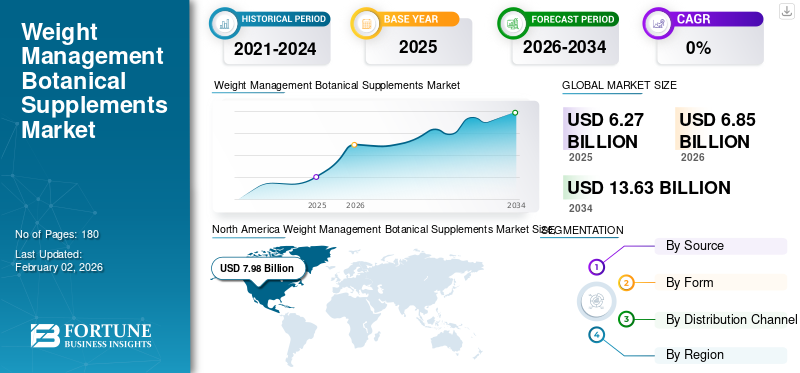
The global weight management botanical supplements market size was valued at USD 6.27 billion in 2025. The market is projected to grow from USD 6.85 billion in 2026 to USD 13.63 billion by 2034, exhibiting a CAGR of 8.99% during the forecast period. North America dominated the weight management botanical supplements market with a market share of 45.08% in 2025.
Weight management botanical supplements are dietary items that contribute to weight loss. These supplements are manufactured from botanical ingredients such as herbs, flowers, and leaves and are intended to supplement a healthy lifestyle and diet. The goal of these weight management products is to minimize appetite, alter fat absorption, and improve metabolism.
Predominantly, the Asia Pacific and North America regions are considered the prominent consumers of weight management supplements. A few of the well-known botanical ingredients such as green tea extract, green coffee bean extract, and moringa extract, are used in these supplements. The rising obesity rates and growing demand for natural weight suppressant supplements are contributing to the global market growth.
A few of the key players in the global industry include Amway Corporation, Herbalife Nutrition, and Shaklee Corporation, among others.
Download Free sample to learn more about this report.
WEIGHT MANAGEMENT BOTANICAL SUPPLEMENTS MARKET KEY TAKEAWAYS
 Global Market Size & Forecast
- 2025 Market Size: USD 6.27 billion
- 2026 Market Size: USD 6.85 billion
- 2034 Forecast Market Size: USD 13.63 billion
- CAGR: 8.99% from 2026–2034
 Market Share
- North America dominated the weight management botanical supplements market with a 45.08% share in 2025.
- The leaves segment led the market due to its high concentration of bioactive compounds.
- The pharmacies/drug stores segment dominated the distribution channel market.
 Key Regional Highlights
North America
North America the market reached USD 2.25 billion in 2025 and is projected to grow to USD 2.43 billion in 2026.
Asia Pacific
Asia Pacific the market reached USD 4.92 billion in 2025 and is expected to grow to USD 5.43 billion in 2026.
Europe
Europe the market was valued at USD 1.21 billion in 2025 and is projected to reach USD 1.32 billion in 2026.
U.S.
The market is expected to witness strong growth, fueled by increasing demand for sports nutrition products and consumer preference for botanical ingredients.
Japan
The market is expected to grow steadily, supported by rising health awareness and increasing demand for plant-based wellness supplements.
Read More

MARKET DYNAMICS
Market Drivers
Surging Prevalence of Obesity Improves Sales of Weight Management Supplements
The rising prevalence of obesity globally is a remarkable factor driving the sales of weight management botanical supplements. Obesity has emerged as a public health concern affecting thousands of individuals worldwide. This health ailment arises due to a combination of factors, such as changes in lifestyle, diet, and environment. Owing to the spike in obesity cases, most consumers are also facing additional health challenges, such as diabetes and cardiovascular ailments. As a result, individuals suffering from obesity are opting for weight management, particularly weight loss products. Moreover, to reduce the negative effects of regular supplements, consumers are switching to botanical supplements, which contribute to both weight management and health.
Market Restraints
Side Effects of Weight Management Supplements and High Costs are Main Hurdles Affecting Market Growth
A major obstacle for global producers is the risk of adverse reactions to weight management supplements. Many weight-reducing supplements contain botanical extracts and stimulants, which are known to cause side effects such as anxiety, high heart rate, and insomnia. Moreover, a few of the supplements pose a risk of interacting with medications, resulting in adverse reactions. Thus, such negative effects can be a barrier to the global weight management botanical supplements market growth.
Additionally, the high prices of weight management botanical supplements pose a significant barrier for consumers. Compared to other conventional ingredients, botanical extracts are expensive to procure and require extra processing. Thus, the aforementioned factors impact the overall price of the finished product.
Market Opportunities
Rising Celebrity Endorsements of Weight Management Products Build Growth Chances
Growing celebrity endorsements of weight loss or maintenance supplements unlock several growth opportunities in the global space. Celebrity endorsements in the weight management supplement industry are considered pivotal tools that can enhance brand awareness and attract consumers. In today’s digital world, over half of the population is moving toward end products endorsed by popular celebrity figures. By associating an end product with a prominent celebrity, the weight management dietary items producers can draw a large base of consumers’ attention. Thus, this marketing strategy can create several growth possibilities for the industry.
Weight Management Botanical Supplements Market Trends
Growing Inclination Toward Natural Ingredients is a Prominent Trend
The global market is witnessing a rising trend of using natural ingredients in weight management items. In today’s era, most consumers seek plant-based ingredients to maintain their health. Compared to synthetic ingredients, natural options are safe and align with a healthy lifestyle. Moreover, such ingredients offer various health benefits such as improving immunity, enhancing gut health, alongside weight management. As a result, this inclination toward natural ingredients influences manufacturers to introduce superior quality weight management products.
SEGMENTATION ANALYSIS
By Source
Leaves Segment Dominated Owing to Its Health Benefits
On the basis of source, the market is segmented into spices, herbs, flowers, leaves, and others. Among these, the leaves segment dominated the weight management botanical supplements market share. They are primarily utilized for weight management purposes, owing to their strong concentration of bioactive components (alkaloids, phenolics). These compounds help in appetite suppression, metabolic stimulation, and enhancing digestion. Some of the popular leaves used for botanical supplements include green tea leaves, moringa leaves, olive leaf, and others. Hence, these benefits are responsible for the segment’s growth.
The herbs segment has a high CAGR and is anticipated to soar at the same pace in the future. The consumer’s inclination toward natural remedies and potential advantages in weight management stimulates their utilization rate.
By Form
Easy Swallowing Properties Drive Tablet Segment Growth
Depending on the form, the market is distributed into powder, tablet, liquid, capsules, and others. The tablet is the leading sector in the global industry. This form of supplement is more stable compared to powder or liquid and has a long shelf life. Also, it is economical, easy to consume, and shows resistance to external factors such as temperature and moisture. As a result, the above-mentioned aspects facilitate the consumption of weight management botanical supplements in tablet form.
Powder is the fastest-growing segment and is predicted to soar at a higher trajectory of growth in the near term. The ease of storing and transport, and flexibility in dosing are promoting the category’s potential.
By Distribution Channel
Pharmacies/Drug Stores Segment Leads Market Due to Its Accessibility
Based on the distribution channel, the market is divided into supermarkets/hypermarkets, pharmacies/drug stores, specialty stores, online retail, and others. Among these, the pharmacies/drug stores secured the first position in the market, primarily due to their convenience and accessibility. Along with this, the personalized service, where pharmacists offer guidance to consumers regarding supplements and cost-effectiveness, boosts the momentum of the segment.
Online retail is the fastest-growing segment and is anticipated to maintain the same growth in the coming years. The rising inclination toward home delivery and discount coupons appeals to a large base of consumers, which boosts the potential.
Weight Management Botanical Supplements Market Regional Outlook
On the basis of region, the market is segmented into North America, Europe, Asia Pacific, South America, and the Middle East & Africa.
North America
North America Weight Management Botanical Supplements Market Size, 2025 (USD Billion)
To get more information on the regional analysis of this market, Download Free sample
North America maintained a strong presence in the global market, reaching USD 2.25 billion in 2025, accounting for 45.08% share, and is expected to reach USD 2.43 billion in 2026. In this region, a mass of individuals is proactively engaging in physical fitness activities and are striving for supplements that can aid in maintaining their weight. Most athletes seek safe and botanical-rich products owing to their minimal side effects and therapeutic advantages. Thus, this demand propels the use of weight management products across the region. Additionally, the rising private-label brands offered by prominent retailers such as Costco and Walmart make it easier for Americans to purchase such supplements. Thus, these factors boost the North America weight management botanical supplement market growth.
Among all countries, the U.S. is the leading nation in the region, followed by Canada and Mexico. The growing demand for weight loss products in the sports nutrition sector, marketing by celebrities, and rising consumer preference for natural alternatives fuel the nation’s potential.
Download Free sample to learn more about this report.
Asia Pacific
The Asia Pacific market accounted for USD 4.92 billion in 2025, representing 40.25% of the global industry, and is expected to reach USD 5.43 billion in 2026. Asia Pacific secured a prominent position and held a substantial market share. In comparison to other regions, the Asia Pacific region encompasses the largest number of individuals with obesity or overweight problems. To minimize this condition, the majority of Asians are moving toward natural plant-centric solutions such as botanical extracts. As a result, this increasing awareness regarding health & wellness bolsters the intake of botanical-enriched weight loss supplements. Moreover, the surging government initiatives and adoption of e-commerce channels have further captivated a wide base of consumers.
Among all Asian countries, China is considered the biggest consumer of weight management botanical supplements in 2024. The influence of traditional medicine and an augmented sedentary lifestyle drives the consumption of supplements made from botanical ingredients.
Europe
In 2025, Europe generated USD 1.21 billion, contributing 41.38% to global market revenue, and is projected to grow to USD 1.32 billion in 2026. Europe is the third largest region and generated the highest market share. The growth of the region is influenced by surging obesity concerns, technological advancements in extraction techniques, and an increasing focus on personalized nutrition. Within the region, Europeans are spending higher amounts on preventative care and are choosing supplements composed of natural ingredients. Specifically, a huge number of consumers seek natural extract-based weight loss supplements. Thus, this reliance on supplements paves the way toward growth.
South America
South America is at its developing stage and is expected to grow at a higher pace in the near future. The expanding supplements industry, surging consumer awareness regarding weight management items, and enhanced purchasing power strengthen the region’s momentum. Latin America contributed 39.27% to the global market in 2025, with a valuation of USD 0.59 billion, and is projected to reach USD 0.64 billion in 2026.
Middle East & Africa
In 2025, the Middle East & Africa region represented USD 0.67 billion, accounting for 35.94% of the worldwide market, and is projected to grow to USD 0.72 billion in 2026. The Middle East & Africa region is also at its nascent stage and is anticipated to rise rapidly over the forecast period. The growing weight-related conditions, increasing disposable income, and surge in supplement firms stimulate the intake of weight management botanical supplements.
COMPETITIVE LANDSCAPE
Key Industry Players
Active Players Concentrate on Promotional Campaigns and New Launches to Strengthen Industry’s Growth
The prominent players in the weight management botanical supplements market include Amway Corporation, Herbalife Nutrition, Shaklee Corporation, GNC Holdings, LLC, and others. Enterprises in the global space are trying to enhance awareness of weight management supplements via promotional campaigns. These campaigns will aid in boosting the product’s awareness, ultimately escalating sales. Moreover, the companies are launching innovative products, particularly for health-conscious consumers, which are expected to strengthen their revenue generation.
List of Key Weight Management Botanical Supplement Companies Profiled
- GNC Holdings, LLC (U.S.)
- Barker Wellness (U.S.)
- Herbalife Nutrition (U.S.)
- Shaklee Corporation (U.S.)
- Fermentis Life Sciences (India)
- Jeeva Organic Private Limited (India)
- Amway Corporation (U.S.)
- Ajinomoto Health & Nutrition (U.S.)
- Himalaya Wellness Company (India)
- HK Vitals (India)
KEY INDUSTRY DEVELOPMENTS
- November 2024: A study conducted by the researchers at Wellness Discovery Labs, a research lab in the U.S., the University of North Florida, and Jacksonville University in Florida claims that the West African spice, sourced from Dichrostachys glomerata, offers weight management advantages.
- January 2024: GNC Holdings, LLC, a health & nutrition-based products manufacturer in the U.S., announced the launch of Total Lean Gluca Trim, which supports lean muscle mass and weight loss. This item comprises white mulberry leaf extract, moringa, turmeric, and other extracts. Additionally, it is available across the U.S.
- August 2023: Princess Luna, a German brand, expanded its portfolio and launched a weight management supplement, “Fat Burner Probiotics,” formulated with botanical extracts (ginger root, bitter orange, and others) and post-biotics for the Chinese population.
- July 2020: Public Health England, a Government agency, released an adult health campaign to tackle the growing obesity concerns. This campaign provides apps and tools that help in making healthier food choices and preventing weight gain in the future.
- February 2021: Iovate Health Sciences, a U.S.-based firm, unveiled a new campaign, “No Fads Just Weight Loss,” through its weight loss supplement brand, Hydroxycut.” This campaign highlights a three-step weight loss journey, which includes a healthy lifestyle and a balanced diet.
REPORT COVERAGE
The global market report includes quantitative and qualitative insights into the market. It also offers a detailed global weight management botanical supplements market analysis of the market sizing and growth rate for all possible market segments. Key insights presented in the report include an overview of related markets, a competitive landscape, recent industry developments such as mergers & acquisitions, the regulatory environment in critical countries, and current global market trends.
Request for Customization to gain extensive market insights.
Report Scope and Segmentation
|
ATTRIBUTE |
DETAILS |
|
Study Period |
2021-2034 |
|
Base Year |
2025 |
|
Estimated Year |
2026 |
|
Forecast Period |
2026-2034 |
|
Historical Period |
2021-2024 |
|
Unit |
Value (USD Billion) |
|
Growth Rate |
CAGR of 8.99% from 2026 to 2034 |
|
Segmentation |
By Source
|
|
By Form
|
|
|
By Distribution Channel
|
|
|
By Region
|
Frequently Asked Questions
Fortune Business Insights says that the global market size was valued at USD 6.27 billion in 2025 and is projected to reach USD 13.63 billion by 2034
The market is expected to grow at a CAGR of 8.99% during the forecast period (2026-2034).
By source, the leaves segment led the market.
The surging prevalence of obesity improves the sales of weight management botanical supplements.
Amway Corporation, Herbalife Nutrition, and GNC Holdings, LLC, are a few of the top players in the market.
North America held the highest share of the market.
Rising celebrity endorsements of weight management products are the key opportunity in the market.



- 2021-2034
- 2025
- 2021-2024
- 180
-
(Offer valid till 31st Oct 2026)
Get 30-60 hrs Free Customization
Expand Regional and Country Coverage, Segments Analysis, Company Profiles, Competitive Benchmarking, and End-user Insights.




















Related Reports
-
US +1 833 909 2966 ( Toll Free )
-
Get In Touch With Us