Welded Spiral Heat Exchangers Market Size, Share & Industry Analysis, By Type (Fully Welded Spiral Heat Exchangers and Semi-Welded Spiral Heat Exchangers), By Material Type (Carbon Steel, Stainless Steel, Duplex & Super Duplex Steel, and Titanium / Specialty Alloys), By Application (Chemical & Petrochemical, Oil & Gas, Pulp & Paper, Power Generation, and Others), and Regional Forecast, 2026-2034
 Download Free Sample
Welded Spiral Heat Exchangers Market Size and Future Outlook
 Listen to Audio Version
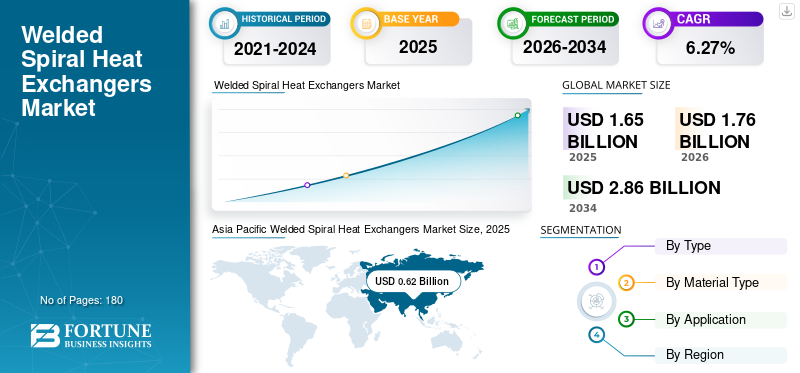
The global welded spiral heat exchangers market size was valued at USD 1.65 billion in 2025. The market is projected to grow from USD 1.76 billion in 2026 to USD 2.86 billion by 2034, with a CAGR of 6.27% during the forecast period. Asia Pacific dominated the welded spiral heat exchangers market with a market share of 37.58% in 2025.
Moreover, Asia Pacific dominates the market, driven by rapid industrialization in China and India, surging petrochemical and chemical processing demand, and infrastructure growth in the power and food sectors.
Welded Spiral Heat Exchangers (WSHEs) are high-performance, compact industrial heat exchangers characterized by two long, metal strips wrapped around a central core to form two concentric spiral channels. Unlike shell-and-tube heat exchangers, they feature a single channel per fluid, which makes them ideal for handling high-viscosity fluids, slurries, and liquids prone to fouling.
- For instance, India's chemical sector, valued at approximately USD 250 billion in 2024, is projected to expand to USD 300 billion by 2028 and reach USD 1 trillion by 2040. Despite global uncertainties, this dynamic industry continues to offer substantial growth opportunities.
Alfa Laval holds a dominant, market-leading position in the welded Spiral Heat Exchanger (SHE) industry. With more than 30,000 units currently in operation, their installed base exceeds that of all other competitors combined. Other players in the market include Danfoss A/S, Nexson Group, and others.
Download Free sample to learn more about this report.
WELDED SPIRAL HEAT EXCHANGERS MARKET TRENDS
Growing Preference for Compact & Space-Saving Equipment is Shaping Market Trends
The growing preference for compact, space-saving equipment is accelerating the adoption of welded spiral heat exchangers across industries facing real estate constraints in modern plants. Their single-pass, counter-current spiral design occupies minimal footprint compared to bulky shell-and-tube alternatives, enabling seamless integration into tight retrofits and greenfield projects. This trend gains momentum in urbanizing industrial hubs, where floor space commands a premium, alongside modular plant configurations that prioritize efficiency. Spiral exchangers deliver high thermal performance within slender envelopes, supporting flexible layouts in chemical processing, power generation, and wastewater facilities while optimizing capital deployment and operational agility.
Welded Spiral Heat Exchangers Market Key Takeaways
 Global Market Size & Forecast
- 2025 Market Size: USD 1.65 Billion
- 2026 Market Size: USD 1.76 Billion
- 2034 Forecast Market Size: USD 2.86 Billion
- CAGR: 6.27% from 2026–2034
 Market Share
- Asia Pacific dominated the market with a 37.58% share in 2025.
- The semi-welded spiral heat exchangers segment led the market in 2025.
- The chemical & petrochemical segment accounted for 40.12% of the market in 2025.
 Key Regional Highlights
Asia Pacific
Asia Pacific led the market with USD 0.62 billion in 2025 and is projected to reach USD 0.67 billion in 2026.
Europe
Europe reached USD 0.45 billion in 2025 and is projected to record a 27.10% CAGR during the forecast period.
North America
North America accounted for USD 0.34 billion in 2025, driven by refinery upgrades and chemical processing demand.
U.S
The market was valued at USD 0.29 billion in 2025.
Japan
The market was valued at USD 0.07 billion in 2025.
Read More

MARKET DYNAMICS
MARKET DRIVERS
Download Free sample to learn more about this report.
Rising Industrialization in Emerging Economies is Driving Market Growth
Rising industrialization in emerging economies is driving demand for welded spiral heat exchangers by fueling rapid expansion in the manufacturing, chemical processing, and power generation sectors. These economies, undergoing rapid infrastructure development and urban growth, require efficient, compact heat-transfer solutions to optimize energy use and streamline operations in resource-intensive industries. Welded spiral designs excel at handling viscous fluids, slurries, and high-pressure environments common in such applications, offering superior thermal efficiency and durability compared to traditional alternatives.
- For instance, in July 2025, Vanya Steels, a subsidiary of A-One Steel Group, invested in a 10 MW waste heat recovery power plant at its Koppal, Karnataka facility using WHRB technology. Expected to be operational by July 2025, it converts steelmaking waste heat into clean electricity, cutting emissions and reducing grid dependence.
As factories multiply and production scales up, industries prioritize reliable equipment to reduce downtime and enhance productivity, making spiral heat exchangers essential for sustainable industrial advancement.
MARKET RESTRAINTS
High Initial Capital Cost to Restraint Market Growth
High initial capital costs act as a key restraint on the welded spiral heat exchangers market growth, deterring widespread adoption, particularly among small and medium enterprises in cost-sensitive regions. The specialized fabrication process, which involves precision welding and high-grade materials to ensure leak-proof performance under extreme conditions, demands a substantial upfront investment compared to conventional shell-and-tube designs. This financial barrier heightens perceived risk for budget-constrained buyers, slowing market penetration in emerging industrial hubs where short-term capital allocation favors cheaper alternatives. Despite long-term savings in maintenance and energy efficiency, the steep entry price often leads to prolonged decision-making cycles and a preference for less robust options.
MARKET OPPORTUNITIES
Growth in Wastewater & Effluent Treatment Plants is Expected to Create Lucrative Opportunities
Growth in wastewater and effluent treatment plants presents a prime opportunity for the market, as these facilities increasing focus robust solutions for efficient heat recovery from complex, contaminated streams. Spiral designs excel at managing high-fouling fluids such as sewage sludge and industrial effluents, providing self-cleaning capabilities through turbulent flow that minimize buildup and extend operational life. With global regulations tightening on water reuse and pollution control, expanding treatment infrastructure in urbanizing regions creates a surge in need for compact, corrosion-resistant exchangers that enhance energy efficiency and reduce treatment costs. This trend positions welded spiral heat exchangers as vital enablers of sustainable water management.
MARKET CHALLENGES
Competition from High-Efficiency Electric & Magnetic Bearing Chillers May Create Challenges for Market Growth
Competition from alternative technologies poses a significant challenge for the market, as innovations in plate-and-frame, brazed plate, and advanced shell-and-tube designs offer compelling advantages in cost, modularity, and ease of maintenance. These rivals often provide higher thermal efficiency for clean fluids, quicker installation, and scalability that appeal to diverse applications, eroding the niche dominance of spiral exchangers for handling viscous or fouling media. Rapid advancements in materials and digital optimization further intensify pressure, compelling manufacturers to innovate relentlessly to demonstrate superior lifecycle value amid shifting customer preferences toward versatile, lower-maintenance options.
Segmentation Analysis
By Type
Semi-Welded Spiral Heat Exchangers are Dominant Due to High Demand
Based on type, the market is classified into fully welded spiral heat exchangers and semi-welded spiral heat exchangers.
In 2025, semi-welded spiral heat exchangers dominated the market share. Demand for semi-welded spiral heat exchangers surges due to their superior handling of aggressive and fouling fluids in refrigeration, industrial heat pumps, and chemical processing, where a single welded circuit ensures leak-free performance. At the same time, the open side allows easy inspection.
Meanwhile, fully welded spiral heat exchangers are poised for significant growth at a 5.11% CAGR over the forecast period. They see rising demand for their robust handling of corrosive, high-pressure fluids in chemical and petrochemical processes, ensuring leak-proof efficiency.
By Material Type
Carbon Steel Segment Dominated Due to Large-Scale Adoption
Based on material type, the market is classified into carbon steel, stainless steel, duplex & super duplex steel, and titanium/specialty alloys.
In 2025, carbon steel dominated the welded spiral heat exchanges market share with 27.75%. Carbon steel drives the demand due to its cost-effectiveness, strength, and weldability in handling moderate-temperature, non-corrosive fluids across industrial processes.
Meanwhile, duplex & super duplex steel are set for significant growth, with a CAGR of 6.27% over the forecast period. Duplex and super duplex steel drive demand in welded spiral heat exchangers for superior corrosion resistance and strength in harsh offshore, chemical, and desalination environments.
By Application
To know how our report can help streamline your business, Speak to Analyst
Chemical & Petrochemical Emerged as a Growing Segment Owing to High Adoption
Based on application, the market is classified into chemical & petrochemical, oil & gas, pulp & paper, power generation, and others.
In 2025, chemical & petrochemical dominated with a 40.12% market share due to their ability to handle corrosive, viscous fluids under high pressure in refining, distillation, and reaction processes. Self-cleaning turbulent flow ensures reliability, boosting energy recovery and process efficiency.
- For instance, in January 2026, the Government of India announced plans to invest USD 500 billion in energy infrastructure to expand oil, gas, and LNG, with PM Modi highlighting opportunities at India Energy Week 2026. Focus areas include refining capacity growth to 300 MTPA, domestic LNG vessel production, new terminals, and pipelines for energy independence.
Meanwhile, oil & gas is primed for significant growth, with a CAGR of 7.01% over the projected period. Oil & gas industries drive welded spiral heat exchanger demand through robust handling of viscous crudes, high-pressure gas streams, and corrosive conditions in refining, separation, and recovery processes, enhancing thermal efficiency and uptime.
Welded Spiral Heat Exchangers Market Regional Outlook
By geography, the market is categorized into North America, Europe, Asia Pacific, Latin America, and the Middle East & Africa.
Asia Pacific
Asia Pacific Welded Spiral Heat Exchangers Market Size, 2025 (USD Billion)
To get more information on the regional analysis of this market, Download Free sample
Asia Pacific held the dominant share in 2025, valued at USD 0.62 billion, and will also lead in 2026, with USD 0.67 billion. Asia Pacific drives the market through rapid industrialization in China and India, surging petrochemical demand, expanding chemical processing, and infrastructure growth in power, HVAC, and food sectors.
China Welded Spiral Heat Exchangers Market
The China market was valued to be around USD 0.28 billion in 2025, accounting for roughly 17.23% of the global market revenues. China's market thrives on rapid petrochemical expansion, chemical processing growth, and power sector modernization, fueled by industrial policies and infrastructure investments, positioning it as the Asia Pacific's dominant hub.
India Welded Spiral Heat Exchangers Market
India's market is projected to be one of the largest globally, with 2025 revenues valued at around USD 0.12 billion, representing approximately 7.10% of the global market.
Japan Welded Spiral Heat Exchangers Market
The Japan market was valued at around USD 0.07 billion in 2025, accounting for approximately 4.51% of global revenues.
Europe
Europe is projected to grow at a CAGR of 27.10% over the coming years, the second-highest among all regions, and reached a valuation of USD 0.45 billion in 2025. Europe's market emphasizes energy-efficient solutions for district heating, food beverages processing, and waste-to-energy plants. European Union EcoDesign regulations and German engineering precision drive adoption, with steady growth in mature chemical and pharmaceutical sectors.
Germany Welded Spiral Heat Exchangers Market
The German market was valued to be around USD 0.11 billion in 2025. It is projected to reach USD 0.12 billion by 2026, representing approximately 6.52% of the global industry revenues.
North America
The North America market reached USD 0.34 billion in 2025, securing its position as the third-largest market region. North America's market is showing steady growth, driven by replacement demand in U.S. oil refineries and chemical plants, and in Canada's mining sector. Strict ASME standards and EPA efficiency rules favor high-performance, gasket-free designs for handling corrosive media.
U.S. Welded Spiral Heat Exchangers Market
With North America's strong contribution and the U.S. dominance in the region, the U.S. market was valued at around USD 0.29 billion in 2025, accounting for roughly 17.45% of the global market. The U.S. market is growing steadily, driven by oil refinery upgrades, chemical processing expansion, and stringent EPA efficiency regulations favoring compact, gasket-free designs for corrosive applications.
Latin America
Latin America is expected to witness moderate growth in this market during the forecast period. The Latin America market reached a valuation of USD 0.09 billion in 2025. The market is led by Brazil's ethanol distilleries, Chile's mining operations, and offshore oil platforms that require compact, corrosion-resistant units for viscous, fouling media.
Brazil Welded Spiral Heat Exchangers Market
Brazil's market reached approximately USD 0.04 billion in 2025, accounting for a very minor share of the global market.
Middle East & Africa
The Middle East & Africa are expected to witness significant growth in this market during the forecast period. The Middle East & Africa market reached a valuation of USD 0.15 billion in 2025. The market is growing, driven by Saudi/UAE oil refining expansion and South African mining wastewater treatment, favoring corrosion-resistant designs for harsh desert and corrosive conditions.
GCC Welded Spiral Heat Exchangers Market
The GCC market reached approximately USD 0.10 billion in 2025, accounting for around 5.87% of the global market.
COMPETITIVE LANDSCAPE
Key Industry Players
Vendors are Focusing on Technological Advancements to Gain a Competitive Edge
The global welded spiral heat exchangers industry is considered consolidated, featuring a mix of major global players and numerous regional manufacturers. Top-tier companies include Alfa Laval, Kelvion Holding GmbH, SPX FLOW, Inc., GEA Group AG, Thermowave GmbH, Tranter Inc., and others. For instance, in September 2025, Alfa Laval unveiled the TS25 semi-welded heat exchanger, advancing energy efficiency for clean energy and process industries. Engineered for pressure-drop-limited applications such as electrolyser cooling, sulphuric acid production, and industrial heat pumps, it offers a compact design, superior performance, durability, and scalability to lower hydrogen costs and boost thermal recovery. Such developments are expected to fuel market growth during the forecast period.
LIST OF KEY WELDED SPIRAL HEAT EXCHANGERS COMPANIES PROFILED IN REPORT:
- Alfa Laval (Sweden)
- Kelvion Holding GmbH (Germany)
- SPX FLOW, Inc. (U.S.)
- GEA Group AG (Germany)
- Thermowave GmbH (Germany)
- Tranter Inc. (U.S.)
- Hisaka Works, Ltd. (Japan)
- SWEP International AB (Sweden)
- Barriquand Technologies Thermiques (France)
- API Heat Transfer Inc. (U.S.)
- Sondex A/S (Denmark)
- SGL Carbon SE (Germany)
- Danstoker A/S (Denmark)
KEY INDUSTRY DEVELOPMENTS
- December 2025: Alfa Laval's spiral heat exchangers at the US Energy's Wisconsin RNG plant handle viscous manure feedstock efficiently, delivering 7,200 MWh/year in energy savings, 18+ months of uptime without maintenance, and reduced CO2 emissions through the self-cleaning design.
- December 2025: Nexson Group delivered the world's largest spiral heat exchangers for a major mining project, showcasing their expertise in handling extreme conditions with custom designs that optimize energy recovery and process efficiency in harsh environments.
- November 2025: Alfa Laval Korea signed an MOU with Hanwha Ocean Ecotech to co-develop safe ammonia fuel systems for dual-fuel vessels, combining Alfa Laval's ammonia supply/mitigation tech with Hanwha's engineering for maritime decarbonization and pilot projects.
- May 2024: Tranter Inc. and Hexxcell Ltd. announced a strategic partnership to revolutionize the monitoring and predictive maintenance of industrial plate-and-frame heat exchangers. Combining Tranter's global expertise with Hexxcell's hybrid-AI digital twin technology, the collaboration delivers actionable insights to drive efficiency gains, reduce downtime, and enable sustainable operations through advanced analytics.
- October 2022: Alfa Laval signed a global partnership with Spirax Sarco, becoming their preferred plate heat exchanger supplier for three years across Europe, Asia, and the U.S. Building on 20 years of collaboration, the deal leverages Alfa Laval's energy-efficient designs, up to 50% more efficient than traditional tech, to support sustainability goals in steam and thermal applications.
REPORT COVERAGE
The global welded spiral heat exchangers market analysis provides an in-depth study of the market size & forecast by all the market segments included in the report. It contains details on the market dynamics and industry trends expected to drive the market during the forecast period. It offers information on technological advancements, new product launches, key industry developments, and partnerships, mergers & acquisitions. The market report also encompasses a detailed competitive landscape, including market share and profiles of key market players.
Request for Customization to gain extensive market insights.
Report Scope & Segmentation
| ATTRIBUTE | DETAILS |
| Study Period | 2021-2034 |
| Base Year | 2025 |
| Estimated Year | 2026 |
| Forecast Period | 2026-2034 |
| Historical Period | 2021-2024 |
| Growth Rate | CAGR of 6.27% from 2026-2034 |
| Unit | Value (USD Billion) |
| Segmentation | By Type, Material Type, Application, and Region |
| By Type |
|
| By Material Type |
|
| By Application |
|
| By Region |
|
Frequently Asked Questions
Fortune Business Insights says that the global market value stood at USD 1.65 billion in 2025 and is projected to reach USD 2.86 billion by 2034.
In 2025, Asia Pacifics market value stood at USD 0.62 billion.
The market is expected to exhibit a CAGR of 6.27% during the forecast period of 2026-2034.
The chemical & petrochemical sector led the application segment.
Expansion of industrial waste heat recovery is driving the market.
Alfa Laval, Kelvion Holding GmbH, SPX FLOW, Inc., GEA Group AG, Thermowave GmbH, and Tranter Inc. are some of the prominent players in the market.
Asia Pacific held the largest share of the market in 2025.
As factories multiply and production scales up, industries prioritize reliable equipment to cut downtime and enhance productivity, positioning spiral heat exchangers as essential for sustainable industrial advancement.



- 2021-2034
- 2025
- 2021-2024
- 180
Get 30-60 hrs Free Customization
Expand Regional and Country Coverage, Segments Analysis, Company Profiles, Competitive Benchmarking, and End-user Insights.



















Related Reports
-
US +1 833 909 2966 ( Toll Free )
-
Get In Touch With Us