Wheat Market Size, Share & Industry Analysis, By Nature (Conventional, Organic), By End-User (B2B, B2C), and Regional Forecast, 2026–2034
 Download Free Sample
Wheat Market Overview
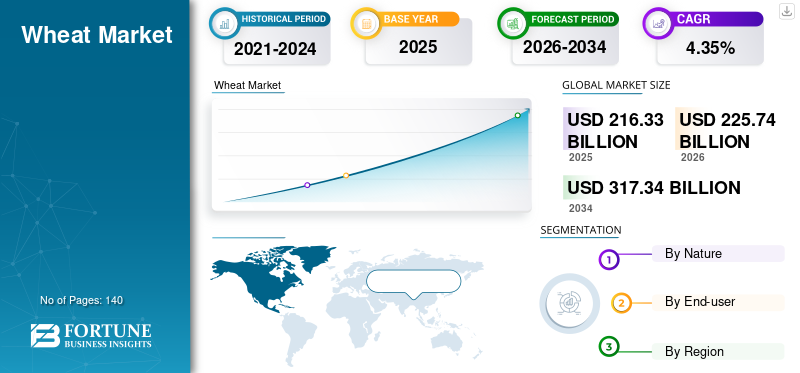
The global wheat market size was valued at USD 216.33 billion in 2025. The market is projected to grow from USD 225.74 billion in 2026 to USD 317.34 billion by 2034, exhibiting a CAGR of 4.35% during the forecast period.

The global wheat market remains one of the most essential agricultural commodity markets due to rising food consumption, expanding population, and increasing demand for wheat-based processed products. Wheat is widely utilized in bakery products, noodles, pasta, breakfast cereals, animal feed, and industrial food processing applications. wheat market analysis highlights growing investments in high-yield seed technologies, precision farming, and climate-resilient agricultural practices to improve production efficiency and food security. Governments across major wheat-producing countries continue to support wheat cultivation through subsidies, export programs, and agricultural modernization initiatives. Rising global trade activities and increasing demand for protein-rich grain products continue to strengthen long-term wheat market growth worldwide.
The USA wheat market remains one of the largest agricultural sectors globally due to advanced farming infrastructure, large-scale export operations, and strong food processing industries. American wheat producers increasingly adopt precision agriculture technologies, automated harvesting systems, and drought-resistant wheat varieties to improve productivity and crop quality. wheat market research report findings indicate rising demand for wheat flour, processed bakery products, and high-protein grain ingredients across the United States food industry. Export demand from Asia-Pacific and Middle Eastern markets continues to support strong domestic wheat production activities. Sustainable farming initiatives and technological advancements in grain storage and logistics are also strengthening the wheat market outlook across the U.S. agricultural industry.
Download Free sample to learn more about this report.
Wheat Market Key Takeaways
 Global Market Size & Forecast
- 2025 Market Size: USD 216.33 Billion
- 2026 Market Size: USD 225.74 Billion
- 2034 Forecast Market Size: USD 317.34 Billion
- CAGR: 4.35% from 2026–2034
 Market Share
- The market in Asia-Pacific dominated with a revenue share of 39% in 2025.
- Conventional wheat held an 81% market share by nature.
- B2B accounted for a 68% market share by end-user.
 Key Regional Highlights
Asia-Pacific
Asia-Pacific held 39%, supported by strong wheat production and consumption.
North America
North America held 29%, driven by advanced farming and food processing.
Europe
Europe accounted for 24%, supported by established wheat production and processing.
U.S
Strong demand from food processing, bakery, and grain industries.
Japan
Japan accounted for 21% of the Asia-Pacific market, supported by wheat-based food consumption.
Read More

Wheat Market Latest Trends
The wheat market trends indicate increasing adoption of precision agriculture technologies, climate-resilient seed varieties, and sustainable farming practices across global agricultural industries. Farmers are increasingly utilizing satellite monitoring systems, AI-driven crop analysis tools, and automated irrigation technologies to improve yield efficiency and reduce environmental impact. Organic wheat cultivation is also gaining popularity due to rising consumer preference for natural and chemical-free food products. wheat market insights further reveal increasing investment in high-protein wheat varieties and specialty grain products for bakery and food processing industries.
Download Free sample to learn more about this report.
Another major trend shaping the Wheat Industry report is the rising demand for processed wheat products and ready-to-eat food applications. Food manufacturers are increasingly utilizing wheat in noodles, bakery products, cereals, and snack foods due to growing urbanization and changing consumer lifestyles. Export-oriented wheat production is also expanding as countries focus on strengthening food supply chains and international grain trade. Governments and agricultural organizations are investing heavily in storage infrastructure, sustainable irrigation systems, and agricultural research programs to improve long-term food security. wheat market forecast trends further indicate increasing demand for organic wheat and functional grain ingredients across health-conscious consumer markets globally.
Wheat Market Dynamics
DRIVER
Rising Global Food Demand and Processed Food Consumption
Increasing global population and rising consumption of wheat-based processed food products are major drivers supporting growth in the wheat market. Wheat remains one of the most widely consumed staple grains globally due to its affordability, nutritional value, and versatility in food manufacturing applications. Bakery products, noodles, pasta, cereals, and snack foods continue to generate strong industrial demand for wheat across both developed and emerging economies. wheat market analysis indicates growing investment in advanced agricultural technologies and high-yield seed varieties aimed at improving production efficiency and ensuring food security.
Urbanization and changing consumer lifestyles are also increasing demand for ready-to-eat and convenience food products utilizing wheat ingredients. Food processing industries are expanding production capacities to meet rising demand for packaged bakery products and processed grain foods. Governments across major agricultural economies are supporting wheat cultivation through subsidies, irrigation infrastructure development, and agricultural modernization programs. Increasing export demand and expansion of global grain trade continue to strengthen market opportunities. These factors collectively continue to support long-term wheat market growth worldwide.
RESTRAINT
Climate Instability and Fluctuating Agricultural Productivity
Climate instability and unpredictable weather conditions remain major restraints for the wheat market. Wheat cultivation is highly sensitive to droughts, floods, extreme temperatures, and changing rainfall patterns, which can significantly affect crop yield and production quality. Agricultural regions experiencing climate-related disruptions often face reduced harvest volumes and supply chain instability. wheat market research report findings also indicate that increasing fertilizer prices, irrigation costs, and fuel expenses continue to create financial pressure on farmers and agricultural producers.
Pest infestations and plant diseases also impact wheat productivity and increase dependency on chemical crop protection solutions. Smaller farmers often struggle to invest in advanced farming technologies and sustainable irrigation systems necessary for maintaining stable production levels. Global trade restrictions and export limitations imposed during supply shortages can further disrupt international wheat supply chains and pricing stability. These operational and environmental challenges continue to create uncertainties within the Wheat Industry analysis landscape.
OPPORTUNITY
Expansion of Organic and Specialty Wheat Products
Growing consumer demand for organic food products and high-quality specialty grains presents substantial opportunities within the wheat market. Health-conscious consumers increasingly prefer organic wheat products free from synthetic fertilizers and chemical pesticides. Food manufacturers are expanding production of organic bakery products, cereals, and whole-grain foods to meet changing dietary preferences. wheat market opportunities are also increasing through development of high-protein wheat varieties and fortified grain ingredients designed for premium food applications.
Emerging economies with expanding food processing industries and rising disposable income offer strong growth potential for wheat-based consumer products. Agricultural technology companies are investing heavily in precision farming systems, AI-driven crop monitoring tools, and sustainable irrigation solutions to improve productivity and environmental sustainability. Export-oriented wheat production and international grain trade are also creating additional commercial opportunities for large agricultural producers and food manufacturers. Continuous innovation in grain processing technologies and specialty wheat cultivation is expected to strengthen long-term wheat market outlook opportunities globally.
CHALLENGE
Supply Chain Disruptions and Volatile Commodity Pricing
Supply chain disruptions and volatile commodity prices remain major challenges for the wheat market. Transportation costs, fuel price fluctuations, and geopolitical uncertainties can significantly affect wheat distribution and international trade operations. Global wheat prices are highly influenced by weather conditions, export restrictions, and agricultural policy changes among major wheat-producing countries. These factors create pricing instability and operational uncertainty for farmers, grain processors, and food manufacturers.
wheat market insights also highlight increasing pressure on agricultural producers to adopt sustainable farming practices while maintaining profitability and competitive production costs. Labor shortages, storage limitations, and inadequate rural infrastructure in certain regions further affect supply chain efficiency and grain quality management. Food manufacturers relying heavily on wheat-based ingredients must also manage fluctuating raw material costs and changing consumer demand patterns. Companies operating within the wheat market forecast landscape must therefore balance productivity improvement, sustainability initiatives, and efficient supply chain management to maintain strong market competitiveness.
Wheat Market Segmentation
By Nature
Conventional wheat dominates the global wheat market and contributes approximately 81% of total market share due to large-scale commercial farming operations and widespread industrial food processing demand. Conventional wheat cultivation relies on advanced farming technologies, chemical fertilizers, and high-yield crop protection methods to maximize productivity and maintain stable supply chains. Food manufacturers extensively utilize conventional wheat in bakery products, noodles, pasta, breakfast cereals, and packaged food applications because of its consistent quality and large-scale availability. Major wheat-producing countries continue investing in modern irrigation systems, mechanized harvesting technologies, and precision agriculture practices to improve production efficiency and export competitiveness. Conventional wheat remains highly important for global food security because it supports large population centers and industrial food manufacturing operations.
Organic wheat contributes approximately 19% of the global wheat market and continues to witness increasing demand due to rising consumer preference for natural and chemical-free food products. Organic wheat cultivation avoids synthetic fertilizers and chemical pesticides while emphasizing environmentally sustainable agricultural practices and soil health management. Health-conscious consumers increasingly prefer organic bakery products, cereals, and whole-grain foods because of growing awareness regarding food quality and nutritional benefits. Food manufacturers and specialty grain suppliers are expanding organic wheat production to meet rising demand from premium food markets and natural product retailers. wheat market analysis highlights increasing investment in sustainable farming technologies, biological crop protection systems, and regenerative agriculture methods aimed at improving organic wheat productivity.
By End-user
The B2B segment accounts for approximately 68% of the global wheat market and represents the largest application category due to strong industrial demand from food manufacturers, bakery companies, grain processors, and animal feed industries. Wheat is widely utilized as a primary raw material in flour production, pasta manufacturing, cereals, snack foods, and processed food applications. Industrial buyers prioritize consistent grain quality, high protein content, and reliable supply chain operations when sourcing wheat products. Large-scale food processing companies and commercial bakeries continue to increase wheat procurement volumes due to rising global demand for packaged food products and ready-to-eat meals. wheat market research report findings indicate growing investment in grain storage infrastructure, automated milling technologies, and export logistics systems to support industrial wheat supply chains.
The B2C segment contributes approximately 32% of the global wheat market and continues to grow steadily due to rising household consumption of wheat-based food products. Consumers increasingly purchase wheat flour, whole-grain products, breakfast cereals, bakery goods, and packaged snacks through retail stores, supermarkets, and online grocery platforms. Health-conscious consumers are also showing strong interest in organic wheat products and fortified grain foods designed for balanced nutrition and healthy diets. Urbanization and changing dietary habits continue to support rising demand for convenience foods and ready-to-cook wheat products across both developed and emerging economies. wheat market forecast trends indicate increasing popularity of specialty flour products including gluten-managed, multigrain, and protein-enriched wheat formulations among retail consumers.
Wheat Market Regional Outlook
North America
North America accounts for 29% of the global wheat market and remains one of the leading agricultural production and export regions worldwide. The region benefits from advanced farming infrastructure, large-scale mechanized agriculture, and strong grain storage and transportation systems. Wheat cultivation across the United States and Canada supports extensive food processing industries, export operations, and animal feed manufacturing activities. High-protein wheat varieties and advanced precision farming technologies continue to improve production efficiency and crop quality across the region.
Food manufacturers across North America increasingly utilize wheat in bakery products, cereals, snack foods, and processed meals due to strong consumer demand for convenience foods and packaged grain products. Governments and agricultural organizations continue investing in irrigation infrastructure, sustainable farming practices, and agricultural research programs aimed at improving long-term food security. Wheat exports to Asia-Pacific, Latin America, and Middle Eastern markets continue to strengthen regional trade activities. Technological advancements in harvesting systems, crop monitoring, and grain logistics are also supporting the continued expansion of the wheat market throughout North America.
Europe
Europe contributes 24% of the global wheat market and continues to witness stable growth due to strong agricultural infrastructure and increasing demand for high-quality grain products. Wheat remains one of the most important cereal crops across Europe because of its extensive utilization in bakery products, pasta, animal feed, and industrial food processing applications. European farmers increasingly adopt precision agriculture technologies, sustainable irrigation systems, and environmentally responsible cultivation practices to improve productivity and reduce environmental impact.
Organic wheat production is gaining significant momentum across Europe due to rising consumer preference for natural and sustainably sourced food products. Governments and agricultural cooperatives continue supporting research initiatives focused on climate-resilient wheat varieties and advanced crop protection technologies. wheat market insights indicate increasing export demand for premium European wheat from Middle Eastern and African food markets. Modern grain storage systems and efficient logistics infrastructure continue to strengthen supply chain operations throughout the region. Increasing consumption of bakery products and processed grain foods continues to support long-term wheat market growth across Europe.
Germany Wheat Market
Germany accounts for 37% of the European wheat market and remains one of the largest grain-producing and food-processing economies in the region. The country’s advanced agricultural infrastructure and modern farming practices support high wheat productivity and strong domestic food manufacturing industries. Wheat is extensively utilized in bakery products, beer production, cereals, and industrial food processing applications throughout Germany. Farmers increasingly adopt precision agriculture technologies and sustainable cultivation methods to improve crop quality and environmental efficiency.
Organic wheat production and specialty grain farming are also witnessing strong growth due to rising consumer demand for healthy and environmentally sustainable food products. German food manufacturers continue investing in advanced milling technologies, automated grain processing systems, and export-oriented food production capabilities. wheat market analysis highlights increasing focus on climate-resilient crop varieties and efficient irrigation systems to address changing environmental conditions. Strong retail distribution networks and rising consumption of premium bakery products continue to strengthen Germany’s position within the Wheat Industry analysis landscape.
United Kingdom Wheat Market
The United Kingdom contributes 28% of the European wheat market and remains an important agricultural and food-processing market within the region. Wheat cultivation supports large-scale bakery industries, flour milling operations, and livestock feed production across the country. British farmers increasingly focus on sustainable agriculture practices, crop rotation systems, and high-yield wheat varieties to improve production efficiency and soil management.
The food processing industry in the United Kingdom continues to drive substantial demand for wheat flour, cereals, snack foods, and convenience products due to changing consumer lifestyles and rising urbanization. Organic wheat and specialty grain products are also gaining popularity among health-conscious consumers seeking natural and minimally processed foods. wheat market forecast trends indicate increasing investment in digital farming technologies, climate monitoring systems, and automated harvesting equipment across the country’s agricultural sector. Expansion of modern retail chains and online grocery platforms continues to improve accessibility to premium wheat-based consumer products throughout the United Kingdom.
Asia-Pacific
Asia-Pacific dominates the global wheat market with 39% market share and represents the fastest-growing region due to rising population, increasing food consumption, and rapid expansion of food processing industries. Countries including China, India, Japan, and Australia are major producers and consumers of wheat products across bakery, noodle, cereal, and processed food applications. Rapid urbanization and changing dietary habits continue to increase demand for wheat-based convenience foods and packaged grain products throughout the region.
Governments across Asia-Pacific are heavily investing in agricultural modernization, irrigation infrastructure, and high-yield wheat seed technologies to improve domestic food security and production efficiency. wheat market research report findings indicate increasing adoption of mechanized farming systems and AI-driven crop monitoring technologies among large agricultural producers. International wheat trade and import activities are also expanding to support growing regional food demand. Rising middle-class income levels and increasing consumption of processed bakery products continue to create strong long-term growth opportunities for the wheat market across Asia-Pacific.
Japan Wheat Market
Japan contributes 21% of the Asia-Pacific wheat market and remains a technologically advanced food-processing economy with strong demand for premium wheat products. Wheat is widely utilized in noodles, bakery products, confectionery items, and processed food manufacturing across Japan’s food industry. Consumers increasingly prefer high-quality wheat flour and specialty grain products designed for premium bakery and packaged food applications.
Japanese agricultural organizations continue investing in advanced crop management systems, climate-resilient farming technologies, and sustainable agricultural practices to improve wheat productivity and food security. Food manufacturers are expanding production of convenience foods and ready-to-eat wheat-based products to meet changing consumer lifestyles and urban consumption trends. wheat market outlook trends indicate increasing import demand for high-protein wheat varieties and specialty grain ingredients. Technological innovation in food processing and rising consumer preference for healthy grain-based diets continue to support stable market expansion across Japan.
China Wheat Market
China accounts for 4% of the Asia-Pacific wheat market and remains the largest producer and consumer of wheat products within the region. The country’s massive population and rapidly expanding food processing industry continue to drive substantial demand for wheat across noodles, bakery products, animal feed, and industrial food applications. Urbanization and rising middle-class income levels are significantly increasing consumption of packaged wheat-based foods and convenience products.
Chinese agricultural producers are heavily investing in mechanized farming equipment, advanced irrigation systems, and high-yield seed technologies to improve domestic wheat productivity. Government support for agricultural modernization and food security initiatives continues to strengthen wheat cultivation and supply chain operations across the country. wheat market trends indicate rising demand for imported premium wheat varieties and specialty grain ingredients for food manufacturing applications. Expansion of e-commerce grocery platforms and modern retail infrastructure continues to improve accessibility to wheat-based consumer products throughout China.
Rest of the World
The Rest of World region contributes 8% of the global wheat market and includes emerging agricultural economies across Latin America, the Middle East, and Africa. Increasing population growth, urbanization, and food security initiatives are supporting gradual expansion of wheat production and consumption throughout these regions. Wheat is widely utilized in bread production, flour milling, animal feed, and processed food applications because of its affordability and nutritional importance.
Governments and agricultural organizations are investing in irrigation systems, grain storage infrastructure, and climate-resilient farming technologies to improve agricultural productivity and reduce food import dependency. International wheat trade and food aid programs also continue to support market growth across developing economies. wheat market opportunities are increasing through expansion of modern retail channels, packaged food industries, and commercial bakery operations. Rising awareness regarding balanced nutrition and increasing adoption of mechanized farming systems continue to create favorable long-term opportunities for the wheat market throughout Rest of World regions.
List of Top Wheat Companies
- China National Cereals, Oils and Foodstuffs Corporation (COFCO)
- Archer-Daniels-Midland (ADM)
- Cargill, Inc.
- CHS Inc.
- Bunge
- Glencore
- Louis Dreyfus Company
- Ardent Mills
- The Scoular Company
- Munsa
- Nisshin Seifun Group Inc.
- SENSAKO
- The Soufflet Group
- Adani Wilmar
- Adecoagro
Top Two Companies by Market Share
- Cargill, Inc. – 15% market share
- Archer-Daniels-Midland (ADM) – 12% market share
Investment Analysis and Opportunities
The wheat market continues to attract substantial investment due to rising global food demand, expanding processed food industries, and increasing focus on agricultural modernization. Governments and private agricultural organizations are investing heavily in precision farming technologies, climate-resilient seed development, automated irrigation systems, and grain storage infrastructure to improve production efficiency and food security. Large agribusiness companies are also expanding grain processing facilities and export logistics networks to strengthen international wheat trade operations.
Organic wheat farming and specialty grain production present significant long-term investment opportunities due to growing consumer demand for healthy and sustainable food products. Food processing companies are investing in high-protein wheat varieties, fortified flour products, and advanced milling technologies to support premium food manufacturing applications. Emerging economies with expanding urban populations and rising packaged food consumption continue to offer strong commercial potential for wheat producers and grain processors. Continuous innovation in digital agriculture, supply chain optimization, and sustainable cultivation practices is expected to strengthen future wheat market opportunities globally.
New Product Development
Innovation remains a key competitive factor within the wheat market as food manufacturers and agricultural companies focus on improving grain quality, sustainability, and nutritional value. Companies are developing high-protein wheat varieties, fortified flour products, and specialty grain formulations designed for bakery, cereal, and functional food applications. Organic wheat products and whole-grain food ingredients are also gaining popularity among health-conscious consumers seeking natural and minimally processed dietary options.
Agricultural technology companies continue investing in climate-resilient wheat seeds, AI-driven crop management systems, and precision farming technologies aimed at improving productivity and reducing environmental impact. Food manufacturers are introducing wheat-based convenience foods, protein-enriched snacks, and ready-to-cook bakery products to meet changing consumer lifestyles and urban consumption patterns. wheat market insights indicate that continuous innovation in sustainable farming methods, specialty grain processing, and advanced food applications will remain essential for long-term market competitiveness.
Five Recent Developments (2023-2025)
- Cargill, Inc. expanded grain storage and wheat export infrastructure in 2024.
- Archer-Daniels-Midland (ADM) introduced advanced wheat milling technologies for premium flour production in 2025.
- COFCO increased investment in climate-resilient wheat farming initiatives during 2023.
- Bunge strengthened wheat supply chain operations and export logistics in 2024.
- Louis Dreyfus Company expanded sustainable grain sourcing programs during 2025.
Report Coverage of Wheat Market
The Wheat Market Report provides a comprehensive analysis of industry trends, growth drivers, restraints, opportunities, and competitive developments influencing global grain production and food processing industries. The report evaluates major market segments including conventional wheat, organic wheat, B2B applications, and B2C food consumption patterns. wheat market analysis also includes regional demand patterns, agricultural modernization trends, and international grain trade activities to provide detailed business insights.
Request for Customization to gain extensive market insights.
The report further examines technological advancements including precision agriculture, AI-based crop monitoring systems, sustainable irrigation technologies, and advanced grain storage infrastructure shaping industry growth. Regional analysis covers North America, Europe, Asia-Pacific, and Rest of World markets with country-level evaluations for major agricultural economies. wheat market research report findings also highlight strategic developments including agricultural investments, specialty grain innovation, export expansion, and sustainable farming initiatives adopted by leading companies. The report scope supports long-term business planning, investment evaluation, and strategic decision-making within the global agricultural and food processing industries.
Frequently Asked Questions
Fortune Business Insights says that the global market value stood at USD 216.33 billion in 2025 and is projected to reach USD 317.34 billion by 2034.
The market is expected to exhibit a CAGR of 4.35% during the forecast period of 2026-2034.
Conventional wheat was the leading nature segment, accounting for approximately 81% of the market, driven by its widespread availability and strong demand from industrial food processing.
Key players include Cargill, Inc., Archer-Daniels-Midland (ADM), China National Cereals, Oils and Foodstuffs Corporation (COFCO), CHS Inc., Bunge, and Glencore.
Major trends include increasing adoption of precision agriculture, climate-resilient seeds, and sustainable farming practices, alongside rising demand for processed wheat products and specialty grains. Asia-Pacific leads regionally with a 39% market share.



- 2021-2034
- 2025
- 2021-2024
- 140
-

(Offer valid till 15th Oct 2026)
Get 30-60 hrs Free Customization
Expand Regional and Country Coverage, Segments Analysis, Company Profiles, Competitive Benchmarking, and End-user Insights.














-
US +1 833 909 2966 ( Toll Free )
-
Get In Touch With Us