Wind Turbine Tower Market Size, Share & Industry Analysis, By Type (Steel Tower, Concrete Tower, Hybrid Tower), By Installation (Offshore, Onshore) and Regional Forecast, 2026-2034
 Download Free Sample
Wind Turbine Tower Market Overview
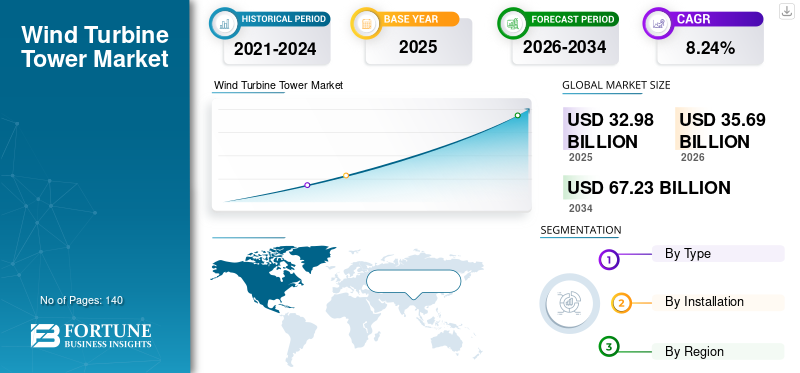
The wind turbine tower market size was valued at USD 32.97 billion in 2025. The market is projected to grow from USD 35.69 billion in 2026 to USD 67.22 billion by 2034, exhibiting a CAGR of 8.24 % during the forecast period.

The wind turbine tower market is witnessing substantial expansion due to increasing renewable energy deployment, rising investments in utility-scale wind farms, and growing global focus on carbon emission reduction. Wind turbine towers play a critical role in supporting turbine efficiency by enabling greater rotor height and stronger wind capture capability. The wind turbine tower market report highlights increasing adoption of high-capacity towers designed for offshore and onshore wind installations. Technological advancements in hybrid tower construction, modular manufacturing, and lightweight structural materials are improving installation flexibility and operational efficiency. Expansion of government-supported clean energy projects continues to support wind turbine tower market growth globally.
The USA wind turbine tower market is growing steadily due to rising investments in renewable power generation and expansion of utility-scale wind energy projects across multiple states. Energy developers in the United States are increasingly deploying advanced steel and hybrid wind turbine towers capable of supporting higher-capacity turbines and improved energy output. Federal clean energy initiatives and growing corporate renewable energy procurement are encouraging infrastructure development across the country. Increasing modernization of transmission networks and rising focus on energy independence continue to strengthen wind turbine tower market trends throughout the United States.
Download Free sample to learn more about this report.
Wind Turbine Tower Market Key Takeaways
 Global market size & Forecast
- 2025 market size: USD 32.97 Billion
- 2026 market size: USD 35.69 Billion
- 2034 Forecast market size: USD 67.22 Billion
- CAGR: 8.24% from 2026–2034
 market share
- The market in North America dominated with a revenue share of 34% in 2025.
- Steel towers held a 58% market share by type.
- Onshore installations accounted for a 63% market share.
 Key Regional Highlights
North America
North America held 34%, driven by expanding wind energy projects.
Asia-Pacific
Asia-Pacific held 30%, supported by growing renewable energy investments.
Europe
Europe accounted for 29%, driven by offshore and onshore wind development.
U.S
Strong demand from utility-scale and onshore wind projects.
Japan
22% of Asia-Pacific, supported by offshore wind development.
Read More

Wind Turbine Tower Market Latest Trends
The wind turbine tower market trends indicate increasing adoption of taller turbine towers and modular construction technologies to improve wind energy generation efficiency. Manufacturers are developing lightweight hybrid towers combining steel and concrete structures to support larger turbines and reduce transportation limitations. Offshore wind projects are also driving demand for corrosion-resistant tower systems capable of operating in harsh marine environments.
Download Free sample to learn more about this report.
Another major trend in the wind turbine tower market analysis is the growing use of automation and digital monitoring technologies within tower manufacturing and maintenance operations. Companies are integrating sensor-based structural monitoring systems and predictive maintenance technologies to improve tower durability and operational reliability. Rising deployment of floating offshore wind farms is also encouraging innovation in tower engineering and anchoring technologies. Expansion of renewable energy infrastructure and government clean energy targets continues to create strong wind turbine tower market opportunities. Increasing localization of manufacturing operations and supply chain optimization strategies are further reshaping the global wind turbine tower industry.
Wind Turbine Tower Market Dynamics
DRIVER
Rising Global Investment in Renewable Energy Infrastructure
The primary factor driving wind turbine tower market growth is the increasing global investment in renewable energy infrastructure and large-scale wind farm deployment projects. Governments and private energy companies are accelerating wind power installation activities to reduce dependence on fossil fuels and strengthen long-term energy sustainability. Wind turbine towers are essential structural components that directly influence turbine performance, energy generation efficiency, and operational stability.
The wind turbine tower market research report highlights that rising demand for utility-scale wind power generation is increasing adoption of taller and stronger tower structures capable of supporting larger turbine blades and advanced nacelle systems. Offshore wind development programs are also generating strong demand for corrosion-resistant tower designs and specialized engineering solutions. Energy developers are prioritizing modern tower systems with improved durability, transportation flexibility, and maintenance efficiency. Expansion of national renewable energy targets and corporate sustainability initiatives continues to strengthen long-term wind turbine tower market opportunities globally.
RESTRAINT
High Transportation and Installation Costs
One of the major restraints affecting the wind turbine tower market is the high transportation and installation cost associated with large-scale tower structures. Wind turbine towers often require specialized logistics systems, heavy transportation equipment, and complex assembly procedures, particularly for remote onshore and offshore wind projects. Oversized tower components can create operational challenges related to road infrastructure limitations and port handling capabilities.
The Wind Turbine Tower industry analysis also indicates that fluctuating steel prices and raw material supply chain disruptions can significantly impact manufacturing costs and project profitability. Tower manufacturers must continuously manage cost pressures while maintaining structural quality and regulatory compliance standards. Delays in project approvals, environmental permitting processes, and grid connectivity development can also affect deployment timelines. These operational and financial constraints continue to limit rapid market expansion across certain developing regions and smaller energy markets.
OPPORTUNITY
Expansion of Offshore Wind Energy Projects
The rapid expansion of offshore wind energy projects presents substantial wind turbine tower market opportunities for manufacturers, engineering firms, and renewable energy developers. Offshore wind farms require highly durable tower systems capable of supporting larger turbines in challenging marine environments. Governments worldwide are increasingly investing in offshore renewable infrastructure to improve energy security and accelerate decarbonization goals.
The wind turbine tower market Outlook highlights increasing opportunities for floating wind tower technologies, hybrid tower systems, and modular offshore structures. Companies are investing in corrosion-resistant materials, advanced fabrication methods, and automated installation technologies to improve offshore project efficiency. Rising deployment of deep-water wind farms and expansion of coastal renewable energy infrastructure continue to strengthen market potential. Increasing collaboration between renewable energy developers, infrastructure investors, and tower manufacturers is also supporting long-term industry growth.
CHALLENGE
Structural Durability and Supply Chain Complexity
Structural durability remains a major challenge within the wind turbine tower market due to continuous exposure to harsh environmental conditions, high wind loads, and operational stress. Wind turbine towers must maintain long-term mechanical stability while supporting increasingly larger turbine systems and higher rotor diameters. Offshore tower structures face additional challenges related to corrosion, saltwater exposure, and extreme weather conditions.
The wind turbine tower market forecast also identifies supply chain complexity and manufacturing scalability as major industry challenges. Tower manufacturers require consistent access to steel, concrete, fabrication equipment, and transportation infrastructure to support growing project demand. Skilled labor shortages and rising energy costs can further affect production efficiency and operational profitability. Companies are increasingly investing in advanced materials, digital manufacturing systems, and localized supply chains to improve structural performance and strengthen operational resilience within the wind turbine tower industry.
Wind Turbine Tower Market Segmentation
By Type
Steel towers account for approximately 58% of the wind turbine tower market share due to their high structural strength, manufacturing scalability, and widespread use across utility-scale wind projects. Steel towers are highly preferred for both onshore and offshore installations because they provide excellent durability and flexibility for supporting large-capacity wind turbines. Manufacturers continue to optimize steel tower designs to improve transportation efficiency and installation performance. The wind turbine tower market analysis highlights increasing demand for tubular steel towers with enhanced corrosion resistance and modular construction capabilities. Offshore wind developers particularly favor steel towers due to their ability to withstand harsh marine conditions and support high-capacity turbines. Rising investment in renewable energy infrastructure continues to strengthen long-term demand within the steel tower segment globally.
Concrete towers contribute nearly 24% of the wind turbine tower market size due to increasing adoption in high-altitude and remote onshore wind installations. Concrete tower systems offer strong stability, reduced vibration, and improved lifespan compared to certain conventional structures. Energy developers are increasingly using precast concrete sections to overcome transportation limitations associated with oversized steel components. The wind turbine tower market insights indicate rising use of concrete towers in regions with challenging terrain and limited transportation infrastructure. Hybrid concrete technologies and advanced casting methods are improving installation efficiency and reducing maintenance requirements. Expansion of utility-scale wind projects in inland regions continues to support market demand within this segment.
Hybrid towers represent approximately 18% of the wind turbine tower market share due to increasing demand for taller turbine structures capable of maximizing wind energy capture. Hybrid towers combine steel and concrete materials to improve structural efficiency, reduce transportation challenges, and support larger turbine systems. These towers are becoming increasingly popular for modern wind farms requiring high hub heights and improved energy generation performance. The wind turbine tower market report highlights growing investment in modular hybrid tower systems and advanced fabrication technologies. Hybrid structures provide enhanced flexibility for complex wind farm installations and can support deployment in remote locations with transportation constraints. Increasing focus on optimizing wind turbine efficiency and reducing installation costs continues to strengthen growth within the hybrid tower segment.
By Installation
Offshore installations account for approximately 37% of the wind turbine tower market share due to rising global investment in offshore renewable energy infrastructure and large-capacity marine wind farms. Offshore wind turbine towers are designed to support high-capacity turbines operating in demanding environmental conditions including strong winds, corrosion exposure, and deep-water deployment challenges. The Wind Turbine Tower industry report highlights increasing adoption of corrosion-resistant materials, floating tower technologies, and automated offshore assembly systems. Governments and private energy developers are prioritizing offshore wind projects due to their high energy generation potential and long-term sustainability advantages. Expansion of coastal energy infrastructure and deep-water wind farm development continues to create strong market demand within the offshore installation segment.
Onshore installations contribute nearly 63% of the wind turbine tower market size due to extensive deployment of land-based wind energy projects across developed and emerging economies. Onshore wind farms remain highly attractive because of lower installation complexity, reduced operational costs, and established infrastructure networks. Steel and hybrid towers are widely used within onshore projects to support larger turbine systems and improve energy capture efficiency. The wind turbine tower market forecast indicates rising investment in high-capacity onshore wind projects and repowering initiatives aimed at replacing older turbine infrastructure with modern systems. Energy developers are increasingly adopting taller tower structures to maximize performance in lower wind-speed regions. Expansion of renewable energy targets and grid modernization initiatives continues to strengthen demand for onshore wind turbine towers globally.
Wind Turbine Tower Market Regional Outlook
North America
North America accounts for approximately 34% of the wind turbine tower market share due to strong renewable energy investment, expanding utility-scale wind farms, and supportive clean energy policies. The region continues to witness increasing deployment of high-capacity wind turbines across both onshore and offshore energy projects.
The wind turbine tower market Outlook for North America highlights rising demand for modular tower systems, advanced steel fabrication technologies, and hybrid tower solutions. Energy developers are increasingly investing in grid modernization and offshore renewable energy infrastructure to strengthen long-term energy security. Expansion of domestic manufacturing capabilities continues to support market growth across the region.
Europe
Europe represents nearly 29% of the wind turbine tower market share due to aggressive renewable energy targets and strong offshore wind development activities. European countries continue to invest heavily in offshore wind farms, floating wind technologies, and advanced renewable infrastructure projects.
The Wind Turbine Tower industry analysis highlights increasing adoption of corrosion-resistant offshore towers and lightweight hybrid tower technologies throughout Europe. Governments are prioritizing decarbonization strategies and renewable energy integration within national power systems. Expansion of large-scale offshore wind farms and coastal energy infrastructure continues to support regional market development.
Germany Wind Turbine Tower Market
Germany contributes approximately 31% of the European wind turbine tower market share due to strong renewable energy infrastructure and advanced wind power manufacturing capabilities. German energy developers are increasingly deploying taller and more efficient wind turbine towers to improve renewable power generation capacity.
The Germany wind turbine tower market report highlights growing investment in offshore wind expansion, modular tower manufacturing, and sustainable energy modernization programs. Technological innovation in hybrid tower engineering and advanced fabrication systems continues to strengthen Germany’s position within the global wind turbine tower industry. Increasing focus on grid stability and renewable integration is also supporting long-term market growth.
United Kingdom Wind Turbine Tower Market
The United Kingdom accounts for approximately 24% of the European wind turbine tower market share due to strong offshore wind energy development and increasing renewable infrastructure investment. The country remains one of the leading offshore wind markets globally, driving substantial demand for advanced wind turbine tower systems.
The United Kingdom wind turbine tower market analysis indicates rising adoption of floating wind technologies, corrosion-resistant offshore structures, and automated installation systems. Energy developers are prioritizing high-capacity offshore projects to strengthen clean energy generation capabilities. Expansion of marine energy infrastructure and government renewable targets continues to support market demand across the United Kingdom.
Asia-Pacific
Asia-Pacific holds around 30% of the wind turbine tower market share and remains one of the fastest-growing regional markets due to rapid renewable energy expansion and large-scale wind power investments. Countries including China, Japan, India, and South Korea are accelerating wind farm development to reduce dependence on conventional energy sources.
The wind turbine tower market forecast for Asia-Pacific highlights increasing deployment of utility-scale onshore wind farms and offshore renewable energy infrastructure. Governments are supporting domestic manufacturing expansion and renewable technology innovation through favorable policy initiatives. Rising industrialization and energy demand continue to create strong market opportunities across the region.
Japan Wind Turbine Tower Market
Japan contributes approximately 22% of the Asia-Pacific wind turbine tower market share due to increasing investment in offshore wind infrastructure and renewable energy diversification strategies. Japanese energy companies are focusing on advanced offshore tower technologies capable of supporting floating wind farm projects and deep-water installations.
The Japan wind turbine tower market insights indicate growing adoption of lightweight structural materials, corrosion-resistant tower systems, and modular offshore fabrication methods. Government support for clean energy development and carbon reduction initiatives continues to strengthen market demand. Expansion of marine renewable energy projects is also supporting long-term industry growth across Japan.
China Wind Turbine Tower Market
China represents nearly 46% of the Asia-Pacific wind turbine tower market share due to massive renewable energy deployment and extensive domestic manufacturing capabilities. Chinese energy developers are rapidly expanding onshore and offshore wind installations to strengthen energy security and support industrial decarbonization goals.
The China wind turbine tower market research report highlights strong government support for renewable energy infrastructure, localized tower manufacturing, and advanced wind technology development. Expansion of utility-scale wind farms and modernization of transmission infrastructure continue to drive substantial demand for wind turbine towers across China. The country remains a dominant growth market within the global wind energy industry.
Rest of World
The Rest of World region accounts for approximately 7% of the wind turbine tower market share and includes emerging renewable energy markets in Latin America, the Middle East, and Africa. Increasing government interest in sustainable energy generation and renewable infrastructure development is supporting gradual market expansion across these regions.
The wind turbine tower market opportunities within Rest of World markets are driven by growing wind power investments, international clean energy partnerships, and rising electricity demand. Governments and private investors are increasingly exploring utility-scale renewable energy projects to improve energy diversification and reduce environmental impact. Expansion of renewable infrastructure financing continues to support future growth opportunities across emerging economies.
List of Top Wind Turbine Tower Companies
- Siemens Gamesa Renewable Energy, S.A.U.
- Arcosa Wind Towers, Inc.
- US Forged Rings Inc.
- CS Wind
- Marmen
- Modvion
- CNBM
- GRI Renewable Industries
- Vestas
- PVUNITE Ltd.
- SENLISWELD
- Rohn Products, LLC
- Ventower Industries
- Global Energy (Group) Limited
Top Two Companies with the Highest Market Share
- Vestas – 18% market share
- Siemens Gamesa Renewable Energy, S.A.U. – 16% market share
Investment Analysis and Opportunities
The wind turbine tower market is attracting substantial investment due to rising renewable energy demand, offshore wind expansion, and increasing global focus on carbon neutrality initiatives. Governments, utility companies, and infrastructure investors are allocating significant resources toward utility-scale wind projects and advanced tower manufacturing technologies.
The wind turbine tower market opportunities are particularly strong within offshore renewable infrastructure, hybrid tower engineering, and modular fabrication systems. Investors are supporting development of corrosion-resistant materials, floating tower technologies, and automated manufacturing platforms to improve operational efficiency and project scalability. Expansion of renewable energy financing programs and clean energy partnerships continues to strengthen long-term investment potential across the wind turbine tower industry.
New Product Development
Innovation remains a major focus area within the wind turbine tower market as manufacturers introduce taller tower systems, lightweight structural materials, and advanced offshore engineering solutions. Companies are increasingly developing modular hybrid towers capable of supporting high-capacity turbines while improving transportation flexibility and installation efficiency.
The wind turbine tower market trends also highlight increasing development of smart monitoring systems and predictive maintenance technologies integrated within tower infrastructure. Manufacturers are focusing on corrosion-resistant coatings, automated welding technologies, and digital structural analytics tools to improve operational lifespan and reduce maintenance costs. Expansion of floating offshore wind projects continues to drive innovation across the wind turbine tower industry.
Five Recent Developments (2023-2025)
- Siemens Gamesa Renewable Energy, S.A.U. expanded offshore wind tower manufacturing capabilities for large-scale marine energy projects.
- Vestas introduced advanced modular hybrid tower systems designed for high-capacity wind turbines.
- CS Wind strengthened global steel tower production capacity to support expanding renewable energy demand.
- Modvion developed lightweight wooden tower technologies aimed at improving sustainability within wind infrastructure projects.
- Arcosa Wind Towers, Inc. expanded automated fabrication operations to improve manufacturing efficiency and supply chain performance.
Report Coverage of the Wind Turbine Tower Market
The wind turbine tower market report provides comprehensive analysis of market trends, renewable energy infrastructure developments, competitive landscape, and engineering innovations shaping the global wind energy industry. The report evaluates steel towers, concrete towers, hybrid structures, offshore technologies, and modular manufacturing systems influencing future wind turbine deployment.
Request for Customization to gain extensive market insights.
The wind turbine tower market research report also examines market dynamics including growth drivers, restraints, opportunities, and operational challenges across major regions. Detailed segmentation analysis covers steel towers, concrete towers, hybrid towers, offshore installations, and onshore installations. Regional analysis includes North America, Europe, Asia-Pacific, and Rest of World markets with country-level insights for Germany, the United Kingdom, Japan, and China. The report further evaluates market share, investment activities, product innovation strategies, and competitive positioning across the global wind turbine tower market.
Frequently Asked Questions
Fortune Business Insights says that the global market value stood at USD 32.98 billion in 2025 and is projected to reach USD 67.23 billion by 2034.
The market is expected to exhibit a CAGR of 8.24% during the forecast period of 2026-2034.
The onshore segment was the leading application segment, driven by lower installation costs, easier maintenance, and widespread deployment of onshore wind farms.
Key players include Vestas Wind Systems A/S, Siemens Gamesa Renewable Energy, S.A., GE Vernova, Suzlon Energy Limited, Nordex SE, and Enercon GmbH.
Major trends include increasing development of taller towers and larger wind turbines and growing adoption of hybrid and modular tower designs to improve efficiency and access stronger winds. Asia Pacific is a key regional market, supported by expanding wind-power installations.



- 2021-2034
- 2025
- 2021-2024
- 140
-

(Offer valid till 30th Sep 2026)
Get 30-60 hrs Free Customization
Expand Regional and Country Coverage, Segments Analysis, Company Profiles, Competitive Benchmarking, and End-user Insights.



















-
US +1 833 909 2966 ( Toll Free )
-
Get In Touch With Us