Wood Dining Table Market Size, Share & Industry Analysis, By Table Shape (Oval, Rectangle, Round, and Square), By End-user (Residential and Commercial), By Distribution Channel (Specialty Stores, Supermarkets & Hypermarkets, Online Stores, and Others), and Regional Forecast, 2026-2034
 Download Free Sample
(Offer valid till 15th Oct 2026)

KEY MARKET INSIGHTS
 Listen to Audio Version
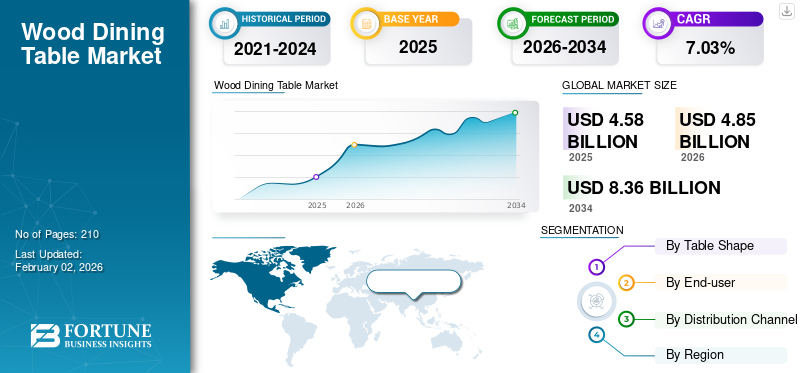
The global wood dining table market size was valued at USD 4.58 billion in 2025 and is projected to grow from USD 4.85 billion in 2026 to USD 8.36 billion by 2034, exhibiting a CAGR of 7.03% during the forecast period.
Consumers prefer wooden dining tables because of their natural beauty, contemporary designs, and durability, making them a preferred choice for traditional and modern interiors. Additionally, there has been a rising demand for sustainable and eco-friendly materials, such as wood, metal, and recyclable plastic, along with ongoing investments in home improvement projects, which has led to the increased demand for wooden dining tables and dining chairs. Furthermore, leading manufacturers, such as IKEA, Herman Miller Inc., Steelcase Inc., and Ethan Allen Global, Inc., emphasize using sustainable and recycled materials for furniture production, contributing to the global market growth. For instance, according to the U.S. Census Bureau, in June 2025, the number of housing completions in the U.S. reached around 1,526,000 units.
Download Free sample to learn more about this report.
WOOD DINING TABLE MARKET KEY TAKEAWAYS
 Market Size & Forecast
- 2025 Market Size: USD 4.58 Billion
- 2026 Market Size: USD 4.85 Billion
- 2034 Forecast Market Size: USD 8.36 Billion
- CAGR: 7.03% from 2026–2034
 Market Share
- Asia Pacific dominated the wood dining table market in 2025.
- The rectangle segment held the largest share by table shape in 2025.
- The residential segment accounted for the leading share by end-user in 2025.
 Key Regional Highlights
Asia Pacific
Asia Pacific led the global wood dining table market and is expected to maintain its dominance during the forecast period.
Europe
Europe is projected to be the fastest-growing regional market due to strong demand for sustainable furniture.
North America
North America is anticipated to grow at the second-fastest CAGR, supported by rising demand for customized wooden furniture.
U.S.
Advancements in woodworking technology and manufacturing automation are supporting market growth.
Japan
Growing preference for high-quality and durable wooden furniture is contributing to market expansion.
Read More

Market Dynamics
Market Drivers
Rapid Growth of Urban Residents to Foster Market Growth
People in urban areas tend to adopt different lifestyles, necessitating space-saving and multifunctional tables furniture solutions. With rising disposable incomes, people are more likely to spend on home improvement and furnishing, including upgrading their dining tables. Moreover, urban areas are the centers of fashion, design, and trends. Therefore, consumers in cities are more exposed to innovative wood dining table designs and styles, which can influence their preferences and drive the global wood dining table market growth. For instance, according to the United Nations Human Settlements Programme Data, the urban population in South Africa is expected to clock ~80% by 2050, from ~67% in 2020.
Market Restraints
Fluctuation in Costs of Raw Materials to Hinder Market Growth
The availability of raw materials, such as timber, lumber, and others, influences the production of wood products, including furniture items. Furthermore, frequent changes in raw material prices can lead to inconsistent pricing of furniture products, making it difficult for consumers to anticipate the costs of purchasing wooden dining tables. As furniture prices change due to raw material fluctuations, consumer demand may decrease as people become more cautious with their spending, resulting in reduced growth for the wood dining tables market.
Market Opportunities
Flourishing E-Retailing Portals of Furniture Companies to Provide Market Opportunity
E-retailing platforms allow consumers to browse, compare, and purchase dining tables anywhere and anytime. This convenience broadens the consumer base, including customers from areas with limited access to modern furniture products. Additionally, online stores offer a wide variety of furniture brands and styles, encouraging high-value purchases of wooden dining tables, thus propelling the wood dining table market growth.
Wood Dining Table Market Trends
Inclination Toward Home Renovation to Surge Market Growth
In recent times, there has been a strong correlation between increased home renovation activities and furniture demand. Home renovation projects often involve remodeling or updating living spaces, which can drive the need for new furniture products, including wooden dining tables, to complement the refreshed interiors. These factors are expected to drive the growth of the global dining table market during the forecast period. For instance, according to the Department of Trade, Industry and Competition (DTIC) of South Africa, in February 2021, year-on-year retail sales of residential furniture increased by an average of 9.9% per month.
Segmentation Analysis
By Table Shape
Availability of a Variety of Sizes to Drive Rectangle Segment Growth
Based on table shape, the market is divided into oval, rectangle, round, and square.
The rectangle segment holds the major share of the market. Rectangular-shaped dining tables offer versatility and functional advantages, making them suitable for various dining room areas and layouts. Moreover, they provide a variety of sizes and often come with extendable options, which are ideal for everyday family meals and large gatherings, further boosting the segment growth.
The round segment is expected to be the fastest-growing segment of the market in the coming years. Round dining tables are particularly in demand by consumers seeking space-saving solutions and a more casual and social atmosphere. Their curved edges facilitate better movement around compact spaces, thus propelling segment growth.
By End-user
Increasing Trend for Home Renovation to Drive Residential Segment Growth
Under the end-user, the market is bifurcated into residential and commercial.
The residential segment holds the foremost share of the market. Dining tables are a fundamental product of household furniture, which are widely used for daily meals, family gatherings, and other functional purposes. Additionally, the growing trend of home renovation and the rising disposable income of consumers also foster the segment's growth.
The commercial segment is also predicted to be the fastest-growing segment of the market. The expanding hospitality industry, such as restaurants, cafes, and corporate settings, requires durable and aesthetic dining tables. This enhances customer requirements and accommodates business needs, further fueling segment growth.
By Distribution Channel
Possibility of Physical Inspection to Foster Specialty Stores Segment Growth
In terms of distribution channel, the market is segmented into specialty stores, supermarkets & hypermarkets, online stores, and others.
The specialty stores segment captured a dominant share of the market. These stores allow customers to physically inspect dining tables, check material quality, and product finish. Additionally, they have trained experts who can guide consumers in selecting the right size and style of dining tables, further fostering segment growth.
The online segment is predicted to be the fastest-growing segment in the near term. E-retailing portals offer a wide array of products and brands for wood dining tables, compared to physical stores. Additionally, hassle-free delivery options through online channels also attract consumers who value ease and flexibility. This fuels the online segment growth.
Wood Dining Table Market Regional Outlook
Regionally, the market is studied across North America, Europe, Asia Pacific, South America, and the Middle East & Africa.
Asia Pacific
Asia Pacific dominated the wood dining table market share. The market is also expected to lead during the forecast period. The region benefits highly from competitive manufacturing centers in countries such as India, China, Vietnam, and Malaysia, among others. These countries have access to abundant raw materials, i.e., wood, which supports the production of wooden furniture, including dining tables. For instance, according to the IBEF, India’s wood products exports reached around USD 623 billion in 2023, an increase of ~60% from 2014.
Europe
Europe is the fastest-growing region in the market. Local buyers prioritize high-quality, durable, and sustainable furniture products and are willing to pay a premium price for eco-friendly and well-crafted furniture, including dining tables. Furthermore, the EU is one of the leading regions that is involved in sustainable forestry and manufacturing, supported by initiatives such as the European Green Deal and strict environmental regulations, contributing to the market growth.
North America
North America is expected to grow at the second-fastest CAGR in the market. North American Consumers in the region value aesthetics and functionality, increasing the demand for customized furniture products. Moreover, there is a rising preference for custom, artisanal, and high-quality wood dining tables, which are considered sustainable and luxury choices. These factors are expected to drive the growth of the wood dining table market.
In the U.S., advancements in woodworking technology, automation, and digital design have improved production efficiency, product quality, and customization options. These innovations help furniture manufacturers meet the demand for high-performance dining table products, boosting the U.S. market growth. For instance, in January 2025, the U.S. Department of Agriculture (USDA) launched a new program to support the wood manufacturing and processing sector in the U.S, in terms of improving wood processing efficiency and achieving sustainability.
South America and Middle East & Africa
South America and the Middle East Africa are expected to achieve considerable growth in the near term. The hospitality industry in these regions is a significant driver of furniture products, including dining tables. Furthermore, the growth of the tourism sector in Middle Eastern countries, followed by rising international visitors to the region, also fuels the demand for wooden furniture products, including dining tables. Moreover, the growth of e-commerce platforms has made a wide variety of wood furniture products easily accessible in these regions, fostering market growth.
Competitive Landscape
Key Market Players
Growing Investments of Furniture Companies toward Product Innovation to Support Growth Prospects
Recently, increased R&D has enabled manufacturers to develop new furniture products, such as smart tables embedded with wireless charging, sensor-based lighting, and other IoT-enabled features, suitable for dining area. Moreover, advanced engineered wood designs, such as eco-friendly adhesives and recycled composites, improve product quality and drive the market's growth. Additionally, R&D investments help companies develop new products that meet the evolving consumer demand for sustainable furniture, thus fostering the global furniture market growth during the projected period.
List of Key Players in the Wood Dining Table Market
- IKEA (Netherlands)
- Herman Miller Inc. (U.S.)
- Steelcase Inc. (U.S.)
- Ashley Furniture (U.S.)
- West Elm (U.S.)
- Furniture Root (India)
- PBZ Manufacturing (U.S.)
- Bernhardt Furniture Company (U.S.)
- Sunpan Trading Importing, Inc. (Canada)
- Ethan Allen Global, Inc. (U.S.)
Key Industry Developments
- April 2025 – IKEA opened its first Plan and Order Point (PaOP) in India. This would help the company gain expertise and personalized consultation for furniture products, including dining tables, before purchasing.
- March 2025 – Ashley Furniture opened 13 new stores in India, which helped the company expand its presence in the Indian furniture market.
- November 2024 – Pepperfry partnered with Infra.Market to enhance their product offerings and facilitate a one-stop destination for home furniture products.
- September 2024 – Steelcase launched a new dealer store in Bengaluru, India. This would help the company to reach a broader audience within the Indian market.
- May 2022 – IKEA inaugurated new stores in Mumbai, India, to expand its presence within the Indian furniture industry.
- July 2021 – IMM Private Equity acquired Hanssem Co., a furniture-making company of South Korea, with an investment of USD 1.3 billion to expand its business operations.
REPORT COVERAGE
The wood dining table market research report provides a comprehensive analysis, focusing on key elements such as major companies, regional and market segmentation, competitive dynamics, product type, categories, end-user, and distribution channels. Additionally, it offers insights into the market analysis, market dynamics, and highlights significant developments within the industry. Beyond these aspects, it also examines various factors that have contributed to market growth in recent years.
Request for Customization to gain extensive market insights.
Report Scope & Segmentation
|
ATTRIBUTE |
DETAILS |
|
Study Period |
2021-2034 |
|
Base Year |
2025 |
|
Estimated Year |
2026 |
|
Forecast Period |
2026-2034 |
|
Historical Period |
2021-2024 |
|
Growth Rate |
CAGR of 7.03% from 2026 to 2034 |
|
Unit |
Value (USD Billion) |
|
Segmentation |
By Table Shape
By End-user
By Distribution Channel
By Region
|
Frequently Asked Questions
Fortune Business Insights says that the global market size is USD 4.85 billion in 2026 and is anticipated to record a valuation of USD 8.36 billion by 2034.
Fortune Business Insights says that the global market value stood at USD 4.58 billion in 2025.
The global market will exhibit a CAGR of 7.03% during the forecast period.
By table shape, the rectangle segment is dominating the market.
Rapid growth of urban residents is a key factor driving the global market.
IKEA, Herman Miller Inc., Steelcase Inc., and Ethan Allen Global, Inc. are some of the leading players globally.
Asia Pacific dominated the global market in 2025.



- 2021-2034
- 2025
- 2021-2024
- 210
-
(Offer valid till 15th Oct 2026)
Get 30-60 hrs Free Customization
Expand Regional and Country Coverage, Segments Analysis, Company Profiles, Competitive Benchmarking, and End-user Insights.



















-
US +1 833 909 2966 ( Toll Free )
-
Get In Touch With Us