2 Seal Pouch Market Size, Share & Industry Analysis, By Material (Aluminum, Plastic, Paper, and Others), By Product Type (Flat Pouches, Stand-up Pouches, Zipper/Resealable Pouches, and Others), By End-use Industry (Food & Beverages, Pharmaceuticals, Personal Care & Cosmetics, and Others), and Regional Forecast, 2026-2034
 Download Free Sample
(Offer valid till 15th Oct 2026)

2 Seal Pouch Market Size and Future Outlook
 Listen to Audio Version
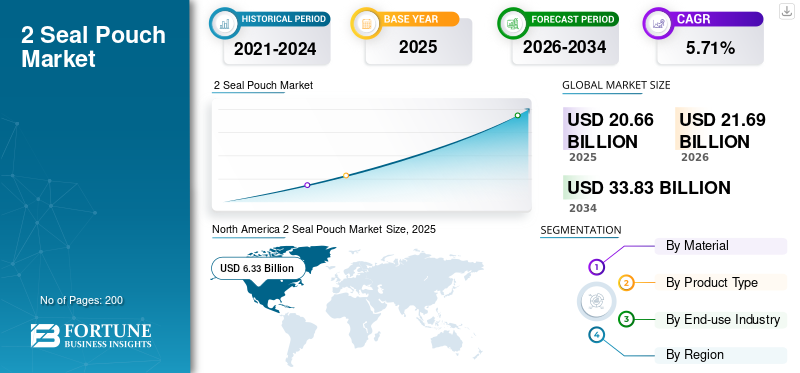
The 2 seal pouch market size was valued at USD 20.66 billion in 2025. The market is projected to grow from USD 21.69 billion in 2026 to USD 33.83 billion by 2034, exhibiting a CAGR of 5.71% during the forecast period. North America dominated the 2 seal pouch market with a market share of 30.63% in 2025.
The market refers to the sector engaged in the manufacturing and distribution of flexible packaging pouches sealed on two sides (usually the top and bottom). The increasing demand for convenient packaging, particularly in the food and personal care industries, is propelling the adoption of 2-seal pouches. This trend is further supported by the rise in urbanization, the expansion of e-commerce, and a growing preference for flexible packaging formats.
Furthermore, many key industry players, such as Amcor Plc, Mondi, and Constantia Flexibles, operating in the market, are focusing on developing innovative products and conducting R&D.
Download Free sample to learn more about this report.
2 SEAL POUCH MARKET KEY TAKEAWAYS
 Market Size & Forecast
- 2025 Market Size: USD 20.66 Billion
- 2026 Market Size: USD 21.69 Billion
- 2034 Forecast Market Size: USD 33.83 Billion
- CAGR: 5.71% from 2026–2034
 Market Share
- North America dominated the 2 seal pouch market with a 30.63% share in 2025.
- The aluminum segment accounted for the largest market share in 2025.
- The food & beverages segment held the largest market share in 2025.
 Key Regional Highlights
North America
North America led the market with a value of USD 6.33 billion in 2025.
Asia Pacific
Asia Pacific reached USD 5.34 billion in 2025, driven by rapid urbanization and rising demand for packaged food.
Europe
Europe reached USD 4.36 billion in 2025, supported by strong demand for sustainable packaging.
U.S.
The market reached USD 5.13 billion in 2025, accounting for 24.83% of global revenue.
Japan
The market reached USD 0.68 billion in 2025, representing 3.31% of global revenue.
Read More

2 SEAL POUCH MARKET TRENDS
Shift Toward Sustainable and Recyclable Materials is a Prominent Market Trend
A significant trend in the market is the growing shift toward sustainable and recyclable materials. Manufacturers are focusing on mono-material laminates, biodegradable films, and reducing plastic content to comply with regulatory requirements and meet changing consumer preferences for environmentally friendly packaging. Furthermore, advances in materials science are enabling the development of high-performance, sustainable films compatible with current filling and sealing equipment. This trend is further supported by corporate sustainability pledges and governmental regulations aimed at reducing plastic waste globally.
MARKET DYNAMICS
MARKET DRIVERS
Download Free sample to learn more about this report.
Rising Demand for Flexible and Convenient Packaging is Driving Market Growth
The main factor driving the 2 seal pouch market growth is increasing demand for flexible, lightweight, and convenient packaging solutions. As urbanization accelerates and lifestyles become busier, consumers are leaning toward packaging formats that are easy to handle, store, and dispose. 2-seal pouches offer benefits such as reduced material use, lower transportation costs, and improved shelf efficiency compared to rigid packaging. Their versatility across a diverse array of products, from snacks to liquid detergents, encourages their adoption. Additionally, the growth of e-commerce has heightened the necessity for durable yet lightweight packaging formats that can endure logistical challenges while preserving product integrity.
MARKET RESTRAINTS
Limited Structural Strength Compared to Rigid Packaging Hampers Market Growth
A major limitation to market expansion is the low structural strength of these pouches compared to rigid packaging options. Although they are economical and lightweight, they may not offer the same degree of protection for heavy, sharp, or extremely sensitive items. This constraint limits their use in specific industries where durability and rigidity are essential. Furthermore, factors such as puncture resistance, supply chain issues, and seal integrity can influence food safety during both transportation and storage. Consequently, some manufacturers persist in using rigid packaging formats despite the higher costs, hindering the widespread adoption of 2-seal pouch solutions.
MARKET OPPORTUNITIES
Expansion in Emerging Economies Offers Potential Growth Opportunities
A significant opportunity exists in the market owing to increasing packaging demand in emerging economies. The rapid pace of industrialization, population growth, and rising disposable incomes in Asia Pacific, Latin America, and Africa are driving the consumption of packaged goods. Local manufacturers are progressively embracing flexible packaging technologies to meet the needs of various product categories, including food, beverages, and household items. Moreover, the expanding reach of organized retail and e-commerce platforms in these regions is expected to boost the adoption of 2-seal pouch packaging solutions.
MARKET CHALLENGES
Recycling and Waste Management Issues Pose a Critical Challenge to Market Growth
One of the primary challenges hampering market is the intricate nature of recycling multi-layer flexible packaging. Numerous 2-seal pouches are constructed from laminated materials that combine plastic, aluminum, and various other substrates, making them challenging to separate and recycle through traditional systems. This situation has raised environmental concerns and drawn regulatory attention, especially in developed markets. The inadequate recycling infrastructure in many areas further intensifies the problem, leading to increased landfill waste. As sustainability becomes a vital focus, manufacturers are under pressure to develop recyclable alternatives while maintaining performance, which can increase production costs and operational complexity.
Segmentation Analysis
By Material
Superior Barrier Performance, Extended Shelf Life, and Product Protection Drives Dominance of Aluminum Segment
Based on the material, the market is divided into aluminum, plastic, paper, and others.
The aluminum segment is expected to account for the largest share of the market. This is mainly due to their outstanding barrier characteristics against moisture, oxygen, light, and contaminants, which are essential for maintaining product quality and extending shelf life. Furthermore, aluminum enhances the puncture resistance and overall durability of pouches, ensuring safe handling and transportation. Therefore, manufacturers favor aluminum to comply with rigorous packaging standards, particularly for sensitive, high-value products that require long-term protection.
The plastic segment is expected to grow at a CAGR of 5.64% over the forecast period.
By Product Type
Cost Efficiency, Space Optimization, and High-Speed Production Leads to Flat Pouches Segment Growth
Based on product type, the market is segmented into flat pouches, stand-up pouches, zipper/resealable pouches, and others.
In 2025, the flat pouches segment dominated the global market. This is primarily due to their straightforward design that facilitates minimal material consumption and cost-efficient production. Their slender shape promotes efficient storage, stacking, and transportation, thereby reducing logistics costs and optimizing shelf space for retailers. Furthermore, flat pouches are exceptionally compatible with high-speed filling and sealing machinery, rendering them suitable for large-scale production in the food, pharmaceutical, and personal care sectors. As businesses seek affordable, scalable packaging options, flat pouches remain the preferred choice for high-volume applications.
The stand-up pouches segment is projected to grow at a CAGR of 5.80% over the forecast period.
By End-Use Industry
To know how our report can help streamline your business, Speak to Analyst
High Consumption Volumes and Shelf-Life Requirements, Augments Food & Beverages Segment Growth
Based on the end-use industry, the market is segmented into food & beverages, pharmaceuticals, personal care & cosmetics, and others.
The food and beverages sector held the largest 2 seal pouch market share, driven by high consumption and the ongoing need for effective packaging solutions. Moreover, the growing consumer preference for convenient, portable, and single-use packaging has further propelled the segment’s growth. The capacity of these pouches to provide economical packaging for both dry and semi-liquid food items enhances their appeal, making them a favored option for manufacturers targeting high-volume distribution.
The pharmaceuticals segment is projected to grow at a CAGR of 5.74% over the forecast period.
2 Seal Pouch Market Regional Outlook
By geography, the market is categorized into Europe, North America, Asia Pacific, Latin America, and the Middle East & Africa.
North America
North America 2 Seal Pouch Market Size, 2025 (USD Billion)
To get more information on the regional analysis of this market, Download Free sample
North America held the dominant share in 2024, at USD 6.03 billion, and maintained its leading position in 2025, at USD 6.33 billion. In North America, the market is propelled by a robust demand for convenient, portable packaging and a significant consumption of processed foods. Innovative packaging technologies, sustainability efforts, and stringent regulatory requirements encourage manufacturers to pursue recyclable, high-barrier pouch solutions. At the same time, the expansion of e-commerce also fosters the adoption of flexible packaging.
U.S. 2 Seal Pouch Market
Based on North America's strong contribution, the U.S. market was at USD 5.13 billion in 2025, accounting for 24.83% of global sales. The U.S. market is primarily driven by advancements in packaging materials and strong demand for single-serve and ready-to-eat food items. Brand owners emphasize sustainability, lightweight packaging, and improved shelf appeal, while the growth of online retail heightens the necessity for durable yet cost-effective pouch formats.
Europe
Europe is projected to grow at 5.35% over the coming years, the third-highest among regions, and reached USD 4.36 billion in 2025. The growth of this market is significantly affected by strict environmental regulations and a robust movement toward circular economy practices. There is increasing demand for recyclable, mono-material pouches, particularly in the food and personal care industries. Consumer inclination toward sustainable packaging plays a crucial role in guiding product development and material choices throughout the region.
U.K. 2 Seal Pouch Market
The U.K. market in 2025 was at USD 0.64 billion, representing 3.12% of global revenues.
Germany 2 Seal Pouch Market
Germany's market reached USD 1.02 billion in 2025, equivalent to 4.94% of global sales.
Asia Pacific
Asia Pacific was valued at USD 5.34 billion in 2025 and secure the position of the second-largest region in the market. The region leads in volume due to rapid urbanization, population growth, and rising disposable incomes. The rising demand for packaged food, development of retail infrastructure, and presence of cost-sensitive regions are propelling the use of economical 2-seal pouches, with local manufacturers concentrating on scalability and cost effectiveness in flexible packaging solutions.
Japan 2 Seal Pouch Market
The Japanese market in 2025 was at USD 0.68 billion, accounting for 3.31% of global revenues. Stringent packaging quality standards, innovation, and a growing demand for portion-controlled, convenient products influence Japan's market. The aging population, along with a preference for compact, user-friendly packaging formats, drives the adoption of 2-seal pouches. Meanwhile, cutting-edge material technologies provide enhanced product protection and visual appeal.
China 2 Seal Pouch Market
China's market is projected to be one of the largest worldwide, with 2025 revenues reached at USD 1.86 billion, representing 9.03% of global sales.
India 2 Seal Pouch Market
The Indian market in 2025 was at USD 1.37 billion, accounting for 6.64% of global revenue.
Latin America
The Latin America region is expected to witness moderate growth during the forecast period. The market reached a valuation of USD 2.69 billion in 2025. This is driven by rising demand for packaged food and beverages, alongside improvements in retail distribution networks. Affordable packaging solutions are essential in price-sensitive markets, promoting the use of 2 seal pouches, as local manufacturing capabilities steadily grow in significant countries.
Middle East & Africa
In the Middle East & Africa, South Africa reached USD 0.45 billion in 2025. The market growth is shaped by increasing urbanization, population expansion, and a growing need for cost-effective packaged products. The growth of the food and beverage industries, along with the expansion of retail infrastructure, drives the adoption of pouches. In contrast, severe climatic conditions create a need for packaging with robust barrier properties to maintain product stability.
Saudi Arabia 2 Seal Pouch Market
The Saudi Arabian market reached a valuation of USD 0.68 billion by 2025, accounting for 3.27% of global revenues.
COMPETITIVE LANDSCAPE
Key Industry Players
Focus on Expanding Product Launch and Acquisitions by Key Players to Propel Market Progress
The global market has a semi-consolidated structure, with prominent players including Amcor Plc, Mondi, and Constantia Flexibles. The significant market shares of these packaging companies are due to numerous strategic initiatives, including collaborations among operating entities to advance research.
- For instance, in February 2026, Amcor announced the expansion of its sustainable flexible packaging range, introducing new high-barrier, recyclable pouch solutions tailored for food and pharmaceutical Additionally, the company underscored its heightened investments in research and development, as well as collaborations with global brands, to expedite the shift from multi-layer laminates to environmentally friendly options, thereby reinforcing its leadership in the 2 seal pouch and the wider flexible packaging sector.
Other notable players in the global market include Huhtamaki Oyj, ProAmpac LLC, and Nexibles. These companies are expected to prioritize new product launches, strategic partnerships, and collaborations to increase their global market shares during the forecast period.
LIST OF KEY 2 SEAL POUCH COMPANIES PROFILED
- Amcor Plc (Switzerland)
- Mondi (U.K.)
- Constantia Flexibles (Austria)
- Huhtamaki Oyj (Finland)
- ProAmpac LLC (U.S.)
- Nexibles (U.S.)
- CarePac (U.S.)
- Minfly Packaging (China)
- InstaPac Flexible Packaging (U.S.)
- Caltex Plastics Inc. (U.S.)
- Red Dot Packaging (U.S.)
- EKA Packaging (India)
- PalsPack (India)
- Truepack Flexibles Pvt Ltd (India)
- Haide Packaging (China)
KEY INDUSTRY DEVELOPMENTS
- November 2025: Mondi has launched a new collection of paper-based flexible pouches intended to minimize plastic consumption in food packaging. These solutions are crafted to preserve product freshness while enhancing recyclability. The innovation focuses on the dry food and powdered product sectors, where 2-seal pouch formats are commonly utilized. This introduction underscores Mondi's dedication to its MAP2030 sustainability objectives and addresses the growing regulatory demands throughout Europe for eco-friendly packaging solutions.
- August 2025: Constantia Flexibles has enhanced its production capacity in Asia by establishing a new facility dedicated to high-performance flexible laminates, which includes 2-seal pouch formats. This expansion is designed to address the increasing regional demand from the food and pharmaceutical sectors. The facility incorporates cutting-edge extrusion and printing technologies, enabling the creation of sustainable, high-barrier packaging solutions tailored to the requirements of emerging markets.
- March 2024: Huhtamaki has introduced a groundbreaking mono-material flexible packaging that is intended to be entirely recyclable, with applications including snacks, condiments, and personal care items. The company highlighted its compatibility with current packaging lines and enhanced barrier performance. This effort aligns with Huhtamaki's worldwide strategy to ensure that all its packaging is recyclable, compostable, or reusable by 2030, thereby reinforcing its role as a leader in sustainable pouch solutions.
- January 2024: ProAmpac launched its ProActive Recyclable RP-1000 series, a high-barrier recyclable pouch solution intended to substitute conventional multi-material laminates. This product is tailored for food applications that necessitate an extended shelf life. The introduction underscores the company's commitment to innovation in sustainable packaging and its initiatives to help brand owners achieve their circular economy objectives.
- June 2023: CarePac has broadened its product offerings by launching an extensive selection of both stock and custom 2-seal pouches designed for food, nutraceutical, and cosmetic uses. The company has improved its digital printing capabilities to accommodate low minimum order quantities and expedite turnaround times, thereby serving small- and medium-sized enterprises in need of adaptable, scalable packaging solutions.
REPORT COVERAGE
The market analysis includes a comprehensive study of market size & forecast across all market segments included in the report. It includes details on the market dynamics and market trends expected to drive the market over the forecast period. It provides information on key aspects, including technological advancements, pipeline candidates, the regulatory environment, and product launches. Additionally, it details partnerships, mergers & acquisitions, and key industry developments, along with their prevalence by region. The global market research report also provides a detailed competitive landscape, including market share and profiles of key operating players.
Request for Customization to gain extensive market insights.
Report Scope & Segmentation
| ATTRIBUTE | DETAILS |
| Study Period | 2021-2034 |
| Base Year | 2025 |
| Estimated Year | 2026 |
| Forecast Period | 2026-2034 |
| Historical Period | 2021-2024 |
| Growth Rate | CAGR of 5.71% from 2026-2034 |
| Unit | Value (USD Billion) |
| Segmentation | By Material, Product Type, End-use Industry, and Region |
| By Material |
|
| By Product Type |
|
| By End-use Industry |
|
| By Region |
|
Frequently Asked Questions
According to Fortune Business Insights, the global market value stood at USD 20.66 billion in 2025 and is projected to reach USD 33.83 billion by 2034.
In 2025, the North America market value stood at USD 6.33 billion.
The market is expected to grow at a CAGR of 5.71% over the forecast period of 2026-2034.
By material, the aluminum segment is expected to lead the market.
Rising demand for flexible and convenient packaging is driving market growth.
Amcor Plc, Mondi, and Constantia Flexibles are the major players in the global market.
North America dominated the market in 2025.



- 2021-2034
- 2025
- 2021-2024
- 200
-
(Offer valid till 15th Oct 2026)
Get 30-60 hrs Free Customization
Expand Regional and Country Coverage, Segments Analysis, Company Profiles, Competitive Benchmarking, and End-user Insights.








Related Reports
-
US +1 833 909 2966 ( Toll Free )
-
Get In Touch With Us