Aerospace Fiber Optic Sensors Market Size, Share & Industry Analysis, By Sensor Type (Fiber Bragg Grating Sensors, Distributed Fiber Optic Sensors, and Interferometric Sensors), By Sensing Parameter (Strain, Temperature, Pressure, and Acoustic/Vibration), By Application (Structural Health Monitoring, Flight Control & Navigation, and Engine Health Monitoring), By Platform (Commercial Aircraft, Military Aircraft, Business Jets & General Aviation, and UAVs), By End User (Aircraft OEMs, Aftermarket/MRO Providers, Defense Organizations, and Space Agencies), and Regional Forecast, 2026-2034
 Download Free Sample
Aerospace Fiber Optic Sensors Market Size and Future Outlook
 Listen to Audio Version
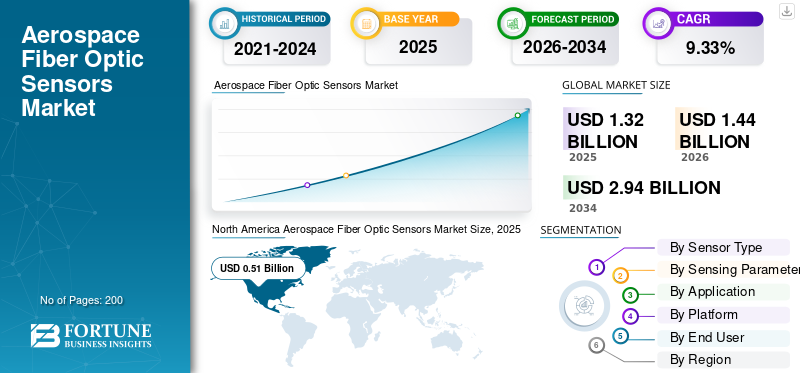
The global aerospace fiber optic sensors market size was valued at USD 1.32 billion in 2025. The market is projected to grow from USD 1.44 billion in 2026 to USD 2.94 billion by 2034, exhibiting a CAGR of 9.33% during the forecast period. North America dominated the aerospace fiber optic sensors market with a market share of 38.64% in 2025.
The aerospace fiber optic sensors market includes optical-fiber-based sensing systems used to measure strain, temperature, pressure, vibration, rotation, structural load, fuel leakage, and navigation movement across aircraft, UAVs, satellites, and launch vehicles. It covers fiber Bragg grating sensors, distributed fiber optic sensors, interferometric sensors, fiber optic gyroscope-based sensors, interrogators, optical fibers, connectors, signal processing units, and software. These sensors are used for structural health monitoring, flight control, navigation, engine monitoring, fuel systems, spacecraft monitoring, and aircraft testing. The market’s growth is supported by lightweight aircraft design, EMI-resistant sensing, predictive maintenance, and digital aircraft health monitoring.
Key players in the market include Honeywell International Inc., Safran SA, R, Luna Innovations Incorporated, Parker Hannifin Corporation, Thales Group, and Northrop Grumman Corporation. The companies are active in inertial navigation, fiber optic sensing, aerospace testing, avionics, and platform-level sensor integration.
Download Free sample to learn more about this report.
Aerospace Fiber Optic Sensors Market Key Takeaways
 Global Market Size & Forecast
- 2025 Market Size: USD 1.32 billion
- 2026 Market Size: USD 1.44 billion
- 2034 Forecast Market Size: USD 2.94 billion
- CAGR: 9.33% from 2026-2034
 Market Share
- North America dominated the aerospace fiber optic sensors market with a 38.64% share in 2025.
- The distributed fiber optic sensors segment is projected to grow at a 9.99% CAGR.
- The structural health monitoring segment is projected to grow at a 9.82% CAGR.
 Key Regional Highlights
North America
North America maintained its leading position, reaching USD 0.51 billion in 2025.
Asia Pacific
Asia Pacific is estimated to reach USD 0.32 billion in 2026, supported by increasing aerospace investments.
Europe
Europe is expected to reach USD 0.35 billion in 2026, growing at a 9.38% CAGR during the forecast period.
U.S.
The market is expected to reach around USD 0.35 billion in 2026, supported by strong aerospace and defense activities.
Japan
Growing adoption of advanced sensing technologies in aerospace applications is supporting market expansion.
Read More

AEROSPACE FIBER OPTIC SENSORS MARKET TRENDS
Embedded Structural Health Monitoring is a Key Market Trend
Embedded structural health monitoring is becoming a key market trend as aerospace manufacturers move toward lighter airframes, composite structures, and condition-based maintenance. Fiber optic sensors can be placed across wings, fuselage sections, joints, landing gear structures, and propulsion areas to track strain, fatigue, temperature, and vibration without adding heavy wiring. NASA has highlighted the value of fiber Bragg grating sensors for aerospace strain and temperature sensors for measurement, especially where multiple sensing points are needed along a single optical fiber. This trend is moving beyond laboratory testing, as OEMs and defense users increasingly seek real-time structural data to reduce inspection burden, improve safety, and support longer aircraft operating life.
MARKET DYNAMICS
MARKET DRIVERS
Download Free sample to learn more about this report.
Rising Demand for Lightweight and EMI-Resistant Sensors to Drive Market Growth
The main driver for the aerospace fiber optic sensors market is the need for lighter, more reliable, and EMI-resistant sensing systems. Traditional electrical sensors add wiring weight and can be exposed to signal interference in high-voltage, high-temperature, and defense environments. Fiber optic sensors reduce this burden as they are lightweight, passive at the sensing point, and capable of measuring multiple parameters across long distances. Aircraft OEMs are also increasing the use of composites, digital real time monitoring, and predictive maintenance tools, which strengthens demand for advanced embedded sensors. Fiber optic gyroscopes further support aerospace fiber optic sensors market growth as aircraft, UAVs, missiles, and spacecraft require accurate navigation even when external satellite signals are limited or denied.
MARKET RESTRAINTS
Certification Complexity and High Integration Cost are Market Restraints
Certification complexity and high integration cost continue to restrain wider adoption of aerospace fiber optic sensors. These systems require qualification for vibration, temperature, pressure, fuel exposure, electromagnetic conditions, software reliability, and long-term durability before they can be used in certified aircraft applications. Embedded sensors are especially difficult as they must be validated during material production, structural assembly, and flight testing. Interrogators and signal processing units also add to system cost, making the business case harder for lower-value platforms or older aircraft. As a result, adoption remains stronger in navigation, defense, space, aircraft testing, and high-value structural aircraft monitoring applications, while broad commercial retrofit adoption remains selective.
MARKET OPPORTUNITIES
Space Platforms and UAV Expansion Creates New Market Growth Opportunities
Space platforms, launch vehicles, and high-end UAVs create a strong opportunity for aerospace fiber optic sensors as these platforms need lightweight, compact, and high-reliability sensing systems. Optical sensors are attractive in space and defense applications as they resist electromagnetic interference, support multi-point sensing and perform well under harsh operating conditions. ESA and NASA-backed research has shown the relevance of fiber optic sensors for spacecraft, launch structures, cryogenic systems, and composite rocket bodies. As satellite deployments, reusable launch systems, tactical UAVs, and autonomous aircraft grow, suppliers offering ruggedized, radiation-tolerant, and embedded fiber optic sensing technology solution will be better placed to capture premium aerospace demand.
MARKET CHALLENGES
Harsh Aerospace Operating Conditions and Long-Term Sensor Durability to Hinder Market Expansion
Harsh aerospace operating conditions remain a major challenge for the adoption of fiber optic sensor. Aircraft, UAVs, satellites, and launch vehicles expose sensors to vibration, temperature swings, pressure changes, moisture, fuel exposure, radiation, and mechanical stress over long service periods. Although fiber optic sensors are technically strong, their connectors, bonding materials, interrogators, protective coatings, and embedded installation points must remain stable throughout the platform life cycle. Any signal drift, fiber breakage, connector loss, or calibration issue can affect system reliability. This makes qualification, packaging, installation quality, and long-term durability testing critical before wider use across commercial aircraft, defense platforms, and space systems.
Segmentation Analysis
By Sensor Type
Multiplexing Capability and Composite Structure Monitoring Support Growth of Fiber Bragg Grating Sensors
Based on sensor type, the market is segmented into fiber Bragg grating sensors, distributed fiber optic sensors, interferometric fiber optic sensors, fiber optic gyroscope-based sensors, and others.
The fiber Bragg grating sensors segment is anticipated to account for the largest market share. The Fiber Bragg Grating Sensors segment is growing because FBG sensors can measure strain and temperature at multiple points along a single optical fiber. Their lightweight design and suitability for composite aircraft structures make them useful for structural health monitoring, aircraft testing, and embedded airframe monitoring.
The distributed fiber optic sensors segment is anticipated to rise with a CAGR of 9.99% over the forecast period.
By Sensing Parameter
Structural Load Tracking and Fatigue Monitoring Supported the Strain Segment Growth
Based on sensing parameter, the market is segmented into strain, temperature, pressure, acoustic/vibration, and others.
In 2025, the strain segment dominated the global market, as aircraft structures require continuous monitoring of stress, bending, fatigue, and deformation during operation. Fiber optic strain sensors help OEMs and operators track structural performance across wings, fuselage sections, landing gear areas, and composite assemblies.
The acoustic/vibration segment is projected to grow at a CAGR of 9.99% over the forecast period.
By Application
Flight Control & Navigation Segment to Lead due to Expanding Adoption across Defense Platforms
Based on application, the market is segmented into structural health monitoring, flight control & navigation, engine health monitoring, fuel system & leakage detection, and others.
The flight control & navigation segment is anticipated to dominate the market over the forecast period, due to the rising use of fiber optic gyroscope-based sensing in aircraft, UAVs, defense platforms, and spacecraft. These sensors support reliable attitude control, stabilization, heading, and navigation, especially in mission-critical and GPS-denied environments.
The structural health monitoring segment is projected to grow at a CAGR of 9.82% over the forecast period.
By Platform
Large Global Fleet Base and Aircraft Modernization Supported the Commercial Aircraft Segment Growth
Based on platform, the market is segmented into commercial aircraft, military aircraft, business jets & general aviation, UAVs, and others.
The commercial aircraft segment dominated the market, as large global fleets create strong demand for line-fit sensors, retrofit upgrades, aircraft health monitoring, and predictive maintenance. New-generation aircraft also require lightweight and reliable sensing systems for navigation, structural monitoring, and system health tracking.
The UAVs segment is projected to grow at a CAGR of 9.88% during the forecast period.
By End User
To know how our report can help streamline your business, Speak to Analyst
Easier Integration During Aircraft Manufacturing Supported the Growth of Aircraft OEMs
Based on end user, the market is segmented into aircraft OEMs, aftermarket/MRO providers, defense organizations, space agencies & satellite operators, and others.
The aircraft OEMs segment dominated the market, as fiber optic sensors are easier to integrate during aircraft design and production than through retrofitting. OEMs can embed sensors into aircraft structures, validate them during testing, and connect them with aircraft health-management systems before certification.
The space agencies & satellite operators segment is projected to grow at a CAGR of 9.95% during the forecast period.
Aerospace Fiber Optic Sensors Market Regional Outlook
By geography, the market is categorized into Europe, North America, Asia Pacific, and Rest of the World.
North America
North America Aerospace Fiber Optic Sensors Market Size, 2025 (USD Billion)
To get more information on the regional analysis of this market, Download Free sample
North America held the dominant aerospace fiber optic sensors market share in 2024, valued at USD 0.47 billion, and also maintained its leading position in 2025, reaching USD 0.51 billion. North America is expected to remain a leading region due to its mature aircraft OEM, defense, space, and aircraft health-monitoring ecosystems. NASA’s work on fiber optic sensing for real-time structural monitoring and the FAA’s guidance on integrated aircraft health management support wider use of onboard sensing, data analysis, and structural-condition monitoring.
U.S. Aerospace Fiber Optic Sensors Market
Based on North America’s strong contribution and the U.S. dominance within the region, the U.S. market is expected to reach around USD 0.35 billion in 2026, accounting for roughly 9.58% CAGR. The market is supported by strong aerospace R&D, defense aircraft modernization, space programs, UAV adoption, and growing use of predictive maintenance systems.
Europe
Europe is projected to record a steady growth rate of 9.38% during the forecast period, which is the second-highest among all regions. The market is expected to reach a valuation of USD 0.35 billion in 2026. Europe is growing on the back of aircraft sustainability programs, composite airframe development, space-platform monitoring, and EU-funded structural health monitoring projects. ESA has investigated fiber optic sensors for spacecraft engineering across launcher and satellite applications, while Clean Aviation/Clean Sky projects have supported integrated sensor-based structural monitoring for aircraft components.
U.K. Aerospace Fiber Optic Sensors Market
The U.K. market is estimated to reach around USD 0.11 billion in 2026 and will represent 9.84% CAGR during the forecast period. The U.K. market is supported by advanced aerospace research, flight-test activity, engine monitoring, and composite structure development. Cranfield University has developed advanced fiber optic sensors for aircraft flight testing, while the Aerospace Technology Institute highlights advanced sensing as a key area for deeper aircraft subsystem integration.
Germany Aerospace Fiber Optic Sensors Market
Germany’s market is projected to reach approximately USD 0.10 billion in 2026. Germany benefits from a strong aerospace research ecosystem, advanced composite manufacturing, and optical sensor solutions development led by DLR and Fraunhofer institutes. Fraunhofer is developing fiber optic sensors for the structural monitoring of lightweight composites, while DLR’s optical sensor and aerospace SHM activities support aircraft and space-related sensing applications.
Asia Pacific
The Asia Pacific region is estimated to reach USD 0.32 billion in 2026, securing the position of the third-largest regional market and the fastest-growing region during the forecast period. Regional growth is supported by expanding aircraft programs, indigenous aerospace manufacturing, UAV development, and rising space activity in China, India, Japan, South Korea, and Australia. Demand across the region is shifting from basic platform procurement toward domestic engineering, aircraft health monitoring, inertial navigation, and structural monitoring for composite airframes.
China Aerospace Fiber Optic Sensors Market
China’s market is projected to be one of the largest in Asia Pacific. The market is expected to reach around USD 0.10 billion in 2026. China is expected to grow steadily due to domestic civil aircraft development, UAV programs, space missions, and strong interest in optical-fiber-based deformation monitoring for flight vehicles. The (Civil Aviation Administration of China) CAAC notes that China’s domestic trunk aircraft uses advanced fly-by-wire and integrated avionics architecture, which supports demand for reliable navigation, monitoring, and aircraft-system sensing.
India Aerospace Fiber Optic Sensors Market
The Indian market is estimated to reach around USD 0.09 billion in 2026. India is gaining traction due to indigenous space systems, defense electronics, UAV development, and aerospace manufacturing localization. ISRO’s Inertial Systems Unit develops optical-gyro-based inertial navigation systems for space missions, while DRDO’s Technology Development Fund supports futuristic defense technologies, including fiber Bragg grating-based SHM activity.
Rest of the World
The rest of the world include Middle East & Africa and Latin America. Latin America is mainly supported by Brazil’s aerospace base and Embraer-led structural health monitoring activities, while the Middle East is gaining momentum through UAE and Saudi space-sector development, satellite programs, and aerospace localization initiatives. Embraer, EDGE-related UAE aerospace entities, Mohammed Bin Rashid Space Centre (MBRSC), Saudi Space Agency-linked programs, and regional MRO providers are the main demand drivers rather than broad-based sensor manufacturers. The Middle East & Africa and Latin America market is set to reach a valuation of USD 0.13 billion and USD 0.09 billion, respectively, in 2026.
COMPETITIVE LANDSCAPE
Key Industry Players
Key Players Focus on Partnerships to Help Suppliers Secure Long-Cycle Aerospace Programs
The aerospace fiber optic sensors market is moderately consolidated, with major avionics, navigation, defense, and aircraft-system suppliers competing alongside specialized photonics companies. Key players include Honeywell International Inc., Collins Aerospace, Safran SA, Northrop Grumman Corporation, Thales Group, Parker Hannifin Corporation, and Luna Innovations Incorporated. Competition is shaped by sensor network accuracy, certification readiness, lightweight design, signal stability, harsh-environment reliability, and platform integration capabilities. Companies are investing in fiber optic gyroscopes, FBG-based structural monitoring, distributed sensing, compact interrogators, and digital signal processing. Partnerships with OEMs, defense contractors, space agencies, and research institutions help suppliers secure long-cycle aerospace programs.
LIST OF KEY AEROSPACE FIBER OPTIC SENSORS COMPANIES PROFILED
- Honeywell International Inc. (U.S.)
- Collins Aerospace Inc. (U.S.)
- Safran SA (France)
- Northrop Grumman Corporation (U.S.)
- Thales Group (France)
- Parker Hannifin Corporation (U.S.)
- Luna Innovations Incorporated (U.S.)
- Exail Technologies (France)
- EMCORE Corporation (U.S.)
- PhotonFirst Technologies (Netherlands)
KEY INDUSTRY DEVELOPMENTS
- July 2026: Thales signed an agreement to acquire the Gorgé family’s stake in Exail, strengthening its navigation portfolio by adding Exail’s fiber-optic gyroscope-based inertial navigation expertise.
- June 2026: PhotonFirst and Curtiss-Wright announced a collaboration to integrate FBG-based fiber optic sensing into aerospace flight test instrumentation architectures.
- May 2025: Exail Technologies secured two aerospace orders worth over USD 11.43 million, including its selection to equip Airbus SIRTAP tactical drones with UmiX 40 navigation systems using fiber-optic gyroscope technology.
- October 2024: ANELLO Photonics was selected by SpaceWERX for a Phase I SBIR program focused on resonator laser gyroscope technology for U.S. Department of the Air Force applications.
- September 2024: Collins Aerospace received a USD 44.56 million U.S. Army contract modification for engineering services supporting the production of the Mounted Assured Positioning, Navigation, and Timing System Generation II.
REPORT COVERAGE
The global aerospace fiber optic sensors industry analysis includes a comprehensive study of the market size & forecast across all market segments included in the report. It includes details on market dynamics and market trends expected to drive the market over the forecast period. It provides information on key aspects, including technological advancements, the regulatory environment, Porter’s Five Forces analysis, company profiles, and retrofitting program. Additionally, it details partnerships, mergers & acquisitions, and key aviation industry developments. The global market report also provides a depth competitive landscape with information on the market share and profiles of key operating players.
Request for Customization to gain extensive market insights.
Report Scope & Segmentation
| ATTRIBUTE | DETAILS |
| Study Period | 2021-2034 |
| Base Year | 2025 |
| Estimated Year | 2026 |
| Forecast Period | 2026-2034 |
| Historical Period | 2021-2024 |
| Growth Rate | CAGR of 9.33% from 2026-2034 |
| Unit | Value (USD Billion) |
| Segmentation | By Sensor Type, Sensing Parameter, Application, Platform, End User, and Region |
| By Sensor Type |
|
| By Sensing Parameter |
|
| By Application |
|
| By Platform |
|
| By End User |
|
| By Region |
|
Frequently Asked Questions
According to Fortune Business Insights, the global market value stood at USD 1.32 billion in 2025 and is projected to reach USD 2.94 billion by 2034.
In 2025, the market value stood at USD 0.51 billion.
The market is expected to exhibit a CAGR of 9.33% during the forecast period.
By sensor type, the fiber Bragg grating sensors segment is expected to dominate the market.
Rising demand for lightweight and Emi-resistant sensors is a factor driving the market.
Honeywell International Inc., Safran SA, Collins Aerospace, Luna Innovations Incorporated, Parker Hannifin Corporation, Thales Group, and Northrop Grumman Corporation are few key players in the global market.
North America dominated the market in 2025



- 2021-2034
- 2025
- 2021-2024
- 200
Get 30-60 hrs Free Customization
Expand Regional and Country Coverage, Segments Analysis, Company Profiles, Competitive Benchmarking, and End-user Insights.




















Related Reports
-
US +1 833 909 2966 ( Toll Free )
-
Get In Touch With Us