Aerospace NDI Market Size, Share & Industry Analysis, By Offering (Equipment, Software, Consumables, and Services), By Inspection Method (Visual, Ultrasonic, Eddy Current, and Radiographic Testing), By Platform (Commercial Aircraft, Military Aircraft, and Business Aviation), By Component (Airframe Assemblies, Engine Components, and Landing Gear Systems), By Material (Aluminum, Titanium & Nickel Alloys, and Composites), By Automation Level (Manual, Semi-Automated, and Fully Automated), By End User (Aircraft OEMs, Component Suppliers, and MRO Providers), and Regional Forecast, 2026-2034
 Download Free Sample
Aerospace NDI Market Size and Future Outlook
 Listen to Audio Version
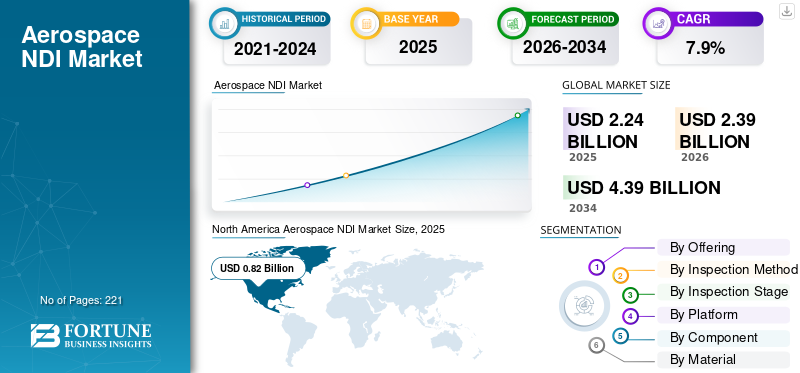
The aerospace NDI market size was valued at USD 2.24 billion in 2025. The market is projected to grow from USD 2.39 billion in 2026 to USD 4.39 billion by 2034, exhibiting a CAGR of 7.9% during the forecast period. North America dominated the aerospace NDI market with a market share of 36.60% in 2025.
Aerospace nondestructive inspection systems comprise integrated equipment, software, consumables, and specialist services used to detect surface, subsurface, and internal defects in aerospace materials, components, and structures without impairing their future use. These systems support the inspection of aircraft airframes, wings, fuselages, engines, turbine components, landing gear, fasteners, composite structures, fuel systems, pressure vessels, spacecraft, launch vehicles, missiles, and unmanned aerial systems. The market includes visual inspection systems, ultrasonic and phased-array ultrasonic equipment, eddy-current instruments, radiographic systems, liquid-penetrant and magnetic-particle materials.
Key market participants such as Evident Corporation, Eddyfi Technologies, and Zetec provide aerospace-focused inspection instruments, probes, scanners, software, and automated testing solutions. Evident offers remote visual inspection, ultrasonic, phased-array, eddy-current, bond-testing, and material-analysis solutions for aircraft and helicopter components, while Eddyfi Technologies provides aircraft and spacecraft inspection technologies for engines, fuselages, wings, composites, tanks, welds, and other safety-critical structures.
Download Free sample to learn more about this report.
AEROSPACE NDI MARKET TRENDS
AI-Assisted Defect Recognition, Automation, and Digital Inspection is Emerging as a Significant Market Trend
The market is shifting from technician-dependent, standalone inspection instruments toward digitally connected systems combining automated scanning, high-resolution imaging, artificial intelligence, robotics, advanced analytics, and centralized inspection-data management. Aerospace OEMs and MRO providers are increasingly adopting phased-array ultrasonic systems, eddy-current arrays, digital radiography, computed tomography, automated optical inspection, robotic scanning, and AI-assisted borescope systems across aircraft structures, engines, turbine components, composite assemblies, and space hardware. AI is primarily being positioned as a decision-support capability that prioritizes images, identifies suspected anomalies, and reduces inspector fatigue, while qualified personnel retain responsibility for technical evaluation and final acceptance decision.
- For instance, in February 2025, GE Aerospace started deploying an AI-enabled Blade Inspection Tool across more than a dozen company and customer MRO facilities servicing CFM LEAP engines.
This trend is expected to support demand for automated ultrasonic scanners, AI-enabled borescopes, industrial computed-tomography systems, robotic inspection cells, digital radiography equipment, machine-vision software, inspection-data platforms, and cloud-supported defect-analysis solutions.
MARKET DYNAMICS
MARKET DRIVERS
Download Free sample to learn more about this report.
Mandatory Airworthiness Assurance and Rising Aerospace Production and MRO Workloads is Propelling Market Growth
Aerospace NDI market growth is fundamentally supported by airworthiness, product-quality, fracture-control, and maintenance requirements governing safety-critical aircraft and spacecraft components. Aircraft structures, engines, propellers, landing gear, pressure vessels, rotor systems, and other components must be inspected using qualified personnel, approved procedures, calibrated equipment, and documented acceptance criteria. The Federal Aviation Administration (FAA’s) active guidance requires appropriate experience, training, examination, qualification, and certification for personnel responsible for aviation NDI, while European Union Aviation Safety Agency EASA requires maintenance organizations to establish written practices covering personnel qualification, equipment calibration, inspection procedures, and technical authorization.
Expanding aircraft fleets and higher utilization generate recurring demand for fatigue-crack detection, corrosion inspection, engine borescope examination, turbine-component evaluation, composite damage assessment, and repair verification.
- For instance, in October 2025, Airbus forecast that global commercial aviation services demand increased by approximately 10% during 2025 and will reach USD 311 billion by 2044. Its forecast valued off-wing maintenance at USD 107 billion and on-wing maintenance at USD 21 billion in 2025.
This driver is expected to support recurring demand for portable NDI equipment, engine-inspection systems, phased-array ultrasonic testing, eddy-current testing, radiographic inspection, penetrant and magnetic-particle consumables, calibration services, and outsourced aerospace inspection.
MARKET RESTRAINTS
High Capital Requirements and Lengthy Procedure Qualification Limits Expansion of Market
Advanced aerospace NDI systems require considerable expenditure on inspection equipment, probes, scanners, robotic manipulators, radiation-controlled facilities, reference standards, software, data storage, calibration infrastructure, and personnel training. Industrial computed-tomography systems, automated immersion-ultrasonic systems, digital radiography installations, and robotic inspection cells can be difficult to justify for smaller MRO providers and aerospace component suppliers with limited inspection volumes.
Technology adoption also involves more than equipment procurement. Organizations must develop and approve inspection procedures, establish probability-of-detection performance, qualify operators, validate software, calibrate equipment, manufacture representative test specimens, integrate results with quality-management systems, and maintain complete inspection records.
MARKET OPPORTUNITIES
Expanding Use of Composite and Additively Manufactured Aerospace Structures Presents Significant Opportunities
The increasing use of carbon-fiber composites, bonded structures, ceramic-matrix composites, additively manufactured engine components, composite pressure vessels, reusable launch-vehicle structures, and advanced propulsion hardware is creating a substantial opportunity for aerospace nondestructive inspection providers. These materials and manufacturing processes introduce defect mechanisms that differ from those associated with conventional metallic structures.
The technical complexity of these components is increasing demand for inspection methods capable of evaluating internal geometry, bond integrity, material uniformity, and subsurface damage. Phased-array ultrasonic testing, X-ray computed tomography, digital radiography, flash thermography, shearography, and laser-based inspection technologies are therefore becoming increasingly important across aircraft production, engine manufacturing, satellite assembly, launch-vehicle qualification, and structural maintenance. The continued adoption of advanced materials and manufacturing processes is therefore expected to support demand for higher-value inspection platforms and specialized technical services.
MARKET CHALLENGES
Qualified-Personnel Shortages, Data Standardization, and AI Validation Challenges Market Growth
Aerospace NDI remains dependent on qualified inspectors capable of selecting appropriate methods, configuring equipment, evaluating indications, distinguishing relevant defects from false signals, and determining whether components meet engineering acceptance criteria. Advanced equipment does not eliminate this requirement. Instead, digital radiography, computed tomography, phased-array ultrasonic, and AI-assisted inspection create demand for personnel with additional competencies in data interpretation, software validation, digital workflows, and automated-system supervision.
Training and certification can require formal instruction, method-specific examinations, documented practical experience, vision testing, employer authorization, and periodic recertification. EASA recognizes EN 4179 for aerospace NDT personnel qualification and requires Level 1, Level 2, and Level 3 personnel to be recertified at defined intervals.
Segmentation Analysis
By Offering
Broad Multimethod Hardware Requirements to Support Equipment and Accessories Segment Dominance
Based on offering, the market is divided into equipment and accessories; software; consumables; and services.
The equipment and accessories segment is expected to hold a leading share in the market due to the extensive range of physical instruments required across aerospace manufacturing, qualification, maintenance, and overhaul activities. Aerospace organizations also replace legacy equipment to meet updated inspection procedures, improve probability of detection, support digital data capture, and maintain compatibility with newer aircraft structures. The comparatively high acquisition value of advanced inspection systems further strengthens the segment’s revenue contribution.
- For instance, in September 2024, TESTIA reported that its Smart UE1 ultrasonic and eddy-current inspection instrument was referenced in 185 Airbus nondestructive testing manual procedures for aircraft maintenance, demonstrating the extensive equipment requirements associated with approved aerospace inspection tasks.
Software segment is anticipated to rise with a fastest growth rate of 10.3% over the forecast period.
By Inspection Method
High Subsurface Defect-Detection Capability to Propel Ultrasonic Testing Segment Leadership
Based on inspection method, the market is divided into visual testing; ultrasonic testing; eddy current testing; radiographic testing; liquid penetrant testing; magnetic particle testing; and others.
The ultrasonic testing segment is expected to dominate the market as it supports the detection, location, and characterization of internal defects across metallic, composite, and bonded aerospace structures. The method is extensively applied to airframes, wings, engine forgings, turbine disks, landing gear, composite panels, adhesive bonds, pressure vessels, and other safety-critical components. The method’s ability to provide depth information, defect sizing, digital imaging, and repeatable inspection records supports its broader revenue contribution compared to lower-value surface inspection methods.
- For instance, in June 2026, Sonatest presented the XEO phased-array ultrasonic inspection platform with phased-array, total focusing method, time-of-flight diffraction, advanced imaging, automated reporting, and connected data capabilities for complex inspection workflows.
Ultrasonic testing segment is anticipated to rise with a steady growth rate of a CAGR of 9.5% over the forecast period.
By Inspection Stage
Maintenance, Repair, Overhaul, and In-Service Inspection Segment is Expected to Dominate Due to Recurring Airworthiness Requirements
Based on inspection stage, the market is divided into research, development, and qualification; manufacturing and production; and maintenance, repair, overhaul, and in-service inspection.
The maintenance, repair, overhaul, and in-service inspection segment is expected to hold the largest aerospace NDI market share due to the recurring nature of aircraft and component inspection throughout their operational lives. Unlike production inspection, which is conducted primarily during manufacturing and acceptance, in-service NDI is repeated according to flight cycles, flight hours, calendar intervals, airworthiness directives, maintenance manuals, and condition-based findings.
Research, development, and qualification segment is anticipated to grow with a fastest growth rate of 10.2% over the forecast period.
To know how our report can help streamline your business, Speak to Analyst
By Platform
Large Installed Fleet and High Maintenance Frequency to Boost Commercial Aircraft Segment Dominance
Based on platform, the market is divided into commercial aircraft; military aircraft; business and general aviation aircraft; unmanned aerial systems; spacecraft, launch vehicles and missile systems; and others.
The commercial aircraft segment is expected to account for leading share of the market due to the scale of worldwide passenger and cargo aircraft fleet, high aircraft utilization, and extensive inspection requirements across manufacturing and maintenance. Commercial aircraft require NDI during material acceptance, airframe assembly, engine production, component manufacturing, delivery inspection, scheduled maintenance, heavy checks, engine overhaul, structural repair, and aircraft life-extension programs.
Spacecraft, launch vehicles, and missile systems segment is anticipated to rise with a CAGR of 9.7% over the forecast period.
By Component
Extensive Inspection Area and Repetitive Structural Checks Will Support Airframe and Structural Segment Dominance
Based on component, the market is divided into airframe and structural assemblies; engine and propulsion components; landing gear and mechanical systems; fluid systems, tanks and pressure vessels; avionics and electrical assemblies; and other.
The airframe and structural assemblies segment is expected to dominate the global market as fuselages, wings, frames, stringers, bulkheads, control surfaces, doors, and bonded panels represent a substantial proportion of the inspectable area of an aircraft. These structures are exposed to repeated pressurization, aerodynamic loading, vibration, environmental degradation, ground-handling damage, and lightning strikes. Inspection programs therefore require recurring visual, eddy-current, ultrasonic, penetrant, radiographic, thermographic, and shearographic examinations.
Engine and propulsion components segment is anticipated to grow with a fastest rate of 9.5% over the forecast period.
By Material
Large Installed Base of Metallic Aircraft Will Drive Aluminum Alloys Segment Dominance
Based on material, the market is divided into aluminum alloys; titanium and nickel-based alloys; steel and other metallic materials; composite materials; and others.
The aluminum alloys segment is expected to hold a leading share in the market as a substantial proportion of the global operating aircraft fleet continues to use aluminum across fuselage skins, wing structures, frames, stringers, bulkheads, floor structures, and control surfaces. Aluminum components require inspection for fatigue cracks, corrosion, exfoliation, fastener-hole damage, material thinning, and manufacturing discontinuities.
- For instance, in February 2026, Embraer and Hindalco Industries signed a memorandum of understanding to evaluate aerospace-grade aluminum manufacturing opportunities in India in support of Embraer’s industrial initiatives and regional aerospace supply-chain development.
Composite materials segment is anticipated to rise with a fastest CAGR of 10.0% over the forecast period.
By Defect Type
Large Legacy Installed Base and Increasing Integration Requirements is Predicted to Propel Cracks and Fractures Segment Dominance
Based on defect type, the market is divided into cracks and fractures; corrosion and material loss; delamination and disbanding; porosity, voids and inclusions; weld, braze and joint defects; and others.
The cracks and fractures segment is expected to dominate the global market as cracking represents one of the most safety-critical defect categories across airframes, engines, landing gear, rotor systems, fasteners, welds, and mechanical assemblies. Repeated loading, vibration, pressurization cycles, thermal exposure, corrosion, and stress concentration can initiate cracks that progressively reduce structural capability. Therefore, aerospace inspection programs prioritize the early detection of surface and subsurface cracking through visual testing, eddy-current inspection, ultrasonic testing, magnetic-particle inspection, penetrant testing, and radiography.
Delamination and disbonding segment is anticipated to rise with a fastest growth rate of 9.6% over the forecast period.
By Automation Level
Operational Flexibility and Technician-Controlled Evaluation to Support Manual Inspection Segment Dominance
Based on automation level, the market is divided into manual inspection; semi-automated inspection; and fully automated inspection.
The manual inspection segment is expected to hold largest share in the market as many aerospace inspections involve localized areas, irregular geometries, restricted access, low production volumes, and aircraft-on-ground requirements that do not justify fixed automated systems. Qualified technicians continue to conduct visual, penetrant, magnetic-particle, conventional ultrasonic, eddy-current, borescope, and portable radiographic inspections across production facilities, hangars, flight lines, engine shops, and remote operating locations.
Fully automated inspection segment is anticipated to rise with a fastest CAGR of 9.9% over the forecast period.
By End User
Extensive Production-Quality Requirements to Augment Aircraft, Engine, and Aerospace System OEMs Segment Leadership
Based on end user, the market is divided into aircraft, engine and aerospace system OEMs; aerospace component and tier suppliers; airlines and aircraft operators; MRO providers; defense organizations and government depots; space, launch and missile organizations; NDI service providers; and others.
Aircraft, engine, and aerospace system OEMs are expected to account for the leading share of the market due to their extensive inspection requirements across incoming materials, castings, forgings, machined components, composite structures, welds, engine parts, airframe assemblies, and final products. OEMs conduct NDI during process development, first-article inspection, serial production, supplier acceptance, qualification testing, failure analysis, and final conformity verification. Major manufacturers also maintain internal NDI engineering teams, laboratories, automated inspection cells, reference standards, and qualified Level II and Level III personnel.
- For instance, in March 2025, GE Aerospace announced plans to invest nearly USD 1 billion in its U.S. factories and supply chain, including expansions, new inspection technology, and building upgrades across more than two dozen communities.
Space, launch, and missile organizations segment is anticipated to rise with a fastest growth rate of 10.9% over the forecast period.
Aerospace NDI Market Regional Outlook
By geography, the market is segmented into North America, Europe, Asia Pacific, Latin America, and Middle East & Africa.
North America
North America Aerospace NDI Market Size, 2025 (USD Billion)
To get more information on the regional analysis of this market, Download Free sample
North America dominated the market in 2025 with a valuation of USD 0.82 billion, and is expected to reach USD 0.86 billion in 2026. The region held the leading global share due to its concentration of aircraft and engine OEMs, commercial and military fleets, aerospace component manufacturers, MRO providers, defense depots, launch-vehicle programs, and space-system developers. Demand is strong across airframe structures, turbine engines, landing gear, composite assemblies, pressure vessels, propulsion systems, missiles, and spacecraft components. The regional market benefits from extensive use of ultrasonic testing, phased-array ultrasonic, eddy-current inspection, digital radiography, computed tomography, penetrant testing, magnetic-particle inspection, and remote visual inspection.
- In May 2025, the U.S. Air Force’s 412th Maintenance Squadron completed a comprehensive B-52 nondestructive inspection 17 days ahead of schedule at Edwards Air Force Base. The inspection included radiographic, ultrasonic, oil-analysis, and other NDI techniques used to verify aircraft structural integrity and support an earlier return to service.
U.S. Aerospace NDI Market
Based on North America’s strong contribution, the U.S. market reached USD 0.77 billion in 2025. The U.S. market is growing significantly due to the presence of Boeing, GE Aerospace, RTX, Lockheed Martin, Northrop Grumman, major airline and independent MRO networks, military maintenance depots, NASA facilities, commercial space companies, and an extensive aerospace supplier base.
Europe
Regional demand is supported by commercial aircraft and engine manufacturing, aerostructure production, helicopter programs, defense aviation, missile systems, space hardware, airline maintenance, and independent MRO activity across the U.K., Germany, France, Italy, Spain, Russia, and the wider European aerospace supply chain.
European aerospace organizations operate within structured airworthiness and maintenance frameworks that require documented NDI procedures, personnel qualification, equipment calibration, technical authorization, and inspection traceability.
- For instance, in 2025, Rolls-Royce outlined plans to expand its global civil-aerospace MRO capacity through 2030, including investment in advanced inspection and repair technologies intended to increase engine life, reduce turnaround time, and improve maintenance efficiency.
U.K. Aerospace NDI Market
The U.K. market in 2025 was at USD 0.10 billion, representing roughly 4.6% of global revenues.
Germany Aerospace NDI Market
Germany market reached USD 0.12 billion in 2025, equivalent to around 5.4% of global sales.
Asia Pacific
Asia Pacific is expected to register the fastest growth in the global market. This growth is supported by expanding commercial aircraft fleets, domestic aerospace manufacturing, MRO-capacity additions, military aircraft programs, space activity, engine maintenance, and supplier localization across China, India, Japan, South Korea, Singapore, Australia, and Southeast Asia. Increasing aircraft utilization and fleet expansion are expected to raise requirements for engine inspections, structural checks, composite damage assessment, component overhaul, and production-quality verification.
- For instance, in 2025, ST Engineering opened an expanded engine MRO facility at its Paya Lebar aerospace complex in Singapore. The investment is intended to progressively double the company’s CFM56 and LEAP engine-maintenance capacity to more than 300 engines annually by 2027.
Japan Aerospace NDI Market
The Japan market in 2025 was at USD 0.12 billion, accounting for roughly 5.5% of global revenues.
China Aerospace NDI Market
China’s market is projected to be one of the largest worldwide, with 2025 revenues at USD 0.20 billion representing roughly 9.1% of global sales.
India Aerospace NDI Market
The India market in 2025 reached USD 0.09 billion, accounting for roughly 4.0% of global revenues.
Latin America
Brazil and Mexico represent the principal markets across Latin America region, supported by aircraft manufacturing, aerospace-component production, airline fleets, defense aviation, engine maintenance, and independent MRO activity. Argentina, Colombia, Chile, and other regional countries contribute through commercial fleet maintenance, military aviation, and airport-based engineering operations.
- For instance, in October 2025, Embraer reported a record USD 31.3 billion backlog, including a USD 4.9 billion Services & Support backlog that had increased by 40% year over year. The company also delivered 62 aircraft during the third quarter of 2025.
Brazil Aerospace NDI Market
Brazil market in 2025 was at USD 0.06 billion, accounting for roughly 2.5% of global revenues.
Middle East & Africa
Aerospace NDI demand is supported by widebody-aircraft fleets, major airline engineering operations, defense aviation, engine and component maintenance, aerospace localization, missile programs, and growing MRO infrastructure across the UAE, Saudi Arabia, Türkiye, Israel, South Africa, Qatar, and other markets. The regional market is expected to benefit from new engine shops, component-repair facilities, military MRO localization, inspection training, digital radiography, borescope inspection, ultrasonic testing, and long-term maintenance agreements.
UAE Aerospace NDI Market
UAE market in 2025 was valued at USD 0.06 billion, accounting for roughly 1.6% of global revenues.
COMPETITIVE LANDSCAPE
Key Industry Players
Key Player’s Focus on Boosting Multimethod Inspection Portfolios and Aerospace Qualification Expertise Drives Their Competitive Leadership
The global market is characterized by competition among NDI equipment manufacturers, inspection-software developers, sensor and probe suppliers, robotic-system integrators, independent testing laboratories, calibration providers, and specialist aerospace inspection companies. Competitive leadership is increasingly determined by the ability to deliver integrated solutions covering ultrasonic and phased-array ultrasonic testing, eddy-current inspection, remote visual inspection, digital radiography, computed tomography, automated scanning, defect-analysis software, probes, accessories, calibration, training, and inspection-engineering services.
LIST OF KEY AEROSPACE NDI COMPANIES PROFILED
- Evident Corporation (Japan)
- Eddyfi Technologies (Canada)
- Baker Hughes Company (U.S.)
- Nikon Corporation (Japan)
- MISTRAS Group, Inc. (U.S.)
- TESTIA SAS (France)
- Element Materials Technology Group Limited (U.K.)
- Applus Services, S.A. (Spain)
- Sonatest Ltd. (U.K.)
- Comet Yxlon GmbH (Germany)
KEY INDUSTRY DEVELOPMENTS
The global market analysis provides an in-depth study of market size & forecast by all the aerospace NDI market segmentation included in the report. It includes details on the market dynamics, trends, and regional analysis expected to drive the market in the forecast period. The market report includes porter s five forces analysis which illustrates the potency of buyers suppliers in the market. Market forecast offers information on the technological advancements, new product launches, key trends, major aviation sector developments, and details on partnerships, mergers & acquisitions. The market analysis also encompasses detailed competitive landscape with information on the market share and profiles of key players.
Request for Customization to gain extensive market insights.
Report Scope & Segmentation
| ATTRIBUTE | DETAILS |
| Study Period | 2021-2034 |
| Base Year | 2025 |
| Estimated Year | 2026 |
| Forecast Period | 2026-2034 |
| Historical Period | 2021-2024 |
| Growth Rate | CAGR of 7.9% from 2026-2034 |
| Unit | Value (USD Billion) |
| Segmentation | By Offering, By Inspection Method, By Inspection Stage, By Platform, By Component, By Material, By Defect Type, By Automation Level, By End User, and Region |
| By Offering |
|
| By Inspection Method |
|
| By Inspection Stage |
|
| By Platform |
|
| By Component |
|
| By Material |
|
| By Defect Type |
|
| By Automation Level |
|
| By End User |
|
| By Region |
|
Frequently Asked Questions
According to Fortune Business Insights, the global market value stood at USD 2.24 billion in 2025 and is projected to reach USD 4.39 billion by 2034.
In 2025, the North America market value stood at USD 0.82 billion.
The market is expected to exhibit a CAGR of 8.8% during the forecast period of 2026-2034.
By material, the aluminum alloys segment is expected to lead the market.
Mandatory airworthiness assurance and rising aerospace production and MRO workloads is driving market expansion.
Evident Corporation, Eddyfi Technologies, and Baker Hughes Company are some of the major players in the global market.
North America dominated the market in 2025.



- 2021-2034
- 2025
- 2021-2024
- 221
Get 30-60 hrs Free Customization
Expand Regional and Country Coverage, Segments Analysis, Company Profiles, Competitive Benchmarking, and End-user Insights.




















Related Reports
-
US +1 833 909 2966 ( Toll Free )
-
Get In Touch With Us