"Smart Market Solutions to Help Your Business Gain Edge over Competitors"
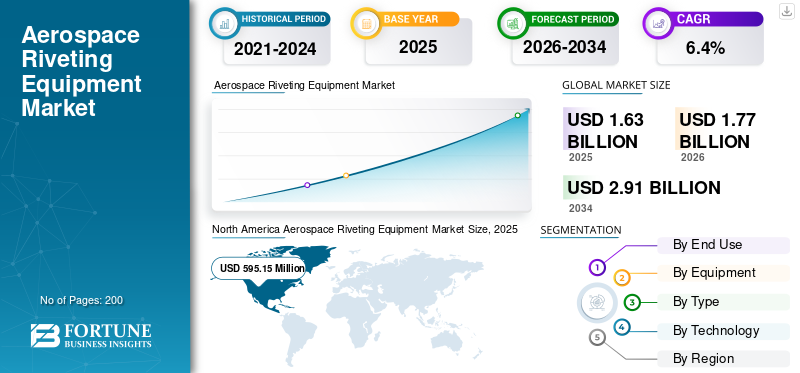
The global aerospace riveting equipment market size was valued at USD 124.00 million in 2025. The market is projected to grow from USD 131.07 million in 2026 to USD 204.22 million by 2034, exhibiting a CAGR of 5.70% during the forecast period.
The Aerospace Riveting Equipment Market encompasses specialized tools and machinery designed for precision riveting in aerospace applications. These tools include hydraulic, electric, and pneumatic riveting systems, along with fixed and portable solutions tailored for commercial aircraft, military aircraft, satellites, and spacecraft components. B2B adoption spans aerospace OEMs, maintenance, repair, and overhaul (MRO) operators, and satellite manufacturing enterprises. Vehicles and platforms benefit from robust, lightweight, and high-strength riveting applications to ensure structural integrity, fatigue resistance, and long-term durability. Technological integration such as automated riveting systems, torque monitoring, and programmable control enhances productivity. The market is driven by increasing aircraft production, military modernization, and satellite launch activities, requiring high-precision, efficient, and reliable riveting solutions. Modular, ergonomic, and portable designs improve field adaptability, while compliance with aerospace standards ensures quality assurance.
Precision riveting is critical in aircraft fuselage assembly, wing construction, and spacecraft components. American enterprises increasingly adopt hydraulic, electric, and pneumatic riveting systems with automated control to enhance efficiency, reduce human error, and ensure compliance with FAA and MIL standards. Portable riveting tools are widely used in field maintenance, retrofits, and emergency repairs, while fixed equipment supports high-volume production lines. Integration with torque monitoring, programmable settings, and real-time quality feedback enables enterprises to maintain structural integrity and safety. OEMs and MRO providers leverage these solutions for commercial aircraft, military platforms, and space vehicles. U.S. adoption emphasizes high reliability, productivity, and enterprise scalability in aerospace manufacturing.
The Aerospace Riveting Equipment Market Trends highlight the shift toward automation, precision, and multi-functional solutions in aerospace manufacturing and maintenance. Enterprises increasingly adopt automated riveting systems that integrate programmable control, torque monitoring, and real-time quality inspection to minimize defects and enhance throughput. Hybrid systems combining hydraulic and electric technologies are gaining traction, offering reliability and energy efficiency for large-scale aircraft assembly lines. Portable and modular riveting tools are being designed for field maintenance, retrofitting, and on-site emergency repairs, enabling MRO providers to support multi-location operations efficiently. B2B enterprises are leveraging ergonomic designs, lightweight materials, and user-friendly interfaces to reduce operator fatigue while maintaining precision.
Emerging trends include multi-rivet heads for simultaneous fastener installation, adaptive torque control for different materials, and integration with robotic arms for complex aerospace structures. Enterprises are also prioritizing sustainability, developing energy-efficient and low-noise riveting equipment. Functional versatility, regulatory compliance, and interoperability with other production systems remain critical. Overall, automation, portability, and technological integration are shaping enterprise adoption and driving Aerospace Riveting Equipment Market Growth globally.
Download Free sample to learn more about this report.
Rising Commercial Aircraft Production and Military Modernization
The primary driver of the Aerospace Riveting Equipment Market is the increased demand for commercial aircraft and military fleet expansion. Aerospace OEMs, defense contractors, and MRO providers require high-precision riveting equipment for fuselage assembly, wing structures, and spacecraft components. Hydraulic, electric, and pneumatic systems enable rapid, reliable, and structurally sound fastener installation. B2B enterprises are adopting automated systems for repetitive operations to improve production efficiency, reduce errors, and ensure quality compliance. MRO operators leverage portable and ergonomic riveting tools to perform maintenance and repairs across aircraft fleets efficiently. Integration with torque monitoring, programmable settings, and real-time quality feedback ensures consistent performance and operational safety. Modular designs allow enterprises to switch between rivet types, such as blind, semi-tubular, and solid rivets, based on mission requirements.
High Cost of Equipment and Maintenance
A key restraint in the Aerospace Riveting Equipment Market is the high cost of acquisition, maintenance, and specialized training required for enterprise deployment. Hydraulic, electric, and automated systems often involve significant capital expenditure, making it challenging for smaller OEMs and MRO operators to invest. Maintenance requires trained personnel, spare parts, and adherence to aerospace quality standards. Portable riveting tools also demand regular calibration, ergonomic training, and adherence to torque specifications to ensure structural integrity. Multi-rivet heads, robotic integration, and advanced control systems increase operational complexity and support costs. Emerging markets face additional barriers due to limited access to certified maintenance networks and high transportation costs. Subscription models and OEM leasing solutions are being adopted to mitigate upfront costs.
Adoption of Automated and Multi-Functional Riveting Systems
The Aerospace Riveting Equipment Market offers significant opportunities through the adoption of automated, robotic, and multi-functional systems. Enterprises, including OEMs and MRO providers, leverage automation to improve throughput, reduce human error, and ensure quality compliance in fuselage, wing, and spacecraft assembly. Hydraulic-electric hybrid systems, multi-rivet heads, and modular tooling enable simultaneous installation of multiple rivets, saving time and increasing efficiency. B2B stakeholders are integrating IoT-enabled sensors, cloud-based monitoring, and predictive maintenance to optimize fleet performance and minimize downtime. Portable and modular systems support field repairs, retrofitting, and emergency operations, expanding enterprise reach. Emerging markets present opportunities for cost-effective, energy-efficient, and lightweight riveting tools suitable for commercial and defense applications. Regulatory compliance, ergonomic designs, and interoperability with other production systems strengthen enterprise adoption.
Technological Complexity and Operator Training Requirements
A major challenge for the Aerospace Riveting Equipment Market is managing technological complexity and ensuring proper operator training. Automated and robotic riveting systems require skilled personnel to configure programmable settings, maintain torque precision, and integrate with robotic arms or multi-rivet heads. B2B enterprises must provide rigorous training for hydraulic, electric, and pneumatic equipment to ensure safety and compliance. Complexity increases with unmanned or portable modular systems that must operate in tight fuselage spaces or on elevated wing structures. Enterprise operations must maintain high reliability, quality assurance, and regulatory adherence. Emerging markets may face additional hurdles due to limited technical expertise, lack of certified training centers, and insufficient service networks.
Hydraulic : The Hydraulic segment accounts for approximately 40% of the Aerospace Riveting Equipment Market, primarily adopted by B2B enterprises in commercial and military aerospace manufacturing. Hydraulic riveting systems offer high force output, precision control, and durability for fuselage assembly, wing construction, and satellite components. OEMs use hydraulic systems on high-volume production lines for repetitive tasks, while MRO operators leverage portable hydraulic units for field repairs and retrofitting. North America and Europe dominate adoption due to large-scale aircraft production and strict quality standards, while Asia-Pacific shows rising adoption in emerging aerospace hubs. Functional benefits include consistent torque application, modular attachments for different rivet types, and compatibility with automation. Enterprises benefit from integration with robotic arms, multi-rivet heads, and cloud-based monitoring to ensure operational efficiency.
Electric : The Electric segment holds around 35% of the Aerospace Riveting Equipment Market, widely adopted by commercial aircraft manufacturers, MRO operators, and defense contractors. Electric riveting systems provide energy efficiency, precise control, and adaptability for manual or automated production lines. B2B enterprises leverage these systems for fuselage assembly, satellite manufacturing, wing panel integration, and on-site repairs. North America and Europe lead adoption, while Asia-Pacific is growing due to expanding industrial infrastructure and aerospace production. Functional benefits include programmable torque, ergonomic design, portability, and integration with automated systems. Cloud-based monitoring and predictive maintenance improve operational reliability. Enterprises adopt subscription models and OEM partnerships for cost-effective scalability.
Pneumatic : The Pneumatic segment represents roughly 25% of the Aerospace Riveting Equipment Market, adopted by B2B enterprises requiring lightweight, portable, and ergonomic riveting solutions. Pneumatic systems are widely used for field maintenance, retrofits, and emergency repairs by MRO providers and industrial operators. Vehicles and aerospace components benefit from portable pneumatic riveting tools for fuselage assembly, wing panels, and spacecraft integration. North America and Europe lead adoption due to infrastructure readiness, while Asia-Pacific adoption grows with industrial expansion. Functional benefits include high-speed riveting, consistent force application, modular attachments, and ease of portability. Enterprises integrate pneumatic systems with robotic arms, telecommunication modules, and multi-rivet heads for automation.
Blind Rivet : The Blind Rivet segment accounts for approximately 40% of the Aerospace Riveting Equipment Market, widely adopted in commercial and military aircraft assembly. B2B enterprises utilize blind rivets for applications requiring access from only one side, including fuselage panels, wing structures, and satellite exteriors. North America and Europe lead adoption due to high-volume aircraft production and strict aerospace standards, while Asia-Pacific is growing in OEM and MRO sectors. Functional benefits include ease of installation, consistent torque, and compatibility with automated riveting systems. Enterprises deploy modular tooling, cloud-based monitoring, and predictive maintenance to ensure precision. Blind rivets support lightweight structures, corrosion resistance, and multi-material assembly. Co-branded solutions, OEM partnerships, and subscription-based procurement expand enterprise scalability.
Semi-Tubular Rivet : The Semi-Tubular Rivet segment represents roughly 20% of the Aerospace Riveting Equipment Market, primarily used by B2B enterprises in structural aerospace assembly and MRO operations. Semi-tubular rivets provide controlled deformation, high-strength fastening, and compatibility with multiple riveting systems. North America and Europe lead adoption in commercial aircraft production, while Asia-Pacific is expanding in industrial aerospace and satellite manufacturing. Functional benefits include reduced material stress, efficient installation, and integration with automated riveting tools. Enterprises utilize predictive maintenance, modular tooling, and OEM partnerships for reliability. Co-branded and subscription-based solutions enhance scalability. Semi-tubular rivets are deployed in fuselage panels, wing assemblies, and spacecraft structures.
Solid Rivet : The Solid Rivet segment accounts for approximately 25% of the Aerospace Riveting Equipment Market, widely adopted in commercial aircraft, military aircraft, and satellite manufacturing. B2B enterprises utilize solid rivets for structural assembly where high-strength fastening and fatigue resistance are critical, including fuselage panels, wing assemblies, and spacecraft frameworks. North America and Europe lead adoption due to large-scale aerospace production and stringent quality standards, while Asia-Pacific is growing in emerging OEMs and MRO operators. Functional benefits include superior shear and tensile strength, compatibility with hydraulic and pneumatic riveting systems, and suitability for automated riveting processes. Enterprises leverage cloud-based monitoring, predictive maintenance, and modular tooling for consistent quality and operational efficiency. Co-branded solutions, subscription-based procurement, and OEM partnerships expand enterprise scalability.
Other : The Other Rivet Types segment represents roughly 15% of the Aerospace Riveting Equipment Market, covering specialty fasteners like flush rivets, split rivets, and custom alloy rivets. B2B adoption includes aerospace OEMs, MRO providers, and satellite manufacturers requiring niche solutions for complex assembly tasks. North America and Europe dominate enterprise adoption due to advanced aircraft and spacecraft production, while Asia-Pacific adoption is growing for specialized applications. Functional benefits include adaptability to unique materials, aerodynamic surface integration, and compatibility with hydraulic, electric, and pneumatic systems. Enterprises leverage modular tooling, co-branded solutions, and subscription-based models for scalable deployment. Predictive maintenance, cloud monitoring, and OEM partnerships ensure reliability.
Fixed Equipment : The Fixed Equipment segment accounts for approximately 60% of the Aerospace Riveting Equipment Market, primarily adopted by high-volume aerospace OEMs, MRO operators, and satellite production enterprises. Fixed riveting systems are installed on production lines for fuselage assembly, wing construction, and spacecraft manufacturing. B2B enterprises leverage hydraulic, electric, and pneumatic systems with programmable controls, automated multi-rivet heads, and integrated quality monitoring. North America and Europe lead adoption due to large-scale production and regulatory compliance, while Asia-Pacific is growing in industrial OEM operations. Functional benefits include high throughput, precision control, repeatable torque application, and integration with robotic arms. Enterprises adopt modular tooling, cloud-based monitoring, predictive maintenance, and subscription-based procurement for scalability.
Portable Equipment : The Portable Equipment segment represents roughly 40% of the Aerospace Riveting Equipment Market, widely adopted by B2B enterprises for field maintenance, retrofits, and emergency operations. Portable riveting tools include hydraulic, pneumatic, and electric systems optimized for mobility, ergonomic operation, and multi-terrain deployment. North America and Europe lead adoption in MRO operations, while Asia-Pacific is expanding portable unit deployment for industrial, municipal, and defense applications. Functional benefits include rapid deployment, modular interiors, integration with multiple rivet types, and compatibility with unmanned systems. Enterprises leverage cloud-based monitoring, predictive maintenance, OEM partnerships, and subscription-based solutions for scalability.
Automated Riveting : The Automated Riveting segment accounts for approximately 65% of the Aerospace Riveting Equipment Market, primarily adopted by large aerospace OEMs, MRO operators, and satellite manufacturers. B2B enterprises leverage automated systems for high-volume fuselage assembly, wing panel integration, and spacecraft structural applications. These systems include hydraulic, electric, and pneumatic equipment integrated with robotic arms, multi-rivet heads, programmable torque control, and real-time quality monitoring. North America and Europe dominate adoption due to advanced production lines, regulatory compliance, and skilled technical workforce, while Asia-Pacific adoption is increasing with emerging aerospace OEMs and industrial expansion. Functional benefits include high throughput, consistent torque application, reduced human error, and operational reliability.
Manual Riveting : The Manual Riveting segment represents roughly 35% of the Aerospace Riveting Equipment Market, widely adopted by B2B enterprises in maintenance, retrofitting, and small-scale production operations. Manual riveting is critical for complex fuselage assemblies, repair operations, and satellite adjustments where automated systems may not reach or where flexibility is required. North America and Europe lead adoption due to skilled labor availability and industrial standards, while Asia-Pacific adoption is growing for field maintenance and emerging aerospace OEMs. Functional benefits include portability, adaptability to diverse rivet types, ergonomic operation, and compatibility with hydraulic, electric, and pneumatic systems. Enterprises implement predictive maintenance, cloud monitoring, and co-branded solutions for operational reliability. Manual riveting supports precision in tight spaces, emergency repairs, and multi-mission adaptability in commercial and military aerospace operations.
Commercial Aircraft : The Commercial Aircraft segment holds approximately 50% of the Aerospace Riveting Equipment Market, primarily adopted by aerospace OEMs, airline MRO providers, and component manufacturers. B2B enterprises utilize hydraulic, electric, and pneumatic systems for fuselage assembly, wing construction, and cabin structural integration. North America and Europe dominate adoption due to major aircraft manufacturing hubs and high-volume commercial airline fleets, while Asia-Pacific adoption is rising with emerging OEMs. Functional benefits include high precision, modular tooling, multi-rivet capability, and automated torque monitoring. Cloud-based monitoring, predictive maintenance, and robotic integration improve operational efficiency. Enterprises implement subscription-based procurement and co-branded solutions for scalability.
Military Aircraft : The Military Aircraft segment represents roughly 20% of the Aerospace Riveting Equipment Market, focusing on B2B enterprise adoption by defense contractors, military OEMs, and tactical MRO operators. Vehicles require high-strength rivets for fuselage, wing, and armored component integration. North America and Europe lead adoption due to robust defense budgets and multi-terrain military platforms, while Asia-Pacific is growing with modernization programs. Functional benefits include automated and manual riveting, precision torque control, modular tooling, and payload versatility. Cloud-based monitoring, predictive maintenance, and robotic integration improve operational readiness. Subscription models, OEM partnerships, and co-branded solutions expand enterprise scalability.
Satellite Launch Vehicle : The Satellite Launch Vehicle segment accounts for approximately 15% of the Aerospace Riveting Equipment Market, adopted by space agencies, satellite manufacturers, and private aerospace enterprises. B2B applications include fuselage, payload integration, and structural assembly of launch vehicles. North America and Europe dominate adoption due to established aerospace space programs, while Asia-Pacific adoption grows with new satellite launch initiatives. Functional benefits include hydraulic and electric automated riveting, multi-rivet heads, precision torque control, and modular tooling. Enterprises leverage cloud-based monitoring, predictive maintenance, and OEM partnerships for operational efficiency and reliability. Manual systems support field adjustments, testing, and retrofitting of satellites.
Others : The Others segment holds roughly 15% of the Aerospace Riveting Equipment Market, covering experimental platforms, unmanned aerial vehicles, and industrial aerospace prototypes. B2B enterprises include R&D units, aerospace OEMs, MRO operators, and space startups. Vehicles and components are assembled using hydraulic, electric, and pneumatic riveting systems for precise structural integration. North America and Europe lead adoption due to technological maturity, while Asia-Pacific adoption is growing for emerging aerospace innovations. Functional benefits include modular tooling, high precision, multi-rivet installation, torque monitoring, and compatibility with automated and manual systems. Enterprises implement cloud monitoring, predictive maintenance, subscription models, and OEM partnerships for scalability.
OEM (Original Equipment Manufacturer) : The OEM segment accounts for approximately 60% of the Aerospace Riveting Equipment Market, reflecting extensive B2B adoption in commercial and military aircraft manufacturing, satellite assembly, and aerospace component production. OEMs rely on hydraulic, electric, and pneumatic riveting systems for high-precision fuselage assembly, wing integration, and spacecraft structural components. North America and Europe lead adoption due to established aerospace hubs, high-volume production lines, and regulatory compliance requirements, while Asia-Pacific adoption is increasing with emerging OEMs and industrial expansion. Functional benefits include automated riveting systems, programmable torque control, multi-rivet heads, and integration with robotic arms. Enterprises implement modular tooling, predictive maintenance, and cloud-based monitoring to ensure operational efficiency and reduce downtime.
MRO (Maintenance, Repair, and Overhaul) : The MRO segment represents roughly 40% of the Aerospace Riveting Equipment Market, reflecting the adoption of both portable and fixed riveting equipment by B2B enterprises involved in aircraft maintenance, retrofit programs, and component repair. MRO operators rely on hydraulic, electric, and pneumatic riveting tools for fuselage repairs, wing panel replacement, spacecraft maintenance, and satellite component servicing. North America and Europe lead adoption due to mature airline fleets, regulatory oversight, and advanced industrial capabilities, while Asia-Pacific adoption is growing with fleet expansion and industrial aerospace development. Functional benefits include modular and portable riveting systems, multi-rivet heads, adjustable torque control, and ergonomic designs for operator efficiency. Enterprises implement cloud-based monitoring, predictive maintenance, and OEM partnerships to improve operational reliability and reduce downtime.
North America accounts for approximately 35% of the global Aerospace Riveting Equipment Market, driven by large aerospace OEMs, military contractors, and MRO providers. B2B adoption includes commercial aircraft manufacturers, defense organizations, satellite producers, and maintenance operators. Hydraulic, electric, and pneumatic riveting systems are deployed across fuselage assembly, wing panel integration, and spacecraft structural applications. Functional benefits include precision torque control, multi-rivet heads, ergonomic portable systems, and modular tooling for automated or manual operations. North America leads adoption of automated riveting systems integrated with robotic arms, cloud-based monitoring, and predictive maintenance. Subscription-based procurement and co-branded OEM solutions expand enterprise scalability. Regulatory compliance with FAA, MIL, and EASA standards ensures structural integrity and operational safety. Vehicles, satellites, and commercial aircraft benefit from fatigue-resistant assembly and multi-material capability. MRO operations rely on portable and field-deployable systems for emergency repairs, retrofitting, and maintenance.
Europe holds approximately 30% of the global Aerospace Riveting Equipment Market, with B2B adoption across commercial OEMs, defense contractors, satellite manufacturers, and MRO operators. Key countries include Germany, the United Kingdom, France, and the Netherlands, which lead in high-volume aerospace production and advanced MRO services. Enterprises leverage hydraulic, electric, and pneumatic riveting systems for fuselage assembly, wing integration, spacecraft production, and satellite assembly. Functional benefits include modular tooling, multi-rivet heads, precision torque control, automated systems, and ergonomic portable units. Enterprises adopt cloud-based monitoring, predictive maintenance, and OEM partnerships to improve operational efficiency and scalability. Compliance with EASA, FAA, and military standards ensures safety, quality, and reliability. Multi-mission adaptability allows vehicles to be used for commercial aircraft, military platforms, and spacecraft. MRO operations rely on portable and modular systems for emergency repairs, retrofits, and field servicing.
Germany represents roughly 10% of Europe’s Aerospace Riveting Equipment Market, primarily serving aerospace OEMs, defense contractors, and MRO operators. Enterprises adopt hydraulic, electric, and pneumatic riveting systems for fuselage assembly, wing integration, and satellite component production. Functional benefits include high-precision torque control, modular tooling, multi-rivet heads, and integration with automated systems. Portable units support field repairs and retrofits. Cloud-based monitoring, predictive maintenance, and OEM partnerships ensure operational reliability and scalability. Compliance with EASA and military standards ensures structural integrity. German enterprises focus on multi-mission adaptability, ergonomic designs, and energy-efficient systems. Vehicles, satellites, and aircraft benefit from fatigue-resistant assembly.
The United Kingdom accounts for approximately 8% of Europe’s Aerospace Riveting Equipment Market, with B2B adoption across commercial aircraft OEMs, defense contractors, and MRO providers. Enterprises leverage hydraulic, electric, and pneumatic systems for fuselage, wing, and satellite component assembly. Functional benefits include multi-rivet heads, modular tooling, automated systems, and ergonomic portable units. MRO operators use portable systems for retrofitting, emergency repairs, and field servicing. Cloud-based monitoring, predictive maintenance, and subscription-based deployment enhance operational efficiency. Regulatory compliance with EASA, FAA, and military standards ensures structural integrity and reliability. Multi-mission adaptability allows deployment across aircraft, military platforms, and satellite assemblies. Co-branded and OEM partnership solutions increase scalability and enterprise productivity.
Asia-Pacific accounts for approximately 20% of the global Aerospace Riveting Equipment Market, driven by expanding commercial aircraft production, military modernization, and satellite programs. B2B adoption includes aerospace OEMs, MRO operators, and defense contractors in countries such as China, Japan, India, and Southeast Asian nations. Hydraulic, electric, and pneumatic systems are deployed for fuselage assembly, wing integration, and spacecraft manufacturing. Functional benefits include modular tooling, multi-rivet heads, torque monitoring, and integration with automated or robotic systems. Enterprises implement cloud-based monitoring, predictive maintenance, and subscription-based procurement for scalable operations. Portable units are widely adopted for field maintenance, retrofitting, and emergency repairs. Multi-mission capability enables deployment across commercial, military, and satellite platforms. Regulatory compliance, safety certifications, and interoperability with other production systems ensure operational reliability. Asia-Pacific enterprises prioritize precision, ergonomics, and energy-efficient systems. Market growth is supported by emerging OEMs, industrial expansion, and increasing MRO activities. Integration with unmanned systems, co-branded solutions, and OEM partnerships strengthens enterprise adoption.
Japan represents roughly 5% of the Asia-Pacific Aerospace Riveting Equipment Market, with B2B adoption concentrated in commercial aircraft assembly, defense manufacturing, and satellite production. Enterprises utilize hydraulic, electric, and pneumatic riveting systems for fuselage, wing, and spacecraft structural components. Functional benefits include multi-rivet heads, modular tooling, precise torque application, and automated system integration. Portable units support MRO operations, field repairs, and emergency retrofitting. Cloud-based monitoring, predictive maintenance, and OEM partnerships enhance operational efficiency and reliability. Compliance with Japanese aerospace standards, FAA, and military regulations ensures structural integrity. Multi-mission capability allows deployment across commercial, defense, and space applications. Subscription-based models and co-branded solutions expand enterprise scalability. Japan emphasizes ergonomics, energy efficiency, and precision, supporting high-quality output in aerospace production.
China accounts for approximately 8% of the Asia-Pacific Aerospace Riveting Equipment Market, driven by government-led aerospace initiatives, commercial aircraft manufacturing, and satellite launch programs. B2B adoption includes OEMs, MRO operators, defense contractors, and private aerospace enterprises. Hydraulic, electric, and pneumatic systems are deployed for fuselage assembly, wing panel integration, and spacecraft manufacturing. Functional benefits include modular tooling, multi-rivet heads, torque monitoring, and automated systems. Enterprises implement cloud-based monitoring, predictive maintenance, and subscription-based deployment for operational efficiency. Portable riveting tools are widely used for field repairs, retrofitting, and emergency maintenance. Multi-mission capability allows deployment across commercial, defense, and satellite platforms. Regulatory compliance, safety certifications, and adherence to international aerospace standards ensure reliability. Integration with unmanned systems, co-branded solutions, and OEM partnerships strengthens enterprise adoption.
The Rest of World (ROW), including Latin America, the Middle East, and Africa, accounts for approximately 7% of the global Aerospace Riveting Equipment Market, with emerging B2B adoption in aerospace OEMs, MRO operators, and defense enterprises. Hydraulic, electric, and pneumatic riveting systems are deployed for commercial aircraft assembly, military platforms, and satellite manufacturing. Functional benefits include modular tooling, multi-rivet heads, automated and portable systems, precise torque control, and ergonomic operation. Enterprises implement cloud-based monitoring, predictive maintenance, and OEM partnerships for scalability. Portable units are used for emergency repairs, retrofitting, and field maintenance. Subscription-based models, co-branded solutions, and multi-mission capability enhance enterprise adoption. Regulatory compliance, structural integrity, and interoperability with global aerospace standards are essential. ROW markets focus on emerging industrial hubs, disaster preparedness, and defense modernization, driving Aerospace Riveting Equipment Market Growth globally.
The Aerospace Riveting Equipment Market presents significant investment opportunities driven by the growth of commercial aircraft, military modernization, satellite launches, and MRO expansion. B2B enterprises, including aerospace OEMs, MRO operators, and defense contractors, are investing in hydraulic, electric, and pneumatic systems to improve precision, efficiency, and compliance. Emerging markets in Asia-Pacific, Latin America, and the Middle East provide growth potential due to expanding industrial infrastructure, rising aircraft production, and defense modernization initiatives. Investments in automated riveting systems, multi-rivet heads, modular tooling, and portable systems enhance operational flexibility. Enterprises adopt cloud-based monitoring, predictive maintenance, and OEM partnerships to reduce downtime and optimize fleet performance. Subscription-based procurement and co-branded solutions allow scalable deployment across multiple production and maintenance sites.
Multi-mission capability supports commercial, military, and satellite platforms, enabling cost-efficient and high-quality production. Advanced torque monitoring, robotic integration, and ergonomic designs reduce operator fatigue while maintaining precision. B2B adoption focuses on compliance with FAA, EASA, and military regulations, ensuring structural integrity and safety. Investment in technological innovation, modular designs, and automation strengthens enterprise efficiency and drives Aerospace Riveting Equipment Market Growth globally.
Innovation in the Aerospace Riveting Equipment Market focuses on multi-mission functionality, automation, and ergonomic design. Enterprises are developing hydraulic, electric, and pneumatic systems capable of high-volume fuselage assembly, wing panel integration, and satellite component installation. Automated systems with multi-rivet heads, programmable torque control, and integration with robotic arms improve production efficiency and operational consistency. Portable and modular riveting tools are designed for field maintenance, retrofitting, and emergency repair scenarios, enabling B2B enterprises to support diverse MRO and industrial operations. IoT-enabled sensors, cloud-based monitoring, and predictive maintenance platforms enhance operational readiness and reduce downtime.
Co-branded solutions and OEM partnerships allow scalable deployment across multiple sites. Multi-material assembly, fatigue-resistant structures, and compliance with FAA, EASA, and military standards ensure product reliability. Advanced torque monitoring, ergonomic designs, and high-speed riveting systems increase productivity while reducing operator fatigue. Hybrid hydraulic-electric solutions, energy-efficient systems, and lightweight tools further strengthen enterprise adoption. New products emphasize modularity, flexibility, and precision, supporting multi-mission applications across commercial aircraft, military platforms, and satellite programs. These innovations drive enterprise efficiency, reliability, and Aerospace Riveting Equipment Market Insights globally.
The Aerospace Riveting Equipment Market Report provides a detailed analysis of global production, technological trends, and B2B enterprise adoption across commercial aircraft, military aircraft, satellites, and other aerospace platforms. The report covers segmentation by Product Type (Hydraulic, Electric, Pneumatic), Rivet Type (Blind, Semi-Tubular, Solid, Other), and Mobility (Fixed, Portable). It further examines Applications including Automated vs Manual riveting, Platforms such as Commercial Aircraft, Military Aircraft, Satellite Launch Vehicles, and End-Use by OEM and MRO operators. Regional insights encompass North America, Europe, Asia-Pacific, and the Rest of World, with country-level analysis for the USA, Germany, the UK, Japan, and China. Enterprise adoption patterns, technological integration, modular tooling, and multi-rivet solutions are analyzed for high-volume production and field maintenance applications.
Request for Customization to gain extensive market insights.
The report highlights investment opportunities, new product development, and five key developments from 2023–2025. Regulatory compliance, FAA, EASA, and MIL standards, and multi-mission adaptability are emphasized. Cloud-based monitoring, predictive maintenance, and subscription-based deployment models are covered in detail. B2B insights focus on efficiency, reliability, ergonomics, and modularity for OEMs, MROs, and defense contractors. Overall, the report equips enterprise decision-makers with actionable intelligence to optimize aerospace riveting operations, scale multi-platform deployments, and enhance operational productivity.
|
By Product Type |
By Rivet Type |
By Mobility |
By Technology |
By Platform |
By End Use |
By Region |
|
|
|
|
|
|
|
Expand Regional and Country Coverage, Segments Analysis, Company Profiles, Competitive Benchmarking, and End-user Insights.

Get In Touch With Us
US +1 833 909 2966 ( Toll Free )