Agricultural Coatings Market Size, Share & Industry Analysis, By Product Type (Seed Coating, Fertilizer Coatings, and Crop Protection Coatings), By Function (Protection, Enhancement, Controlled Release, Adhesion & Binding, and Others), By Form (Liquid Coatings, Powder Coatings, and Granular Coatings), By Application Method (Pre-Sowing, Soil Application, and Foliar Application), By Crop Type (Cereals & Grains, Oilseeds & Pulses, Fruits & Vegetables, and Others), and Regional Forecast, 2026-2034
 Download Free Sample
(Offer valid till 31st Oct 2026)

Agricultural Coatings Market Size and Future Outlook
 Listen to Audio Version
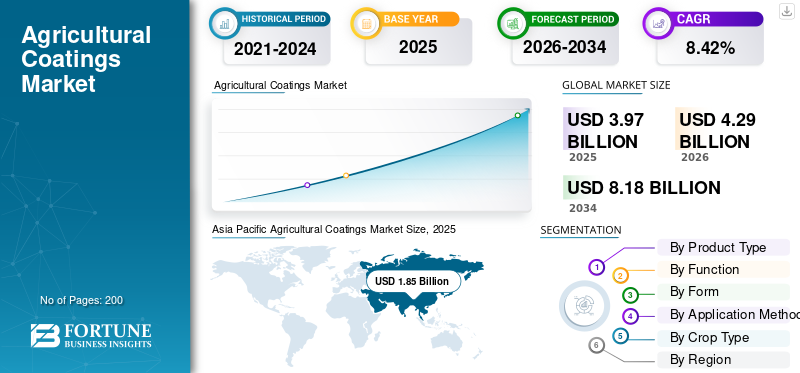
The global agricultural coatings market size was valued at USD 3.97 billion in 2025. The market is projected to grow from USD 4.29 billion in 2026 to USD 8.18 billion by 2034, exhibiting a CAGR of 8.42% during the forecast period. Asia Pacific dominated the agricultural coatings market with a market share of 46.6% in 2025.
Agricultural coatings are specialized material systems applied to seeds, fertilizers, crop protection inputs, and soil-applied products to improve handling, stability, controlled release, adhesion, protection, and performance efficiency. These coatings are increasingly used to support precision agriculture, reduce input losses, improve nutrient and active ingredient delivery, enhance seed plantability, and improve early crop establishment across cereals, oilseeds, pulses, fruits, vegetables, and other commercial crops.
The market is supported by leading agricultural input, seed technology, and specialty chemical companies such as BASF SE, Croda International Plc, Clariant AG, Solvay SA, Sensient Technologies Corporation, Germains Seed Technology, BrettYoung, Milliken & Company, Precision Laboratories, and Centor Group, all of which maintain active positions in seed treatment, seed enhancement, coating polymers, colorants, binders, controlled-release materials, or agricultural formulation technologies.
Download Free sample to learn more about this report.
Agricultural Coatings Market Key Takeaways
 Global Market Size & Forecast
- 2025 Market Size: USD 3.97 billion
- 2026 Market Size: USD 4.29 billion
- 2034 Forecast Market Size: USD 8.18 billion
- CAGR: 8.42% from 2026–2034
 Market Share
- Asia Pacific dominated the agricultural coatings market with a 46.6% share in 2025.
- The fertilizer coatings segment accounted for a significant market share in 2025 and is projected to grow at the fastest CAGR of 9.61% during 2026–2034.
- The granular coatings segment recorded strong demand in 2025 and is expected to expand at the fastest CAGR of 9.56% during 2026–2034.
 Key Regional Highlights
Asia Pacific
Asia Pacific led the global market with a value of USD 1.85 billion in 2025 and is projected to reach USD 3.84 billion by 2034.
North America
North America was valued at USD 0.82 billion in 2025 and is forecast to reach USD 1.65 billion by 2034.
Europe
Europe accounted for USD 0.64 billion in 2025 and is projected to grow to USD 1.25 billion by 2034.
U.S.
U.S. The U.S. dominated the North American agricultural coatings market, valued at approximately USD 0.64 billion in 2025.
Japan
Japan Rising adoption of advanced crop protection technologies and coated fertilizers is expected to support steady market growth.
Read More

Agricultural Coatings Market Trends
Growing Shift Toward Precision Seed Treatment and Sustainable Coating Technologies to Shape Industry Trends
The global market is increasingly being shaped by the shift toward precision seed treatment, biological seed-applied solutions, and sustainable coating polymers. Seed coatings are no longer limited to basic colorants or binders; they are now being used as delivery systems for fungicides, insecticides, nematicides, micronutrients, biostimulants, inoculants, and biological agents. This trend is supported by the need to improve germination, protect high-value seeds during early growth, reduce crop input wastage, and minimize environmental exposure.
- A key indicator of this shift is the high adoption of treated seed in major row crops. In the U.S., a 2024 American Soybean Association and United Soybean Board survey of nearly 500 soybean growers across 17 leading soybean-producing states found that 90% of soybean acres were planted with treated seeds. The same survey indicated that 72% of surveyed farmers used fungicide seed treatments, while 66% used insecticide seed treatments, highlighting the strong movement toward seed-applied crop protection rather than broad-field applications.
MARKET DYNAMICS
Market Drivers
Download Free sample to learn more about this report.
Rising Demand for Efficient Crop Input Delivery to Support Market Growth
The global agricultural coatings market growth is being significantly supported by the rising need to improve the efficiency of seeds, fertilizers, and crop protection products. As agricultural production systems face pressure to deliver higher yields from limited land, coating technologies are becoming essential for improving input placement, reducing losses, and enhancing biological and chemical performance at the seed, soil, and plant level. Increasing pests diseases and environmental stress are raising the importance of the products that offer protection against pests and diseases. In modern agriculture practices, seed coating technology offers effective solutions to the farmers. It will be a factor which plays a crucial role in shaping the industry growth. Agricultural coatings help bind active ingredients to seeds, regulate fertilizer release, reduce dust-off, improve product appearance, increase flowability, and support uniform application. Therefore, the agricultural coatings are being widely adopted in modern agricultural practices.
- According to the Food and Agriculture Organization (FAO), global cereal production in 2025 is placed at around 3,036 million tons, reflecting the scale of crop systems that require efficient seeds, fertilizers, and crop protection inputs.
Market Restraints
Regulatory Pressure, Material Compatibility Issues, and Environmental Concerns to Limit Market Expansion
The growth of the market is being constrained by regulatory pressure on coating materials, active ingredients, microplastics, dust-off, and environmental residues. Seed coatings, fertilizer coatings, and crop protection coatings must comply with product safety, residue, handling, and environmental standards across different regions. This makes product development complex, especially for companies operating across multiple regulatory jurisdictions. Environmental concerns are also increasing pressure on conventional polymer-based coatings. The European and global shift toward biodegradable and microplastic-free coating materials is creating innovation opportunities, but it also raises reformulation costs and technical barriers for manufacturers.
- A major example is the European Union’s Regulation (EU) 2023/2055, which restricts intentionally added synthetic polymer microparticles, commonly referred to as microplastics. The regulation began applying on 17 October 2023 and directly affects industries using synthetic polymer particles in mixtures, including agricultural formulations and coating materials.
Market Opportunities
Controlled-Release Fertilizers and Bio-Based Seed Coatings to Create New Growth Avenues
Controlled-release fertilizers and bio-based seed coatings are creating strong growth opportunities in the global market as farmers, input suppliers, and regulators move toward higher nutrient-use efficiency, lower nutrient losses, biodegradable materials, and precision input delivery. These technologies allow nutrients, crop protection actives, micronutrients, and biologicals to be released gradually or placed directly near the seed, improving early crop establishment while reducing wastage.
- The Food and Agriculture Organization (FAO) cropland nutrient balance analysis reported that, at the global level, cropland nutrient surplus in 2022 reached 82 million tons of nitrogen, 7 million tons of phosphorus, and 8 million tons of potassium, equal to 52 kg nitrogen per hectare, 4 kg phosphorus per hectare, and 5 kg potassium per hectare of cropland. These surpluses indicate the scale of nutrient inefficiency and create a need for coated fertilizers that release nutrients more gradually and reduce leaching, volatilization, and runoff.
SEGMENTATION ANALYSIS
By Product Type
Seed Coating Segment Dominated Market Due to Its Strong Role in Plantability, Seed Protection, and Active Ingredient Delivery
Based on product type, the market is segmented into seed coating, fertilizer coatings, and crop protection coatings.
The seed coating segment dominated the global agricultural coatings market share, valued at USD 2.03 billion in 2025, owing to its extensive use in improving seed flowability, appearance, treatment retention, dust control, and early crop establishment. Within seed coating, polymer coatings accounted for USD 0.95 billion in 2025, supported by their use as binders, film-forming agents, and treatment carriers.
Fertilizer coatings segment was valued at USD 1.31 billion in 2025 and are projected to grow at the fastest CAGR of 9.61% during 2026-2034, supported by increasing demand for nutrient-use efficiency and controlled-release fertilizers.
By Function
Protection Segment Dominated Market Due to Its Core Role in Seed Safety, Input Stability, and Crop Establishment
Based on function, the market is segmented into protection, enhancement, controlled release, adhesion & binding, and others.
The protection segment dominated the global agricultural coatings market share, valued at USD 1.50 billion in 2025, owing to the widespread use of coating technologies to safeguard seeds, fertilizers, pesticides, and other agricultural inputs during storage, transportation, handling, and field application. Protection-oriented coatings help reduce mechanical abrasion, moisture absorption, dust-off losses, microbial contamination, and premature degradation of active ingredients. In seed applications, protective coatings improve seed integrity, enhance flowability during planting, reduce cracking and breakage, and support uniform emergence by shielding seeds from early-stage soilborne pests and pathogens.
The controlled release segment was valued at USD 0.78 billion in 2025 and is projected to grow at the fastest CAGR of 10.54% during the forecast period, driven by the increasing adoption of coated fertilizers and slow-release active ingredient delivery systems.
To know how our report can help streamline your business, Speak to Analyst
By Form
Liquid Coatings Segment Dominated Market Due to Its Ease of Application and Compatibility with Seed Treatment Systems
Based on form, the market is segmented into liquid coatings, powder coatings, and granular coatings.
The liquid coatings segment dominated the global market, valued at USD 2.18 billion in 2025, owing to its widespread use in commercial seed treatment, fertilizer coating, and crop protection formulation systems. Liquid coatings are preferred as they offer uniform coverage, easier blending with active ingredients, better adhesion, and compatibility with automated seed treatment equipment.
Granular coatings segment reached USD 0.85 billion in 2025 and are projected to grow at the fastest CAGR of 9.56% during 2026-2034, driven by increasing demand for coated fertilizers, controlled-release granules, and soil-applied nutrient delivery products.
By Application Method
Pre-Sowing Segment Dominated Market Due to High Adoption of Coated and Treated Seeds
Based on application method, the market is segmented into pre-sowing, soil application, and foliar application.
The pre-sowing segment dominated the market, valued at USD 2.09 billion in 2025, due to the large-scale use of seed coatings, film coatings, seed treatment polymers, pigments, and seed-applied crop protection products before planting. This method is widely adopted since it allows precise placement of active ingredients at the seed level, improves early crop establishment, and supports efficient mechanized planting.
Soil application segment was valued at USD 1.24 billion in 2025 and is projected to grow at the fastest CAGR of 9.61% during the forecast period, supported by the rising use of coated fertilizers, soil-applied biologicals, and slow-release nutrient technologies.
By Crop Type
Cereals & Grains Segment Dominated Market Due to Large Cultivated Area and High Use of Treated Seeds
Based on crop type, the market is segmented into cereals & grains, oilseeds & pulses, fruits & vegetables, and others.
The cereals & grains segment dominated the global market, valued at USD 1.54 billion in 2025, owing to the large-scale cultivation of crops such as corn, wheat, rice, barley, and sorghum, along with extensive use of treated seeds, coated fertilizers, and crop protection inputs.
Fruits & vegetables segment reached USD 1.27 billion in 2025 and are projected to grow at the fastest CAGR of 9.06% during 2026-2034, driven by higher-value crop production, precision seed technology, pelleting, encrusting, biological coatings, and demand for uniform germination.
Agricultural Coatings Market Regional Outlook
Regionally, the market is studied across North America, Europe, Asia Pacific, South America, and the Middle East & Africa.
Asia Pacific
Asia Pacific Agricultural Coatings Market Size, 2025 (USD Billion)
To get more information on the regional analysis of this market, Download Free sample
Asia Pacific dominated the global market, valued at USD 1.85 billion in 2025, and is projected to reach USD 3.84 billion by 2034, growing at the fastest CAGR of 8.54% over the forecast period. Growth is driven by expanding crop production, rising seed treatment adoption, increasing fertilizer consumption, and growing demand for yield-enhancing agricultural technologies in China, India, Japan, Australia, and Southeast Asia.
China Agricultural Coatings Market
China dominates the regional market, valued at approximately USD 0.69 billion in 2025, due to its large crop production base, strong fertilizer consumption, and increasing adoption of advanced seed treatment and crop protection technologies.
India Agricultural Coatings Market
The Indian market was valued at approximately USD 0.47 billion in 2025. India is emerging as a high-growth market supported by rising seed replacement, commercial seed treatment, micronutrient use, and the government's focus on improving crop productivity across cereals, pulses, oilseeds, cotton, and horticulture.
North America
North America was valued at USD 0.82 billion in 2025 and is projected to reach USD 1.65 billion by 2034, growing at a CAGR of 8.12% over the forecast period. Growth is driven by advanced seed treatment infrastructure, high mechanization, strong adoption of treated seeds, and increasing demand for coated fertilizers and precision farming technologies.
U.S. Agricultural Coatings Market
The U.S. dominates the North American market, valued at approximately USD 0.64 billion in 2025, supported by large-scale corn, soybean, wheat, cotton, and specialty crop production.
Europe
Europe was valued at USD 0.64 billion in 2025 and is projected to reach USD 1.25 billion by 2034, growing at a CAGR of 7.78% over the forecast period. The region benefits from a strong regulatory focus on dust reduction, sustainable coatings, microplastic-free materials, and efficient use of crop inputs.
Germany Agricultural Coatings Market
Germany’s market was valued at approximately USD 0.15 billion in 2025, and growth is driven by its strong seed treatment industry, advanced crop protection sector, and increasing demand for sustainable agricultural practices.
U.K. Agricultural Coatings Market
The U.K. market was valued at approximately USD 0.06 billion in 2025, supported by demand for treated seeds, crop establishment solutions, and sustainable coating systems in cereals, oilseeds, and horticultural crops.
South America and Middle East & Africa
South America was valued at USD 0.47 billion in 2025 and is projected to reach USD 1.09 billion by 2034, growing at a CAGR of 9.82% over the forecast period. Growth in the region is driven by large-scale soybean, corn, sugarcane, and cotton production, strong export-oriented agriculture, and increasing adoption of treated seeds and coated fertilizers.
The Middle East & Africa market was valued at USD 0.20 billion in 2025 and is projected to reach USD 0.36 billion by 2034, growing at a CAGR of 6.84% over the forecast period. Growth is supported by rising demand for efficient fertilizer use, seed enhancement technologies, and crop protection solutions in water-constrained and input-sensitive farming systems.
Brazil Agricultural Coatings Market
Brazil dominates the South American market, valued at approximately USD 0.28 billion in 2025, supported by its strong soybean, corn, cotton, and sugarcane production base.
COMPETITIVE LANDSCAPE
Key Industry Players
Key Players Focus on Seed Enhancement, Controlled-Release Technologies, and Sustainable Coating Solutions to Strengthen Market Position
Key players in the global agricultural coatings market focus on innovation in seed coating polymers, fertilizer coating materials, active ingredient delivery systems, colorants, binders, biological carriers, and microplastic-free coating solutions. Companies are investing in product development, biodegradable materials, controlled-release formulations, and crop-specific coating systems to improve seed performance, input efficiency, and sustainability.
Key Players in the Agricultural Coatings Market
|
Rank |
Company Name |
|
1 |
BASF SE |
|
2 |
Croda International Plc |
|
3 |
Clariant AG |
|
4 |
Solvay SA |
|
5 |
Sensient Technologies Corporation |
List of Key Agricultural Coatings Companies Profiled in Report
- BASF SE (Germany)
- Croda International Plc (U.K.)
- Clariant AG (Switzerland)
- Solvay SA (Belgium)
- Sensient Technologies Corporation (U.S.)
- Germains Seed Technology (U.K.)
- BrettYoung Seeds Limited (Canada)
- Milliken & Company (U.S.)
- Precision Laboratories, LLC (U.S.)
- Centor Group (Australia)
KEY INDUSTRY DEVELOPMENTS
- September 2025: Ashland commercialized a new, advanced seed‑coating polymer for crop care called Agrimer Eco-Coat, based on its Transformed Vegetable Oils (TVO) technology platform. Agrimer Eco-Coat is a nature‑derived, inherently biodegradable, microplastic‑free seed‑coating polymer designed to replace conventional petroleum‑based polymers in seed treatments.
- November 2024: Arevo launched Arevo Booster, an innovative seed coating specifically designed for soy plants to enhance performance while minimizing environmental impact. This biostimulant uses organic nitrogen from the amino acid arginine, applied as a film coating directly on soybean seeds.
- January 2024: Lucent Bio has introduced Nutreos, a biodegradable seed coating that replaces microplastic-based alternatives in agriculture. Nutreos is a non-toxic, plant-based micronutrient coating delivering copper, iron, manganese, and zinc to seeds for enhanced germination, early vigor, root growth, and crop establishment.
- November 2023: BASF introduced Flo Rite Pro 02, an advanced plantability polymer designed to enhance seed flow and treatment performance in agriculture. This colorless polymer coating improves seed singulation, spacing, and population accuracy by optimizing flow through modern high-speed planters.
- September 2022: ICL launched eqo.x, a groundbreaking biodegradable coating technology for controlled-release fertilizers, primarily urea-based products for field crops. The new product provides precise, crop-responsive nutrient release while rapidly biodegrading into CO2, water, and biomass within 48 months, leaving no soil residues.
REPORT COVERAGE
The global agricultural coatings market report analyzes the market in depth and highlights crucial aspects such as global market trends, market dynamics, supply chains, prominent companies, investment in research and development, and crop type. Besides this, the report also provides insights into the global market analysis and highlights significant industry developments.
Request for Customization to gain extensive market insights.
Report Scope & Segmentation
| ATTRIBUTE | DETAILS |
| Study Period | 2021-2034 |
| Base Year | 2025 |
| Estimated Year | 2026 |
| Forecast Period | 2026-2034 |
| Historical Period | 2021-2024 |
| Growth Rate | CAGR of 8.42% from 2026 to 2034 |
| Unit | Value (USD Billion) |
|
Segmentation |
By Product Type
|
|
By Function
|
|
|
By Form
|
|
|
By Application Method
|
|
|
By Crop Type
|
|
|
By Region
|
Frequently Asked Questions
Fortune Business Insights says that the global market was valued at USD 3.97 billion in 2025 and is anticipated to reach USD 8.18 billion by 2034.
At a CAGR of 8.42%, the global market will exhibit steady growth over the forecast period.
By form, the liquid coatings segment led the market.
Asia Pacific held the largest market share in 2025.
Rising demand for efficient crop input delivery to support market growth.
BASF SE, Croda International Plc, Clariant AG, Solvay SA, Sensient Technologies Corporation, Germains Seed Technology, BrettYoung, Milliken & Company, Precision Laboratories, and Centor Group are the leading players in the market.
Growing shift toward precision seed treatment and sustainable coating technologies to shape industry trends.


- 2021-2034
- 2025
- 2021-2024
- 200
-
(Offer valid till 31st Oct 2026)
Get 30-60 hrs Free Customization
Expand Regional and Country Coverage, Segments Analysis, Company Profiles, Competitive Benchmarking, and End-user Insights.














Related Reports
-
US +1 833 909 2966 ( Toll Free )
-
Get In Touch With Us