Agricultural Logistics Market Size, Share & Industry Analysis, By Transportation Mode (Roadways, Railways, Waterways, and Airways), By Service Type (Transportation, Warehousing and Storage, Freight Forwarding and Customs Services, Cold-Chain Logistics Services, and Value-Added Logistics Services), By Agricultural Commodity Type (Grains and Cereals, Oilseeds and Pulses, Fruits and Vegetables, Animal-Based Agricultural Products, and Agricultural Inputs and Other Commodities), By Logistics Flow (Domestic Logistics and International and Cross-Border Logistics), and Regional Forecast, 2026-2034
 Download Free Sample
(Offer valid till 15th Oct 2026)

Agricultural Logistics Market Size and Future Outlook
 Listen to Audio Version
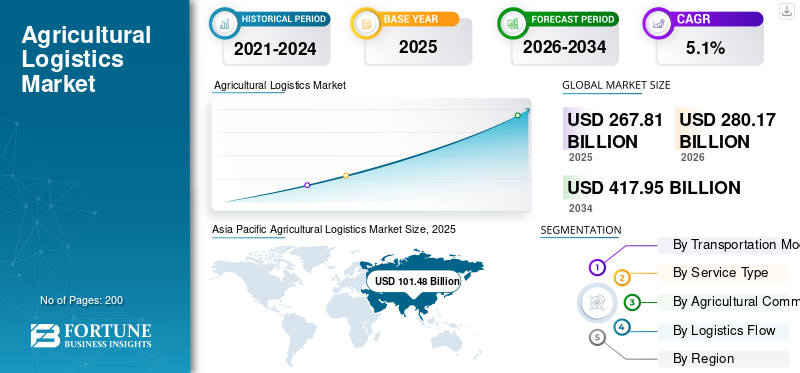
The global agricultural logistics market size was valued at USD 267.81 billion in 2025. The market is projected to grow from USD 280.17 billion in 2026 to USD 417.95 billion by 2034, exhibiting a CAGR of 5.1% during the forecast period. Asia Pacific dominated the agricultural logistics market with a market share of 37.89% in 2025.
Agricultural logistics includes transportation by road, rail, waterways, and air, ambient and temperature-controlled storage, freight forwarding, customs support, and value-added activities such as grading, packaging, labelling, inspection, and consolidation. The global market covers commercial services used to move, store, protect, and manage agricultural inputs and primary farm commodities. The market connects input suppliers, farms, collection centres, warehouses, processors, traders, ports, and wholesale markets through an organized agricultural supply chain.
Demand is supported by rising agricultural output, expanding trade, urban consumption, and the need to reduce losses after harvesting. Efficient farm-to-market transportation helps producers reach buyers faster, while agricultural warehousing protects seasonal crops and supports stable supply throughout the year. Post-harvest logistics, grain storage solutions, and dependable agricultural freight services are especially important for cereals, oilseeds, fertilizers, fruits, vegetables, milk, eggs, and livestock products. Perishable commodities also require cold chain logistics, refrigerated transportation, and specialized perishables logistics to preserve freshness and quality.
The industry will become more connected, data-driven, and multimodal. Investments in rural roads, rail corridors, ports, inland terminals, silos, packhouses, and refrigerated facilities will improve the agri-distribution network. Digital platforms will support route planning, shipment tracking, inventory control, and food supply chain management. Wider use of sensors, automated warehouses, artificial intelligence, and logistics automation will improve visibility and reduce delays. Precision agriculture logistics will also link farm-level production information with collection schedules, storage availability, and transport capacity.
Growth may be affected by fuel inflation, trade tariffs, climate shocks, border delays, and geopolitical disruptions. Even so, the need for reliable crop transportation and food security will keep the market expanding.
Leading companies in the market include A.P. Moller-Maersk, Americold Realty Trust Inc., and Lineage, Inc. They are developing integrated networks, modern cold stores, multimodal services, and real-time monitoring systems to improve reliability, reduce waste, and strengthen customer access to domestic and international markets across major producing regions.
Download Free sample to learn more about this report.
Agricultural Logistics Market Key Takeaways
 Global Market Size & Forecast
- 2025 Market Size: USD 267.81 billion
- 2026 Market Size: USD 280.17 billion
- 2034 Forecast Market Size: USD 417.95 billion
- CAGR: 5.1% from 2026–2034
 Market Share
- Asia Pacific dominated the market with a 37.89% share in 2025.
- Cold-chain logistics services is projected to grow at a CAGR of 7.6% from 2026–2034.
- Fruits and vegetables is projected to grow at a CAGR of 6.7% from 2026–2034.
 Key Regional Highlights
North America
North America is projected to grow at a CAGR of 4.3% and reach USD 55.78 billion in 2026.
Europe
Europe is expected to remain the second-largest region, reaching USD 60.97 billion in 2026.
Asia Pacific
Asia Pacific maintained its leading position with a market value of USD 101.48 billion in 2025.
U.S.
The U.S. market was valued at approximately USD 37.56 billion in 2025, representing around 14.0% of global revenues.
Japan
The Japanese market is supported by increasing demand for efficient agricultural transportation, storage, and supply-chain solutions.
Read More

AGRICULTURAL LOGISTICS MARKET TRENDS
Digital Visibility and Automation Transform Agricultural Logistics Operations
The market is shifting toward connected platforms that combine tracking, warehouse data, temperature records, and route planning. Providers are using sensors, artificial intelligence, digital documentation, and logistics automation to improve visibility and reduce manual errors. This trend supports faster decisions across food supply chain management, while precision agriculture logistics can align harvest forecasts with vehicles, labor, storage space, and buyer requirements.
- For instance, in December 2025, DP World expanded real-time reefer monitoring and terminal scheduling for Chilean cherry exports, strengthening visibility and temperature control.
MARKET DYNAMICS
MARKET DRIVERS
Download Free sample to learn more about this report.
Rising Agricultural Output and Trade Accelerate Market Growth
Rising agricultural production and trade increase the volume of crops, livestock products, and farm inputs requiring dependable movement and storage. This expands demand for agricultural freight services, crop transportation, silos, terminals, and customs support. Growing separation between production centres and urban consumers also lengthens delivery routes, encouraging organized providers to expand capacity, improve reliability, and strengthen the wider agri-distribution network.
- For instance, in July 2025, OECD-FAO (Organisation for Economic Co-operation and Development - Food and Agriculture Organization of the United Nations) projected the gross value of global agricultural production to rise 14% to USD 3.96 trillion by 2034.
|
Rank |
Market Drivers |
Overall Impact Rank |
CAGR Contribution (2026-2034) |
Impact 2026–2028 |
Impact 2029–2031 |
Impact 2032–2034 |
|
1 |
Rising Agricultural Output and Trade Accelerate Logistics Demand |
High |
2.10% |
High |
High |
High |
|
2 |
Expansion of Cold-Chain and Post-Harvest Infrastructure |
High |
1.70% |
High |
High |
High |
|
3 |
Development of Multimodal Transport and Storage Infrastructure |
Medium-High |
1.50% |
Medium |
High |
High |
|
4 |
Adoption of Digital Platforms, Automation, and Shipment Visibility |
Medium |
1.30% |
Medium |
High |
High |
|
5 |
Increasing Outsourcing and Formalization of Agricultural Supply Chains |
Medium-Low |
1.00% |
Medium |
High |
High |
|
6 |
Others |
Low |
0.80% |
Low |
Low |
Low |
|
|
Total Positive Growth Contribution |
|
8.40% |
|
|
|
MARKET RESTRAINTS
Freight Volatility and Geopolitical Disruptions Restrain Market Expansion
Geopolitical conflicts, tariffs, port congestion, and volatile fuel prices raise transport costs and make delivery schedules less predictable. Agricultural cargo is especially exposed as grains, fertilizers, and perishables often move through international shipping lanes and border crossings. Higher insurance, rerouting, and inventory expenses can reduce exporter margins, delay farm-to-market transportation, and discourage smaller producers from using formal logistics services consistently and profitably. This is expected to hinder the agricultural logistics market growth over the forecast period.
|
Rank |
Market Restraints |
Overall Impact Rank |
CAGR Contribution (2026-2034) |
Impact 2026–2028 |
Impact 2029–2031 |
Impact 2032–2034 |
|
1 |
Freight Volatility and Geopolitical Disruptions Restrain Market Expansion |
High |
−1.20% |
High |
High |
Medium |
|
2 |
Weak Rural Infrastructure and Fragmented Agricultural Supply Chains |
Medium-High |
−0.90% |
High |
Medium |
Medium |
|
3 |
High Capital and Operating Costs Limit Logistics Expansion |
Medium |
−0.70% |
High |
Medium |
Medium |
|
4 |
Others |
Low |
−0.50% |
Low |
Low |
Low |
|
|
Total Negative Growth Impact |
|
−3.3% |
|
|
|
MARKET OPPORTUNITIES
Cold-Chain and Storage Gaps Create Strong Investment Opportunities
Large post-harvest losses in emerging economies create strong investment potential for packhouses, silos, refrigerated warehouses, and temperature-controlled vehicles. Expanding cold chain logistics, grain storage solutions, and refrigerated transportation can extend shelf life, improve farmer incomes, and connect rural producers with distant markets. Public-private projects that combine storage, rail, roads, and digital monitoring can unlock substantial underserved demand across developing agricultural regions.
- For instance, in May 2025, DP World opened a 110,000 ft. multi-temperature warehouse in Taloja with 11,000 pallet positions for perishable agricultural cargo.
MARKET CHALLENGES
Fragmented Rural Infrastructure Limits Reliable Agricultural Logistics Services
Agricultural logistics networks remain fragmented in many rural areas, where weak roads, limited storage, unreliable electricity, and small shipment sizes increase costs. These gaps make post-harvest logistics and perishables logistics difficult to scale, particularly for small farmers. Financing modern facilities is also challenging as demand is seasonal, equipment is expensive, and climate-related production changes can reduce asset utilization and investment returns.
Segmentation Analysis
By Transportation Mode
Roadways Take the Lead Due to Flexible Farm-to-Market Connectivity
On the basis of transportation mode, the market is segmented into roadways, railways, waterways, and airways.
Roadways dominate the agricultural logistics market share, as farms, villages, collection centres, warehouses, and markets require flexible door-to-door movement. Trucks can collect smaller loads, reach remote production areas, and connect cargo with rail terminals, ports, and airports. Road transport is particularly important for fresh produce, milk, livestock, and short-haul crop transportation, while expanding rural roads, organized fleets, and modernization support continued market growth across the globe.
- For instance, in March 2025, India’s government reported road transport carried 71% of national freight, highlighting trucks’ central role in agricultural collection and delivery.
The waterways segment is expected to grow at a CAGR of 6.3% over the forecast period.
To know how our report can help streamline your business, Speak to Analyst
By Service Type
Transportation Leads Market Due to Essential Movement across Supply-Chain Stages
On the basis of service type, the market is segmented into transportation, warehousing and storage, freight forwarding and customs services, cold-chain logistics services, and value-added logistics services.
The transportation segment dominates the market, as every agricultural commodity must move between farms, collection centres, warehouses, processors, domestic markets, or export gateways. Freight spending is repeated across first-mile, line-haul, and final-delivery stages, creating a larger revenue base than individual support services. Rising output, longer trade routes, fuel costs, and outsourcing strengthen transportation demand within the overall agri-supply chain across producing economies across the globe.
The cold-chain logistics services segment is expected to grow at a CAGR of 7.6% over the forecast period.
By Agricultural Commodity Type
Grains and Cereals Dominate Market Due to Their Large Transport Volumes
On the basis of agricultural commodity type, the market is segmented into grains and cereals, oilseeds and pulses, fruits and vegetables, animal-based agricultural products, and agricultural inputs and other commodities.
Grains and cereals dominate the market, as wheat, rice, corn, barley, and other staples move in exceptionally large volumes. Their supply chains require trucks, rail wagons, barges, ocean vessels, elevators, silos, and bulk terminals. Regular domestic consumption, animal-feed demand, public reserves, and international trade generate continuous requirements for grain storage solutions, handling, forwarding, and long-distance agricultural transport and storage services across the globe.
- For instance, in December 2025, FAO reported global cereal production reached 3.1 billion tons in 2024, supporting extensive bulk movement, handling, and storage demand.
The fruits and vegetables segment is expected to grow at a CAGR of 6.7% over the forecast period.
By Logistics Flow
Domestic Logistics Dominates Market Owing to Extensive In-Country Agricultural Movement
On the basis of logistics flow, the market is segmented into domestic logistics and international and cross-border logistics.
Domestic logistics dominates the market, as most agricultural output is collected, stored, processed, and consumed within the country where it is produced. Farms require local input delivery, first-mile pickup, movement to warehouses, and distribution to national buyers before any export occurs. Large internal populations, short regional routes, and repeated farm-to-market transportation activities create a broader revenue base than cross-border shipments overall globally.
The international and cross-border logistics segment is expected to grow at a CAGR of 6.0% over the forecast period.
Agricultural Logistics Market Regional Outlook
By geography, the market is categorized into North America, Europe, Asia Pacific, South America, and the Middle East & Africa.
Asia Pacific
Asia Pacific Agricultural Logistics Market Size, 2025 (USD Billion)
To get more information on the regional analysis of this market, Download Free sample
Asia Pacific held the dominant share in 2024, with USD 97.32 billion, and also maintained the leading share in 2025, valued at USD 101.48 billion. Asia Pacific dominates, as it contains the world’s largest agricultural producers and consumer markets, including China and India. High volumes of rice, wheat, vegetables, milk, oilseeds, and plantation crops create extensive transport and storage demand. Rapid urbanization, expanding organized retail, rural infrastructure investment, and rising cold-chain use strengthen the market. Large domestic flows support food supply chain management, while ports and regional trade expand agricultural freight services and perishables logistics across the region, especially around major urban and export corridors.
- For instance, in June 2026, OECD-FAO projected Asia Pacific would contribute 57.5% of additional global agricultural output by 2035, led by India and China.
China Agricultural Logistics Market
China’s market is projected to be one of the largest across the globe, with 2025 revenues valued at around USD 42.13 billion, representing roughly 15.7% of global revenues.
India Agricultural Logistics Market
The Indian market in 2025 was valued at around USD 18.22 billion, accounting for roughly 6.8% of global revenues.
Europe
Europe is estimated to reach USD 60.97 billion in 2026 and secure the position of the second-largest region in the market. The market in Europe will expand steadily as cross-border trade, strict product standards, traceability rules, and sustainable transport encourage higher-value logistics services. Mature infrastructure limits volume growth, but cold-store upgrades, multimodal corridors, digital customs, and advanced agricultural warehousing will support revenue. Energy costs, climate pressures, and regulatory complexity will moderate expansion across countries.
Germany Agricultural Logistics Market
The Germany market in 2025 was valued at around USD 5.27 billion, accounting for roughly 2.0% of global revenues.
France Agricultural Logistics Market
France market in 2025 was valued at around USD 4.68 billion, accounting for roughly 1.7% of global revenues.
North America
North America is projected to record a CAGR of 4.3% in the coming years, and reach a valuation of USD 55.78 billion in 2026. The market in the region will grow significantly through stable grain and livestock flows, integrated cross-border trade, automated warehouses, and modernization of refrigerated facilities. Advanced rail, trucking, port, and silo networks support dependable agricultural movement. In the U.S., the market remains mature but substantial, with growth coming from digital visibility, refrigerated transportation, warehouse automation, and resilient export corridors serving global buyers efficiently today.
U.S. Agricultural Logistics Market
The U.S. market in 2025 was valued at around USD 37.56 billion in 2025, representing roughly 14.0% of global revenues.
South America
South America is set to grow steadily in the coming years through rising soybean, corn, sugar, coffee, fruit, and livestock exports. Long farm-to-port distances create strong transport and storage demand, while new railways, terminals, waterways, and silos improve capacity. Currency volatility, road dependence, extreme weather, and changing Chinese demand will influence investment and freight performance over time.
Middle East & Africa
The Middle East & Africa market is expected to grow gradually over the forecast period due to a rise in population, food imports, agricultural commercialization, and infrastructure spending. New ports, grain stores, rural roads, and refrigerated facilities can improve market access and reduce losses. Growth remains exposed to conflict, weak currencies, costly financing, customs delays, electricity shortages, and uneven logistics infrastructure regionally.
COMPETITIVE LANDSCAPE
Key Industry Players
Integrated Networks and Technology Shape Competitive Advantage
Competition in the global agricultural logistics market is shaped by global freight groups, regional specialists, port operators, cold-storage companies, and technology-led logistics providers. Large participants compete through broad transport networks, customer relationships, warehouse capacity, customs expertise, and the ability to manage complex agricultural cargo across countries. Their main advantage comes from combining road, rail, ocean, air, storage, and forwarding services within one contract.
Leading companies are building end-to-end solutions that connect farms, inland collection points, silos, ports, and overseas buyers. This approach gives customers better control over the agri supply chain and reduces the need to coordinate several separate providers. Companies also invest in cold chain logistics, reefer containers, packhouses, and temperature-monitoring systems to serve fruits, vegetables, dairy products, flowers, seeds, and other sensitive goods. Agricultural warehousing and automated handling systems help providers manage seasonal peaks, improve inventory accuracy, and reduce product damage.
Digital capability has become another source of differentiation. Major players use route-optimization tools, shipment visibility platforms, warehouse-management systems, sensors, and predictive analytics. These investments strengthen logistics automation, improve delivery planning, and support faster responses to port congestion, weather events, or border delays. Providers are also expanding through acquisitions, joint ventures, public-private partnerships, and long-term agreements with exporters, cooperatives, retailers, and food processors.
Regional companies remain competitive as they understand local roads, crop seasons, regulations, and farmer networks. They often provide flexible farm-to-market transportation and post-harvest logistics in locations where global companies have limited coverage. Larger groups may partner with or acquire these businesses to improve first-mile access.
Sustainability is also influencing strategy. Companies are introducing rail-based corridors, lower-emission vehicles, energy-efficient cold stores, reusable packaging, and improved load consolidation. Competitive success will increasingly depend on reliable execution, transparent pricing, compliance, scalable infrastructure, and the ability to provide measurable reductions in waste, transit time, emissions, and total logistics cost.
- For instance, in October 2025, DHL committed over USD 339 million in Africa, including stronger cold-chain and perishables capabilities for agricultural and horticultural exporters.
LIST OF KEY AGRICULTURAL LOGISTICS COMPANIES PROFILED
- P. Moller-Maersk (Denmark)
- DHL Group (Germany)
- Kuehne+Nagel International AG (Switzerland)
- DSV A/S (Denmark)
- CEVA Logistics (France)
- DP World (UAE)
- H. Robinson Worldwide, Inc. (U.S.)
- Lineage, Inc. (S.)
- Americold Realty Trust, Inc. (S.)
- GXO Logistics, Inc. (S.)
- UPS Supply Chain Solutions (S.)
- FedEx Logistics, Inc. (S.)
- Rhenus Group (Germany)
- GEODIS (France)
- DACHSER SE (Germany)
KEY INDUSTRY DEVELOPMENTS
- October 2025: Maersk inaugurated the Belcon Cold Store in Cape Town as part of an investment exceeding USD 100 million in South African cold-chain infrastructure. Together with the Cato and PreCool facilities, the network offers 32,000 pallet positions for citrus, grapes, and other agricultural exports.
- September 2025: Maersk and Arla announced the conversion of part of Maersk’s Taulov facility in Denmark into a dedicated dairy cold store. The 9,100-square-metre area will include separate temperature chambers and automated guided vehicles under an initial ten-year agreement.
- September 2025: Americold opened its largest Middle Eastern cold-storage facility at the Jebel Ali Free Zone in Dubai through RSA Cold Chain and DP World. The hub provides 40,000 pallet positions, multiple temperature zones, and bonded and non-bonded storage for regional food flows.
- July 2025: Maersk launched an integrated packing and cold-storage center in Olmos to serve Peru’s expanding fruit-export industry. The 17,500-square-meter facility combines field collection, sorting, packing, cooling, refrigerated storage, customs support, and inland transportation for blueberries, avocados, mangoes, and grapes.
- April 2025: Lineage acquired three Bellingham Cold Storage warehouses in Washington State, adding around 24 million cubic feet and 85,000 pallet positions. The transaction expanded Lineage’s presence near the Port of Bellingham, an important gateway for seafood and agricultural commodities.
- February 2025: Maersk completed its new 35,000-square-meter cold store beside the Maasvlakte II terminal in Rotterdam. The facility provides more than 34,000 pallet positions for fruits, meat, seafood, and other temperature-sensitive cargo, supporting faster transfer between reefer containers and storage.
REPORT COVERAGE
The global agricultural logistics market analysis provides an in-depth study of market size & forecast by all the market segments included in the report. It includes details on the market dynamics and market trends expected to drive the market over the forecast period. It offers information on the technological advancements, new product launches, key industry developments, and details on partnerships, mergers & acquisitions. The research report also encompasses a detailed competitive landscape with information on the market share and profiles of key operating players.
Request for Customization to gain extensive market insights.
Report Scope & Segmentation
| ATTRIBUTE | DETAILS |
| Study Period | 2021-2034 |
| Base Year | 2025 |
| Estimated Year | 2026 |
| Forecast Period | 2026-2034 |
| Historical Period | 2021-2024 |
| Growth Rate | CAGR of 5.1% from 2026 to 2034 |
| Unit | Value (USD Billion) |
| Segmentation | By Transportation Mode, Service Type, Agricultural Commodity Type, Logistics Flow, and Region |
| By Transportation Mode |
|
| By Service Type |
|
| By Agricultural Commodity Type |
|
| By Logistics Flow |
|
| By Region |
|
Frequently Asked Questions
Fortune Business Insights says that the global market value stood at USD 267.81 billion in 2025 and is projected to reach USD 417.95 billion by 2034.
In 2025, the market value in Asia Pacific stood at USD 101.48 billion.
The market is expected to exhibit a CAGR of 5.1% during the forecast period of 2026-2034.
The roadways segment leads the market by transportation mode.
Rising agricultural output and trade drive the global market.
A.P. Moller-Maersk, DHL Group, Americold Realty Trust Inc., and Lineage, Inc. are some of the top players in the market.
Asia Pacific dominated the market in 2025.



- 2021-2034
- 2025
- 2021-2024
- 200
-
(Offer valid till 15th Oct 2026)
Get 30-60 hrs Free Customization
Expand Regional and Country Coverage, Segments Analysis, Company Profiles, Competitive Benchmarking, and End-user Insights.




















-
US +1 833 909 2966 ( Toll Free )
-
Get In Touch With Us