 Download Free Sample



Get a Quote
Receive a tailored pricing based on your needs.
- Choose license type
- Multiple user options
- Custom scope & coverage
- Fast turnaround
"Smart Strategies, Giving Speed to your Growth Trajectory"
 Listen to Audio Version
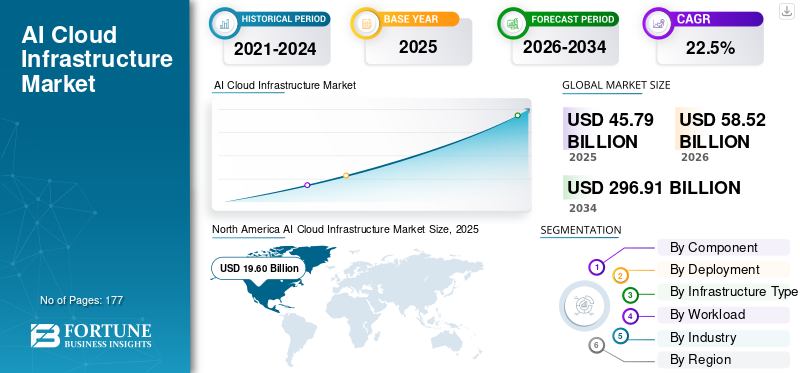
The global AI cloud infrastructure market size was valued at USD 45.79 billion in 2025. The market is projected to grow from USD 58.52 billion in 2026 to USD 296.91 billion by 2034, exhibiting a CAGR of 22.5% during the forecast period. North America dominated the AI cloud infrastructure market with a market share of 42.80% in 2025.
AI cloud infrastructure comprises the hardware, software, and services that enable organizations to develop, train, deploy, and scale artificial intelligence applications through cloud environments. The market encompasses AI-optimized servers, GPUs, AI accelerators, high-performance storage, networking infrastructure, cloud orchestration platforms, and managed services designed to support compute-intensive AI workloads. As enterprises increasingly integrate generative AI, Large Language Models (LLMs), computer vision, natural language processing, and machine learning into business operations, demand for scalable, high-performance AI cloud infrastructure continues to accelerate. Organizations across BFSI, healthcare, manufacturing, retail, IT & telecommunications, government, and media sectors are investing heavily in AI-ready cloud environments to improve operational efficiency, enable real-time data processing, and support next-generation AI applications.
Growing enterprise investments in AI infrastructure, rapid expansion of hyperscale cloud data centers, and continuous advancements in AI processors, high-speed networking, and cloud-native architectures are further strengthening market growth. Cloud service providers and infrastructure vendors are expanding AI-optimized cloud offerings with advanced GPU clusters, AI accelerators, high-bandwidth memory, and intelligent resource orchestration to meet rising computational requirements.
Major companies operating in the market include Microsoft Corporation, Amazon Web Services, Inc., Google LLC, CoreWeave, Inc., and Oracle Corporation. Companies capable of delivering comprehensive AI cloud infrastructure ecosystems with advanced computing capabilities and global cloud availability are expected to strengthen their market leadership over the forecast period.
Download Free sample to learn more about this report.
 Global Market Size & Forecast
 Market Share
 Key Regional Highlights
North America
The region led the market with a valuation of USD 19.60 billion in 2025, accounting for a 42.80% share.
Europe
Europe accounted for 22.9% of the global market share in 2025.
Asia Pacific
The region is estimated to reach USD 15.92 billion in 2026 and is projected to grow at the highest CAGR of 26.9% during the forecast period.
U.S.
The U.S. accounted for over 36.9% of global market revenue in 2025, driven by hyperscale cloud providers, AI chip manufacturers, and enterprise software companies.
Japan
The Japanese market was valued at approximately USD 1.99 billion in 2025, accounting for around 4.3% of global revenue.
Read More

Growing Adoption of Generative AI Accelerates Demand for AI-Optimized Cloud Infrastructure
Generative AI has fundamentally transformed enterprise cloud infrastructure requirements by driving unprecedented demand for AI-optimized computing resources capable of supporting large language models, foundation models, multimodal AI, and advanced machine learning workloads. Organizations are increasingly deploying generative AI across customer service, AI software development, content generation, cybersecurity, healthcare, financial services, and industrial automation, resulting in higher requirements for computational density, memory capacity, data throughput, and low-latency processing across cloud environment. As AI workloads become more complex and operate at larger scale, enterprises are increasingly optimizing infrastructure capacity to improve model training efficiency, accelerate inference performance, and maximize resource utilization.
Generative AI is reshaping cloud operations through intelligent workload scheduling, automated infrastructure management, AI-driven resource optimization, predictive capacity planning, and dynamic allocation of computing resources. Cloud providers are continuously introducing AI-native infrastructure services that enable enterprises to deploy, scale, and manage generative AI applications more efficiently while reducing operational complexity. As enterprise adoption of generative AI continues to expand, demand for AI cloud infrastructure capable of supporting increasingly sophisticated AI workloads is expected to accelerate during the forecast period.
Emergence of AI Factories and Hyperscale GPU Cloud Infrastructure is a Key Market Trend
The market is witnessing a significant shift toward AI factories and hyperscale GPU cloud infrastructure as cloud providers and enterprises build dedicated environments optimized for large-scale artificial intelligence workloads. These environments are increasingly being designed as integrated AI computing ecosystems, combining dense computing capacity with high-speed data movement, specialized memory architectures, and automated resource management to support large-scale model operations. As enterprises increasingly move beyond pilot projects toward enterprise-wide AI adoption, demand for purpose-built AI infrastructure capable of supporting continuous model development and high-volume inference is accelerating.
Hyperscale cloud providers are expanding AI-ready data centers by deploying next-generation energy-efficient GPUs, liquid-cooled server architectures, high-speed interconnect technologies, and infrastructure to improve computing performance while supporting sustainable AI growth. Organizations are also embracing AI factories to reduce model development timelines, enhance resource utilization, and enable scalable AI innovation across industries such as healthcare, financial services, manufacturing, telecommunications, and scientific research. This transition toward specialized AI cloud infrastructure is expected to remain one of the defining trends shaping the market over the forecast period.
Download Free sample to learn more about this report.
Growing Enterprise Investments in AI Infrastructure to Support Large Language Models and AI-native Applications are Driving Market Growth
Growing enterprise investments in artificial intelligence infrastructure are emerging as one of the primary factors driving the AI cloud infrastructure market growth. Organizations across industries are rapidly integrating generative AI, LLMs, machine learning, computer vision, and intelligent automation into business operations, creating substantial demand for scalable cloud infrastructure capable of supporting increasingly compute-intensive AI workloads. Enterprises are investing heavily in Enterprises are increasingly shifting from experimental AI deployments toward production-scale environments, prompting greater investments in dedicated AI capacity, scalable computing resources, and infrastructure optimization to accelerate model training, improve inference performance, and enable real-time AI applications. As AI adoption expands from experimentation to enterprise-wide deployment, organizations are prioritizing AI-ready cloud infrastructure to improve operational efficiency, accelerate innovation, and strengthen competitive advantage.
The demand is particularly strong among hyperscale cloud providers and large enterprises, which continue expanding AI data centers equipped with advanced GPU clusters, high-speed networking technologies, and intelligent resource management platforms to support growing AI workloads. Continuous investments by technology companies in AI computing infrastructure, next-generation processors, and cloud-native AI platforms are expected to further strengthen market growth over the forecast period.
Market Drivers - Impact & CAGR Contribution (2026–2034)
| Rank | Market Drivers | Expected Impact on Market Growth | Estimated Gross Market Growth Contribution (USD Million) | Impact: 2026-2028 | Impact: 2029-2031 | Impact: 2032-2034 |
|---|---|---|---|---|---|---|
| 1 | Rapid expansion of AI and high-performance computing systems is increasing bandwidth density and energy-efficiency requirements, accelerating demand for embedded optical I/O across processors, accelerators, and network fabrics. | High | 1048.7% | High | High | High |
| 2 | Rising network switch ASIC speeds and scale-out traffic are driving adoption of co-packaged optical interface chips that shorten electrical paths and reduce connectivity power consumption. | High | 821.6% | High | High | High |
| 3 | Growth of chiplet-based processor architectures is expanding demand for photonic I/O chiplets that provide modular, high-bandwidth connectivity between host electronic devices. | High | 679.4% | Medium | High | High |
| 4 | Increasing memory bandwidth bottlenecks in accelerator-rich systems are supporting the development of compute-to-memory and storage optical interconnects. | Medium | 558.9% | Medium | High | High |
| 5 | Wider adoption of embedded sensing and signal processing across telecommunications, automotive, industrial, aerospace, and Defense systems is sustaining demand for board- and substrate-embedded photonic chips. | Medium-Low | 501.3% | High | Medium | Medium |
| 6 | Advances in silicon photonics, heterogeneous integration, and open optical chiplet interfaces are improving compatibility and accelerating product commercialization. | Medium | 440.8% | Medium | High | High |
| Total Gross Growth Contribution | 4,050.70% | |||||
Source: Fortune Business Insights
Download Free sample For In-Depth Market Drivers & Impact Forecasts
High Power Consumption and Upfront Investment for Large Scale AI Cloud Deployments Limit Market Growth
The rapid increase in AI workloads is also driving higher electricity consumption and thermal management requirements across data centers. Training and deploying large language models, foundation models, and other compute-intensive AI applications require enormous processing power, making energy efficiency and sustainable infrastructure critical operational challenges. Furthermore, GPU supply constraints, lengthy procurement cycles, and integration complexity can delay infrastructure expansion projects and slow enterprise AI deployments. As a result, organizations continue to carefully balance AI infrastructure investments against operational costs, return on investment, and long-term scalability requirements.
The substantial capital investment required to build and operate AI cloud infrastructure remains one of the major restraints affecting market growth. Deploying AI-ready cloud environments requires advanced GPU clusters, AI accelerators, high-performance servers, high-bandwidth networking equipment, large-scale storage systems, and sophisticated cooling and power infrastructure. In addition to hardware investments, organizations must allocate significant resources toward AI infrastructure software, cloud orchestration, cybersecurity, skilled workforce, and ongoing maintenance, considerably increasing the total cost of ownership. These financial requirements often present adoption challenges for small and medium-sized enterprises and cloud providers with limited infrastructure budgets.
Market Restraints - Impact & Negative CAGR Contribution (2026–2034)
| Rank | Market Restraints | Overall Impact Rank | Negative CAGR Contribution (2026–2034) | Impact: 2026-2028 | Impact: 2029-2031 | Impact: 2032-2034 |
|---|---|---|---|---|---|---|
| 1 | High power consumption and infrastructure investment requirements | High | -0.7% | Medium | High | High |
| 2 | GPU supply constraints and long deployment cycles for AI infrastructure | Medium-High | -0.3% | High | Medium | Medium |
| 3 | Data security, regulatory compliance, and data sovereignty challenges | Medium | -0.2% | Medium | Medium | Medium |
| 4 | Others (vendor lock-in, interoperability issues, shortage of AI infrastructure expertise, cooling constraints) | Low | -0.1% | Low | Low | Low |
| Total Negative Growth Impact | -1.30% | |||||
Source: Fortune Business Insights
Download Free sample For In-Depth Market Restraints & Risk Analysis
Expansion of Sovereign AI Cloud Infrastructure and Industry-specific AI Clouds is Creating Significant Growth Opportunities
The growing emphasis on sovereign AI capabilities and industry-specific cloud platforms is creating substantial opportunities for the market. Governments and enterprises are increasingly investing in localized AI cloud infrastructure to ensure greater control over sensitive data, regulatory compliance, cybersecurity, and national digital sovereignty. This trend is accelerating the development of sovereign AI clouds that support domestic AI innovation while complying with regional data governance and privacy regulations. Cloud infrastructure providers capable of delivering secure, scalable, and regionally compliant AI platforms are expected to benefit from this growing demand.
Industry-specific AI cloud environments are emerging as an important growth opportunity across highly regulated sectors such as healthcare, BFSI, government, manufacturing, and life sciences. These specialized AI cloud platforms are optimized to support sector-specific AI models, regulatory requirements, High-Performance Computing (HPC) clusters, and mission-critical workloads while simplifying enterprise AI deployment. As organizations increasingly seek purpose-built AI infrastructure tailored to their operational requirements, demand for vertical AI cloud platforms and managed AI infrastructure services is predicted to increase rapidly in the coming years.
Rising Focus on Fraud Detection, Risk Analytics, Customer Service Automation Boosted BFSI Segment Growth
Based on industry, the market is segmented into BFSI, healthcare & life sciences, manufacturing, retail & e-commerce, IT & telecommunications, media & entertainment, government & defense, and others.
The BFSI segment accounted for the largest market share of 21.4% in 2025. Financial institutions are increasingly deploying AI cloud infrastructure to support fraud detection, risk analytics, customer service automation, credit assessment, algorithmic trading, regulatory compliance, and personalized financial services. Growing investments in AI-powered digital banking and intelligent financial operations continue to accelerate demand for secure, scalable AI cloud infrastructure across the sector.
The healthcare & life sciences segment is projected to register the fastest CAGR of 28.8% during the forecast period. Healthcare organizations are increasingly utilizing AI cloud infrastructure to support medical imaging analysis, clinical decision support, drug discovery, genomics research, personalized medicine, and predictive healthcare analytics. The growing adoption of AI across healthcare workflows, combined with increasing computational requirements for medical AI models, is expected to significantly drive infrastructure investments over the forecast period.
To know how our report can help streamline your business, Speak to Analyst
Increasing Deployment of Next-generation AI Chips Fueled Hardware Segment Growth
Based on component, the market is segmented into hardware, software, and services.
The hardware segment accounted for the largest market share of 50.0% in 2025. The segment's dominance is attributed to substantial capital deployment by hyperscale cloud providers and enterprises to expand AI computing capacity, including advanced processors, memory, storage, and networking equipment required for increasingly demanding workloads. Hyperscale cloud providers and enterprises continue expanding AI-ready data centers equipped with advanced hardware infrastructure to enable large language model (LLM) training, AI inference, and high-performance computing applications. The rapid deployment of next-generation AI chips and high-density computing platforms continues to strengthen the hardware segment's market leadership.
The software segment is projected to register the fastest CAGR of 26.1% during the forecast period. The growth is driven by increasing adoption of AI infrastructure management platforms, cloud orchestration software, workload scheduling tools, AI model lifecycle management, and resource optimization solutions. Organizations are increasingly investing in software platforms capable of automating AI workload deployment, optimizing GPU utilization, improving infrastructure efficiency, and simplifying management across hybrid AI cloud environments.
Growing Preference for Flexible AI Infrastructure Supported Public Cloud Leadership
Based on deployment, the market is segmented into public cloud, private cloud, and hybrid cloud.
The public cloud segment accounted for the largest market share of 59.7% in 2025. The dominance is attributed to increasing enterprise adoption of scalable AI infrastructure delivered through hyperscale cloud platforms. Organizations increasingly leverage public cloud platforms to accelerate AI development, model training, and enterprise-wide AI deployments while benefiting from operational flexibility and faster implementation.
The hybrid cloud segment is projected to register the fastest CAGR of 26.1% during the forecast period. Enterprises are increasingly adopting hybrid AI cloud strategies to balance scalability, security, regulatory compliance, and workload optimization. Hybrid cloud environments enable organizations to retain sensitive AI workloads within private infrastructure while utilizing public cloud resources for compute-intensive AI training and inference, supporting greater operational flexibility across diverse business requirements.
Rapid Expansion of Generative AI & Foundation Models Strengthened Compute Segment’s Dominance
Based on infrastructure type, the market is segmented into compute, storage, and networking.
The compute segment accounted for the largest market share of 65.3% in 2025. The segment's leadership is driven by the exceptionally high computational requirements associated with model training, inference, fine-tuning, and other AI workloads, which require substantial processing capacity and accelerated computing resources. The rapid expansion of generative AI, foundation models, and enterprise AI applications continues to drive substantial investments in AI computing capacity across hyperscale cloud providers and enterprise data centers.
The networking segment is anticipated to register the fastest CAGR of 26.1% during the forecast period. Growing AI cluster deployments require ultra-low latency, high-bandwidth networking technologies capable of efficiently connecting thousands of GPUs and distributed computing resources. Organizations are increasingly investing in high-speed interconnects, advanced Ethernet solutions, InfiniBand technologies, and AI-optimized networking architectures to improve data movement, reduce communication bottlenecks, and maximize AI infrastructure performance.
Rising Adoption of Large Language Models Boosted AI Training Segment Dominance
Based on workload, the market is segmented into AI training, AI inference, AI development & fine-tuning, and AI data processing & analytics.
The AI training segment accounted for the largest market share of 47.9% in 2025. The segment's growth is attributed to the substantial computational resources required for training large language models, foundation models, computer vision algorithms, and other advanced machine learning systems. Enterprises and cloud providers continue investing heavily in AI infrastructure capable of supporting large-scale model development, distributed training, and accelerated computing to reduce model training time and improve AI innovation.
The AI inference segment is projected to register the fastest CAGR of 25.9% during the forecast period. The rapid commercialization of generative AI applications, intelligent virtual assistants, recommendation engines, autonomous systems, and real-time analytics is significantly increasing demand for inference infrastructure capable of delivering low-latency AI responses at scale. Organizations are expanding inference-optimized cloud environments to efficiently serve growing enterprise and consumer AI workloads while improving operational efficiency and reducing infrastructure costs.
By geography, the market is categorized into North America, South America, Europe, the Middle East & Africa, and Asia Pacific.
North America AI Cloud Infrastructure Market Size, 2025 (USD Billion)
To get more information on the regional analysis of this market, Download Free sample
North America held the largest AI cloud infrastructure market share in 2024, valued at USD 15.41 billion, and also maintained its leading share in 2025, with USD 19.60 billion. The region's dominance is attributed to the strong presence of hyperscale cloud providers, leading AI technology companies, semiconductor manufacturers, and cloud infrastructure vendors that continue investing heavily in AI-ready data centers and high-performance computing infrastructure. Growing enterprise adoption of generative AI, machine learning, and advanced analytics across BFSI, healthcare, manufacturing, retail, and government sectors is accelerating demand for AI-optimized cloud infrastructure.
The U.S. market held over 36.9% of global sales in 2025, owing to its concentration of hyperscale cloud providers, AI chip manufacturers, and enterprise software companies. Organizations across industries are rapidly expanding investments in AI cloud infrastructure to support generative AI, foundation models, autonomous systems, and enterprise AI applications.
Europe accounted for the significant market share of 22.9% in 2025. The region is witnessing growing investments in AI-enabled cloud infrastructure as enterprises accelerate digital transformation and adopt generative AI across financial services, manufacturing, healthcare, automotive, telecommunications, and public sector organizations. Increasing emphasis on digital sovereignty, secure cloud environments, and responsible AI deployment is encouraging organizations to invest in AI-ready cloud infrastructure capable of supporting advanced AI workloads while meeting stringent regulatory and data governance requirements.
The U.K. market stood at around USD 1.43 billion in 2025, representing roughly 3.1% of global revenues.
Germany’s market reached approximately USD 2.69 billion in 2025, equivalent to around 5.9% of global sales.
The Asia Pacific region is estimated to reach USD 15.92 billion in 2026 and is expected to grow at the highest CAGR of 26.9% during the forecast period. The region's rapid growth is driven by accelerating AI adoption across manufacturing, consumer electronics, financial services, healthcare, e-commerce, and smart city initiatives. Enterprises are significantly increasing investments in AI cloud infrastructure to support intelligent automation, predictive analytics, computer vision, robotics, and large-scale AI applications.
China's market in 2025 stood at approximately USD 5.28 billion, representing roughly 11.5% of global revenues. This growth is supported by aggressive investments in domestic AI capabilities, cloud computing infrastructure, intelligent manufacturing, and AI research.
The Japanese market in 2025 stood at around USD 1.99 billion, accounting for roughly 4.3% of global revenues.
The Indian market in 2025 stood at around USD 1.69 billion, accounting for roughly 3.7% of global revenues.
The Middle East & Africa is expected to register the second-highest CAGR of 24.9% over the forecast period. Countries across the GCC are expanding AI-ready data centers, sovereign cloud infrastructure, and smart city projects to strengthen digital economies and diversify beyond traditional industries. Increasing enterprise adoption of AI across government, financial services, healthcare, energy, and telecommunications is generating demand for scalable AI cloud infrastructure capable of supporting mission-critical AI applications. Growing investments in regional cloud availability zones and AI innovation hubs are expected to create favorable growth opportunities over the forecast period.
The GCC market is projected to reach around USD 1.05 billion in 2025, representing roughly 2.3% of global revenues.
South America is projected to expand at a CAGR of 23.5% during the forecast period. The increasing availability of hyperscale cloud services, improving digital infrastructure, and growing enterprise investments in AI technologies are expected to support long-term market expansion across the region.
The Brazilian market in 2025 stood at around USD 0.95 billion, accounting for roughly 2.1% of global revenues.
Continuous Expansion of AI Infrastructure and Strategic Partnerships Strengthening Market Competition
Strategic collaborations, cloud partnerships, acquisitions, and infrastructure expansion remain key competitive strategies across the AI cloud infrastructure market. Leading companies are partnering with semiconductor manufacturers, hyperscale cloud providers, enterprise software vendors, and system integrators to accelerate deployment of AI-ready cloud infrastructure while expanding AI computing capacity globally. Organizations are also establishing dedicated AI data centers, introducing GPU-as-a-Service offerings, and integrating AI infrastructure with cloud-native software platforms to strengthen their competitive positioning and support enterprise AI transformation initiatives.
The global AI cloud infrastructure market report provides a comprehensive analysis of the industry's current landscape, future growth prospects, and emerging business opportunities across key market segments. The study evaluates market dynamics, technological advancements, competitive developments, regulatory landscape, and evolving enterprise requirements influencing AI cloud infrastructure adoption across multiple industries.
Request for Customization to gain extensive market insights.
| ATTRIBUTE | DETAILS |
| Study Period | 2021-2034 |
| Base Year | 2025 |
| Estimated Year | 2026 |
| Forecast Period | 2026-2034 |
| Historical Period | 2021-2024 |
| Growth Rate | CAGR of 22.5% from 2026 to 2034 |
| Unit | Value (USD Billion) |
| Segmentation | By Component, By Deployment, By Infrastructure Type, By Workload, By Industry, and By Region |
| By Component |
|
| By Deployment |
|
| By Infrastructure Type |
|
| By Workload |
|
| By Industry |
|
| By Region |
|
According to Fortune Business Insights, the global market value stood at USD 45.79 billion in 2025 and is projected to reach USD 296.91 billion by 2034.
In 2025, the market value in North America stood at USD 19.60 billion.
The market is expected to grow at a CAGR of 22.5% during 2026–2034.
By component, the hardware segment led the market.
North America held the largest market share in 2025.
Growing enterprise investments in AI infrastructure to support large language models and AI-native applications are driving market growth.

Get 30-60 hrs Free Customization
Expand Regional and Country Coverage, Segments Analysis, Company Profiles, Competitive Benchmarking, and End-user Insights.




















Related Reports
Get In Touch With Us
US +1 833 909 2966 ( Toll Free )
Receive a tailored pricing based on your needs.
Discuss your questions with our industry experts.
Have questions? Get quick answers before you purchase.

