Specialty Optical Fiber Market Size, Share & Industry Analysis, By Type (Single-Mode Specialty Optical Fiber and Multi-Mode Specialty Optical Fiber), By Material (Silica Glass, Fluoride Glass, Chalcogenide Glass, Polymer Optical Fiber, Sapphire Optical Fiber, and Others), By Product Function (Laser Delivery, Optical Sensing, Imaging Fiber, Polarization Maintaining, and Others), By Industry (Aerospace & Defense, Semiconductor, Healthcare & Medical Devices, Industrial Manufacturing, Energy & Utilities, Oil & Gas, Telecommunication, and Others), and Regional Forecast, 2026-2034
 Download Free Sample
SPECIALTY OPTICAL FIBER MARKET SIZE AND FUTURE OUTLOOK
 Listen to Audio Version
The global specialty optical fiber market size was valued at USD 2.11 billion in 2025. The market is projected to grow from USD 2.31 billion in 2026 to USD 4.84 billion by 2034, exhibiting a CAGR of 9.7% during the forecast period. North America dominated the specialty optical fiber market with a market share of 36.01% in 2025.
Specialty optical fibers are advanced engineered optical fibers with customized materials, refractive index profiles, coatings, and structural designs to deliver superior optical performance under demanding operating conditions. Unlike conventional communication fibers, these fibers are designed for specialized applications requiring high speed data transmission, precise sensing, polarization control, radiation resistance, temperature tolerance, or nonlinear optical properties. The market includes active optical fibers, passive optical fibers, polarization-maintaining fibers, Photonic Crystal Fibers (PCF), rare-earth doped fibers, multicore fibers, hollow-core fibers, and other specialty fiber solutions. Such solutions are used across industrial lasers, telecommunications, aerospace & defense, healthcare, energy, sensing, scientific research, and semiconductor manufacturing.
Specialty optical fibers support a broad range of applications, including high-power industrial laser processing, distributed fiber optic sensing, fiber laser systems, medical imaging, minimally invasive surgical devices, aerospace navigation, oil & gas monitoring, quantum technologies, and advanced telecommunications networks. Industries are increasingly investing in high-performance optical fibers capable of delivering greater signal integrity, higher power handling, improved environmental resistance, and enhanced sensing capabilities under extreme operating conditions. However, high manufacturing complexity, stringent quality requirements, and specialized fabrication processes continue to influence deployment costs across certain application areas.
Major companies operating in the market include Corning Incorporated, Coherent Corp., Fujikura Ltd., Furukawa Electric Co., Ltd., and YOFC. These organizations are continuously expanding their portfolios of high-power laser fibers, sensing fibers, polarization-maintaining fibers, specialty photonic fibers, and customized optical fiber solutions to strengthen their competitive position in the market.
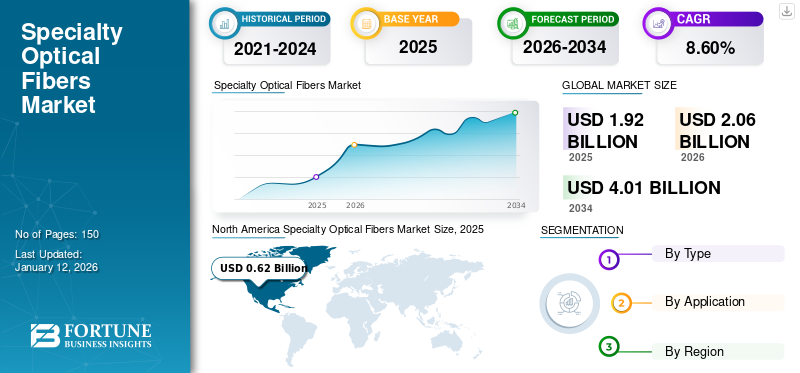
Download Free sample to learn more about this report.
IMPACT OF GENERATIVE AI
Expanding Adoption of AI Infrastructure and High-Performance Computing is Accelerating Demand for Specialty Optical Fibers
The rapid advancement of generative AI is significantly increasing the deployment of High-Performance Computing (HPC) clusters, AI servers, and hyperscale data center infrastructure, creating strong demand for high-performance optical connectivity solutions. As AI models become larger and more computationally intensive, data centers require faster, lower-latency, and energy-efficient optical interconnects capable of supporting high-bandwidth communication between GPUs, CPUs, accelerators, and networking equipment. Specialty optical fibers are increasingly being utilized in advanced optical transceivers, silicon photonics, coherent optical communication systems, and high-speed interconnect architectures to enable reliable data transmission across AI infrastructure. Additionally, manufacturers are investing in next-generation fiber technologies with improved transmission performance, lower signal loss, and enhanced environmental stability to address the evolving requirements of AI-driven computing and intelligent infrastructure. As global investments in AI infrastructure continue to accelerate, demand for specialty optical fibers is expected to increase steadily throughout the forecast period.
- In September 2025, Coherent Corp. expanded its portfolio of high-performance optical interconnect technologies to support next-generation AI data centers, enabling faster optical networking solutions for large-scale AI and high-performance computing environments.
SPECIALTY OPTICAL FIBER MARKET TRENDS
Expanding Deployment of Fiber Optic Sensing Technologies Across Critical Infrastructure
Fiber optic sensing technologies are witnessing widespread adoption across industries as organizations increasingly prioritize real-time monitoring, predictive maintenance, and asset reliability. Specialty optical fibers are becoming an integral component of Distributed Temperature Sensing (DTS), Distributed Acoustic Sensing (DAS), Distributed Strain Sensing (DSS), and Fiber Bragg Gratings (FBG)-based sensing systems used to monitor structural integrity, operational performance, and environmental conditions. These sensing technologies are gaining traction across energy & utilities, oil & gas, civil infrastructure, transportation, aerospace, and defense applications where continuous monitoring is essential for improving operational safety and minimizing unplanned downtime.
Specialty optical fibers offer superior resistance to electromagnetic interference, long-distance signal transmission, corrosion resistance, and high measurement accuracy, making them increasingly suitable for harsh operating environments. As industries continue adopting intelligent monitoring systems to improve operational efficiency and infrastructure resilience, specialty optical fibers are expected to play an increasingly important role in next-generation sensing applications.
- In May 2026, Lightera, a subsidiary of Furukawa Electric Co. Group, announced the partnership with Immer Messen, a Brazil-based advanced Distributed Fiber Optic Sensing (DFOS) solutions provider. Under this partnership, both companies aim to combine Distributed Acoustic Sensing (DAS) technology with specialty optical fibers and systems integration.
MARKET DYNAMICS
MARKET DRIVERS
Download Free sample to learn more about this report.
Growing Use of Specialty Fibers in Industrial Lasers is Driving Market Growth
The increasing deployment of industrial laser systems across manufacturing industries is emerging as one of the primary factors driving the specialty optical fiber market growth. Fiber lasers have become the preferred solution for cutting, welding, engraving, additive manufacturing, micromachining, semiconductor processing, and precision material fabrication due to their superior beam quality, energy efficiency, reliability, and operational flexibility. The growing adoption of electric vehicle manufacturing, semiconductor fabrication, consumer electronics production, aerospace component manufacturing, and precision engineering is accelerating investments in advanced fiber laser technologies worldwide. Manufacturers are increasingly utilizing rare-earth-doped fibers, large-mode-area fibers, polarization-maintaining fibers, and double-clad fibers to support higher laser output, improved thermal management, and enhanced processing precision. As industrial automation and high-precision manufacturing continue expanding globally, demand for specialty optical fibers supporting next-generation laser systems is expected to increase significantly throughout the forecast period.
- In May 2026, Lightera unveiled its expanding portfolio of rollable ribbon products at Fiber Connect 2026. The company states that these cables can be adopted for both outside plant (OSP) and flame-rated indoor applications where they deliver superior fiber density, flexibility, and installation efficiency.
|
Rank |
Market Driver |
Overall Impact Rank |
CAGR Contribution (2026–2034) |
Impact: 2026-2028 |
Impact: 2029-2031 |
Impact: 2032-2034 |
|
1 |
Growing use of specialty fibers in industrial lasers |
High |
3.0% |
High |
High |
High |
|
2 |
Expansion of semiconductor manufacturing and inspection equipment |
High |
2.4% |
High |
High |
High |
|
3 |
Rising adoption of fiber-based sensing systems |
Medium-High |
2.0% |
Medium |
High |
High |
|
4 |
Increasing demand from aerospace and defense applications |
Medium-High |
1.7% |
High |
High |
Medium- |
|
5 |
Growing use in medical imaging and laser-based procedures |
Medium |
1.5% |
Medium |
Medium |
Medium |
|
6 |
Others, including infrared transmission, research, data transmission, and automotive applications |
Medium-Low |
1.3% |
Medium |
Medium |
Low |
|
Total Positive Growth Contribution |
11.9% |
MARKET RESTRAINTS
High Manufacturing and Processing Costs are Limiting Wider Commercial Adoption
The manufacturing of specialty optical fibers involves highly sophisticated fabrication processes, specialized raw materials, stringent quality control requirements, and precision engineering techniques that significantly increase production costs compared with conventional optical fibers. Processes such as preform fabrication, rare-earth doping, microstructured fiber design, specialty coating application, and precision drawing require advanced manufacturing infrastructure and specialized technical expertise, resulting in substantial capital investment for manufacturers.
In addition, many specialty optical fibers are developed for highly customized applications with relatively lower production volumes, limiting economies of scale and increasing unit costs. Industries adopting specialty fibers often require rigorous qualification testing, application-specific customization, and long product validation cycles before commercial deployment. These factors can delay purchasing decisions, particularly among cost-sensitive customers, while also creating barriers for new manufacturers seeking to enter the market.
|
Rank |
Market Restraint |
Overall Impact Rank |
CAGR Contribution (2026–2034) |
Impact: 2026-2028 |
Impact: 2029-2031 |
Impact: 2032- 2034 |
|
1 |
High manufacturing and processing costs |
High |
-0.9% |
High |
High |
High |
|
2 |
Long product testing and customer approval cycles |
Medium-High |
-0.6% |
High |
Medium |
Medium |
|
3 |
Limited availability of specialty glass and raw materials |
Medium |
-0.4% |
Medium |
Medium |
Medium |
|
4 |
Others, including low production volumes, price pressure, and supply-chain risks |
Medium-Low |
-0.3% |
Medium |
Medium |
Low |
|
Total Negative Growth Impact |
-2.2% |
MARKET OPPORTUNITIES
Rising Adoption of Specialty Optical Fibers in Medical Technologies is Creating Significant Growth Opportunities
The growing use of minimally invasive medical procedures, advanced diagnostic systems, and laser-based therapeutic devices is creating substantial growth opportunities for specialty optical fiber manufacturers. Medical equipment manufacturers are increasingly integrating specialty optical fibers into endoscopic imaging systems, surgical lasers, Optical Coherence Tomography (OCT), biomedical sensors, and laser-based therapeutic platforms to enable precise light delivery, high-resolution imaging, and improved clinical outcomes. Their compact size, flexibility, biocompatibility, and superior optical performance make specialty fibers highly suitable for next-generation medical technologies. As healthcare providers continue investing in advanced medical devices that improve diagnostic accuracy and treatment precision, specialty optical fiber manufacturers are expected to benefit from increasing commercialization opportunities across the global medical technology sector.
- In June 2025, Coherent Corp. announced the launch of disposable surgical fiber assemblies designed specifically for a wide range of precision medical applications. The new product line is suitable for both OEM integration and direct clinical use. The assemblies are optimized for the transmission of high-power laser energy, delivering efficient stone fragmentation during laser lithotripsy, and supporting a range of procedures in urology, phlebology, and other soft tissue surgical procedures.
SEGMENTATION ANALYSIS
By Product Function
Expanding Adoption of High-Power Fiber Laser Systems Favored Laser Delivery Segment Growth
Based on product function, the market is segmented into laser delivery, optical sensing, imaging fiber, infrared transmission, data transmission, polarization maintaining, and others.
The laser delivery segment held the largest specialty optical fiber market share in 2025. The segment's leadership is attributed to increasing deployment of fiber laser systems across automotive manufacturing, semiconductor fabrication, metal processing, electronics manufacturing, and medical laser applications. Specialty optical fibers designed for laser delivery provide high power handling capability, excellent beam quality, and superior thermal performance, enabling efficient transmission of high-energy laser beams for precision industrial processing.
The infrared transmission segment is projected to witness the fastest CAGR of 13.8% during the forecast period. Growing adoption of infrared imaging systems, defense surveillance equipment, spectroscopy, environmental sensing, industrial process monitoring, and medical diagnostic technologies is driving demand for specialty fibers capable of transmitting infrared wavelengths with minimal signal loss. Continuous innovation in infrared photonics is expected to further accelerate segment growth.
To know how our report can help streamline your business, Speak to Analyst
By Type
Growing Demand for Superior Signal Integrity to Drive Single-Mode Specialty Optical Fiber Segment Dominance
Based on type, the market is segmented into single-mode specialty optical fiber and multi-mode specialty optical fiber.
The single-mode specialty optical fiber segment accounted for the largest market share in 2025. The segment's dominance is attributed to its superior signal transmission over long distances, low attenuation, minimal modal dispersion, and high bandwidth capabilities. These characteristics make single-mode specialty fibers the preferred choice for industrial lasers, fiber optic sensing, telecommunications infrastructure, aerospace systems, defense applications, and scientific research. Their ability to deliver precise optical performance under demanding operating conditions continues to support widespread deployment across high-performance photonics applications.
The multi-mode fiber segment is projected to register the highest CAGR of 10.6% during the forecast period. The increasing adoption of high-speed short-distance optical communication, medical imaging equipment, industrial automation systems, data centers, and advanced sensing applications is accelerating demand for multi-mode specialty fibers. Their larger core diameter simplifies light coupling, lowers system costs, and supports growing deployment across commercial and industrial photonic systems.
By Material
Excellent Optical Performance and Manufacturing Maturity Strengthened Silica Glass Segment Leadership
Based on material, the market is segmented into silica glass, fluoride glass, chalcogenide glass, polymer optical fiber, sapphire optical fiber, and others.
The silica glass segment accounted for the largest market share of 67.3% in 2025. The segment’s dominance is owing to its exceptional optical transparency, low transmission loss, high mechanical strength, excellent thermal stability, and long operational lifetime. Silica-based specialty fibers are extensively utilized across industrial laser systems, optical communications, sensing technologies, aerospace, healthcare, and defense applications due to their proven reliability and broad compatibility with existing photonic infrastructure.
The chalcogenide glass segment is anticipated to expand at the fastest CAGR of 16.7% during the forecast period. The growth is driven by increasing demand for mid-infrared photonics, thermal imaging systems, spectroscopy, environmental monitoring, defense sensing, and infrared laser technologies. Chalcogenide glass fibers provide excellent infrared transmission characteristics that enable emerging applications requiring advanced optical performance beyond the capabilities of conventional silica fibers.
By Industry
Rising Industrial Automation and Precision Production Investments Supported Industrial Manufacturing Segment Leadership
Based on industry, the market is segmented into aerospace & defense, semiconductor, healthcare & medical devices, industrial manufacturing, energy & utilities, oil & gas, telecommunication, automotive, and others.
The industrial manufacturing segment accounted for the largest market share of 19.2% in 2025. The segment's dominance is driven by widespread deployment of specialty optical fibers in industrial laser processing, precision welding, cutting, additive manufacturing, quality inspection, and factory automation systems. Manufacturers are increasingly integrating fiber-based photonic technologies to improve production accuracy, operational efficiency, and manufacturing flexibility across advanced production environments.
The semiconductor segment is anticipated to register the fastest CAGR of 13.5% during the forecast period. Increasing investments in advanced chip manufacturing, wafer inspection, lithography systems, semiconductor metrology, and photonic integrated circuit production are driving demand for high-performance specialty optical fibers. As semiconductor manufacturers continue expanding fabrication capacity to support AI, high-performance computing, automotive electronics, and next-generation communication technologies, adoption of specialty optical fibers is expected to increase substantially.
Specialty Optical Fibers Market Regional Outlook
By region, the market is categorized into North America, South America, Europe, the Middle East & Africa, and Asia Pacific.
North America
North America Specialty Optical Fiber Market Size, 2025 (USD Billion)
To get more information on the regional analysis of this market, Download Free sample
North America accounted for the largest market share of 36.1% in 2025 and was valued at USD 0.76 billion. The regional market is projected to reach USD 1.66 billion by 2034, exhibiting a CAGR of 9.0% during the forecast period. The region's leadership is supported by its well-established photonics ecosystem, strong presence of specialty fiber manufacturers, significant investments in aerospace & defense technologies, industrial laser systems, advanced medical devices, and continuous innovation in optical communication infrastructure. Growing deployment of fiber optic sensing technologies and increasing investments in semiconductor manufacturing further strengthen market growth across the U.S. and Canada.
U.S. Specialty Optical Fiber Market
The U.S. market held around 28.4% of global sales in 2025, supported by its strong presence in aerospace & defense, semiconductor manufacturing, industrial laser technologies, medical devices, and advanced scientific research. Continuous investments in defense modernization, silicon photonics, quantum communication, and high-power laser applications are accelerating the adoption of specialty optical fibers across mission-critical applications. Furthermore, the presence of leading optical component manufacturers, research laboratories, and photonics innovation centers continues to strengthen the country's position in the global market.
Europe
Europe held a significant share of 25.5% in 2025 and is expected to grow during the forecast period. This growth is owing to a strong industrial manufacturing base, a well-developed aerospace sector, advanced healthcare industry, and extensive research activities in photonics and optical technologies. The region is witnessing growing investments in precision manufacturing, industrial laser applications, renewable energy infrastructure, and fiber optic sensing systems, supporting sustained demand for high-performance specialty optical fibers.
U.K. Specialty Optical Fiber Market
The U.K. market in 2025 was estimated at around USD 0.09 billion, representing roughly 4.1% of global revenues.
Germany Specialty Optical Fiber Market
Germany’s market value reached approximately USD 0.12 billion in 2025, equivalent to around 5.5% of global sales.
Asia Pacific
The Asia Pacific region is estimated to reach USD 0.75 billion by 2026 and is projected to reach USD 1.81 billion by 2034, with the fastest CAGR of 11.7% during the forecast period. Rapid industrialization, expanding semiconductor manufacturing capacity, growing consumer electronics production, increasing deployment of fiber laser technologies, and rising investments in telecommunications infrastructure are supporting strong market growth across the region. Government initiatives aimed at strengthening domestic photonics manufacturing and continued expansion of advanced manufacturing industries are expected to accelerate adoption of such fibers across China, Japan, South Korea, and India.
China Specialty Optical Fiber Market
China's market in 2025 was estimated at approximately USD 0.26 billion, representing roughly 12.4% of global revenues. The country's rapid expansion of semiconductor manufacturing, industrial automation, electric vehicle production, telecommunications infrastructure, and domestic photonics capabilities is creating strong demand for such fibers.
Japan Specialty Optical Fiber Market
The Japanese market in 2025 was estimated at around USD 0.11 billion, accounting for roughly 5.2% of global revenues.
India Specialty Optical Fiber Market
The Indian market in 2025 was estimated at around USD 0.04 billion, accounting for roughly 1.9% of global revenues.
Middle East & Africa
The Middle East & Africa region is expected to grow at the second-fastest CAGR of 10.5% during the forecast period. The market is experiencing this steady growth as governments invest in digital infrastructure, energy modernization, industrial diversification, and smart city projects requiring advanced fiber optic communication and sensing technologies.
GCC Specialty Optical Fiber Market
The GCC market value reached around USD 0.03 billion in 2025, representing roughly 1.6% of global revenues.
South America
South America is projected to grow from 0.05 billion in 2025 to 0.06 billion in 2034 during the forecast period. This growth is supported by increasing investments in telecommunications infrastructure, industrial modernization, renewable energy projects, and medical technology adoption. Government initiatives to improve digital connectivity and strengthen industrial automation are expected to further support market expansion across the region.
Brazil Specialty Optical Fiber Market
The Brazilian market in 2025 was estimated at around USD 0.03 billion, accounting for roughly 1.5% of global revenues.
COMPETITIVE LANDSCAPE
Key Industry Players
Leading Companies are Expanding Manufacturing Capacity and Developing Application-Specific Specialty Fibers to Strengthen Market Position
The specialty optical fiber market is moderately consolidated, with leading manufacturers focusing on product innovation, advanced material development, and application-specific fiber technologies to strengthen their competitive position. Companies are increasingly investing in high-performance specialty fibers capable of supporting industrial laser systems, aerospace & defense applications, semiconductor manufacturing, medical imaging, optical sensing, and next-generation telecommunications infrastructure. Manufacturers, including Corning Incorporated, Coherent Corp., Fujikura Ltd., and YOFC, are also expanding their production capacities, enhancing fiber fabrication technologies, and improving optical performance to address the growing demand for high-reliability fiber solutions.
LIST OF KEY SPECIALTY OPTICAL FIBERS COMPANIES
- Coherent Corp. (U.S.)
- Corning Incorporated (U.S.)
- Furukawa Electric Co., Ltd. (Japan)
- YOFC (China)
- Prysmian Group (Italy)
- Fujikura Ltd. (Japan)
- Thorlabs, Inc. (U.S.)
- Hamamatsu Photonics A/S (Japan)
- Fibercore (Humanetics) (U.K.)
- Exail Technologies (France)
KEY INDUSTRY DEVELOPMENTS
- June 2026: Amazon announced it would sign an agreement with Corning Corp., a specialty fiber manufacturer, to boost the U.S. based production of optical fiber and connectivity products.
- March 2026: Laser Components announced plans to expand their existing portfolio of high-performance and infrared fibers with two new product lines, namely metal-coated silica fibers and polycrystalline infrared fibers. They offer high performance, mechanical robustness, and broad infrared transmission ranges fit for technical environments and applications such as industrial processing, sensor technology, spectroscopy, and medical systems.
- March 2026: Furukawa Electric Co., Ltd. and Lightera announced the establishment of a new optical cable manufacturing facility in Japan. This facility will start full-scale production of ultra-high-fiber-count optical cables, including cable designs with up to 13824 fibers, to support rapidly growing global demand driven by digital infrastructure expansion.
- May 2025: Fibercore, a Humanetics Company, announced the collaboration with DIMIONE Systems as their distribution partner for France, Belgium, and Luxembourg. The company aims to expand its portfolio to offer complete sensing solutions by combining fiber technology with DIMIONE’s sensing and system integration solutions.
- March 2025: Furukawa Electric Co., Ltd. announced the incorporation of a new business brand “Lightera”, which combines all three of the company’s optical fiber cable business units such as the Fiber Cable Division (Japan), OFS Fitel, LLC (OFS), and Furukawa Electric LATAM S.A. (FEL). With this, the company wants to address rapidly evolving demands of industries such as generative AI, data centers, 5G/6G, utilities, medical, aerospace, defense, and sensing.
- May 2024: Coherent Corp. introduced new Single-Mode (SM), Polarization-Maintaining (PM) Erbium-Doped Fibers (EDF) for high-power 1550 nm, narrow linewidth, and single-frequency amplifiers. This technology is optimal for quantum computing and coherent LiDAR systems research while also significantly improving the power scalability of current single-frequency amplifier systems.
REPORT COVERAGE
The report provides a comprehensive analysis of the global specialty optical fiber market. It highlights key market trends, growth drivers, restraints, opportunities, and the impact of technological advancements across major end-use industries. It offers detailed market size estimates and forecasts across key segments, including type, material, product function, industry, and region.
Request for Customization to gain extensive market insights.
REPORT SCOPE & SEGMENTATION
| ATTRIBUTE | DETAILS |
| Study Period | 2021-2034 |
| Base Year | 2025 |
| Estimated Year | 2026 |
| Forecast Period | 2026-2034 |
| Historical Period | 2021-2024 |
| Growth Rate | CAGR of 9.7% from 2026-2034 |
| Unit | Value (USD Billion) |
| Segmentation | By Type, By Material, By Product Function, By Industry, and By Region |
| By Type |
|
| By Material |
|
| By Product Function |
|
| By Industry |
|
| By Region |
|
Frequently Asked Questions
According to Fortune Business Insights, the global market value stood at USD 2.11 billion in 2025 and is projected to reach USD 4.84 billion by 2034.
The market is projected to grow at a CAGR of 9.7% during the forecast period.
By type, the single-mode specialty optical fiber segment dominated the market share in 2025.
The increasing adoption of specialty optical fibers in industrial laser applications is one of the major factors driving market growth.
North America held the largest market share of 36.1% in 2025.
Asia Pacific is expected to register the fastest growth during the forecast period, driven by expanding semiconductor manufacturing, industrial automation, fiber laser adoption, and investments in advanced photonics technologies.



- 2021-2034
- 2025
- 2021-2024
- 150
Get 30-60 hrs Free Customization
Expand Regional and Country Coverage, Segments Analysis, Company Profiles, Competitive Benchmarking, and End-user Insights.




















Related Reports
-
US +1 833 909 2966 ( Toll Free )
-
Get In Touch With Us