AI-Enabled Predictive Maintenance in Aerospace Market Size, Share & Industry Analysis, By Component (Software, Services, and Hardware), By Technology (Machine & Deep Learning, Digital Twin & Simulation, Edge AI & Real-Time Analytics, NLP, and Computer Vision), By Maintenance Type (Predictive, Condition-Based, Prescriptive, Preventive Optimization, and Corrective Support), By Solution Type (Fleet Health Monitoring, Engine & Propulsion Analytics, Digital MRO, Structural Health Monitoring, Spare Parts & Inventory Optimization, Inspection Automation Tools), and Regional Forecast, 2026-2034
 Download Free Sample
AI-Enabled Predictive Maintenance in Aerospace Market Size and Future Outlook
 Listen to Audio Version
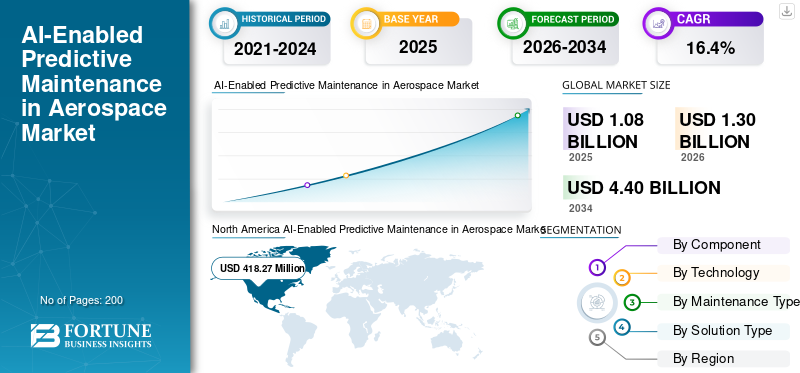
The AI-enabled predictive maintenance in aerospace market size was valued at USD 1,086.7 million in 2025. The market is projected to grow from USD 1,301.9 million in 2026 to USD 4,402.4 million by 2034, exhibiting a CAGR of 16.4% during the forecast period. North America dominated the AI-enabled predictive maintenance in aerospace market with a market share of 38.48% in 2025.
The market is witnessing robust growth, driven by the increasing convergence of artificial intelligence, machine learning, and advanced sensor technologies within aviation and defense ecosystems. Airlines, MRO providers, OEMs, and defense operators are progressively adopting AI-driven solutions to shift from reactive and scheduled maintenance toward proactive, data-informed approaches. The market encompasses a broad range of offerings, including software platforms, fleet health monitoring systems, digital twin integration, and real-time diagnostics tools, serving both commercial aviation and defense sectors globally.
Key players in the market include Airbus, Boeing, GE Aerospace, Rolls-Royce, Lufthansa Technik, Honeywell International, Collins Aerospace (RTX), Safran, Thales Group, and BAE Systems. These companies compete through advanced AI-driven engine health monitoring platforms, integrated fleet diagnostics, digital twin-based maintenance frameworks, real-time sensor analytics, and intelligent MRO solutions tailored for commercial airlines, defense operators, and original equipment manufacturers across global aviation ecosystems.
Download Free sample to learn more about this report.
AI-ENABLED PREDICTIVE MAINTENANCE IN AEROSPACE MARKET Key Takeaways
 Global Market Size & Forecast
- 2025 Market Size: USD 1,086.7 million
- 2026 Market Size: USD 1,301.9 million
- 2034 Forecast Market Size: USD 4,402.4 million
- CAGR: 16.4% from 2026–2034
 Market Share
- North America dominated the AI-enabled predictive maintenance in aerospace market with a market share of 38.48% in 2025.
- The services segment is anticipated to rise with a CAGR of 16.5% over the forecast period.
- Engine & propulsion analytics are projected to grow at a CAGR of 16.2% during the study period.
 Key Regional Highlights
North America
North America held the dominant share in 2024, valued at USD 345.7 million, and also maintained the leading share in 2025, with USD 418.2 million.
Europe
The market is projected to reach USD 356.8 million in 2026, supported by established aerospace manufacturing hubs, stringent safety regulations, and accelerating Industry 4.0 adoption.
Asia Pacific
The region is forecast to reach USD 321.0 million in 2026 and register the fastest 17.1% CAGR, fueled by expanding air traffic, fleet modernization, and government-backed aviation digitalization initiatives.
U.S.
Based on North America’s strong contribution, the U.S. market can be analytically approximated at around USD 432.0 million in 2026, representing roughly 16.1% CAGR of the forecast period.
Japan
The Japan market share in 2026 is estimated at around USD 53.7 million, accounting for roughly 16.2% CAGR during the forecast period.
Read More

AI-ENABLED PREDICTIVE MAINTENANCE IN AEROSPACE MARKET TRENDS
Digital Twin Integration and Real-Time Analytics Are Redefining Aerospace Maintenance Strategies
Digital twin technology is emerging as a transformative accelerant for the market, enabling the creation of high-fidelity virtual replicas of physical assets that can simulate failure scenarios, calibrate sensor data against physics-based models, and generate maintenance recommendations with substantially higher accuracy than data-driven approaches alone. Simultaneously, the integration of IoT technologies into industrial operations has significantly enhanced AI-driven predictive maintenance, as IoT devices facilitate real-time monitoring of equipment performance and health, enabling organizations to detect anomalies before they escalate into costly failures. These converging trends are reshaping how aerospace operators approach fleet management and component lifecycle optimization.
MARKET DYNAMICS
MARKET DRIVERS
Download Free sample to learn more about this report.
Mounting Pressure to Reduce Unplanned Downtime and Optimize Aircraft Operational Costs is Driving Market Growth
The rising demand for reduced maintenance costs and improved aircraft uptime is pushing airlines and MRO organizations to adopt predictive maintenance solutions. AI-driven predictive maintenance is becoming vital for reducing downtime and extending the lifecycle of aerospace components, driving its adoption across the industry. These solutions leverage machine learning and sensor analytics to forecast component degradation before failures occur, preventing unscheduled groundings and supporting flight safety. Overall, these factors drive the AI-enabled predictive maintenance in aerospace market growth.
MARKET RESTRAINTS
High Implementation Costs and Complex System Integration Hinders Market Expansion
A significant restraint in the market is the high cost and complexity associated with implementing AI systems. The retrofitting of older aircraft with advanced sensors, data analytics capabilities, and communication systems poses challenges due to variations in aircraft models and avionics architectures. Achieving seamless integration without disrupting ongoing operations requires overcoming compatibility issues and ensuring that predictive maintenance solutions can effectively communicate with diverse aircraft systems. This complexity often leads to extended implementation timelines and higher integration costs, hindering the swift adoption of predictive maintenance across the entire spectrum of an airline's fleet.
MARKET OPPORTUNITIES
Expanding Connected Aircraft Programs and MRO Digitalization Presents Significant Growth Potential
The expansion of next-generation connected aircraft programs and the increasing adoption of digital twin and simulation technology by airlines and OEMs represent key market opportunities. The growing emphasis on MRO digitalization across emerging aviation markets further opens new deployment avenues. The sector is witnessing increased investment in AI-driven, automated solutions that emphasize scalability and customization, facilitating seamless integration with airline operations and adaptability to evolving industry requirements. As fleets modernize globally, demand for intelligent, scalable predictive platforms continues to accelerate across both commercial and defense verticals.
MARKET CHALLENGES
Data Security Vulnerabilities and Workforce Skill Gaps Threaten AI Deployment Scalability
Ensuring the security of AI systems and the data they handle is crucial, as breaches can lead to significant financial losses, damage to reputation, and safety risks. Addressing these concerns requires robust cybersecurity measures, continuous monitoring, and updates to AI systems. Moreover, the shortage of skilled professionals with expertise in AI, data science, and industrial systems also poses a major challenge. Surveys indicated that a significant share of enterprises faced delays in deploying AI predictive platforms due to inadequate technical expertise. Many small and mid-sized enterprises struggle to attract talent for AI system integration, resulting in limited adoption.
Segmentation Analysis
By Component
Increasing Need for Intelligent Data Processing and Fault Detection Is Driving Demand for Software Segment
Based on component, the market is segmented into software, services, and hardware.
The software segment accounted for the largest AI-enabled predictive maintenance in aerospace market share in 2025. Demand for the software segment is rising as aerospace operators require real-time data processing, fault detection, and failure prediction capabilities that only advanced software platforms can deliver. The sector is witnessing increased investment in AI-driven, automated solutions that emphasize scalability and customization, facilitating seamless integration with airline operations and adaptability to evolving industry requirements. Software's centrality in enabling end-to-end predictive workflows continues to reinforce its dominant position across the market.
The services segment is anticipated to rise with a CAGR of 16.5% over the forecast period.
By Technology
Growing Complexity of Aerospace Data Environments is Leading to Machine Learning & Deep Learning Segment
Based on technology, the market is segmented into machine learning & deep learning, digital twin & simulation, edge AI & real-time analytics, natural language processing, and computer vision.
In 2025, the machine learning & deep learning segment dominated the global market. Demand is rising as aerospace systems generate massive volumes of sensor and operational data that require sophisticated pattern recognition to identify failure precursors. Machine learning has its applications in predictive maintenance, flight operations, and safety management, leveraging supervised and unsupervised models to enhance efficiency and accuracy. These capabilities enable more precise, adaptive, and scalable maintenance intelligence across commercial and defense fleets.
The digital twin & simulation segment is projected to grow at a CAGR of 16.7% over the forecast period.
To know how our report can help streamline your business, Speak to Analyst
By Maintenance Type
Urgent Need to Minimize Aircraft Downtime Leads to Dominance of Predictive Maintenance Segment
Based on maintenance type, the market is segmented into predictive maintenance, condition-based maintenance, prescriptive maintenance, preventive maintenance optimization, and corrective maintenance support.
The predictive maintenance segment is anticipated to witness a dominating market share over the forecast period. Demand for the predictive maintenance is rising as airlines and defense operators face escalating pressure to reduce unscheduled groundings and lower lifecycle costs. Predictive maintenance is also experiencing the fastest growth due to its potential to reduce operational costs. Predictive maintenance software plays a vital role in real-time data processing, fault detection, and failure prediction, making it indispensable for MRO providers and OEMs seeking to optimize fleet reliability and turnaround efficiency.
The prescriptive maintenance segment is projected to grow at a high CAGR of 17.9% over the forecast period.
By Solution Type
Expanding Commercial Fleets Drive Demand for Fleet Health Monitoring Platforms Segment
Based on solution type, the market is segmented into fleet health monitoring platforms, engine & propulsion analytics, digital MRO platforms, structural health monitoring systems, spare parts & inventory optimization, and inspection automation tools.
The fleet health monitoring platforms segment dominated the market in 2025. Demand for these platforms segment is rising as airlines and defense operators require centralized, real-time visibility across entire aircraft fleets to proactively manage component health. Advancements Thales Group in connected aviation systems, onboard diagnostics, and real-time performance monitoring are strengthening the shift toward proactive maintenance strategies. Fleet-wide intelligence platforms enable consolidated health assessments, reducing operational disruptions and improving dispatch reliability across diverse aircraft types.
In addition, engine & propulsion analytics are projected to grow at a CAGR of 16.2% during the study period.
AI-Enabled Predictive Maintenance in Aerospace Market Regional Outlook
By geography, the market is categorized into North America, Europe, Asia Pacific, and Rest of the World.
North America
North America Size, 2025 (USD Million)
To get more information on the regional analysis of this market, Download Free sample
North America held the dominant share in 2024, valued at USD 345.7 million, and also maintained the leading share in 2025, with USD 418.2 million. North America leads the market, supported by a mature aviation ecosystem, early AI adoption, high defense spending, and a dense concentration of major airlines, OEMs, and MRO providers driving continuous investment in advanced diagnostics platforms.
U.S. AI-Enabled Predictive Maintenance in Aerospace Market
Based on North America’s strong contribution, the U.S. market can be analytically approximated at around USD 432.0 million in 2026, representing roughly 16.1% CAGR of the forecast period. The U.S. market benefits from strong federal support for aviation digitalization, safety modernization, and fleet-wide data integration across commercial and defense aircraft, positioning it as a leading market for predictive maintenance solutions.
Europe
Europe is estimated to reach USD 356.8 million in 2026 and secure the position of second largest region in the market. This is driven by strong aerospace manufacturing clusters in the U.K., France, and Germany, stringent safety regulations, and an aggressive Industry 4.0 adoption agenda accelerating AI integration across commercial aviation and defense maintenance operations.
U.K. AI-Enabled Predictive Maintenance in Aerospace Market
The U.K. market in 2026 is estimated at around USD 77.7 million, and expected to represent roughly 15.6% CAGR during the forecast period. The U.K. market growth is driven by established aerospace players including Rolls-Royce and BAE Systems, combined with regulatory emphasis on aviation safety and growing investment in AI-powered engine health monitoring and defense maintenance systems
Germany AI-Enabled Predictive Maintenance in Aerospace Market
Germany’s market is projected to reach approximately USD 88.1 million in 2026. Investments in connected aircraft infrastructure, digital MRO facilities, and AI-based monitoring tools continue to strengthen Germany's position in European market.
Asia Pacific
Asia Pacific is projected to record a CAGR of 17.1% during the forecast period, which is the highest among all regions, and reach a valuation of USD 321.0 million by 2026. The Asia Pacific market is anticipated to grow at the highest CAGR during the forecast period, fueled by rapid air traffic expansion, fleet modernization by major carriers, and government-backed digitalization initiatives supporting AI-driven maintenance technology adoption across aviation infrastructure.
China AI-Enabled Predictive Maintenance in Aerospace Market
China’s market is projected to be one of the largest in Asia Pacific, with 2026 revenues estimated at around USD 110.8 million. China's market is expanding rapidly, propelled by large-scale fleet growth, government-led aviation modernization programs, and increasing adoption of AI analytics platforms by both state-owned carriers and emerging private airlines across domestic routes.
Japan AI-Enabled Predictive Maintenance in Aerospace Market
The Japan market share in 2026 is estimated at around USD 53.7 million, accounting for roughly 16.2% of CAGR during the forecast period. Japan's demand is underpinned by its precision-engineering culture, advanced manufacturing capabilities, and major carriers integrating AI-driven diagnostics platforms to enhance fleet reliability and align with stringent civil aviation authority maintenance standards.
India AI-Enabled Predictive Maintenance in Aerospace Market
The India market in 2026 is estimated at around USD 47.1 million. India represents a high-growth opportunity, driven by rapid air traffic expansion, fleet procurement by domestic carriers, and government initiatives promoting aviation sector digitalization, creating strong demand for scalable, cost-effective AI predictive maintenance solutions.
Rest of the World
The rest of the world include Middle East & Africa and Latin America. These regions are expected to witness moderate growth in this market space during the forecast period. The Middle East & Africa and Latin America market is set to reach a valuation of USD 83.7 million and USD 39.9 million in 2026. The Rest of the World, encompassing the Middle East, Latin America, and Africa, is an emerging growth frontier, with Gulf region airlines modernizing fleets, and Latin American carriers gradually adopting AI-enabled maintenance tools to improve operational safety and reduce unplanned downtime.
COMPETITIVE LANDSCAPE
Key Industry Players
Growing Focus of Key Players’ on AI-Based Fleet Health Monitoring, Engine Analytics, and Digital MRO Platforms Propels Market Competition
The AI-enabled predictive maintenance in aerospace market is being strengthened by key players that are moving aircraft maintenance from scheduled, reactive servicing toward data-driven, condition-based decision-making. Companies such as Airbus, Boeing, GE Aerospace, Rolls-Royce, Lufthansa Technik, Honeywell International, Collins Aerospace/RTX, Safran, Thales Group, and BAE Systems are focusing on aircraft health monitoring, engine analytics, digital MRO platforms, AI/ML-based anomaly detection, fleet-performance dashboards, and automated maintenance planning. Airbus is expanding Skywise as a unified digital platform for predictive maintenance and fleet performance, while Boeing’s Airplane Health Management supports real-time maintenance analytics to improve aircraft availability. Rolls-Royce is using engine health monitoring to analyze every engine and flight, and Lufthansa Technik’s AVIATAR connects engineering expertise with data science across predictive maintenance and automated fulfillment, helping operators reduce downtime, improve dispatch reliability, and lower lifecycle maintenance costs.
LIST OF KEY AI-ENABLED PREDICTIVE MAINTENANCE IN AEROSPACE COMPANIES PROFILED
- Airbus (France)
- Boeing (U.S.)
- GE Aerospace (U.S.)
- Rolls-Royce (U.K.)
- Lufthansa Technik (Germany)
- Honeywell International (U.S.)
- Collins Aerospace / RTX (U.S.)
- Safran (France)
- Thales Group (France)
- BAE Systems (U.K.)
KEY INDUSTRY DEVELOPMENTS
- April 2026: ai signed a commercial collaboration agreement with GACI Technologies to introduce AI-powered predictive maintenance and visual monitoring systems into the French aerospace and defense sectors.
- February 2026: Boeing and Oman Air renewed their predictive maintenance partnership, deploying Boeing's Airplane Health Management (AHM) system across Oman Air’s 787 Dreamliner fleet to optimize maintenance decisions and fleet readiness.
- December 2025: Lockheed Martin and MANTECH formed a strategic teaming agreement to integrate AI-based sustainment platforms including predictive maintenance and performance monitoring into the U.S. combat aircraft fleet.
- October 2025: Soji AI and Active Partners entered a strategic collaboration to apply artificial intelligence solutions to improve the efficiency of aircraft and engine maintenance, inspections, and transitions.
- June 2025: C3 AI was awarded a USD 13 million task order (under a larger USD 450 million contract vehicle) to expand its AI-enabled predictive maintenance program across additional aircraft platforms for the U.S. Air Force Rapid Sustainment Office.
REPORT COVERAGE
This research offers a detailed analysis of emerging trends and rapidly adopted technologies in the industry across key regions. The report outlines key drivers of market growth and challenges to expansion, delivering a detailed overview of the maritime industry landscape. The study highlights recent advancements to boost industry insights and support stakeholders in making well-informed decisions.
Request for Customization to gain extensive market insights.
Report Scope & Segmentation
| ATTRIBUTE | DETAILS |
| Study Period | 2021-2034 |
| Base Year | 2025 |
| Estimated Year | 2026 |
| Forecast Period | 2026-2034 |
| Historical Period | 2021-2024 |
| Growth Rate | CAGR of 16.4% from 2026-2034 |
| Unit | Value (USD Million) |
| Segmentation | By Component, By Technology, By Maintenance Type, By Solution Type and Region |
| By Component |
|
| By Technology |
|
| By Maintenance Type |
|
| By Solution Type |
|
| By Region |
|
Frequently Asked Questions
According to Fortune Business Insights, the global market value stood at USD 1,086.7 million in 2025 and is projected to reach USD 4,402.4 million by 2034.
In 2025, the North America market value stood at USD 418.2 million.
The market is expected to exhibit a CAGR of 16.4% during the forecast period of 2026-2034.
By component, software segment is expected to dominate the market.
Mounting pressure to reduce unplanned downtime and optimize aircraft operational costs drives market growth.
Airbus, Boeing, GE Aerospace, Rolls-Royce, Lufthansa Technik, and Honeywell International are few major players in the global market.
North America dominated the market in 2025.



- 2021-2034
- 2025
- 2021-2024
- 200
Get 30-60 hrs Free Customization
Expand Regional and Country Coverage, Segments Analysis, Company Profiles, Competitive Benchmarking, and End-user Insights.




















Related Reports
-
US +1 833 909 2966 ( Toll Free )
-
Get In Touch With Us