AI-Enabled Tactical Drone Market Size, Share & Industry Analysis, By Platform Type (Fixed-Wing Drones, Rotary-Wing Drones, and Hybrid VTOL Drones), By AI Capability (Computer Vision & Object Recognition, Autonomous Navigation & Obstacle Avoidance, Automatic Target Recognition & Tracking, and Swarm Intelligence & Collaborative Autonomy), By Payload Type (Electro-Optical/Infrared Payloads, Radar & Imaging Payloads, Electronic Warfare & SIGINT Payloads, and Communication Relay Payloads), By End User (Army, Air Force, Navy, and Special Operations Forces), and Regional Forecast, 2026-2034
 Download Free Sample
AI-Enabled Tactical Drone Market Size and Future Outlook
 Listen to Audio Version
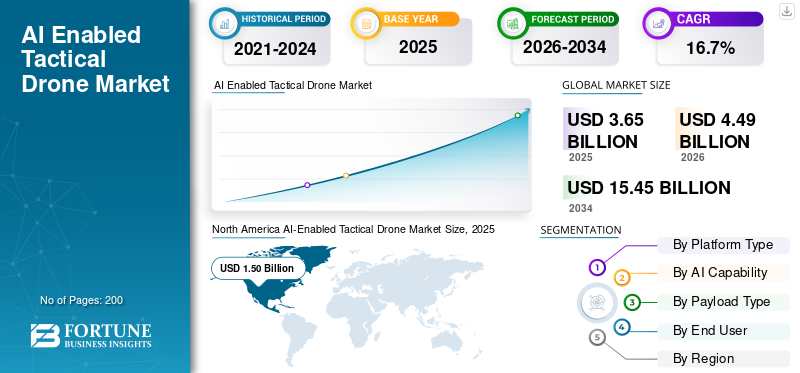
The AI-enabled tactical drone market size was valued at USD 3.65 billion in 2025. The market is projected to grow from USD 4.49 billion in 2026 to USD 15.45 billion by 2034, exhibiting a CAGR of 16.7% during the forecast period. North America dominated the AI-enabled tactical drone market with a market share of 41.09% in 2025.
The market represents convergence of unmanned aerial systems with artificial intelligence capabilities such as autonomous navigation, real-time data processing, swarm coordination, and target recognition. These drones are increasingly deployed for reconnaissance, surveillance, precision strike, and battlefield awareness missions, offering forces enhanced decision-making speed and reduced human risk. The integration of machine learning algorithms allows tactical drones to operate in contested and GPS-denied environments, process sensors data onboard, and adapt to dynamic mission conditions. As modern warfare shifts toward network-centric and autonomous operations, this market continues to evolve as a critical enabler of next-generation defense and security capabilities across air, land, and maritime domains.
Key players in the market include AeroVironment, Inc., Anduril Industries, Inc., Shield AI, Inc., Skydio, Inc., and Elbit Systems Ltd. These companies compete through advancements in autonomous flight software, edge AI processing, swarm intelligence, and resilient navigation in GPS-denied environments. Their portfolios span small tactical UAVs, loitering munitions, and reconnaissance platforms designed for rapid deployment by ground forces. Competitive differentiation is also driven by partnerships with defense agencies, modular payload integration, and ruggedized designs suited for contested battlefield conditions. Continuous innovation in sensor fusion, mission autonomy, and secure communications enables these companies to strengthen their positioning across defense, homeland security, and allied military modernization programs globally.
Download Free sample to learn more about this report.
AI Enabled Tactical Drone Market Key Takeaways
 Global Market Size & Forecast
- 2025 Market Size: USD 3.65 billion
- 2026 Market Size: USD 4.49 billion
- 2034 Forecast Market Size: USD 15.45 billion
- CAGR: 16.7% from 2026–2034
 Market Share
- North America dominated the AI-enabled tactical drone market with a 41.09% share in 2025.
- Hybrid VTOL drones are projected to grow at a 17.8% CAGR during the forecast period.
- Swarm intelligence and collaborative autonomy is projected to grow at an 18.5% CAGR during the forecast period.
 Key Regional Highlights
North America
North America led the market with a valuation of USD 1.50 billion in 2025.
Europe
Europe is expected to reach USD 1.23 billion in 2026 and remain the second-largest region.
Asia Pacific
Asia Pacific is projected to register the highest regional CAGR of 21.6% during the forecast period.
U.S.
The market is estimated at around USD 1.69 billion in 2026, with an approximately 12.7% CAGR.
Japan
The market is estimated at around USD 0.20 billion in 2026, with an approximately 27.3% CAGR.
Read More

AI-ENABLED TACTICAL DRONE MARKET TRENDS
Growing Integration of Autonomous Swarming Capabilities in Tactical Drones is an Emerging Market Trend
A prominent trend shaping the market is the rising adoption of swarming technology, where multiple AI-enabled drones coordinate autonomously to execute complex missions such as reconnaissance, jamming, or coordinated strikes. This trend reflects a broader shift from single-platform operations toward networked, collaborative drone systems capable of overwhelming adversary defenses and covering larger operational areas. Defense forces are increasingly favoring swarming drones for their ability to maintain mission continuity even if individual units are lost. Additionally, advancements in edge computing and low-latency communication are enabling real-time coordination among drone fleets, further reinforcing swarming as a defining trend in tactical drone development and deployment strategies.
MARKET DYNAMICS
MARKET DRIVERS
Download Free sample to learn more about this report.
Rising Need for Autonomous ISR and Reduced Soldier Risk on the Battlefield is Driving Market Growth
Growing emphasis on protecting soldier lives while maintaining continuous Intelligence, Surveillance, and Reconnaissance (ISR) capability is driving AI-enabled tactical drone market growth. These systems allow forces to gather real-time battlefield intelligence, detect threats, and conduct precision operations without exposing personnel to direct risk. AI integration further enhances drone autonomy, enabling faster target identification and reducing operator workload during high-stress missions. As geopolitical tensions and asymmetric warfare threats increase globally, defense forces are prioritizing investment in intelligent and autonomous aerial platforms. This growing focus on force protection and situational awareness continues to reinforce tactical drones as an essential component of modern military operations.
MARKET RESTRAINTS
High Costs and Complexity of AI Integration Limiting Widespread Product Adoption
The high cost associated with developing and deploying AI-enabled tactical drones remains a key market restraint, particularly for smaller defense budgets and developing nations. Integrating advanced AI algorithms, sensor fusion systems, and secure communication modules significantly increases platform costs compared to conventional drones. Additionally, the complexity of maintaining and upgrading AI software throughout a drone's operational lifecycle adds further financial and technical burden. These factors can slow procurement decisions, especially in regions where defense modernization budgets are constrained. As a result, cost sensitivity continues to limit the pace of adoption across certain military segments and geographies, despite growing recognition of the technology's operational benefits.
MARKET OPPORTUNITIES
Expanding Scope for AI-enabled Drones in Multi-Domain and Urban Warfare Offers Lucrative Market Opportunity
Significant opportunity for market exists in adapting tactical drones for multi-domain operations, including urban warfare, where AI-driven navigation and object recognition allow effective performance in cluttered, GPS-denied environments. As military doctrines increasingly emphasize urban and asymmetric conflict scenarios, there is growing demand for compact, intelligent drones capable of indoor navigation, obstacle avoidance, and threat identification. This creates opportunities for manufacturers to develop specialized platforms tailored to close-quarters combat and reconnaissance. Furthermore, partnerships between technology firms and defense ministries to co-develop autonomous systems present avenues for market expansion, particularly as nations seek to modernize infantry-level capabilities with AI-driven tactical support tools.
MARKET CHALLENGES
Vulnerability to Electronic Warfare and Cybersecurity Threats Challenges Market Expansion
A major challenge faced by the market is increasing vulnerability of AI-enabled tactical drones to electronic warfare, jamming, and cyberattacks. As drones rely heavily on data links, GPS signals, and onboard AI processing, adversaries are developing countermeasures such as signal jamming, spoofing, and hacking attempts to disrupt or hijack these systems. This growing threat landscape complicates the design and deployment of secure, resilient drone platforms. Manufacturers must continuously invest in cybersecurity hardening, encrypted communications, and autonomous fail-safe mechanisms to counter growing threats. This ongoing challenge requires significant R&D investment and coordination with defense agencies to ensure operational reliability in contested electromagnetic environments.
Segmentation Analysis
By Platform Type
Extended Endurance and Payload Flexibility Are Driving Fixed-Wing Drones Segment Dominance
Based on platform type, the market is segmented into fixed-wing drones, rotary-wing drones, and hybrid VTOL drones.
The fixed-wing drones segment accounted for largest market share in 2025. Demand for fixed-wing tactical drones is rising as these platforms offer longer flight endurance, greater range, and higher payload capacity compared to rotary-wing alternatives. Military forces increasingly prefer fixed-wing designs for extended surveillance and border monitoring missions, where sustained airborne presence and fuel efficiency are critical operational requirements.
The hybrid VTOL drones segment is anticipated to rise with a CAGR of 17.8% over the forecast period.
To know how our report can help streamline your business, Speak to Analyst
By AI Capability
Rising Need for Real-Time Threat Identification is Augmenting Computer Vision and Object Recognition Segment Leadership
Based on AI capability, the market is segmented into computer vision and object recognition, autonomous navigation and obstacle avoidance, automatic target recognition and tracking, swarm intelligence and collaborative autonomy, and AI-based mission planning and decision support.
In 2025, the computer vision and object recognition segment dominated the global market. Demand for computer vision and object recognition is increasing as forces require faster and more accurate identification of targets, vehicles, and personnel in complex environments. These AI capabilities reduce operator dependency, enable autonomous decision-making, and improve mission accuracy, making them essential for modern tactical drone operations.
The swarm intelligence and collaborative autonomy segment is projected to grow at a CAGR of 18.5% over the forecast period.
By Payload Type
Growing Need for All-Weather Surveillance is Leading to Electro-Optical/Infrared Payloads Segment Dominance
Based on payload type, the market is divided into electro-optical/infrared payloads, radar and imaging payloads, electronic warfare and SIGINT payloads, communication relay payloads, and lethal and precision-strike payloads.
The electro-optical/infrared payloads segment is anticipated to witness a dominating AI-enabled tactical drone market share over the forecast period. This is owing to military operations require continuous surveillance capability regardless of lighting or weather conditions. These payloads enable target detection, night operations, and thermal imaging, making them indispensable for reconnaissance, tracking, and precision engagement across varied operational terrains.
The lethal and precision-strike payloads segment is projected to grow at a high CAGR of 17.4% over the forecast period.
By End User
Increasing Battlefield Autonomy Requirements is Propelling Army Segment Growth
Based on end user, the market is segmented into army, air force, navy, marine forces, special operations forces, and homeland security and border protection agencies.
The army segment dominated the market in 2025. Demand for the product within the army segment is rising as ground forces seek AI-enabled drones for real-time reconnaissance, threat detection, and tactical support during combat operations. Growing emphasis on soldier safety and rapid situational awareness continues to push land forces toward increased adoption of autonomous aerial systems.
In addition, special operations forces segment is projected to grow at a CAGR of 18.7% during the forecast period.
AI-Enabled Tactical Drone Market Regional Outlook
By geography, the market is categorized into North America, Europe, Asia Pacific, and Rest of the World.
North America
North America AI-Enabled Tactical Drone Market Size, 2025 (USD Billion)
To get more information on the regional analysis of this market, Download Free sample
North America held a dominant share in 2024, valued at USD 1.15 billion, and also maintained the leading share in 2025, with USD 1.50 billion. Demand for the product is rising due to strong defense modernization programs, significant R&D investment, and early adoption of autonomous systems, majorly with the U.S. military driving substantial procurement of AI-enabled tactical drones for ISR missions.
U.S. AI-Enabled Tactical Drone Market
Based on North America’s strong contribution, the U.S. market can be analytically approximated at around USD 1.69 billion in 2026, representing roughly 12.7% CAGR during the forecast period. This growth is strong due to continuous defense modernization, high R&D spending, and active procurement programs supporting autonomous ISR and tactical strike drone capabilities across military branches.
Europe
Europe is estimated to reach USD 1.23 billion in 2026 and secure the position of second largest region in the market. Demand is increasing as NATO member nations enhance defense capabilities amid regional security concerns, prioritizing autonomous surveillance and reconnaissance drones to strengthen border security and battlefield readiness across member states.
U.K. AI-Enabled Tactical Drone Market
The U.K. market in 2026 is estimated at around USD 0.28 billion, representing roughly 11.5% CAGR over the forecast period. The market is growing as the country invests in autonomous defense technologies and collaborative programs aimed at strengthening ISR and battlefield awareness capabilities within NATO commitments.
Germany AI-Enabled Tactical Drone Market
Germany’s market is projected to reach approximately USD 0.27 billion in 2026. Product demand is increasing due to rising defense expenditure and modernization efforts aimed at enhancing surveillance, reconnaissance, and autonomous tactical capabilities amid regional security concerns.
Asia Pacific
Asia Pacific is projected to record a CAGR of 21.6% during the forecast period, which is the highest among all regions, and reach a valuation of USD 1.14 billion by 2026. Product demand across the region is growing rapidly due to rising defense budgets, territorial tensions, and modernization initiatives across countries seeking indigenous and imported tactical drone capabilities for surveillance and border monitoring missions.
China AI-Enabled Tactical Drone Market
China’s market is projected to be one of the largest in Asia Pacific, with 2026 revenues estimated at around USD 0.47 billion. Market is growing rapidly driven by aggressive military modernization, indigenous drone development, and strategic emphasis on autonomous systems for surveillance and territorial operations.
Japan AI-Enabled Tactical Drone Market
The Japan market in 2026 is estimated at around USD 0.20 billion, accounting for roughly 27.3% of CAGR during the forecast period. Demand is rising as the country strengthens defense capabilities amid regional tensions, increasingly prioritizing autonomous ISR drones for maritime and border surveillance missions.
India AI-Enabled Tactical Drone Market
The India market in 2026 is estimated at around USD 0.28 billion. Growing defense modernization initiatives, indigenous drone manufacturing push, and heightened border security requirements is driving adoption of AI-enabled tactical platforms.
Rest of the World
The rest of the world include Middle East & Africa and Latin America. These regions are expected to witness moderate growth in this market space during the forecast period. The Middle East & Africa and Latin America market is set to reach a valuation of USD 0.24 billion and USD 0.08 billion in 2026. Product demand across these regions is gradually increasing as nations invest in tactical drones for border security, counter-terrorism, and internal security operations amid evolving threat environments.
COMPETITIVE LANDSCAPE
Key Industry Players
Key Players Focus on Software-Defined Autonomy, Swarm Operations, and EW-Resilient Tactical Drones to Boost Market Competition
The AI-enabled tactical drone market competition is being strengthened by key players that are shifting tactical drones from remotely piloted, single-mission platforms toward software-defined, networked, and increasingly autonomous battlefield systems. Companies such as AeroVironment, Inc., Anduril Industries, Inc., Shield AI, Inc. and others are focusing on onboard edge computing, autonomous navigation, AI-based target detection and tracking, GNSS-denied operations, swarm coordination, modular payload integration, and rapidly scalable production. AeroVironment is expanding AI capabilities through its ARK autonomy retrofit kit and AVACORE software, which add single- and multi-agent autonomy to existing unmanned platforms. Anduril is integrating Ghost, Altius, and other autonomous air vehicles with its Lattice command-and-control software to support tactical ISR, electronic warfare, communications relay, and coordinated strike missions. Shield AI is advancing Hivemind-powered V-BAT operations in GPS- and communications-denied environments, while Skydio and Quantum Systems are strengthening unit-level intelligence and reconnaissance through the AI-enabled X10D and Vector AI platforms.
LIST OF KEY AI-ENABLED TACTICAL DRONE COMPANIES PROFILED
- AeroVironment, Inc. (U.S.)
- Anduril Industries, Inc. (U.S.)
- Shield AI, Inc. (U.S.)
- Skydio, Inc. (U.S.)
- Elbit Systems Ltd. (Israel)
- Israel Aerospace Industries Ltd. (Israel)
- Baykar Makina Sanayi ve Ticaret A.Ş. (Türkiye)
- STM Savunma Teknolojileri Mühendislik ve Ticaret A.Ş. (Türkiye)
- Quantum-Systems GmbH (Germany)
- Helsing SE (Germany)
KEY INDUSTRY DEVELOPMENTS
- July 2026: The U.S. Pentagon awarded AeroVironment an USD 80.5 million task order (part of a USD 500 million contract) to deploy AI-enabled Titan counter-drone systems to protect Air Force installations.
- July 2026: The U.K. selected three companies (Frankenberg Technologies, Greenjets, and Cambridge Aerospace) to develop low-cost, mass-produced drone interceptors under the LEAP European initiative.
- June 2026: DGA (France) and Harmattan AI finalized a landmark mass-production order for 6,000 DELCO tactical drones featuring onboard AI and edge processing.
- May 2026: Perennial Autonomy was awarded a three-year, USD 500 million contract by the Pentagon's Joint Interagency Task Force to deliver AI-enabled counter-drone systems.
- January 2026: The Indian Army partnered with U.S.-based defense firm Shield AI to procure V-BAT unmanned systems equipped with AI-edge Hivemind software, to be manufactured in India.
REPORT COVERAGE
This research offers a detailed analysis of emerging trends and rapidly adopted technologies in the industry across key regions. The report outlines key drivers of market growth and challenges to expansion, delivering a detailed overview of the industry landscape. The study highlights recent advancements to boost industry insights and support stakeholders in making well-informed decisions.
Request for Customization to gain extensive market insights.
Report Scope & Segmentation
| ATTRIBUTE | DETAILS |
| Study Period | 2021-2034 |
| Base Year | 2025 |
| Estimated Year | 2026 |
| Forecast Period | 2026-2034 |
| Historical Period | 2021-2024 |
| Growth Rate | CAGR of 16.7% from 2026-2034 |
| Unit | Value (USD Billion) |
| Segmentation | By Platform Type, By AI Capability, By Payload Type, By End User and Region |
| By Platform Type |
|
| By AI Capability |
|
| By Payload Type |
|
| By End User |
|
| By Region |
|
Frequently Asked Questions
According to Fortune Business Insights, the global market value stood at USD 3.65 billion in 2025 and is projected to reach USD 15.45 billion by 2034.
In 2025, the North America market value stood at USD 1.50 billion.
The market is expected to exhibit a CAGR of 16.7% during the forecast period of 2026-2034.
By platform type, fixed-wing drones segment is expected to dominate the market.
Rising need for autonomous ISR and reduced soldier risk on the battlefield is driving market growth.
AeroVironment, Inc., Anduril Industries, Inc., Shield AI, Inc., Skydio, Inc. are few major players in the global market.
North America held the largest market share in 2025.



- 2021-2034
- 2025
- 2021-2024
- 200
Get 30-60 hrs Free Customization
Expand Regional and Country Coverage, Segments Analysis, Company Profiles, Competitive Benchmarking, and End-user Insights.




















Related Reports
-
US +1 833 909 2966 ( Toll Free )
-
Get In Touch With Us