AI in Drone Market Size, Share & Industry Analysis, By UAV Class (Micro, Mini & Small UAVs, and Tactical UAVs (MALE & HALE)), By Technology (Computer Vision, ML, Deep Learning, and Others), By Operation (Visual Line of Sight, Extended Visual Line of Sight, Beyond Visual Line of Sight, and Others), By Autonomy Level (Remotely Controlled using AI, Semi & Fully Autonomous), By Application (Defense & Security, Infrastructure & Industrial Inspection, Agriculture & Forestry, Logistics & Delivery, Public Safety & Emergency Response, and Others), By End User, and Regional Forecast, 2026-2034
 Download Free Sample
KEY MARKET INSIGHTS
 Listen to Audio Version
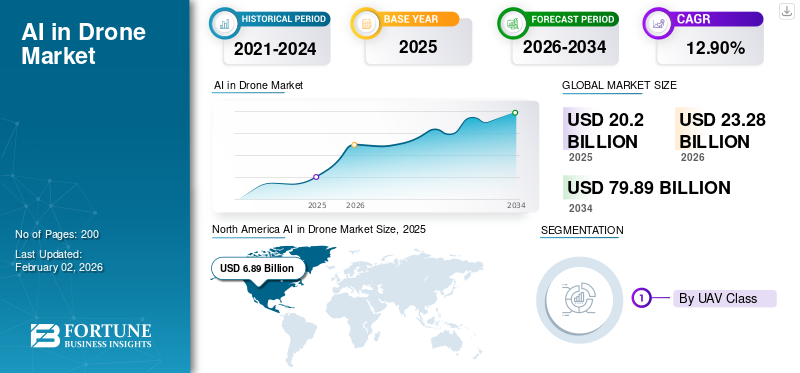
The global AI in drone market size was valued at USD 17,828.4 million in 2025 and is projected to grow from USD 20,204.9 million in 2026 to USD 61,647.9 million by 2034, exhibiting a CAGR of 17.3% during the forecast period. North America dominated the market with a market share of 23.57% in 2025.
Artificial intelligence (AI) is transforming the drone industry by enabling autonomous operations, intelligent navigation, and data-driven decision-making across a variety of applications. The integration of AI technologies such as computer vision, real-time object detection, and machine learning allows drones to analyze surroundings, recognize obstacles, flight paths, and perform complex tasks without constant human intervention. The AI in drone market is witnessing strong growth globally owing to these AI-enhanced capabilities, which are essential in fields such as agriculture, surveillance, delivery, infrastructure inspection, and disaster response.
The market encompasses several major players, with DJI, Shield AI, Teledyne FLIR, and Parrot Inc. at the forefront. This highly dynamic market is anticipated to witness technological advancements from both large multinationals and agile startups.
Download Free sample to learn more about this report.
AI in Drone Market Key Takeaways
 Market Size & Forecast
- 2025 Market Size: USD 17.83 billion
- 2026 Market Size: USD 20.20 billion
- 2034 Forecast Market Size: USD 61.65 billion
- CAGR: 17.3% from 2026–2034
 Market Share
- North America dominated the AI in drone market with a 23.57% share in 2025.
- Tactical UAVs (MALE & HALE) segment is projected to hold a 43.92% market share in 2026.
- Machine Learning (ML) technology segment is expected to account for 36.80% of the market share in 2026.
 Key Regional Highlights
North America
North America was valued at USD 6.89 Billion in 2025 and is projected to reach USD 7.88 Billion in 2026.
Europe
Europe was valued at USD 4.76 Billion in 2025 and is projected to reach USD 5.49 Billion in 2026.
Asia Pacific
Asia Pacific was valued at USD 6.14 Billion in 2025 and is projected to reach USD 7.16 Billion in 2026.
U.S.
The U.S. was valued at USD 6.59 Billion in 2025 and is projected to reach USD 7.55 Billion in 2026.
Japan
Japan was valued at USD 0.84 Billion in 2025 and is projected to reach USD 0.98 Billion in 2026.
Read More

MARKET DYNAMICS
MARKET DRIVERS
Rapid Adoption of AI in Drones in Various Domains to Impel Market Growth
The rapid increase in the usage of AI technologies in drones is mostly driven by technological advancements in machine learning, computer vision, and real-time data analytics, which enable drones to function independently and manage complicated tasks across various industries.
Industries such as agriculture, infrastructure inspection, defense, logistics, and disaster management are increasingly leveraging AI-powered drones to improve precision, reduce operational risks, and streamline decision-making. The operational efficiency, scalability, and adaptability that AI brings to drone operations make it a strategic asset for organizations seeking to automate data collection and enhance mission reliability.
MARKET RESTRAINTS
Complexity and Cost of Embedding Advanced Autonomous Capabilities to Restrict Market Expansion
Integrating sophisticated autonomous capabilities into AI-powered drones brings technological complexity in integrating sensors and machine learning algorithms. High-performance sensors, processors, and AI software raise development and operational expenses, creating barriers for small to mid-sized enterprises and curtailing accessibility in emerging economies. The excessive price of these cutting-edge technologies serves as a major impediment to further market development.
Each layer of complexity, whether in hardware, software development, system integration, and continuous maintenance, translates into increased investment requirements, both in terms of initial cost and running costs.
MARKET OPPORTUNITIES
Surge in digital transformation Across Industries Presents Significant Opportunities for AI Drones
The rise in digital transformation across various sectors has created opportunities for the use of AI-powered drones, providing new approaches to improve data-driven decision-making, operational efficiency, and safety. These drones are being adopted in domains such as agriculture, defense, environment, and logistics.
AI in drones provides aerial perspectives and cutting-edge sensing technology to aid thorough inspections, quality assurance, and maintenance procedures, allowing businesses to spot problems early and minimize downtime.
AI IN DRONE MARKET TRENDS
Growing Adoption of AI-based Drone Swarms is Emerging as a Key Trend in the Market
In recent years, unlike conventional drones that are operated or flown by a single pilot, drone swarms employ complex AI algorithms to facilitate real-time communication, coordination, and decision-making between them. The large number of drones that work together as a cohesive whole, replicating biological systems such as insect swarms or bird flocks. This collective behavior enables drones to dynamically respond to shifting circumstances, avoid obstacles, and effectively reassign mission responsibilities.
MARKET CHALLENGES
Rising Cyberattacks to Hamper Market Growth
Cyberattacks present a serious threat to the development of AI in drone industry by targeting drone systems in ways that could risk operations, data protection, and system integrity. The attack surface increases as drones become more dependent on AI for autonomous navigation, data processing, and communication, making them vulnerable to complex cyberattacks such as GPS spoofing, firmware tampering, and denial-of-service attacks.
These dangers might result in drone hijacking, data manipulation, mission failures, and other critical consequences. Moreover, AI-enabled drones are inherently complex and connected, making them appealing targets for cybercriminals and foes. This necessitates the development of robust, AI-driven cybersecurity measures.
Russia-Ukraine War Impact
The conflict between Russia and Ukraine has accelerated the adoption of artificial intelligence within the drone market, altering both military strategies and technological advancements. As the war has underlined the importance of autonomous systems, especially for tasks such as surveillance, targeting, and real-time data analysis, there has been a notable increase in the demand for AI-driven drones that can function effectively in complex and contested environments. This has driven swift progress in areas such as computer vision, navigation algorithms, and decision-making capabilities, compelling both defense sectors and private developers to focus on creating smarter and more versatile unmanned systems.
Download Free sample to learn more about this report.
Segmentation Analysis
By UAV Class
Tactical UAVs (MALE & HALE) Segment Led the Market due to their Ability to Function across Various Terrains
On the basis of the segmentation of UAV Class, the market is classified into micro UAVs (Below 2 Kg), mini UAVs (2-20 Kg), small UAVs (20-50 Kg), and tactical UAVs (MALE & HALE).
The tactical UAVs (MALE & HALE) segment is projected to dominate the market with a share of 43.92% in 2026, driven by their ability to operate across various terrains with minimal ground risk, a capability which is critical for achieving military objectives.
To know how our report can help streamline your business, Speak to Analyst
By Technology
Machine Learning Segment Dominated due to its Ability to Identify Threats
In terms of technology, the market is categorized into computer vision, Machine Learning (ML), Deep Learning (DL), and others.
The machine learning (ML) segment is expected to account for 36.80% of the market share in 2026. In 2025, the segment is anticipated to dominate with a 36.49% share. ML enables real-time data processing and pattern recognition, allowing UAVs to autonomously identify threats, anomalies, or targets without human intervention. Furthermore, its wide applicability from defense targeting systems to industrial inspections positions ML as the core enabling technology across multiple domains.
The computer vision segment is expected to grow at a CAGR of 17.8% over the forecast period.
By Operation
Beyond Visual Line of Sight (BVLOS) Segment Dominated owing to its Various Capabilities
Based on operation, the market is segmented into Visual Line of Sight (VLOS), Extended Visual Line of Sight (EVLOS), Beyond Visual Line of Sight (BVLOS), and others.
The BVLOS segment dominated the global market with a market share of 33.77% in 2026, holding a 33.11% share in the same year. BVLOS allows UAVs to cover much larger areas without needing to remain within the operator’s visual range, thereby vastly expanding mission potential. Moreover, infrastructure inspection, border monitoring, and wide-area search and rescue depend heavily on BVLOS capabilities.
The VLOS segment is set to flourish and is growing at a CAGR of 17.7% during the forecast period.
By Autonomy Level
Remotely Controlled using AI Segment Led due to its Ability to take Better Control Over Strategic Decisions
Based on autonomy level, the market is segmented into remotely controlled using AI, semi-autonomous, and fully autonomous.
The remotely controlled using AI segment dominated the global market with a market share of 8.51% in 2026. Remotely controlled AI systems allow humans to retain control over strategic decisions while leveraging AI for real-time analysis and decision support.
The segment of Semi-Autonomous is set to flourish with a growth rate of 17.4% growth across the forecast period.
By Application
Military Modernization Boosted the Defense & Security Segment Growth
Based on application, the market is segmented into Defense & Security, infrastructure & industrial inspection, agriculture & forestry, logistics & delivery, public safety & emergency response, environmental monitoring & conservation, smart cities & urban management, healthcare & humanitarian aid, and others.
The defense & Security segment held a dominant position in 2024. The advancement and integration of AI into drone defense applications are mostly driven by military modernization, since AI allows drones to become more autonomous, capable of executing complicated tasks such as precision targeting and swarm intelligence.
The infrastructure & industrial inspection segment is set to flourish with a growth rate of 17.7% during the forecast period.
By End User
Government & Defense Segment Dominates Due to Strong Demand for Military UAVs
Based on end-user, the market is segmented into government & defense, energy, power, oil & gas, construction & mining, agriculture, forestry & wild life conservation, public infrastructure & homeland security, hospitals & emergency medical services, transportation & logistics, media, events & entertainment, and others.
In 2024, the government & defense segment dominated the market in terms of end-user. The growing use of UAVs by the defense and security sector sustained the strong need for military UAVs in real-time analytics for surveillance, mapping, transportation, warfare, and monitoring. Furthermore, the segment is set to hold a 47.44% share in 2025.
In addition, agriculture, forestry & wild life conservation segments are projected to grow at a CAGR of 20.4% during the study period.
AI in Drone Market Regional Outlook
By geography, the market is categorized into Europe, North America, Asia Pacific, the Middle East & Africa, and Latin America.
North America AI in Drone Market Size, 2025 (USD Billion)
To get more information on the regional analysis of this market, Download Free sample
North America
North America held the dominant share in 2023, valued at USD 5,373.2 million, and continued to lead in 2024 with USD 6,127.6 million. This dominance is due to the growing use of drones for surveillance and espionage in the region, especially in the U.S. The growing use of Government rules mandating the use of drones in the construction business for regular site inspections also contributes to this dominance. In 2025, the U.S. market is estimated to reach USD 6,592.0 million. The U.S. market is projected to reach USD 7.55 billion by 2026. The North America market accounted for USD 6.89 billion in 2025, representing 23.57% of the global industry, and is expected to reach USD 7.88 billion in 2026.
Europe
Other regions, such as Europe and the Asia Pacific region, are anticipated to witness a notable AI in Drone market growth in the coming years. The UK market is projected to reach USD 1.19 billion by 2026, while the Germany market is projected to reach USD 0.86 billion by 2026. Europe recorded a market size of USD 4.76 billion in 2025, capturing 30.39% of the global market share, and is projected to reach USD 5.49 billion in 2026.
Asia Pacific
During the forecast period, the Asia Pacific region is projected to record a growth rate of 18.6%, which is the highest amongst all the regions. This is primarily due to the higher investment in AI integration in drones for military and commercial applications. Backed by these factors, China is anticipated to record the valuation of USD 2,117.2 million, Japan USD 838.1 million, and India USD 1,263.7 million in 2025. After Asia Pacific, Europe is estimated to reach USD 4,762.3 million in 2025 and secure the position of the third-largest region in the market. The Japan market is projected to reach USD 0.98 billion by 2026, the China market is projected to reach USD 2.45 billion by 2026, and the India market is projected to reach USD 1.5 billion by 2026. In 2025, Asia Pacific represented USD 6.14 billion, accounting for 4.01% of the worldwide market, and is projected to grow to USD 7.16 billion in 2026.
Middle East & Africa
Middle East & Africa contributed 9.11% to the global market in 2025, with a valuation of USD 1.86 billion, and is projected to reach USD 2.12 billion in 2026.
Latin America
The Latin America market was valued at USD 0.55 billion in 2025, capturing 2.73% of global revenue, and is estimated to reach USD 0.63 billion in 2026.
Over the forecast period, the Middle East, Africa, and Latin America regions would witness a moderate growth in this market during the study period. By 2025, the Middle East market is set to record a valuation of USD 810.2 million, while Africa and Latin America are set to reach USD 1,046.6 million and 551.6 million, respectively.
COMPETITIVE LANDSCAPE
Key Industry Players
Key Companies Opt for Research & Development Activities to Boost Their Market Position
The global AI in drone market shows a semi-concentrated structure, with numerous small-to-mid-size companies actively operating across the globe. Top players in the AI-enabled drone market include DJI, Skydio, Parrot, Northrop Grumman, AeroVironment, Anduril Industries, Shield AI, DroneDeploy, Pix4D, Percepto, and Flytrex. Leading the global market is DJI, which leverages its scale, proprietary R&D, and integrated AI features such as obstacle avoidance and intelligent tracking.
Furthermore, these companies are undertaking various strategic initiatives such as investments in R&D and partnerships to enhance their market presence.
LIST OF KEY AI IN DRONES COMPANIES PROFILED
- DJI (China)
- DroneDeploy (U.S.)
- Teledyne FLIR LLC (U.S.)
- Skydio Inc. (U.S.)
- Draganfly (Canada)
- Honeywell International Inc. (U.S.)
- ShieldAI (U.S.)
- Aerovironment Inc. (U.S.)
- Parrot SA (France)
KEY INDUSTRY DEVELOPMENTS
- July 2024: Shield AI’s V‑BAT drones secured a USD 198 million U.S. Coast Guard contract to provide maritime Intelligence, Surveillance, and Reconnaissance (ISR) services under a contractor-operated model.
- December 2024: Xtend Defense secured a USD 8.8 million contract from the U.S. Department of Defense’s Irregular Warfare Technical Support Directorate to supply AI-driven "Precision Strike Indoor & Outdoor" (PSIO) small UAV systems.
- October 2024- Granta Autonomy won a USD 1.17 million contract from the Lithuanian Ministry of National Defence to supply GA‑10FPV‑AI drones—2,300 to Lithuania and nearly 5,000 to Ukraine.
- November 2024: Shield AI signed a joint venture with JSW Defense & Aerospace to produce and test V‑BAT drones in India, backed by an investment of USD 65 million within the first year and reaching USD 90 million over two years.
- July 2025: Auterion landed a USD 50 million contract from the U.S. Pentagon to deliver 33,000 AI-powered drone “strike kits” (Skynode) to Ukraine by the end of 2025.
REPORT COVERAGE
Request for Customization to gain extensive market insights.
Report Scope & Segmentation
|
ATTRIBUTE |
DETAILS |
|
Study Period |
2021–2034 |
|
Base Year |
2025 |
|
Estimated Year |
2026 |
|
Forecast Period |
2026-2034 |
|
Historical Period |
2021–2024 |
|
Growth Rate |
|
|
Unit |
Value (USD Million) |
|
Segmentation |
By UAV Class
|
|
By Technology
|
|
|
By Operation
|
|
|
By Autonomy Level
|
|
|
By Application
|
|
|
By End User
|
|
|
By Geography
|
Frequently Asked Questions
Fortune Business Insights says that the global market value stood at USD 20.2 billion in 2025 and is projected to reach USD 23.28 billion by 2034.
In 2025, the market value stood at USD 20.2 billion.
The market is expected to exhibit a CAGR of 12.90% during the forecast period of 2026-2034.
The Tactical UAVs (MALE & HALE) segment led the market by UAV Class.
Rapid Adoption of AI in Drones in Various Domains is a key factor driving market growth.
DJI, Skydio, Parrot, Northrop Grumman, AeroVironment, Anduril Industries, Shield AI, DroneDeploy, Pix4D, Percepto, and Flytrex are some of the prominent players in the market.
North America dominated the market.



- 2021-2034
- 2025
- 2021-2024
- 200
Get 30-60 hrs Free Customization
Expand Regional and Country Coverage, Segments Analysis, Company Profiles, Competitive Benchmarking, and End-user Insights.




















Related Reports
-
US +1 833 909 2966 ( Toll Free )
-
Get In Touch With Us