AI in Energy Market Size, Share & Industry Analysis, By Technology (Machine Learning & Predictive Analytics, Optimization & Control Algorithms, Computer Vision & Inspection AI, Digital Twins & Simulation AI, and Others), By Deployment (Cloud and On-Premise), By End User (Energy Storage Systems, EV Infrastructure, Utilities, Oil & Gas, Industrial & Commercial Energy, and Others), and Regional Forecast, 2026-2034
 Download Free Sample
AI in Energy Market Size and Future Outlook
 Listen to Audio Version
The AI in energy market size was valued at USD 33.48 billion in 2025 and is projected to grow from USD 42.26 billion in 2026 to USD 183.79 billion by 2034, with a CAGR of 20.17% over the forecast period. North America dominated the AI in energy market with a market share of 33.93% in 2025. Growth is driven by the intermittent nature of solar and wind power, which creates grid balancing and forecasting challenges that utilities are addressing with AI-powered predictive analytics and optimization.
AI in energy refers to the use of artificial intelligence technologies such as machine learning, predictive analytics, and optimization algorithms to improve the efficiency, reliability, and performance of energy systems. It is applied across utilities, renewable energy, oil & gas, energy storage, and EV infrastructure for functions including grid optimization, predictive maintenance, renewable forecasting, and energy management. AI models enable real-time monitoring, automation, and intelligent decision-making across complex energy networks.
The growth of the market is primarily driven by the increasing integration of renewable energy sources, which requires advanced forecasting and grid operations capabilities to manage intermittency and maintain grid stability. Rising investments in smart grids, energy storage systems, and EV infrastructure are further accelerating the adoption of AI-based energy management and optimization solutions. Utilities and industrial operators are increasingly deploying advanced AI for predictive maintenance, asset performance management, and operational efficiency improvement to reduce downtime and energy costs. Additionally, rapid digitalization, growing electricity demand, and the transition toward decentralized and low-carbon energy systems are creating strong demand for intelligent and automated energy solutions globally.
Leading companies in the industry such as Siemens AG, Schneider Electric SE, GE Vernova, ABB Ltd., and Honeywell International Inc. are actively investing in AI-driven grid optimization, predictive maintenance, industrial automation, and energy management platforms. These companies are focusing on integrating machine learning, digital twins, and advanced analytics into utility, renewable energy, and industrial energy systems to improve operational efficiency and reliability. They are also expanding cloud-based and edge AI solutions for real-time monitoring and intelligent control of energy infrastructure. In addition, strategic partnerships, smart grid modernization projects, and investments in renewable and energy storage optimization technologies remain common priorities across these industry leaders.
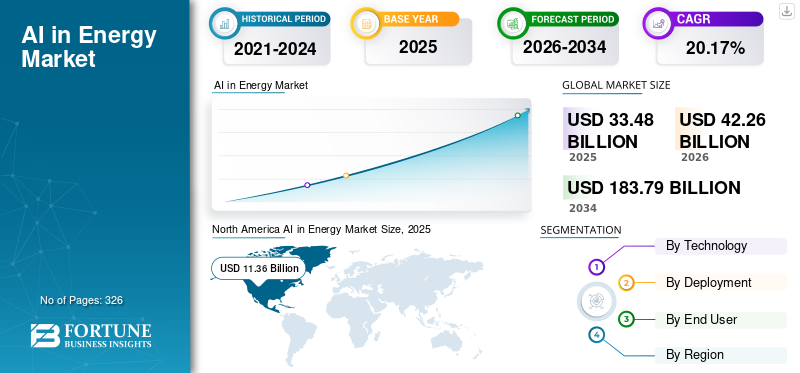
Download Free sample to learn more about this report.
AI in Energy Market Takeaways
 Global Market Size & Forecast
- 2025 Market Size: USD 33.48 billion
- 2026 Market Size: USD 42.26 billion
- 2034 Forecast Market Size: USD 183.79 billion
- CAGR: 20.17% (2026–2034)
 Market Share
- North America dominated the AI in energy market with a 33.93% share in 2025.
- Machine learning & predictive analytics segment led the market with a 45.20% share in 2025.
- Utilities segment accounted for the largest share of 52.24% in 2025.
 Key Regional Highlights
North America
North America dominated the AI in energy market with a valuation of USD 11.36 billion in 2025, supported by strong adoption of smart grids, renewable energy integration, and advanced analytics solutions.
Europe
Europe accounted for USD 8.88 billion in 2025, representing approximately 26.54% of global revenues, driven by investments in renewable energy systems and digital transformation of energy infrastructure.
Asia Pacific
Asia Pacific reached USD 9.45 billion in 2025, accounting for approximately 28.22% of global revenues, supported by increasing smart grid deployments and growing energy demand across emerging economies.
U.S.
The U.S. AI in energy market reached USD 9.95 billion in 2025 and is projected to reach USD 12.53 billion in 2026, driven by grid modernization initiatives and increasing adoption of AI-powered energy management systems.
Japan
The Japan AI in energy market was valued at USD 1.31 billion in 2025 and is expected to reach USD 1.66 billion in 2026, supported by investments in renewable integration, energy efficiency, and advanced automation technologies.
Read More

AI in Energy Market Trends
Growing Adoption of AI-Driven Grid Optimization and Autonomous Energy Management Is a Prominent Market Trend
One of the most significant trends in the market is the increasing adoption of AI-driven grid optimization and autonomous energy management systems. As renewable energy penetration rises globally, electricity grids are becoming more decentralized and complex, requiring advanced forecasting, balancing, and real-time optimization capabilities. Utilities are increasingly deploying AI algorithms to manage Distributed Energy Resources (DERs), battery storage systems, EV charging networks, and demand response programs. For instance, according to the International Energy Agency (IEA), renewable energy is expected to account for over 50% of global electricity generation growth during this decade, significantly increasing grid variability and balancing requirements. This has accelerated investment in AI-enabled smart grids, predictive load forecasting, and automated energy dispatch systems. Utilities and transmission operators are also integrating digital twins and machine learning platforms to improve outage management, reduce transmission losses, and optimize renewable integration, making intelligent and self-optimizing grids a major long-term trend across global energy infrastructure.
AI in Energy Market Dynamics
Market Drivers
Download Free sample to learn more about this report.
Rising Renewable Energy Integration and Grid Modernization Investments to Push Market Growth
The increasing integration of renewable energy sources and growing investments in grid modernization are major drivers of the AI in energy market growth. Solar and wind power generation are inherently intermittent, creating challenges related to grid balancing, forecasting, congestion management, and power quality. AI technologies help utilities optimize generation forecasting, demand response, and real-time power distribution to maintain grid reliability. According to the International Renewable Energy Agency (IRENA), global renewable energy capacity exceeded 4 terawatts in 2023, with solar and wind accounting for the majority of new installations. Simultaneously, governments and utilities globally are investing heavily in smart grids and digital infrastructure to support electrification and decentralized energy systems. AI-powered predictive analytics and optimization platforms are increasingly used to manage transmission networks, battery storage systems, and EV charging infrastructure. The growing complexity of modern power systems is therefore significantly accelerating the adoption of AI solutions across utilities, renewable energy operators, and grid infrastructure providers globally.
Market Restraints
High Implementation Costs and Integration Complexity to Limit Market Growth
High implementation costs and integration complexity remain major restraints for the market, particularly among smaller utilities and emerging economies. Deploying AI solutions in energy infrastructure often requires significant investments in digital sensors, communication networks, cloud platforms, cybersecurity systems, and advanced operational technology integration. Many utilities still operate on legacy infrastructure that was not designed for AI-enabled real-time analytics or automation, making modernization projects both costly and technically challenging. In addition, integrating AI systems with existing Supervisory Control and Data Acquisition (SCADA), energy management systems, and grid control platforms can require long deployment timelines and specialized expertise. According to the World Bank and IEA, many developing regions continue to face underinvestment in grid modernization and digital infrastructure, limiting large-scale AI adoption. Furthermore, utilities handling critical infrastructure remain cautious regarding cybersecurity risks and operational reliability associated with AI deployment, particularly in transmission systems and mission-critical energy operations, slowing implementation across certain regions and markets.
Market Opportunities
Expansion of AI Applications in Energy Storage and EV Infrastructure to Create New Growth Avenues
The rapid expansion of energy storage systems and EV infrastructure presents a major growth opportunity for the market. As renewable energy penetration increases, Battery Energy Storage Systems (BESS) are becoming essential for grid flexibility, peak shaving, renewable integration, and ancillary services. AI technologies are increasingly used for battery degradation analysis, charging optimization, thermal management, and energy arbitrage to maximize storage efficiency and lifecycle performance. Simultaneously, global electric vehicle adoption is creating substantial demand for AI-enabled smart charging and Vehicle-to-Grid (V2G) management systems. According to the International Energy Agency (IEA), global electric vehicle sales surpassed 14 million units in 2023, significantly increasing electricity demand variability and charging infrastructure requirements. AI-driven platforms are helping utilities and charging operators optimize charging schedules, reduce grid congestion, and balance loads in real time. The convergence of storage systems, EV infrastructure, and decentralized energy networks is expected to create substantial long-term opportunities for AI solution providers globally.
Market Challenges
Data Security, Cybersecurity, and Regulatory Compliance Risks to Challenge Market Growth
Data security, cybersecurity, and regulatory compliance remain critical challenges in the market due to the highly sensitive nature of energy infrastructure operations. AI systems increasingly rely on real-time operational data collected from smart grids, substations, industrial assets, and connected devices, making energy networks more exposed to cyber threats and unauthorized access. Utilities and oil & gas operators are particularly concerned about the risks associated with cloud connectivity, remote monitoring systems, and automated control platforms. According to the International Energy Agency (IEA), the digitalization of energy systems is significantly increasing the cyberattack surface across power infrastructure worldwide. In addition, many countries have strict regulations related to critical infrastructure security, data localization, and operational reliability, creating compliance complexities for AI deployment. Ensuring interoperability, maintaining system resilience, and protecting energy assets from cyberattacks while enabling real-time AI-driven automation remains a major operational and regulatory challenge for energy companies globally.
AI in Energy Market Segmentation Analysis
By Technology
Extensive Use in Forecasting Leads to Machine Learning & Predictive Analytics Segment Dominance
Based on technology, the market is segmented into machine learning & predictive analytics, optimization & control algorithms, computer vision & inspection AI, digital twins & simulation AI, and others.
Machine learning & predictive analytics represented a dominant share of 45.20% in 2025. This is due to its extensive use in forecasting, predictive maintenance, anomaly detection, and energy optimization applications. Utilities and renewable energy operators use these technologies to improve grid reliability, forecast energy demand, and optimize renewable energy generation. The growing deployment of smart meters, sensors, and connected infrastructure is generating large volumes of operational data, further supporting adoption. Machine learning also helps reduce equipment downtime and improve operational efficiency across utilities, industrial energy systems, and oil & gas infrastructure.
Digital twins & simulation AI is the fastest growing segment in the market with a CAGR of 21.99% over the forecast period.
To know how our report can help streamline your business, Speak to Analyst
By Deployment
High Scalability and Centralized Data Management to Boost Cloud Segment Growth
Based on deployment, the market is segmented into cloud and on-premise.
Cloud deployment segment held the largest AI in energy market share. This is due to its scalability, centralized data management, and ability to support advanced analytics and real-time monitoring across distributed energy systems. Utilities, renewable energy operators, and energy traders increasingly use cloud-based AI platforms for load forecasting, DER orchestration, predictive maintenance, and energy optimization. The growing adoption of smart grids, Internet of Things (IoT) devices, and connected infrastructure is generating large volumes of operational data that can be efficiently processed through cloud environments. In addition, cloud deployment reduces infrastructure costs, enables remote accessibility, and supports faster AI model updates, making it highly attractive for modern energy management applications.
The on-premise segment is expected to grow at a CAGR of 19.44% during the forecast period.
By End User
Increasing Grid Complexity Due to Renewable Energy Integration to Propel Utilities Segment Growth
Based on end user, the market is segmented into energy storage systems, EV infrastructure, utilities, oil & gas, industrial & commercial energy, and others.
Utilities segment represented the largest share of around 52.24% in the market in 2025. This is due to increasing investments in smart grids, renewable integration, and grid modernization initiatives. AI technologies are widely used for load forecasting, outage management, predictive maintenance, grid optimization, and DER orchestration to improve operational efficiency and grid reliability. The rapid growth of distributed energy resources, battery storage systems, and electrification is making utility networks more complex and data-intensive. As a result, utilities are increasingly adopting AI-driven automation and analytics platforms to support real-time monitoring, intelligent control, and decentralized energy management.
EV infrastructure is the fastest growing segment with a CAGR of 21.83% in the forecast period.
AI in Energy Market Regional Outlook
By geography, the market has been studied across North America, Europe, Asia Pacific, Latin America, and the Middle East & Africa.
North America
North America AI in Energy Market Size, 2025 (USD Billion)
To get more information on the regional analysis of this market, Download Free sample
North America is the dominant region globally with a market valued at USD 11.36 billion in 2025, accounting for approximately 33.93% of the global share. This is due to advanced utility digitalization, strong AI ecosystem maturity, and significant investments in smart grids, renewable integration, and energy storage systems. The region has high adoption of AI technologies across utilities, energy trading, oil & gas operations, and EV infrastructure. The U.S. dominates regional demand with extensive deployment of predictive analytics, grid optimization, and DER management platforms. Growing investments in battery storage, electrification, and AI-driven grid modernization continue to support long-term market expansion across the region.
U.S. AI in Energy Market
The U.S. market reached USD 9.95 billion in 2025 and will reach USD 12.53 billion in 2026. The U.S. is the largest country-level market in the industry due to advanced utility digitalization, large-scale renewable integration, and strong investments in smart grids, battery storage, and EV infrastructure. Utilities and energy companies are widely deploying AI for grid optimization, predictive maintenance, energy trading, and DER management. The presence of major AI technology providers and cloud infrastructure companies further strengthens market growth across the country.
Europe
Europe accounted for USD 8.88 billion in 2025, representing approximately 26.54% of global revenues. Europe is a major market driven by high renewable energy penetration, aggressive decarbonization targets, and strong investments in smart grid modernization. Utilities and grid operators increasingly deploy AI solutions for renewable forecasting, grid balancing, demand response, and energy optimization to manage decentralized electricity networks. Countries such as Germany, the U.K., and France are leading adoption due to advanced power infrastructure and renewable integration complexity. The region also benefits from strong regulatory support for energy efficiency, electrification, and digital energy transformation initiatives.
Germany AI in Energy Market
Germany was valued at USD 1.90 billion in 2025 and is estimated at USD 2.39 billion in 2026. Germany represents the largest market in Europe due to its strong renewable energy transition, industrial base, and grid modernization investments. The increasing complexity of integrating solar and wind power into decentralized electricity networks is accelerating demand for AI-driven grid optimization and energy management solutions. Industrial energy efficiency initiatives and energy storage deployment are also supporting market growth.
U.K. AI in Energy Market
The U.K. market was valued at USD 1.63 billion in 2025 and is predicted to reach USD 2.05 billion in 2026. The market is driven by advanced electricity trading systems, offshore wind expansion, and smart grid modernization initiatives. Utilities increasingly use AI technologies for renewable forecasting, grid balancing, demand response, and virtual power plant management. The country’s highly digitalized power market and strong focus on energy flexibility continue to support rapid AI adoption.
Asia Pacific
Asia Pacific was valued at USD 9.45 billion in 2025, accounting for approximately 28.22% of global revenues. Asia Pacific is the fastest-growing regional market due to rapid urbanization, expanding electricity demand, renewable energy deployment, and large-scale grid modernization programs. China, India, Japan, and Southeast Asia are significantly increasing investments in smart grids, battery storage, EV infrastructure, and industrial energy optimization systems. Utilities across the region are increasingly adopting AI technologies for predictive maintenance, renewable forecasting, and real-time energy management. The rapid expansion of electrification and decentralized energy systems is expected to drive substantial long-term AI adoption across Asia Pacific.
China AI in Energy Market
China remains the dominant contributor, valued at USD 4.33 billion in 2025 and expected to reach USD 5.53 billion in 2026. China is the fastest-scaling market globally due to massive investments in renewable energy, smart grids, battery storage systems, and EV infrastructure. Utilities and energy companies are widely deploying AI technologies for grid optimization, renewable forecasting, battery management, and industrial energy analytics. The country’s large electricity infrastructure and rapid electrification are creating significant long-term growth opportunities for AI-enabled energy solutions.
India AI in Energy Market
India was estimated at USD 1.19 billion in 2025 and will reach USD 1.52 billion in 2026. The market is growing due to rapid renewable energy expansion, smart meter deployment, and increasing electricity demand. Utilities are increasingly adopting AI solutions for load forecasting, grid analytics, predictive maintenance, and distribution management to improve operational efficiency and reduce power losses. Growing investments in smart grids, battery storage, and EV infrastructure are further accelerating AI adoption.
Japan AI in Energy Market
Japan was valued at USD 1.31 billion in 2025 and is expected to reach USD 1.66 billion in 2026. Japan is a technologically advanced market focused on grid resilience, smart infrastructure, and energy efficiency optimization. Utilities and industrial operators are increasingly deploying AI technologies for predictive maintenance, smart building management, and renewable energy integration. The country’s aging energy infrastructure and focus on energy security continue to drive investment in intelligent energy management systems.
Latin America
Latin America accounted for USD 1.60 billion in 2025 and held 4.77% of global revenues. Latin America is witnessing growing adoption of AI in energy solutions due to increasing renewable energy investments, utility modernization, and industrial energy optimization initiatives. Countries such as Brazil, Mexico, and Chile are deploying AI technologies for grid analytics, renewable forecasting, predictive maintenance, and smart energy management. Hydropower optimization and solar and wind integration are key drivers of AI adoption across regional utilities. Although infrastructure modernization remains uneven across countries, rising digitalization and renewable deployment continue to create opportunities for AI-enabled energy solutions in the region.
Middle East & Africa
The Middle East & Africa was valued at USD 2.20 billion in 2025. The region is experiencing increasing AI adoption across utilities, oil & gas operations, and smart infrastructure projects. GCC countries are investing heavily in AI-driven energy optimization, smart grids, renewable energy systems, and autonomous infrastructure as part of broader digital transformation and energy diversification strategies. Oil & gas operators in the region are widely deploying AI technologies for refinery optimization, pipeline monitoring, and predictive maintenance. In Africa, growing investments in distributed energy systems, renewable integration, and grid modernization are gradually supporting the expansion of AI-enabled energy management solutions.
GCC AI in Energy Market
The GCC market was valued at USD 1.29 billion in 2025 and is expected to reach USD 1.61 billion in 2026. The GCC region is emerging as a major market driven by smart city projects, oil & gas digitalization, renewable energy investments, and utility modernization initiatives. Countries such as Saudi Arabia and the UAE are actively deploying AI technologies for refinery optimization, predictive maintenance, smart grids, and energy efficiency management. Large-scale infrastructure projects and national AI strategies continue to accelerate adoption across the regional energy sector.
AI in Energy Market Competitive Landscape
List of Top AI in Energy Companies
High Investment in AI-Enabled Platforms by Key Players Is Boosting Their Market Shares
Leading technology companies in the AI in Energy industry including Siemens AG, Schneider Electric SE, GE Vernova, ABB Ltd., and Honeywell International Inc. are commonly focused on developing AI-enabled platforms for grid optimization, predictive maintenance, industrial automation, and energy management. These companies are investing heavily in machine learning, digital twins, and advanced analytics technologies to improve operational efficiency, reliability, and renewable energy integration across utilities and industrial energy systems. They are also expanding cloud-based and edge AI solutions for real-time monitoring and intelligent control of energy infrastructure. Strategic collaborations with utilities, renewable energy developers, and technology providers, along with investments in smart grids, battery storage optimization, and EV charging management, remain key common initiatives among these market leaders.
- Siemens AG (Germany)
- Schneider Electric SE (France)
- GE Vernova (U.S.)
- ABB Ltd. (Switzerland)
- Honeywell International Inc. (U.S.)
- IBM Corporation (U.S.)
- Microsoft Corporation (U.S.)
- Oracle Corporation (U.S.)
- SAP SE (Germany)
- Hitachi Energy Ltd. (Switzerland)
- Emerson Electric Co. (U.S.)
- C3.ai, Inc. (U.S.)
- AutoGrid Systems, Inc. (U.S.)
- Aspen Technology, Inc. (U.S.)
AI in Energy Market Key Industry Developments
- March 2026: Hitachi, Ltd. launched HMAX Energy™, an AI-powered service and solution suite for critical energy infrastructure, supporting utilities, renewable energy, industrial facilities, and data centers. The strategic objective was to improve asset availability and extend infrastructure life. Capabilities involved included predictive analytics, asset monitoring, AI recommendations, performance simulation, and AI-enabled energy infrastructure management.
- November 2025: IFS announced a strategic partnership with Siemens AG to deliver AI-driven solutions for grid planning, asset management, and field-service optimization across energy and utility infrastructure. The strategic objective was to support autonomous grid operations and digital transformation. Capabilities involved included AI scheduling, asset management, grid planning, field-service optimization, and AI-enabled energy infrastructure management.
- April 2026: Tata Power Company Limited announced enterprise-wide adoption of the Databricks platform to build a data and AI platform across its business clusters, including renewable energy and smart-grid operations. The strategic objective was to accelerate energy-transition initiatives and improve operational decision-making. Capabilities involved included data analytics, machine learning, AI applications, cloud data processing, and AI-enabled energy management.
- May 2026: Siemens AG announced the latest evolution of its Gridscale X® platform, adding AI-powered agentic capabilities for transmission planning and enabling utilities to develop applications on a shared digital foundation. The strategic objective was to improve grid planning speed and scalability. Capabilities involved included agentic AI, transmission modeling, grid analytics, application integration, and AI-enabled energy system planning.
- January 2026: NOV announced a collaboration with AIQ to develop AI-enabled drilling solutions using NOV’s Max™ industrial IoT and edge-computing platform. The strategic objective was to accelerate AI adoption for drilling optimization and operational decision-making. Capabilities involved included industrial IoT, edge computing, AI-driven workflows, real-time data processing, and AI-enabled energy-sector optimization.
- March 2025: Eaton and Siemens Energy signed an agreement to accelerate data center development through modular power systems and grid-independent energy technologies designed to support rising AI-related electricity demand.
- March 2025: Siemens signed a framework agreement with Shanghai Electric to accelerate green digital power grids transformation in China, focusing on AI-enabled grid technologies and intelligent infrastructure modernization.
- February 2025: Schneider Electric announced plans to invest more than USD 700 million in its U.S. operations through 2027 to support AI-driven energy infrastructure, automation, and grid modernization initiatives.
- January 2025: GE Vernova partnered with Chevron and Engine No. 1 to develop up to 4 GW of power solutions for AI-focused data centers, strengthening AI-enabled energy infrastructure deployment in North America.
- July 2024: GE Vernova entered into an agreement with Dragos to integrate AI-based cybersecurity solutions with industrial control and grid management systems for critical energy infrastructure protection.
AI in Energy Market Report Coverage
The report provides a comprehensive analysis of the market, focusing on key aspects such as leading companies, product processes, and Porter’s Five Forces. Additionally, the report provides valuable insights into market trends and highlights key industry developments. In addition to the factors mentioned above, the report also encompasses several factors that contributed to the market's growth in recent years.
Request for Customization to gain extensive market insights.
AI in Energy Market Report Scope & Segmentation
| ATTRIBUTE | DETAILS |
| Study Period | 2021–2034 |
| Base Year | 2025 |
| Estimated Year | 2026 |
| Forecast Period | 2026–2034 |
| Historical Period | 2021–2024 |
| Growth Rate | CAGR of 20.17% (2026–2034) |
| Unit | Value (USD Billion) |
|
Segmentation |
By Technology
|
|
By Deployment
|
|
|
By End User
|
|
|
By Region
|
Frequently Asked Questions
According to Fortune Business Insights, the global market value stood at USD 33.48 billion in 2025 and is projected to reach USD 183.79 billion by 2034.
In 2025, North America’s market value stood at USD 11.36 billion.
The market is expected to exhibit a CAGR of 20.17% during the forecast period of 2026-2034.
By technology, machine learning & predictive analytics segment is expected to lead the market.
Rising renewable energy integration and grid modernization investments are driving market expansion.
Siemens AG, GE Vernova, Schneider Electric SE, ABB Ltd., are the major players in the global market.
North America dominated the market in 2025.



- 2021-2034
- 2025
- 2021-2024
- 326
Get 30-60 hrs Free Customization
Expand Regional and Country Coverage, Segments Analysis, Company Profiles, Competitive Benchmarking, and End-user Insights.



















Related Reports
-
US +1 833 909 2966 ( Toll Free )
-
Get In Touch With Us