AI in Pathology Market Size, Share & Industry Analysis, By Component (Hardware, Software, and Services), By Technology (Machine Learning, Natural Language Processing, and Others), By Application (Disease Diagnostics, Drug Discovery & Development, Clinical Workflow Management, and Others), By Indication (Oncology, Infectious Diseases, Inflammatory & Autoimmune Disorders, Gastrointestinal Diseases, and Others), By End User (Diagnostic Laboratories, Pharmaceutical & Biotechnology Companies, and Others), and Regional Forecast, 2026-2034
 Download Free Sample
KEY MARKET INSIGHTS
 Listen to Audio Version
The global AI in pathology market size was valued at USD 141.6 million in 2025 and is projected to grow from USD 174.0 million in 2026 to USD 1,075.2 million by 2034, exhibiting a CAGR of 25.56% during the forecast period. North America dominated the global market with a share of 48.59% in 2025.
AI in pathology refers to using machine learning for the analysis of pathology data especially most commonly digital whole-slide images of tissue, along with pathology reports, lab results, and sometimes genomics. This is aimed to help with diagnosis, grading, and treatment-related insights. This industry is witnessing a rapid growth owing to factors such as growing adoption of digital infrastructure, increasing integration of AI, and others.
The market encompasses key players such as NVIDIA Corporation, EVIDENT, PathAI, Inc., and Koninklijke Philips N.V. These companies are focusing on technological advancements in their product offerings.
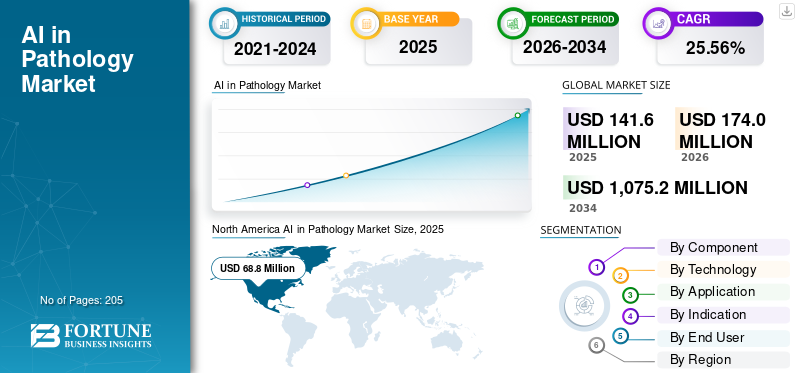
Download Free sample to learn more about this report.
AI in Pathology MARKET KEY TAKEAWAYS
 Market Size & Forecast
- 2025 Market Size: USD 141.6 million
- 2026 Market Size: USD 174.0 million
- 2034 Forecast Market Size: USD 1,075.2 million
- CAGR: 25.56% from 2026–2034
 Market Share
- North America dominated the AI in pathology market with a 48.59% share in 2025.
- The software segment is expected to account for 60.2% of the market in 2025.
- The disease diagnostics segment held a 56.9% market share in 2025.
 Key Regional Highlights
North American
North America reached USD 68.8 million in 2025, driven by high chronic disease burden and strong healthcare infrastructure.
Europe
Europe is projected to grow steadily, driven by supportive regulations and increasing healthcare AI investments.
Asia Pacific
Asia Pacific is projected to reach USD 42.4 million in 2026, supported by rising AI adoption in healthcare and faster diagnostic demand.
U.S.
The market is estimated at USD 77.2 million in 2026, supported by strong adoption of AI-based diagnostic tools and advanced hospital systems.
Japan
The market is estimated at USD 9.4 million in 2026, driven by increasing deployment of AI in clinical pathology workflows.
Read More

AI in PATHOLOGY MARKET TRENDS
Shift Toward Enterprise Platforms and Apps is a Prominent Market Trend
Recently, the market is shifting from single-use AI algorithms to enterprise pathology platforms that can run multiple AI tools across sites, users, and subspecialties. This model reduces integration burden, shorten deployment cycles, and improve user adoption as AI outputs sit inside the daily workflow. These factors are supporting the overall global AI in pathology market growth.
- For instance, in July 2025, Proscia reported rapid scaling of its Concentriq enterprise platform and introduced AI application suites, alongside 100+ LIS integrations including Epic Beaker.
Download Free sample to learn more about this report.
MARKET DYNAMICS
MARKET DRIVERS
Rapid Expansion of Digital Pathology Infrastructure is Boosting Market Growth
The global AI in pathology market is primarily being driven by the rapid expansion of digital pathology such as Whole-Slide Imaging (WSI) infrastructure. WSI adoption also enables remote review, cross-site collaboration, and centralized QA, which increases the operational ROI of adding AI modules on top of digital workflows. Additionally, to capture this growing market demands, operating players are also undertaking various strategies and focusing on regulatory approvals. All these factors drive the market growth.
- For instance, in August 2025, PathAI announced an expansion of its AISight Dx FDA-cleared primary diagnosis labeling to support Roche VENTANA DP 200 and DP 600 whole-slide scanners.
MARKET RESTRAINTS
High Total Cost of Ownership to Hamper Market Growth
High Total Cost of Ownership (TCO) is a key market restraint as AI in pathology typically requires end-to-end digital pathology readiness including scanners/WSI infrastructure, image management, high-performance networks, and IT support before AI can scale. Furthermore, cost sensitivity is higher in emerging markets, where budgets prioritize core lab operations over advanced digital transformation, limiting near-term penetration. This results in limiting the market growth.
- For instance, according to an article published in Virchows Archiv in March 2025, substantial upfront and maintenance costs remain significant barriers, noting high initial investments for scanners, training, and system integration as a major adoption hurdle.
MARKET OPPORTUNITIES
Integration of AI in Workflow Management to Offer Market Growth Opportunities
Integrating AI directly into pathology workflow management offers a major market growth opportunity. Workflow-integrated AI enables triage and prioritization, which helps laboratories manage turnaround time under rising volumes and pathologist shortages. It also supports automated quality control to reduce rescans/rework and improve consistency across multi-site networks. All these factors would drive the market growth over the forecast period.
- For instance, in October 2025, Leica Biosystems launched Aperio HALO AP (AI-powered image management with integrated workflows) and the Aperio AI Store, embedding multiple partner AI analysis applications into a single interface to streamline end-to-end computational pathology workflows.
MARKET CHALLENGES
Workflow Disruption and Adoption Issues Pose a Prominent Challenge to Market Growth
Workflow disruption and adoption friction is a major market challenge as moving from glass-slide review to digital and artificial intelligence often forces labs to redesign daily sign-out routines, case routing, and QA steps. Additionally, integration into LIS/IMS and worklists creates additional friction. Thus, without tight integration, AI becomes an extra step rather than a productivity tool. As a result, early deployments often show a short-term productivity dip and change-management burden before scale benefits appear. All the factors cumulatively affect the market growth.
- For instance, in July 2025, a University Health Network (UHN) team published an open-access paper describing a customized validation protocol for primary digital pathology that emphasizes pathologist-led self-validation, phased rollout with continuous monitoring, and change-management principles to ensure clinicians’ comfort
Segmentation Analysis
By Component
High Number of Software Deployments to Propel Segmental Growth
In terms of component, the market is segregated into hardware, software, and services.
The software segment captured the major global AI in pathology market share. This is the most prevalent and consistently required component, in turn dominating the global market. Additionally, software is the core component that enables case triage, ROI/heatmap visualization, quantitative scoring (IHC/ISH), audit trails, and reporting support in core functions used every day in diagnostic operations.
- For instance, companies such as PathAI, NVIDIA Corporation, and others are some of the leading companies that offer software.
The services segment is projected to rise with a CAGR of 21.90% over the forecast period.
To know how our report can help streamline your business, Speak to Analyst
By Technology
High Usage for Whole Slide Imaging Boosted Machine Learning Segmental Growth
On the basis of technology, the market is divided into machine learning, natural language processing, and others.
The machine learning segment led the global market in 2025. The core input is Whole-Slide Histopathology Images (WSI) where computer vision/deep learning is the most effective approach. This makes it a preferred technology. Additionally, ML scales well in routine lab workflows by generating heatmaps/attention maps that guide pathologists to suspicious areas, improving productivity and consistency. Furthermore, the segment is set to hold 85.0% share in 2026.
- For instance, in December 2025, PathAI announced the U.S. FDA qualified AIM-MASH AI Assist - image-analysis tool for liver biopsies in MASH trials.
The natural language processing segment is anticipated to rise with a CAGR of 31.22% over the forecast period.
By Application
High Usage in Disease Diagnosis Boosted Segmental Growth
In terms of application, the market is segmented into disease diagnostics, drug discovery & development, clinical workflow management, and others.
The disease diagnostics segment captured the highest share of the global market in 2025. This can be attributed to increasing burden of chronic diseases, growing need for rapid disease diagnosis, and increasing number of regulatory approvals for advanced products. Furthermore, the segment is set to hold 56.9% share in 2026.
- For instance, in February 2025, Aiforia announced it obtained IVDR certification and launched three CE-IVD marked AI solutions for breast and prostate cancer diagnostics.
The drug discovery & development segment is set to rise with a CAGR of 28.67% over the projected period.
By Indication
Rising Cancer Burden Supported Oncology Segmental Dominance
Based on indication, the market is segmented into oncology, infectious diseases, inflammatory & autoimmune disorders, gastrointestinal diseases, and others.
The oncology segment is anticipated to capture the largest global AI in pathology market share in 2025. Rising cancer burden results in high tissue-biopsy volumes, making automation and decision support immediately important. Additionally, the segment benefits from stronger regulatory momentum in cancer diagnostics, which reduces adoption friction for pathology labs. Moreover, increasing number of products approvals also supported the market growth. Furthermore, the segment is anticipated to hold 62.3% share in 2026.
- For instance, in February 2025, Ibex Medical Analytics announced it received U.S. FDA 510(k) clearance for Ibex Prostate Detect, an AI-powered in-vitro diagnostic software for prostate cancer detection.
The gastrointestinal diseases segment is projected to rise with a CAGR of 30.08% in the coming years.
By End User
High Patient Admissions in Hospitals Supported Diagnostic Laboratories Maintain Leading Position
In terms of end user, the market is divided into diagnostic laboratories, pharmaceutical & biotechnology companies, and others.
In 2025, the diagnostic laboratories segment held the leading position in the global market. As they handle the highest volume of cases, so even small efficiency gains translate into large savings and faster turnaround times. Additionally, pathologist shortages push labs to adopt AI for triage, workload balancing, and quality control, helping maintain service levels without proportional headcount growth. Furthermore, the segment is projected to hold 62.0% share in 2026.
- For instance, in September 2025, PathAI announced multi-year partnerships with a group of Austrian pathology laboratories to deploy its AISight Dx digital pathology image management system,
In addition, pharmaceutical & biotechnology companies are anticipated to grow at a CAGR of 31.06% during the study period.
AI in Pathology Market Regional Outlook
By geography, the market is segmented into North America, Europe, Asia Pacific, Latin America, and the Middle East & Africa.
North America
North America AI in Pathology Market Size, 2025 (USD Million)
To get more information on the regional analysis of this market, Download Free sample
North America’s market size was USD 57.0 million in 2024 and dominated the global market. The region also maintained its dominance in 2025, with USD 68.8 million. The regional growth can be attributed to high prevalence of chronic diseases creating growing need for rapid diagnosis, well-established healthcare infrastructure, and supportive government policies for AI adoption.
U.S. AI in Pathology Market
The U.S. market held the leading share of the North American market and can be analytically approximated at around USD 77.2 million in 2026, accounting for roughly 44.3% of global market.
Asia Pacific
Asia Pacific’s market size is projected to be valued at USD 42.4 million in 2026 and secure the position of the second largest region in the global industry. This is driven by increasing adoption of artificial intelligence in healthcare, growing focus on rapid disease diagnosis, and other factors.
Japan AI in Pathology Market
Japan’s market in 2026 is estimated at around USD 9.4 million, accounting for roughly 5.4% of global revenues.
China AI in Pathology Market
China’s AI in pathology market is projected to reach revenues of around USD 10.8 million in 2026, representing roughly 6.2% of global sales.
India AI in Pathology Market
The Indian market in 2026 is estimated at around USD 6.0 million, accounting for roughly 3.5% of global revenues.
Europe
Europe’s market size is anticipated to grow at a CAGR of 23.95% in the coming years. The region is anticipated to become the third highest among all regions. European market is majorly driven by widespread adoption of AI technologies in healthcare, supportive regulatory bodies, and increasing investments.
U.K AI in Pathology Market
The U.K. market in 2026 is estimated at around USD 7.0 million, representing roughly 4.0% of global revenues.
Germany AI in Pathology Market
Germany’s market size is projected to reach approximately USD 8.2 million in 2026, equivalent to around 4.7% of global sales.
Latin America and Middle East & Africa
The Latin America and Middle East and Africa regions would grow at a relatively slower over the study period. The Latin America AI in pathology market size is set to reach a valuation of USD 8.0 million in 2026. These regional growth is majorly driven through increasing focus on digital healthcare infrastructure and expanding usage of AI in these regions.
GCC AI in Pathology Market
The GCC market in 2026 is estimated at around USD 2.0 million, accounting for roughly 1.1% of global revenues.
COMPETITIVE LANDSCAPE
Key Industry Players
Focus on Technological Advancements in Product Offerings by Prominent Companies to Fortify Competition in Market
The global AI in pathology market is moderately fragmented. Some of the key players include NVIDIA Corporation, Danaher, Koninklijke Philips N.V., Proscia Inc. and others, accounted for a significant share. These players are focusing on strategic partnerships, and clinical trial collaborations to maintain their market presence.
- For instance, in March 2025, Koninklijke Philips N.V. and Ibex expanded their partnership and announced an updated release of Philips IntelliSite Pathology Solution to deepen interoperability with Ibex AI applications and streamline AI-enabled case workflows.
Other notable players in the AI in pathology market include Aiforia, IBEX, Indica Labs, LLC, and others. These companies are actively involved in the development of innovative platforms for various applications.
LIST OF KEY AI in PATHOLOGY COMPANIES PROFILED IN REPORT
- NVIDIA Corporation (U.S.)
- EVIDENT (Japan)
- PathAI, Inc. (U.S.)
- Koninklijke Philips N.V. (The Netherlands)
- Proscia Inc. (U.S.)
- Aiforia (Finland)
- IBEX (Israel)
- Indica Labs, LLC. (U.S.)
- Mindpeak GmbH (Germany)
- Danaher (U.S.)
KEY INDUSTRY DEVELOPMENTS
- December 2025: Indica Labs’ HALO AP Dx enterprise platform received the U.S. FDA 510(k) clearance in conjunction with Leica Aperio GT 450 DX, supporting SVS + DICOM file formats.
- December 2025: Aiforia announced an expanded AI platform featuring Vision Transformer architecture and a Foundation Engine aimed at faster, more robust model development and deployment.
- November 2025: Lunit and Labcorp announced a collaboration to advance AI-powered digital pathology research.
- June 2025: PathAI and Northwestern Medicine announced a strategic collaboration to deploy the AISight digital pathology platform and co-develop new AI diagnostic
- April 2025: Precision for Medicine and PathAI announced a strategic collaboration to integrate PathAI’s digital pathology and analysis capabilities across Precision’s clinical trial and biospecimen operations.
REPORT COVERAGE
Request for Customization to gain extensive market insights.
Report Scope & Segmentation
|
ATTRIBUTE |
DETAILS |
|
Study Period |
2021-2034 |
|
Base Year |
2025 |
|
Estimated Year |
2026 |
|
Forecast Period |
2026-2034 |
|
Historical Period |
2021-2024 |
|
Growth Rate |
CAGR of 25.56% from 2026-2034 |
|
Unit |
Value (USD Million) |
|
Segmentation |
By Component, Technology, Application, Indication, End User, and Region |
|
By Component |
· Hardware · Software · Services |
|
By Technology |
· Machine Learning · Natural Language Processing · Others |
|
By Application |
· Disease Diagnostics · Drug Discovery & Development · Clinical Workflow Management · Others |
|
By Indication |
· Oncology · Infectious Diseases · Inflammatory & Autoimmune Disorders · Gastrointestinal Diseases · Others |
|
By End User |
· Diagnostic Laboratories · Pharmaceutical & Biotechnology Companies · Others |
|
By Region |
· North America (By Component, Technology, Application, Indication, End User, and Country) o U.S. o Canada · Europe (By Component, Technology, Application, Indication, End User, and Country/Sub-region) o Germany o U.K. o France o Spain o Italy o Scandinavia o Rest of Europe · Asia Pacific (By Component, Technology, Application, Indication, End User, and Country/Sub-region) o China o Japan o India o Australia o Southeast Asia o Rest of Asia Pacific · Latin America (By Component, Technology, Application, Indication, End User, and Country/Sub-region) o Brazil o Mexico o Rest of Latin America · Middle East & Africa (By Component, Technology, Application, Indication, End User, and Country/Sub-region) o GCC o South Africa o Rest of Middle East & Africa |
Frequently Asked Questions
According to Fortune Business Insights, the global market value stood at USD 141.6 million in 2025 and is projected to reach USD 1,075.2 million by 2034.
In 2025, the market value stood at USD 68.8 million.
The market is expected to exhibit a CAGR of 25.56% during the forecast period of 2026-2034.
By component, the software segment is expected to lead the market.
The growing digitization of pathological infrastructure is primarily driving market expansion.
NVIDIA Corporation, EVIDENT, PathAI, Inc., and Koninklijke Philips N.V.are some of the prominent players in the global market.
North America dominated the market in 2025.



- 2021-2034
- 2025
- 2021-2024
- 205
Get 30-60 hrs Free Customization
Expand Regional and Country Coverage, Segments Analysis, Company Profiles, Competitive Benchmarking, and End-user Insights.













.webp)






Related Reports
-
US +1 833 909 2966 ( Toll Free )
-
Get In Touch With Us