North America AI in Healthcare Market Size, Share & Industry Analysis, By Platform (Solutions and Services), By Application (Robot-Assisted Surgery, Virtual Nursing Assistant, Administrative Workflow Assistance, Clinical Trials, Diagnostics, and Others), By End-user (Hospitals & Clinics, Pharmaceutical & Biotechnology Companies, Contract Research Organization (CRO), and Others), and Regional Forecast, 2025-2032
 Download Free Sample
KEY MARKET INSIGHTS
 Listen to Audio Version
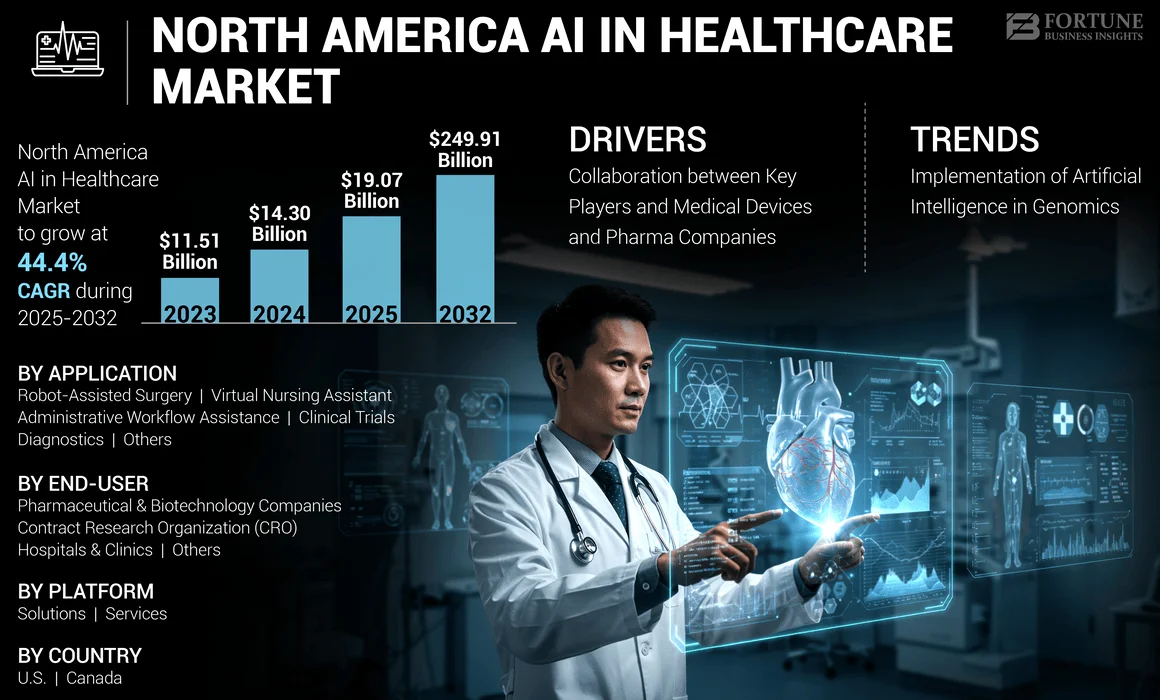
The North America AI in healthcare market size was valued at USD 14.30 billion in 2024. The market is projected to grow from USD 19.07 billion in 2025 to USD 249.91 billion by 2032, exhibiting a CAGR of 44.4% during the forecast period.
AI in healthcare is the integration of Artificial Intelligence (AI) in various healthcare fields. It is used in diagnostics and imaging, drug discovery and development, hospital administration management, patient monitoring, maintaining patient health data, treatment schedules, surgeries, and others. The key companies are offering different services and platforms for integrating AI into the medical devices and also for maintaining day-to-day hospital workflow.
AI technologies, including machine learning (ML), deep learning, natural language processing, and computer vision, are used to enhance diagnostic accuracy, personalize treatment plans, and streamline administrative processes. Furthermore, for patient management, AI offers chatbot virtual assistants, which help improve patient engagement by offering immediate responses to inquiries and appointment scheduling. Also, AI in healthcare assists doctors, nurses, and other healthcare workers to enhance their productivity. This advancement helps patients in treatment and improves their quality of life. Hence, this is driving the adoption of AI in healthcare.
Additionally, with increasing investments and expenditures, there is an expected expansion of AI in the healthcare industry in the fields of medicine, research, innovation, and technology, which is expected to drive the growth of the market. The presence of key players actively involved in strategic activities and product launches further drives the market growth.
- For instance, in September 2024, Medtronic collaborated with Siemens Healthineers with an aim to expand its AiBLE spine surgery ecosystem with robotics, data, AI, imaging, software, and implants.
Key players such as Microsoft Corporation, NVIDIA Corporation, Intel Corporation, and Amazon Web Services Inc. are offering robust solutions for integrating AI into the healthcare sector. Additionally, these companies are strategically collaborating with the major healthcare companies to integrate their AI technology with the company's specialties to obtain better outcomes for both, providers and patients.
MARKET DYNAMICS
MARKET DRIVERS
Rising Collaboration between Key Players and Medical Devices and Pharma Companies to Drive Market Growth
Ongoing collaborations between key players drives the North America AI in healthcare market growth. Formation of joint ventures to develop AI solutions with pharmaceutical companies or medical devices’ companies offers groundbreaking innovations by adding respective strengths to improve the patient outcomes and maintain efficient healthcare systems.
Integration of AI with medical devices has the potential to revolutionize healthcare by enhancing diagnostic accuracy, facilitating personalized treatment strategies, and enabling continuous real-time patient monitoring. This advancement not only improves patient outcomes but also streamlines the clinical workflows. It empowers healthcare professionals with data-driven insights, leading to more effective healthcare delivery.
- For instance, in December 2024, Siemens Healthineers and DeepHealth, Inc. announced a strategic partnership to enhance ultrasound operations by integrating AI-powered health informatics into workflows and imaging hardware.
- In addition, in November 2024, Koninklijke Philips N.V. collaborated with Amazon Web Services (AWS) to offer an integrated diagnostics portfolio in the cloud, including radiology, digital pathology, cardiology, and AI advanced visualization solutions. The collaboration aims to enhance diagnostic workflows, improve access to critical insights, and provide better outcomes across clinical specialties.
Such collaborative activities drive the North America AI in healthcare market growth.
MARKET RESTRAINTS
Concerns Related to Data Breaches are Leading to Disrupt the Market Growth
One of the factors that hampers AI in the healthcare market is data privacy issues. Data breaches refer to the unauthorized access, disclosure, or theft of sensitive personal and medical information collected and stored as part of the research. The breaching occurs through various means, including cyber-attacks, insider threats, and accidental exposure of data, which leads to a decrease in patients' trust in the processes. Furthermore, the rising number of cybercrimes and stealing of healthcare data lead to mistrust between patients and providers and thus, leads to hinder in market growth.
- In January 2025, Community Health Center, Inc. (CHC) announced that they had suffered a massive data breach, affecting over 1.0 million individuals across the U.S. The data comprises patients' personal information, diagnoses, treatment details, test results, and health insurance information.
Such factors are restraining the use of artificial intelligence technology by healthcare providers and hampering the growth of the market.
MARKET OPPORTUNITIES
Increasing Adoption of AI in Predictive Analytics for Extensive Growth Opportunities
The rising number of chronic diseases leads to increased demand for predictive analysis for more accurate forecasting of patient outcomes and disease trends. The AI algorithms can analyze vast datasets and identify patterns and correlations that human analysts might miss, leading to more informed decision-making. This technology allows healthcare providers to anticipate the likelihood of illness by examining a range of data points, including a patient’s birthplace, work environment, lifestyle choices, and local environmental conditions.
By analyzing this information, healthcare professionals can evaluate a patient's risk for chronic diseases and implement preventive measures. Also, this technology facilitates personalized treatment plans, anticipates potential health issues, and offers preventive care strategies, ultimately reducing healthcare costs. Furthermore, increasing launches of AI-powered tools for predictive analysis by key players will boost the growth of the market.
- For instance, in May 2024, ConcertAI launched CARA AI; it is a multi-modal data management, predictive AI, and generative AI platform used to enhance research capabilities and support complex study workflows in clinical oncology.
MARKET CHALLENGES
Lack of Curated Healthcare Data and Skilled AI Professionals to Challenge Market Growth
The fragmented, inconsistent, and unstructured nature of healthcare data presents significant challenges to market growth in the field of AI. Effective AI algorithms necessitate high-quality, curated datasets for training and validation. Yet, the presence of varying data formats, incomplete records, and difficulties in integrating information from diverse sources complicate this process.
Moreover, the rapid advancement of AI technologies often outpaces the ability of educational institutions to adapt, resulting in a shortage of specialized graduate programs focused on AI applications in healthcare. This educational gap contributes to a deficiency of skilled professionals who can proficiently implement and leverage AI tools within healthcare organizations. Collectively, these factors create significant obstacles to market growth as the healthcare industry struggles to harness the full potential of AI technologies.
OTHER CHALLENGES
Resistance from Traditional Practitioners to Adopt AI Challenges Market Growth Prospects
Many healthcare professionals are hesitant to adopt AI technologies due to a lack of understanding, fear of job displacement, or distrust regarding the accuracy and reliability of AI-driven tools. Additionally, a lack of confidence in handling tech-based tools is also a challenging factor in practitioners' adoption of AI. Thus, extensive education, training, & demonstration of AI's benefits must be done to ensure that practitioners have confidence in technologies.
NORTH AMERICA AI IN HEALTHCARE MARKET TRENDS
Rising Implementation of Artificial Intelligence in Genomics is a Prominent Trend in Healthcare Industry
In recent years, artificial intelligence has rapidly transformed the healthcare industry in the field of genomics by enhancing the analysis and interpretation of vast genomic data. AI algorithms can process and analyze complex genetic information at unprecedented speeds, identifying patterns that may elude human researchers. Moreover, AI-driven tools improve the accuracy of genomic sequencing and reduce costs, making genomic testing more accessible. As a result, healthcare providers can offer targeted therapies and preventive measures, ultimately leading to better patient outcomes.
Moreover, AI enhances gene editing tools, improving their precision, efficiency, and scalability for genomic modifications. Also, increasing collaboration between key AI providers and medical device companies to offer integrated platforms for genomic studies is a prominent trend in the market.
- For instance, in January 2025, NVIDIA Corporation collaborated with Illumina, Inc. with an aim to improve clinical research, genomics AI development, and drug discovery by integrating AI advancements with large-scale multiomics data analysis. By combining Illumina's sequencing technology and informatics tools with NVIDIA's AI capabilities, the partnership seeks to expedite drug discovery and clinical development, providing pharmaceutical companies with innovative tools to identify improved drug targets. Such partnerships boost the adoption of AI in genomics.
Download Free sample to learn more about this report.
IMPACT OF COVID-19
The COVID-19 pandemic positively impacted the North America AI in healthcare market during the analysis period. This is attributed to the significant acceleration in the demand for AI-based tools and solutions in healthcare to tackle challenges in pandemic management. Additionally, the use of AI in early diagnosis and detection of viruses during the COVID-19 pandemic supported the increased use of AI-based tools in hospitals.
Moreover, increasing research and development initiatives and the demand for assistance in maintaining the healthcare workload, emphasizes market growth during 2025-2032.
SEGMENTATION ANALYSIS
By Platform
Product Launches for Improving Efficiency Contributed to Dominance of Solutions Segment in 2024
Based on platform, the market is divided into services and solutions.
The solutions segment held the highest North America AI in healthcare market share in 2024. The dominant share of the segment is augmented by the increasing demand for advanced healthcare solutions by healthcare providers to enhance operational efficiency and improve patient outcomes. AI solutions help automate repetitive tasks, assist in clinical decision-making, and analyze vast amounts of data quickly, making them highly valuable.
Additionally, the increasing demand for AI solutions for diagnostic tools, predictive analytics, personalized medicine, and patient management systems is aimed at propelling the demand for AI solutions in healthcare. Furthermore, the increasing product launches by the key technology companies for healthcare process enhancement and offering support to the healthcare providers is anticipated to boost the growth of the segment.
- For instance, in July 2023, Amazon Web Services, Inc. launched AWS HealthScribe. It is a healthcare software that automatically creates robust transcripts, extracts key details, and creates summaries from doctor-patient discussions that can then be entered into an Electronic Health Record (EHR) system.
- This solution helps physicians focus more on patients than maintaining records, making it easier for physicians to review clinical notes before entering them into the EHR.
The services segment is expected to grow with a moderate CAGR during 2025-2032. Healthcare organizations adopt AI solutions and services to help with the implementation and integration of these technologies into existing systems. Services help customize solutions to meet specific organizational needs. Thus, the services that offer customization and scalability of AI solutions are in high demand. This makes the adoption of AI possible for healthcare providers. Such scenarios aim to propel the growth of the segment during the forecast timeframe.
To know how our report can help streamline your business, Speak to Analyst
By Application
Launch of New Platforms for Robotic-Assisted Surgeries Boosts Segment Growth
Based on application, the market is divided into robot-assisted surgery, virtual nursing assistant, administrative workflow assistance, clinical trials, diagnostics, and others.
The robot-assisted surgery segment held the highest market share and dominated the market in 2024 due to an upsurge in technological advancements in the segment. The rising prevalence of chronic diseases and increasing demand for minimally invasive surgery options for quick recovery of patients has majorly driven the segmental growth. Additionally, the incorporation of AI in robotic-assisted surgery has elevated surgical precision, efficiency, and accessibility. Moreover, the surgeries are performed using computer-controlled robotic arms, which enhances agility and visualization and reduces the surgeons’ fatigue compared to the conventional methods. Such advancements and benefits associated with AI-enabled robotic surgeries boosts the segment’s growth.
Furthermore, various AI-enabled platforms are being developed by the leading medical device players to offer innovative AI-based robotic surgery and better patient outcomes.
- In April 2024, Medtronic launched a Live Stream function for the Touch Surgery ecosystem of digital technologies. These novel AI algorithms are used for post-operative analysis, providing AI surgical insights across laparoscopic and robotic-assisted surgery. Such advancements in robotic surgery with AI integration promote market growth.
Furthermore, the diagnostics segment is expected to grow with significant CAGR during the forecast period. The growth of the segment is augmented by increasing demand for accurate diagnosis and imaging in less turn-around time. The incorporation of AI in diagnosis and imaging offers surgeons real-time support and helps in early disease detection, diagnosis, and personalized treatment planning. Such scenarios dominated the adoption of AI in healthcare diagnostics and boosted the segment’s growth.
Additionally, there is a shift of focus to AI in medical imaging for different disease areas to obtain effective data to improve patient outcomes and revolutionize medical practices.
- For instance, in September 2024, Overjet announced the U.S. FDA clearance for AI-powered image enhancement. This technology enables Overjet to automatically improve the quality of blurry or noisy X-rays without losing important clinical details so that dentists can diagnose oral diseases with greater confidence.
Moreover, virtual nursing assistant's administrative workflow assistance held a substantial share of the market. The growth of the segment is amplified by increasing demand for remote patient monitoring, scheduling the patient flow, managing human resources, and insurance claims. Thus, AI assists in maintaining these day-to-day tasks in hospitals and reduces the workload of professionals. Additionally, increasing collaboration among the key players offers platforms for administrative work to boost the segment’s growth.
- For instance, in September 2024, Oracle, in partnership with Amazon Web Services, Inc., announced the launch of Oracle Database@AWS to offer customers simplified database administration, billing, and unified customer support.
The clinical trials and other segments are expected to grow considerably during the forecast period. AI helps in drug discovery, development, and managing patients' records in clinical stages. Moreover, many key players are collaborating to offer advanced platforms for clinical research and drug discovery to propel the segment’s growth.
- For instance, in March 2024, Microsoft Corporation collaborated with NVIDIA Corporation to leverage generative AI, cloud computing, and advanced technology in healthcare. Combining Microsoft Corporation Azure's global scale and security with NVIDIA DGX Cloud and the Clara suite aim to enhance clinical research, drug discovery, medical imaging, and precision medicine, ultimately improving patient care.
By End-user
Incorporation of AI in Managing Patients and Enhance Diagnosis & Treatment led to Hospitals & Clinics Segment’s Dominance
On the basis of end-user, the market is segmented into hospitals & clinics, pharmaceutical & biotechnology companies, Contract Research Organization (CRO), and others.
The hospitals & clinics segment held the maximum share of the market in 2024. The dominant share of the segment is augmented by an increasing number of patients for diagnostics, treatment, and surgeries in these settings, leading to an increasing workload for healthcare providers. Thus, the demand increases for the adoption of AI in these settings.
Additionally, the increasing adoption of AI by hospitals and clinics for better patient outcomes to boost segment growth.
- For instance, in June 2024, University Hospitals (UH), Cleveland, launched Aidoc's aiOS platform across 13 hospitals and multiple outpatient locations, enhancing its AI strategy to improve patient care. This technology aims to enhance the diagnosis and treatment of critical conditions such as pulmonary embolism and aortic dissection. By analyzing CT scans for both expected and unexpected findings, Aidoc's AI helps prioritize urgent cases, ensuring timely review by medical teams and fostering better communication among care providers.
The pharmaceutical & biotechnology companies segment holds a substantial share of the market. The increasing integration of AI in medical devices, drug discovery and development, and maintaining records is anticipated to boost the segment growth. AI in healthcare not only helps in gene sequencing work but also predicts the drug efficacy and safety of pharmaceutical products. Additionally, the growing number of collaborations of different players in the market is driving the growth of this segment.
- For example, in May 2024, Sanofi collaborated with Formation Bio and OpenAI with the aim of developing AI-powered software and accelerating drug development to bring new medicines to patients more efficiently. Such collaborations aim to propel the growth of the segment.
Furthermore, the CRO and other segments are expected to grow during the forecast period. Increasing clinical studies and rising demand for AI in diagnostic laboratories and academic research institutes boost the adoption of AI solutions would propel the growth of the segments.
NORTH AMERICA AI IN HEALTHCARE MARKET REGIONAL OUTLOOK
By country, the North American market is divided into the U.S. and Canada.
U.S.
The U.S. dominated the North American market in 2024. The presence of advanced healthcare facilities and skilled professionals in the country has strongly propelled the market growth in the country. Emphasis on adopting advanced technologies to reduce the workload is a prominent reason for the increased adoption of AI-based medical devices, hospital management solutions, and others.
- For instance, in July 2024, GE HealthCare partnered with Amazon Web Services, Inc. to build foundation models and generative Artificial Intelligence (AI) applications with an aim to improve medical diagnostics and patient care.
Additionally, the country has the presence of key pharma and biotech companies with robust investment and expenditure on research and development, which is expected to drive market growth in the region. Also, the increase in the number of Machine Learning (ML) based clinical trials, which gives results with higher accuracy with reduced study period interval, is likely to contribute to the growth of the country in the region.
Canada
On the other hand, Canada is expected to grow significantly during the forecast period. The increasing adoption of AI-based solutions in hospitals, laboratories, and others. Additionally, the presence of key players with strategic activities and robust regulatory guidelines for incorporation of AI in medical devices and drug development boosts the country’s growth in the market.
- For instance, in April 2024, WELL Health Technologies Corp. collaborated with Microsoft Corporation to optimize digital healthcare in Canada with Microsoft Corporation Cloud and AI capabilities.
COMPETITIVE LANDSCAPE
KEY INDUSTRY PLAYERS
Strategic Activities, Product Launches, and Robust Product Portfolio to Help Companies Maintain Key Positions
The North American market comprises key players such as Amazon Web Services, Inc., Microsoft Corporation, NVIDIA Corporation, and Google (Alphabet Inc.), which held a substantial market share in 2024. Prominent market players are employing strategies such as mergers and acquisitions, new product launches, and technological innovations to bolster their standing.
- For example, in March 2022, Microsoft Corporation unveiled technological enhancements in its healthcare cloud, including access to Azure HealthData services. The updates featured improved health bot templates, enhanced clinical workflow integration, and new patient insight capabilities.
Other notable companies actively operating in the North American market include Hewlett Packard Enterprise Company, Intel Corporation, Siemens AG, and GE HealthCare. These firms are anticipated to concentrate on launching new products and forming collaborations to expand their market share throughout the forecast period.
LIST OF KEY AI IN HEALTHCARE COMPANIES IN NORTH AMERICA
- Amazon Web Services, Inc. (U.S.)
- Microsoft Corporation (U.S.)
- NVIDIA Corporation (U.S.)
- Google (Alphabet Inc.) (U.S.)
- Hewlett Packard Enterprise Company (U.S.)
- Intel Corporation (U.S.)
- Siemens Healthineers AG (Germany)
- GE HealthCare (U.S.)
- Veradigm LLC (U.S.)
- UnitedHealth Group (Optum Inc.) (U.S.)
KEY INDUSTRY DEVELOPMENTS
- January 2025 – Intelerad partnered with CARPL.ai with the aim of adopting the company’s FDA-cleared AI platform to improve radiologists' workflow efficiency, increase diagnostic accuracy, and enhance patient care.
- August 2024 – Accenture collaborated with Amazon Web Services, Inc. to create an Accenture Responsible Artificial Intelligence (AI) Platform powered by AWS with an aim to adopt and scale AI rapidly with trust and confidence throughout their enterprise.
- March 2024 – Johnson & Johnson Services, Inc. partnered with NVIDIA Corporation to accelerate and scale Artificial Intelligence (AI) for surgery and form a digital surgery ecosystem.
- October 2023 – Microsoft Corporation launched new data and AI solutions for healthcare organizations at the HLTH 2023 conference.
- April 2023 – Microsoft Corporation collaborated with Epic to develop generative AI in healthcare by combining Azure OpenAI Service with Epic’s Electronic Health Record (EHR) software.
REPORT COVERAGE
The North America AI in healthcare market research report provides detailed analysis and focuses on key aspects such as an overview of the technological advancements, regulatory scenario for key countries, and challenges faced for the adoption and implementation of AI-based solutions. Additionally, it includes key industry developments, such as mergers, partnerships, acquisitions, and an overview of the application of AI in hospitals and clinics. Furthermore, the report comprises a segmental analysis and the impact of COVID-19 on the market.
Request for Customization to gain extensive market insights.
Report Scope & Segmentation
|
ATTRIBUTE |
DETAILS |
|
Study Period |
2019-2032 |
|
Base Year |
2024 |
|
Estimated Year |
2025 |
|
Forecast Period |
2025-2032 |
|
Historical Period |
2019-2023 |
|
Growth Rate |
CAGR of 44.4% from 2025-2032 |
|
Unit |
Value (USD Billion) |
|
Segmentation |
By Platform
|
|
By Application
|
|
|
By End-user
|
|
|
By Country
|
Frequently Asked Questions
Fortune Business Insights says that the market size was at USD 14.30 billion in 2024 and is projected to reach USD 249.91 billion by 2032.
Registering a CAGR of 44.4%, the market will exhibit rapid growth over the forecast period (2025-2032).
By platform, the solutions segment leads the market.
Rising collaboration and product launches by key players in healthcare AI are driving the market.
Amazon Web Services, Inc., Microsoft Corporation Corporation, NVIDIA Corporation, and Google (Alphabet Inc.) are major players in the North America market.
The U.S. dominated the market in terms of shares in 2024.
Advancements in medicine, research, innovation, and technology are the factors expected to drive the product adoption.



- 2019-2032
- 2024
- 2019-2023
- 65
Get 30-60 hrs Free Customization
Expand Regional and Country Coverage, Segments Analysis, Company Profiles, Competitive Benchmarking, and End-user Insights.













.webp)






Related Reports
-
US +1 833 909 2966 ( Toll Free )
-
Get In Touch With Us