AI in Patient Management Market Size, Share & Industry Analysis, By Component (Software/Platforms and Services), By Deployment (Cloud-based, On-Premise, and Hybrid), By Technology (Machine Learning & Deep Learning, NLP/Generative AI, and Others), By Application (Patient Access & Intake, Care Coordination & Navigation, Remote Patient Management & Monitoring, Risk Stratification & Population Management, and Others), By End User (Hospitals & Health Systems, Ambulatory/Outpatient Centers, Home Care Providers, Healthcare Payers, and Others), and Regional Forecast, 2026-2034
 Download Free Sample
AI in Patient Management Market Size and Future Outlook
 Listen to Audio Version
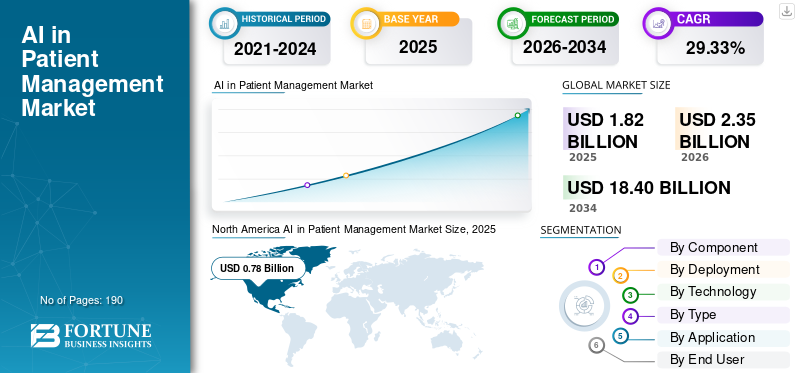
The global AI in patient management market size was valued at USD 1.82 billion in 2025. The market is projected to grow from USD 2.35 billion in 2026 to USD 18.40 billion by 2034, exhibiting a CAGR of 29.33% during the forecast period. North America dominated the AI in patient management market with a market share of 42.86% in 2025.
The global market represents AI-enabled care coordination platforms, remote patient monitoring tools, patient engagement solutions, virtual health assistants, predictive risk analytics, and workflow automation systems, among other tools. The market is growing to combat global clinician burnout, improve operational efficiency, and shift from reactive to proactive, personalized care. These solutions help healthcare providers manage higher patient volumes, rising chronic disease cases, and growing pressure to deliver continuous care outside traditional hospital settings. As a result, AI is being used to identify high-risk patients, automate patient communication, improve care coordination, support timely interventions, and reduce the administrative burden on care teams, prompting strategic collaborations among key players.
- For instance, in May 2025, Viz.ai collaborated with Sanofi and Regeneron to deploy and evaluate an AI-powered workflow solution to improve the management and care of high-risk COPD patients. The collaboration highlighted how AI-based care coordination platforms are being used to support chronic disease management and improve patient follow-up.
Major players, such as Epic Systems Corporation, Oracle Corporation, Microsoft Corporation, and Salesforce, Inc., are actively pursuing strategic collaborations & acquisitions, investment initiatives to expand their offerings, enhance market access, and strengthen their market presence.
Download Free sample to learn more about this report.
AI in Patient Management Market Key Takeaways
 Global Market Size & Forecast
- 2025 Market Size: USD 1.82 billion
- 2026 Market Size: USD 2.35 billion
- 2034 Forecast Market Size: USD 18.40 billion
- CAGR: 29.33% from 2026–2034
 Market Share
- North America dominated the market with a 42.86% share, valued at USD 0.78 billion in 2025.
- Software/platforms segment held the largest market share in 2025.
- Care coordination & navigation segment held the largest market share in 2025.
 Key Regional Highlights
North America
The market reached USD 0.78 billion in 2025, driven by strong EHR adoption and AI implementation.
Asia Pacific
The market is projected to reach USD 0.59 billion by 2026, supported by expanding digital healthcare infrastructure.
Europe
The market is projected to reach USD 0.58 billion by 2026, driven by digital health investments and integrated care adoption.
U.S.
The market is projected to reach USD 0.92 billion by 2026, supported by widespread AI adoption in healthcare.
Japan
The market is projected to reach USD 0.12 billion by 2026, driven by growing digital healthcare adoption.
Read More

AI IN PATIENT MANAGEMENT MARKET TRENDS
Rising Use of Predictive Analytics to Enable Early Risk Identification is an Emerging Trend
A global market trend is the increasing adoption of predictive analytics. Healthcare providers are shifting from reactive patient care to proactive intervention. Hospitals and care teams are increasingly using AI tools to analyze patient records, vitals, utilization patterns, and remote monitoring data to identify patients who may be at higher risk of deterioration, readmission, falls, or emergency visits. These factors help clinicians prioritize attention to vulnerable patients before their condition worsens, improving care planning and reducing avoidable hospital use. As a result, predictive analytics is becoming a crucial part of patient management platforms, encouraging new product launches by major players.
- For instance, in January 2025, Press Ganey expanded its AI capabilities for patient safety and patient experience, including AI-powered predictive rounding. These innovative capabilities are designed to help healthcare leaders anticipate challenges, take proactive action, and improve patient and employee safety and experience.
MARKET DYNAMICS
MARKET DRIVERS
Download Free sample to learn more about this report.
Rapid Adoption of AI-enabled Care Management Due to Growing Patient Volumes Boosts Market Growth
The global market is growing as healthcare providers are managing more patients across hospitals, outpatient centers, urgent care networks, and home-based care settings. As patient volumes increase, manual care coordination, scheduling, follow-ups, documentation, and risk monitoring become difficult for already stretched clinical and administrative teams. These factors elevate global AI demand in the patient management market for automating routine workflows, identifying high-risk patients, enabling faster patient access, and improving communication between patients and care teams. As a result, healthcare organizations are adopting AI-based patient management solutions to improve operational efficiency, reduce care delays, and maintain quality of care while serving a larger patient base.
- For instance, in March 2025, Notable partnered with CityMD to deploy its AI and automation technology across more than 180 urgent care locations. The urgent care volumes had increased by 60% since 2019, and the partnership aimed to improve patient access and operational workflows through AI-enabled automation.
MARKET RESTRAINTS
Limited Clinical Validation and Low Trust in AI Recommendations to Restrain Market Growth
A key factor restraining the global AI in patient management market growth is limited clinical validation and lower trust in AI-generated recommendations. Patient management tools often support risk prediction, care prioritization, triage, follow-up planning, and clinical workflow decisions. Hence, hospitals need strong evidence that these tools work safely across different patient groups and care settings. If AI models are not properly validated, clinicians may hesitate to depend on their alerts or recommendations, as inaccurate outputs can affect patient safety, care quality, and clinical accountability. These factors slow purchasing decisions and make providers more cautious about large-scale AI deployment, especially in workflows directly connected to patient care.
- For instance, in August 2024, a Nature Medicine article noted that not all FDA-authorized AI health tools are clinically validated and warned that devices lacking adequate clinical validation may pose risks to patient care. The article pointed to the need for stronger validation standards before healthcare organizations can fully rely on AI tools in clinical practice.
MARKET OPPORTUNITIES
Expansion of AI-enabled Remote Patient Monitoring to Create Growth Opportunities
One of the prominent factors driving the market growth is the expansion of AI-enabled remote patient monitoring. As hospitals and care providers manage more patients outside traditional care settings, there is a rising need for tools that can continuously track patient vitals, symptoms, and recovery progress from home. AI-enabled remote monitoring converts real-time patient data into actionable alerts, risk scores, and care recommendations, enabling clinicians to identify early signs of deterioration and intervene before complications escalate. This improves chronic disease management, post-discharge care, elderly care, and home-based recovery, while also reducing unnecessary hospital visits and easing pressure on clinical teams.
Key players in the market are streamlining their resources toward expansion and strategic collaborations to improve their remote monitoring capabilities.
- For instance, in 2025, Koninklijke Philips N.V. collaborated with Mass General Brigham to improve patient care using live AI-powered insights. The collaboration is intended to help clinicians capture, analyze, and respond to patient data as it becomes available, supporting more timely and efficient patient care.
MARKET CHALLENGES
Lack of Seamless EHR Integration to Challenge Scalability of AI Patient Management Software
The global market faces a major challenge from limited integration between AI platforms and existing EHR systems. Patient management solutions need continuous access to patient records, lab results, medication history, treatment plans, remote monitoring inputs, and follow-up data to generate useful alerts and recommendations. However, many healthcare systems still operate with fragmented data sources, information silos, and inconsistent interoperability standards, which makes it difficult for AI tools to work smoothly across hospitals, clinics, payers, and home-care settings. As a result, providers may face duplicate data entry, workflow disruption, incomplete patient views, and slower implementation, which can reduce clinician adoption and delay large-scale deployment of AI-based patient management solutions.
- For instance, in December 2024, JMIR Publications published an article titled ‘Digital Information Ecosystems in Modern Care Coordination and Patient Care Pathways and the Challenges and Opportunities for AI Solutions’ highlighted that modern care coordination still faces interoperability issues, information silos, hard-to-map patient care journeys, increased workload on healthcare professionals, coordination gaps, and privacy compliance challenges.
Segmentation Analysis
By Component
Software Platforms Dominate Due to Their Wider Use across Clinical and Administrative Workflows
Based on the component, the market is categorized into software/platforms and services.
The software/platforms segment dominates the market, as most AI-enabled patient management functions are delivered through digital platforms. Hospitals and health systems need platforms that can combine patient data, automate scheduling, support care coordination, generate alerts, manage outreach, and improve patient engagement from one interface. As these platforms can be integrated with EHRs, patient portals, call centers, and remote monitoring tools, they offer broader use across clinical and administrative workflows. This makes software/platforms the primary revenue-generating component, while services mainly support implementation, training, and integration. Underscoring these advantages, key companies are also directing their resources toward new product launches in the segment.
- For instance, in May 2025, Innovaccer launched Innovaccer Gravity, a healthcare intelligence platform designed to accelerate AI-driven transformation for health systems by turning fragmented healthcare data into proactive and coordinated actions.
The services segment is expected to grow at a CAGR of 23.99% over the forecast period.
To know how our report can help streamline your business, Speak to Analyst
By Deployment
Cloud-based Segment Led Market Due to Scalability and Faster AI Adoption
Based on deployment, the market is segmented into cloud-based, on-premise, and hybrid.
In 2025, the cloud-based segment dominated the global market. Healthcare organizations need flexible, scalable, and faster-to-deploy AI solutions across multiple care sites. Cloud platforms enable hospitals, outpatient networks, and home-care teams to access patient management tools without the heavy on-premises infrastructure investment. They also support real-time data sharing, remote updates, centralized analytics, and easier integration with patient engagement and monitoring tools. Collaboration among key companies in developing cloud-deployed solutions is supporting segmental growth.
- For instance, in May 2025, Oracle, the Cleveland Clinic, and G42 announced a strategic partnership to develop an AI-based healthcare delivery platform. The initiative aimed to improve patient care and public health management by leveraging AI, nation-scale data analytics, and intelligent clinical applications to create secure, scalable, and accessible care models that positively impact people’s health and longevity.
The hybrid segment is projected to grow at a 27.67% CAGR during the forecast period.
By Technology
Machine Learning & Deep Learning Segment Led Due to Strong Use in Risk Prediction and Workflow Intelligence
Based on technology, the market is segmented into machine learning & deep learning, NLP/generative AI, and others.
The machine learning and deep learning segment accounted for the leading market share in 2025. Patient management depends heavily on pattern recognition, risk scoring, patient prioritization, and predictive insights. These AI technologies help analyze EHR data, patient history, vitals, claims data, and remote monitoring inputs to identify high-risk patients and support timely care decisions. These machine learning models can continuously improve as more patient data becomes available, making them useful for chronic disease management, care coordination, readmission risk reduction, and population health programs. As a result, providers prefer ML- and deep learning-based solutions for more proactive, personalized patient management.
- For instance, in February 2025, Koninklijke Philips N.V. and Mass General Brigham (MGB) collaborated to develop and deploy an advanced data infrastructure and AI to integrate and process live healthcare data from a wide range of sources, improving patient care.
The NLP/generative AI segment is projected to grow at a CAGR of 33.29% during the forecast period.
By Type
Standalone Segment Leads Due to Faster Deployment for Specific Patient Management Needs
Based on the type, the market is segmented into standalone and integrated.
The standalone segment dominates the AI in patient management market share as many healthcare providers adopt AI first for focused patient management use cases such as patient access, appointment scheduling, intake automation, care navigation, contact center support, and discharge follow-ups. These solutions are easier to deploy than fully integrated enterprise systems and can deliver measurable workflow improvements within specific departments or care pathways. This makes them attractive to hospitals and urgent care networks seeking to reduce waiting times, automate repetitive tasks, and improve patient communication without replacing their core EHR systems. Over time, these standalone tools may integrate more deeply, but their faster implementation supports current market dominance.
- For instance, in November 2025, DeepHealth expanded its portfolio with the launch of next-generation imaging informatics and clinical AI solutions. These new offerings included major enhancements across its portfolio, spanning disease detection, assessment, and monitoring; remote scanning; image management and interpretation; center operations; and AI orchestration—all designed to transform the imaging experience and advance population health.
The integrated segment is projected to grow at a CAGR of 33.36% during the forecast period.
By Application
Care Coordination & Navigation Dominated as Providers Focus on Seamless Patient Journeys
Based on application, the market is segmented into patient access & intake, appointment & follow-up management, care coordination & navigation, patient flow & bed/capacity management, remote patient management & monitoring, risk stratification & population management, and others.
In 2025, the care coordination & navigation segment dominated the market as healthcare systems are under pressure to manage patients across multiple settings, including hospitals, outpatient clinics, specialists, virtual care, and home-based care. Patients often face delays due to fragmented communication, missed follow-ups, referral gaps, and unclear care pathways. AI-enabled care coordination platforms help match patients with the right care, automate reminders, route tasks to care teams, and identify next-best actions. As a result, these solutions directly support better patient flow, stronger engagement, and lower care gaps, making care coordination and navigation a leading use case in the market.
- For instance, in March 2025, Clutch and Care Continuity announced a strategic partnership to combine an AI-driven retention and loyalty platform with patient navigation and care coordination solutions to improve patient engagement and care delivery.
The remote patient management & monitoring segment is projected to grow at a CAGR of 32.29% over the forecast period.
By End User
Hospitals & Health Systems Led Due to High Patient Load and Complex Care Operations
Based on end user, the market is segmented into hospitals & health systems, ambulatory/outpatient centers, home care providers, healthcare payers, and others.
In 2025, hospitals & health systems dominated the market as they manage the highest patient volumes, complex care pathways, multiple departments, and large administrative workloads. These organizations need AI tools to support patient access, clinical prioritization, care team coordination, bed and patient flow, remote monitoring, and post-discharge follow-up. Since hospitals also have larger budgets, stronger IT infrastructure, and greater pressure to reduce readmissions and improve operational efficiency, they are more likely to adopt AI-based patient management platforms at scale. This makes hospitals and health systems the primary buyers and users of AI-enabled patient management solutions.
- For instance, in February 2025, Caregility unveiled iCare Coordinator. This virtual care coordination solution brings bedside clinicians, remote caregivers, and AI tools together to streamline task management, bedside alerting, and communication across care teams.
The home care providers segment is projected to grow at a CAGR of 32.49% over the forecast period.
AI in Patient Management Market Regional Outlook
By geography, the market is categorized into Europe, North America, Asia Pacific, Latin America, and the Middle East & Africa.
North America
North America AI in Patient Management Market Size, 2025 (USD Billion)
To get more information on the regional analysis of this market, Download Free sample
North America held the dominant share in 2024 at USD 0.62 billion and maintained its leading position in 2025 at USD 0.78 billion. The market in North America is growing due to strong EHR adoption, high healthcare spending, and faster use of AI platforms by hospitals and health systems. The U.S. also has a strong base of AI healthcare companies and large health systems testing advanced patient management solutions.
U.S. AI in Patient Management Market
Given North America's substantial contribution and the U.S. dominance in the region, the U.S. market is estimated at around USD 0.92 billion in 2026, accounting for roughly 38.99% of global revenues.
Europe
Europe is projected to grow at 27.49% in the coming years, the second-highest among all regions, and reach a valuation of USD 0.58 billion in 2026. European market growth is supported by rising digital health investments, pressure to reduce hospital burden, and increasing focus on integrated care models. A strong regulatory focus on data governance is also encouraging structured, safer AI adoption.
U.K. AI in Patient Management Market
The U.K. market is estimated at USD 0.11 billion in 2026, accounting for roughly 4.89% of global revenues.
Germany AI in Patient Management Market
Germany's market is projected to reach approximately USD 0.13 billion in 2026, equivalent to around 5.63% of the global revenues.
Asia Pacific
Asia Pacific is estimated to reach USD 0.59 billion in 2026 and secure third place in the market. The market is expanding due to large patient populations, rising chronic disease burden, and growing digital healthcare infrastructure. Emerging economies in the region are increasing the use of telehealth, remote monitoring, and AI-based hospital workflow tools. This creates strong demand for scalable patient management solutions.
Japan AI in Patient Management Market
The Japanese market in 2026 is estimated at around USD 0.12 billion, accounting for approximately 5.14% of global revenues.
China AI in Patient Management Market
China's market is projected to be among the largest globally, with 2026 revenues estimated at around USD 0.19 billion, accounting for approximately 8.27% of global sales.
India AI in Patient Management Market
The Indian market in 2026 is estimated at around USD 0.08 billion, accounting for roughly 3.48% of global revenues.
Latin America and Middle East & Africa
The Latin America and Middle East & Africa regions are expected to witness moderate growth during the forecast period. The market in Latin America is estimated to reach a valuation of USD 0.12 billion in 2026. Growth in Latin America is driven by improving healthcare digitization, rising demand for better patient access, and increasing adoption of telemedicine platforms. Hospitals and clinics are using digital tools to reduce waiting times, improve follow-ups, and manage patients across limited healthcare resources. In the Middle East & Africa, the GCC is set to reach USD 0.03 billion in 2026.
South Africa AI in Patient Management Market
The South African Market is projected to reach approximately USD 0.01 billion in 2026, accounting for roughly 0.41% of global revenues.
COMPETITIVE LANDSCAPE
Key Industry Players
New Product Launches by Key Companies to Propel Market Progress
The global AI in patient management market is moderately competitive, with companies focusing on AI-enabled solutions for patient access, care coordination, remote patient monitoring, virtual care, patient engagement, and workflow automation. Major players such as Epic Systems Corporation, Oracle Corporation, Microsoft Corporation, Salesforce, Philips, Innovaccer, Health Catalyst, Notable, Viz.ai, and Hyro are strengthening their market presence through advanced AI platforms, cloud-based solutions, EHR-integrated tools, and strategic collaborations with hospitals and healthcare systems.
- For instance, in October 2025, Microsoft Corp. launched AI innovations to improve the patient journey, reduce the workflow burden across care teams, and enhance the financial integrity of healthcare provider organizations. These advancements enable secure integration of partner AI apps and agents directly into Dragon Copilot, allowing clinicians to gain efficiencies without leaving their workflow, and empowering nurses with tailored AI capabilities.
Other notable participants in the market include Claritas Rx, Care Continuity, Clutch, hellocare.ai, Current Health, and Huma, which are developing AI-enabled solutions for specialty patient care, care navigation, hospital-at-home models, smart hospital rooms, and remote patient monitoring. These companies are improving their competitive position through product innovation, partnerships with health systems, and expansion into high-demand use cases such as chronic disease management, patient engagement, and virtual care coordination. The market remains strongly data-driven, with companies competing on automation depth, ease of integration, clinical usability, data security, and ability to support scalable patient management across multiple care settings.
LIST OF KEY AI IN PATIENT MANAGEMENT COMPANIES PROFILED
- Epic Systems Corporation (U.S.)
- Oracle Corporation (U.S.)
- Microsoft Corporation (U.S.)
- Salesforce, Inc. (U.S.)
- Koninklijke Philips N.V. (The Netherlands)
- Innovaccer Inc. (U.S.)
- Health Catalyst, Inc. (U.S.)
- Notable Health (U.S.)
- ai, Inc. (U.S.)
- Hyro AI Inc. (U.S.)
- Claritas Rx (U.S.)
- Care Continuity (U.S.)
- co. (U.S.)
- ai (U.S.)
- Current Health, Inc. (U.S.)
- Huma (U.K.)
KEY INDUSTRY DEVELOPMENTS
- November 2025: InteliChart, a leader in patient engagement technology, launched InteliSense, its intelligent AI platform designed to bring automation, efficiency, and humanity to every part of the patient journey.
- October 2025: Hackensack Meridian Health (HMH) unveiled several new AI agents, built with Google Cloud's latest generative AI technologies, to advance patient care and operational efficiency.
- June 2025: ai launched a new multi-year collaboration with Novartis to transform cancer care by developing proprietary AI-powered workflows within the Viz Oncology Suite. The alliance focused on improving the identification and stratification of patients diagnosed with prostate and breast cancers based on key risk factors, accelerating access to guideline-based precision treatments.
- May 2025: Get Well launched Opal, an on-demand AI patient assistant for hospital experience and post-discharge support.
- January 2025: Qventus launched its Perioperative Care Coordination (PCC) solution that alleviates the administrative burden and enhances productivity for pre-admission testing staff, reduces surgery cancellations, and optimizes care for more patients pre- and post-surgery.
REPORT COVERAGE
The report provides a detailed global AI in patient management market analysis across major segments, including component, deployment, technology, type, application, end user, and region. The report covers key market trends, major drivers supporting adoption, restraints limiting large-scale deployment, and growth opportunities emerging across healthcare systems. It also evaluates how hospitals, ambulatory care centers, home care providers, and healthcare payers are adopting AI-enabled solutions for patient access, care coordination, remote patient management, risk stratification, and patient engagement. In addition, the report analyzes competitive developments, recent product launches, partnerships, collaborations, and strategic initiatives undertaken by key market players. The study further highlights regional market dynamics, emerging use cases, and current industry trends to help stakeholders understand market potential, technology adoption, and commercialization strategies.
Request for Customization to gain extensive market insights.
Report Scope & Segmentation
| ATTRIBUTE | DETAILS |
| Study Period | 2021-2034 |
| Base Year | 2025 |
| Estimated Year | 2026 |
| Forecast Period | 2026-2034 |
| Historical Period | 2021-2024 |
| Growth Rate | CAGR of 29.33% from 2026 to 2034 |
| Unit | Value (USD Billion) |
| Segmentation | By Component, Deployment, Technology, Type, Application, End User, and Region |
| By Component |
|
| By Deployment |
|
| By Technology |
|
| By Type |
|
| By Application |
|
| By End User |
|
| By Region |
|
Frequently Asked Questions
According to Fortune Business Insights, the global market value stood at USD 1.82 billion in 2025 and is projected to reach USD 18.40 billion by 2034.
In 2025, the market value in North America stood at USD 0.78 billion.
The market is expected to grow at a CAGR of 29.33% over the forecast period of 2026-2034.
By component, the software/platforms segment leads the market.
Rapid adoption of AI-enabled care management due to growing patient volumes boosts market growth.
Epic Systems Corporation, Oracle Corporation, Microsoft Corporation, and Salesforce, Inc. are among the major players in the global market.
North America dominated the market in 2025.



- 2021-2034
- 2025
- 2021-2024
- 190
Get 30-60 hrs Free Customization
Expand Regional and Country Coverage, Segments Analysis, Company Profiles, Competitive Benchmarking, and End-user Insights.













.webp)






Related Reports
-
US +1 833 909 2966 ( Toll Free )
-
Get In Touch With Us