AI in Semiconductor Market Size, Share & Industry Analysis, By Offering (Hardware, Software, and Services), By Function (AI Processing, AI-Based Semiconductor Design Optimization, AI-Based Semiconductor Manufacturing Optimization, AI-Based Testing & Inspection, and AI Data Movement & Memory Optimization), By Application (Data Center AI Infrastructure, Edge AI Devices, Automotive & Mobility, Industrial Automation, and Aerospace & Defense), By End User (Semiconductor Companies, Foundries, OSAT Providers, Hyperscalers, Cloud Providers, and Electronics OEMs), and Regional Forecast, 2026-2034
 Download Free Sample
AI IN SEMICONDUCTOR MARKET SIZE AND FUTURE OUTLOOK
 Listen to Audio Version
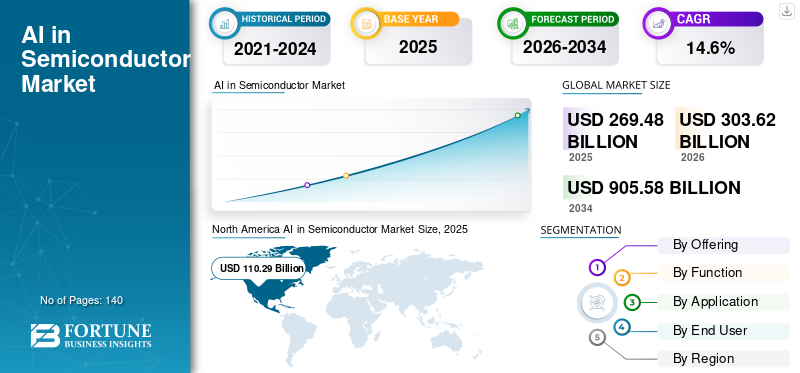
The AI in semiconductor market size was valued at USD 269.48 billion in 2025 and is projected to grow from USD 303.62 billion in 2026 to USD 905.58 billion by 2034, exhibiting a CAGR of 14.6% during the forecast period. North America dominated the ai in semiconductor market with a market share of 40.92% in 2025.
The market includes semiconductor hardware, software, and services that enable artificial intelligence workloads or apply AI across chip design, manufacturing, testing, and deployment. The market covers AI processors, memory, sensors, connectivity ICs, design software, and manufacturing solutions within the broader semiconductor market. Key applications include data centers and cloud AI, edge devices, automotive systems, industrial automation, aerospace and defense, consumer electronics, healthcare, and telecom.
The market growth is driven by expanding Artificial Intelligence (AI) infrastructure, rising demand for high-performance computing, increasing use of AI in chip development, and the need for faster and more energy-efficient semiconductor systems. NVIDIA Corporation, Broadcom Inc., Advanced Micro Devices, Inc., Taiwan Semiconductor Manufacturing Company Limited, and Samsung Electronics Co., Ltd. are the top players in the market.
Download Free sample to learn more about this report.
AI in Semiconductor Market Key Takeaways
 Global Market Size & Forecast
- 2025 Market Size: USD 269.48 Billion
- 2026 Market Size: USD 303.62 Billion
- 2034 Forecast Market Size: USD 905.58 Billion
- CAGR: 14.6% from 2026-2034
 Market Share
- North America dominated the global market with a strong revenue share of 40.92% in 2025.
- Germany accounted for 5.9% of the global market, driven by strong industrial and automotive electronics.
- China held a notable 9.9% share of the global market, driven by expanding foundry and chip design capacity.
 Key Regional Highlights
North America
North America held the largest regional share at 40.92% in 2025, led by strong AI chip design, cloud, and EDA ecosystems.
Europe
Europe held the third-largest share in 2025, supported by strength in automotive semiconductors and industrial automation.
Asia-Pacific
Asia-Pacific is projected to grow at the highest CAGR, driven by dominant fabrication, memory, and packaging capacity.
U.S.
The U.S. accounted for roughly 36.2% of global sales in 2025, driven by leading AI chip designers and hyperscale data centers.
Japan
Japan accounted for roughly 3.4% of global revenues in 2025, supported by precision chip manufacturing and equipment makers.
Read More

AI IN SEMICONDUCTOR MARKET TRENDS
Adoption of Agentic AI Across Semiconductor Design and Verification Workflows is a Key Market Trend
Semiconductor companies are increasingly integrating generative and agentic AI into electronic design automation platforms to manage complex chip development workflows. These systems support design-space exploration, register-transfer level generation, verification planning, debugging, layout optimization, and power-performance-area analysis. The trend is gaining momentum as advanced-node chips, chiplets, and 3D-IC architectures require faster design iterations and greater engineering precision. AI-enabled workflows also help engineering teams automate routine processes, identify design issues earlier, and shorten development timelines while maintaining human oversight across critical design and sign-off stages.
- In March 2026, Siemens launched the Fuse EDA AI Agent to autonomously coordinate semiconductor, 3D-IC, and PCB design, verification, and manufacturing sign-off workflows.
MARKET DYNAMICS
MARKET DRIVERS
Download Free sample to learn more about this report.
Rising Demand for Higher Semiconductor Yields and Manufacturing Efficiency is Driving Market Growth
Semiconductor manufacturers are increasingly adopting AI to improve production yields, control operating costs, and accelerate volume manufacturing. AI-enabled platforms analyze equipment, wafer, metrology, and defect data to detect process deviations, predict equipment failures, and identify yield losses earlier. Machine learning also supports automated defect classification, predictive maintenance, and real-time process optimization across fabrication, assembly, and testing facilities. These capabilities help foundries, semiconductor companies, and OSAT providers reduce material waste, limit unplanned downtime, and improve production consistency across advanced logic, memory, and packaging processes.
- In October 2025, Lam Research introduced Fabtex Yield Optimizer, an AI-powered solution that uses machine learning and digital twins to improve semiconductor manufacturing yields and reduce process variability.
|
Rank |
Market Drivers |
Overall Impact Rank |
Estimated Gross Market Growth Contribution (USD Billion) |
Impact 2026-2028 |
Impact 2029-2031 |
Impact 2032-2034 |
|
1 |
Rising deployment of AI accelerators, GPUs, custom ASICs, and high-performance processors across hyperscale data centers is increasing semiconductor demand for high-speed data processing, AI training, and inference workloads. |
High |
169.27 |
High |
High |
High |
|
2 |
Growing demand for high-bandwidth memory, advanced packaging, chiplets, and high-speed interconnects is supporting the development of increasingly complex AI computing systems. |
High |
134.49 |
High |
High |
Medium |
|
3 |
Expansion of edge AI across automotive, industrial automation, consumer electronics, robotics, and intelligent devices is accelerating demand for compact and energy-efficient AI semiconductors. |
High |
108.95 |
High |
High |
High |
|
4 |
Increasing use of AI-enabled EDA, design optimization, verification, and testing tools is helping semiconductor companies optimize complex chip designs, reduce development cycles, and improve chip performance. |
Medium |
89.26 |
Medium |
High |
High |
|
5 |
Continued investment in advanced-node fabrication, semiconductor manufacturing capacity, and AI-focused foundry and OSAT capabilities is strengthening the global supply ecosystem. |
Medium |
73.93 |
Medium |
Medium |
High |
|
6 |
Others, including adoption across healthcare, telecommunications, aerospace and defense, smart infrastructure, and research applications, are creating additional growth opportunities for AI-enabled semiconductor solutions. |
Low |
51.56 |
Medium |
Medium |
High |
|
|
Total Positive Growth Contribution |
|
627.46 |
|
|
|
MARKET RESTRAINTS
High Development Costs and Limited Access to Advanced Manufacturing Restrains Market Growth
The high cost of developing AI-focused semiconductor solutions may restrict market participation and delay commercialization, further creating limitations for AI in semiconductor market growth. Designing advanced processors, accelerators, memory architectures, and chiplet-based systems requires substantial investment in EDA tools, engineering talent, verification, prototyping, and intellectual property licensing. Access to advanced fabrication nodes, high-bandwidth memory, and sophisticated packaging capacity is also limited and expensive. These barriers particularly affect smaller semiconductor companies and emerging vendors, while longer qualification cycles across automotive, aerospace, industrial, and data center applications further increase development risks and investment requirements.
|
Rank |
Market Restraints |
Overall Impact Rank |
Estimated Reduction in Market Size (USD Billion) |
Impact 2026-2028 |
Impact 2029-2031 |
Impact 2032-2034 |
|
1 |
High development costs associated with advanced AI chips, leading-edge fabrication nodes, specialized design tools, and complex validation processes are limiting participation among smaller semiconductor companies. |
High |
8.45 |
High |
High |
Medium |
|
2 |
Supply constraints involving high-bandwidth memory, advanced packaging capacity, semiconductor manufacturing equipment, and critical materials are restricting the timely scaling of AI semiconductor production. |
High |
7.10 |
High |
High |
Medium |
|
3 |
Rising power consumption, heat generation, and thermal-management requirements associated with AI processors are increasing infrastructure costs and creating deployment challenges across data centers and edge environments. |
Medium |
5.65 |
High |
Medium |
Medium |
|
4 |
Shortages of skilled semiconductor engineers, increasing chip-design complexity, intellectual-property dependencies, and lengthy qualification cycles are slowing the commercialization of new AI semiconductor products. |
Low |
4.30 |
Medium |
Medium |
Low |
|
|
Total Negative Growth Impact |
|
25.50 |
|
|
|
MARKET OPPORTUNITIES
Expansion of Edge AI Across Industrial and Automotive Systems is Creating Market Opportunities
The growing use of AI directly within vehicles, industrial equipment, robots, cameras, and connected devices is creating opportunities for semiconductor providers. Edge AI requires energy-efficient processors, neural processing units, memory, sensors, connectivity ICs, and power management components capable of supporting real-time inference with limited cloud dependence. This allows chip companies to develop application-specific solutions for predictive maintenance, machine vision, autonomous mobility, workplace safety, and intelligent automation. As manufacturers increasingly require faster response times, stronger data privacy, and lower network bandwidth usage, demand for integrated edge AI semiconductor platforms is expected to expand.
- In February 2025, NXP Semiconductors agreed to acquire Kinara to expand its energy-efficient NPU and edge AI capabilities across industrial and automotive applications.
SEGMENTATION ANALYSIS
By Offering
Hardware Segment Led the Market Owing to Strong Demand for AI Computing Infrastructure
Based on offering, the market is divided into hardware, software, and services.
In 2025, the hardware segment held the largest share of 85.0% in the market. The dominance is due to strong demand for Central Processing Units (CPUs), processors, accelerators, high-bandwidth memory, sensors, and connectivity components across data centers, edge devices, and automotive systems. It is also expected to grow at the highest CAGR of 24.8% over the forecast period as semiconductor companies expand production of advanced AI chips, chiplets, and memory-intensive computing platforms.
The software segment held the second-largest share as AI-based design, verification, manufacturing optimization, and data management platforms became increasingly important across semiconductor workflows. The segment is expected to grow at a CAGR of 21.6% over the forecast period, supported by wider adoption of AI-enabled EDA tools and manufacturing analytics.
By Function
AI Processing Segment Led Due to Expanding Demand for High-Performance Computing
Based on function, the market is segmented into AI processing, AI-based semiconductor design optimization, AI-based semiconductor manufacturing optimization, AI-based testing & inspection, and AI data movement & memory optimization.
In 2025, the AI processing segment led the market with a 59.1% share due to strong demand for GPUs, AI accelerators, NPUs, and specialized processors across data centers, edge devices, automotive systems, and industrial applications. The segment benefits from rising deployment of generative AI, machine learning, and real-time inference workloads that require high computing performance and energy efficiency.
The AI data movement & memory optimization segment is projected to grow at the highest CAGR of 18.1% over the forecast period, as AI workloads increasingly face memory bandwidth, latency, and power consumption constraints. Growing adoption of high-bandwidth memory, advanced interconnects, chiplet architectures, and memory-aware computing is encouraging semiconductor companies to improve data transfer efficiency between processors, accelerators, and storage systems.
By Application
Data Center AI Infrastructure Segment Led Due to Expanding AI Compute Deployment
Based on application, the market is segmented into data center AI infrastructure, edge AI devices, automotive & mobility, aerospace & defense, industrial automation, and others.
In 2025, the data center AI infrastructure segment led the market with a 37.5% share due to the large-scale deployment of Graphics Processing Units (GPUs), AI accelerators, high-bandwidth memory, networking chips, and power management components. Rising investments in generative AI platforms, hyperscale computing, cloud computing, AI training clusters, and cloud-based model deployment continue to strengthen semiconductor demand across global data center infrastructure.
Edge AI devices are projected to record the second-highest CAGR of 15.5% over the forecast period as AI processing increasingly shifts closer to connected devices and local systems. Growing adoption of intelligent cameras, smartphones, robotics, industrial equipment, and embedded computing platforms is increasing demand for compact, energy-efficient processors, including Neural Processing Units (NPUs), sensors, AI SoCs, memory, and connectivity ICs.
By End User
To know how our report can help streamline your business, Speak to Analyst
Hyperscalers, Cloud Service Providers & Data Center Operators Led Due to Large-Scale Semiconductor Procurement
Based on end user, the market is segmented into semiconductor companies, foundries, OSAT providers, hyperscalers, cloud service providers & data center operators, electronics OEMs, and others.
In 2025, the hyperscalers, cloud service providers & data center operators segment held the largest AI in semiconductor market share of 27.8%. This dominance is due to substantial investment in AI servers, accelerators, high-bandwidth memory, networking chips, and power management solutions. These operators require advanced semiconductor systems to support the training and inference of complex AI models, cloud platforms, and hyperscale computing workloads.
Foundries are expected to grow at the second-highest CAGR of 16.1% over the forecast period, as demand increases for advanced-node manufacturing, AI accelerators, chiplets, and 3D-packaged semiconductor products. Foundries are expanding process capacity and advanced packaging capabilities to support increasingly complex, high-performance, and energy-efficient AI chips.
AI in Semiconductor Market Regional Outlook
By region, the market is categorized into North America, South America, Asia Pacific, Europe, and the Middle East & Africa.
North America
North America AI in Semiconductor Market Size, 2025 (USD Billion)
To get more information on the regional analysis of this market, Download Free sample
North America held the largest market share in 2025, and accounted for USD 110.29 billion. The dominance is supported by the strong presence of AI chip designers, cloud providers, Electronic Design Automation (EDA) companies, and data center operators across the U.S. and Canada. The regional market is expanding due to rising deployment of AI accelerators, high-bandwidth memory, networking chips, and AI-enabled semiconductor design and manufacturing solutions. According to the Semiconductor Industry Association, U.S.-headquartered semiconductor companies account for over 50% of global semiconductor industry revenue, reflecting the region’s strong chip-design and innovation ecosystem. This established semiconductor base continues to accelerate the development and commercialization of AI processors, design software, and advanced manufacturing technologies.
To know how our report can help streamline your business, Speak to Analyst
U.S. AI in Semiconductor Market
The U.S. market was valued at around USD 97.61 billion in 2025, accounting for roughly 36.2% of sales.
Asia Pacific
Asia Pacific is projected to grow at the highest CAGR in the market, driven by its concentration of semiconductor fabrication, memory production, advanced packaging, and electronics manufacturing capabilities. The region is benefiting from rising demand for AI accelerators, high-bandwidth memory, chiplets, sensors, and connectivity ICs across data centers, smart factories, autonomous systems, and edge devices. Expanding foundry capacity, OSAT investment, and government-backed semiconductor programs across China, India, Japan, South Korea, Taiwan, and ASEAN are further strengthening the regional supply chain and accelerating AI chip production and deployment.
Japan AI in Semiconductor Market
The Japanese market was valued at around USD 9.31 billion in 2025, accounting for roughly 3.4% of global revenues.
China AI in Semiconductor Market
China’s market is projected to be one of the largest globally, with 2025 revenues valued at USD 26.77 billion, roughly 9.9% of global sales.
India AI in Semiconductor Market
The Indian market was valued at USD 5.16 billion in 2025, accounting for roughly 1.9% of global revenues.
Europe
Europe held the third-largest market share in 2025, supported by its strong capabilities in automotive semiconductors, industrial automation, power electronics, sensors, and advanced chipmaking equipment. The region benefits from established semiconductor ecosystems in Germany, France, U.K., Netherlands, and the Nordics, where demand is rising for AI-enabled processors, edge chips, design optimization software, and intelligent manufacturing solutions.
Continued investment in semiconductor sovereignty, advanced packaging, and energy-efficient computing is strengthening Europe’s position in the market, although adoption remains comparatively measured due to strict regulatory, data governance, and compliance requirements.
U.K. AI in Semiconductor Market
The U.K. market was valued at approximately USD 10.92 billion in 2025, accounting for roughly 4.0% of global revenues.
Germany AI in Semiconductor Market
Germany’s market reached USD 15.94 billion in 2025, equivalent to around 5.9% of global sales.
Middle East & Africa
The Middle East & Africa region is anticipated to reach USD 12.15 billion in 2026 and is expected to grow at a prominent rate in the coming years. It is supported by rising investment in sovereign AI infrastructure, hyperscale data centers, smart cities, and advanced digital platforms across the GCC and Israel. Expanding demand for AI accelerators, memory, networking chips, edge processors, and semiconductor design capabilities is strengthening regional adoption, while industrial diversification and government-backed technology programs continue to create new opportunities for AI-enabled semiconductor solutions.
GCC AI in Semiconductor Market
The GCC market reached USD 3.46 billion in 2025, accounting for roughly 1.2% of global revenues.
South America
South America is expected to witness steady market expansion in the coming years, supported by increasing investment in cloud infrastructure, telecom modernization, industrial digitalization, and locally connected electronics ecosystems. Brazil is emerging as the primary regional demand center, driven by growing AI data center capacity, automotive electronics, fintech infrastructure, and smart manufacturing adoption. While Argentina and other countries are gradually increasing the use of edge processors, sensors, connectivity ICs, and AI-enabled computing systems. The region’s expanding digital economy and need for efficient, lower-power semiconductor solutions are expected to support long-term market growth.
Brazil AI in Semiconductor Market
The Brazil market was valued at USD 5.23 billion in 2025, accounting for roughly 1.9% of global revenues.
COMPETITIVE LANDSCAPE
Key Industry Players
Strategic Investment in AI Chips, Memory, and Design Platforms by Key Players Strengthens Market Leadership
The global AI in semiconductor market is semi-consolidated, with NVIDIA Corporation, Advanced Micro Devices, Inc., Broadcom Inc., Intel Corporation, and Qualcomm Incorporated holding prominent positions. These companies are expanding their semiconductor AI solutions through AI accelerators, custom processors, networking chips, edge AI platforms, and energy-efficient computing architectures.
Other key players include Micron Technology, Inc., Samsung Electronics Co., Ltd., SK hynix Inc., Taiwan Semiconductor Manufacturing Company Limited, and Synopsys, Inc. These companies include memory manufacturers, foundries, electronic design automation providers, and Integrated Device Manufacturers (IDMs). Their focus on high-bandwidth memory, advanced-node manufacturing, AI-assisted chip design, lithography optimization, semiconductor design automation, and strategic capacity expansion is expected to strengthen their competitive positioning.
LIST OF KEY AI IN SEMICONDUCTOR COMPANIES PROFILED
- NVIDIA Corporation (U.S.)
- Advanced Micro Devices, Inc. (U.S.)
- Broadcom Inc. (U.S.)
- Intel Corporation (U.S.)
- Qualcomm Incorporated (U.S.)
- Micron Technology, Inc. (U.S.)
- Samsung Electronics Co., Ltd. (South Korea)
- SK hynix Inc. (South Korea)
- Taiwan Semiconductor Manufacturing Company Limited (Taiwan)
- Synopsys, Inc. (U.S.)
KEY INDUSTRY DEVELOPMENTS
- October 2025: Samsung Electronics partnered with NVIDIA to establish an AI Megafactory using more than 50,000 NVIDIA GPUs, integrating AI across semiconductor design, manufacturing processes, equipment operations, and quality control.
- June 2025: SK hynix showcased its 12-layer HBM4 and HBM3E memory solutions for AI servers and data centers, alongside high-capacity enterprise SSDs and low-power memory products for on-device AI applications.
- October 2024: AMD launched the Instinct MI325X accelerator with 256 GB of HBM3E memory and introduced new Pensando networking products to support large-scale AI training, inference, and data center infrastructure.
- October 2024: Samsung Electronics developed its 24 Gb GDDR7 DRAM for next-generation AI computing, data centers, and high-performance graphics applications, strengthening its advanced memory portfolio.
- September 2024: Intel launched Xeon 6 processors and Gaudi 3 AI accelerators, expanding its semiconductor portfolio for generative AI training, inference, high-performance computing, and enterprise data center workloads.
- February 2024: Intel launched Intel Foundry as a systems foundry for the AI era and introduced an expanded roadmap covering Intel 14A technology, advanced packaging, assembly, testing, and semiconductor design ecosystems.
- February 2024: Qualcomm launched Qualcomm AI Hub with more than 75 pre-optimized AI and generative AI models for Snapdragon-powered smartphones, PCs, and other edge devices, enabling hardware-accelerated on-device inference.
REPORT COVERAGE
The AI in semiconductor market report provides an overview of market size, forecasts, and key segments across deployment, enterprise type, application, industry, and region. It examines market dynamics, emerging trends, technological advancements, and rising adoption of AI-enabled design, CAD automation, simulation, visualization, and product customization solutions. The report highlights major developments, including product launches, partnerships, mergers, acquisitions, and strategic initiatives by leading players. It also includes the competitive landscape, market share analysis, and profiles of top companies operating in the market.
Request for Customization to gain extensive market insights.
REPORT SCOPE & SEGMENTATION
| ATTRIBUTE | DETAILS |
| Study Period | 2021-2034 |
| Base Year | 2025 |
| Estimated Year | 2026 |
| Forecast Period | 2026-2034 |
| Historical Period | 2021-2024 |
| Growth Rate | CAGR of 14.6% from 2026-2034 |
| Unit | Value (USD Billion) |
| Segmentation | By Offering, By Function, By Application, By End User, and By Region |
| By Offering |
|
| By Application |
|
| By End User |
|
|
|
| By Region |
|
Frequently Asked Questions
Fortune Business Insights says that the global market value stood at USD 269.48 billion in 2025 and is projected to reach USD 905.58 billion by 2034.
In 2025, the market value stood at USD 110.29 billion.
The market is expected to grow at a CAGR of 14.6% over the forecast period.
By end user, the hyperscalers, cloud service providers & data center operators segment led the market.
The market is driven by rising demand for AI accelerators, high-bandwidth memory, advanced chips, and AI-enabled semiconductor design and manufacturing solutions.
NVIDIA Corporation, Advanced Micro Devices, Inc., Broadcom Inc., Intel Corporation, and Qualcomm Incorporated are among the top players in the market.
North America held the largest market share in 2025.


- 2021-2034
- 2025
- 2021-2024
- 140
Get 30-60 hrs Free Customization
Expand Regional and Country Coverage, Segments Analysis, Company Profiles, Competitive Benchmarking, and End-user Insights.




















Related Reports
-
US +1 833 909 2966 ( Toll Free )
-
Get In Touch With Us