AI in Space Operation Market Size, Share & Industry Analysis, By Technology (Computer Vision & Image Recognition, Autonomous Navigation & Decision-Making AI, Natural Language Processing (NLP) & Cognitive AI, Anomaly Detection Algorithms & Predictive Maintenance (ML), and Others), By Application (Space Exploration & Robotics, Earth Observation & Data Analysis & Science, Satellite Operations & Space Situational Awareness, Mission Planning and Simulation, and Others), By End Use (Government, and Commercial), and Regional Forecast, 2026-2034
 Download Free Sample
KEY MARKET INSIGHTS
 Listen to Audio Version
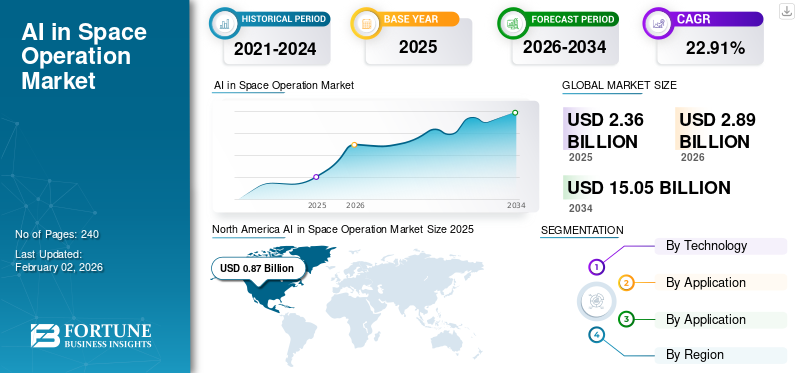
The global AI in space operation market size was valued at USD 2.36 billion in 2025 and is projected to grow from USD 2.89 billion in 2026 to USD 15.05 billion by 2034, exhibiting a CAGR of 22.91% during the forecast period. North America dominated the AI in space operation market with a market share of 36.85% in 2025.
Artificial Intelligence (AI) in space operations involves integrating advanced computational techniques and algorithms to enhance the efficiency, safety, and effectiveness of various space exploration and satellite management activities. Same as all other industries, AI is being extensively used in space exploration and satellite operation activities. AI is used by various space agencies to optimize communication, automate routine tasks, and improve anomaly detection, ensuring better performance and reliability. For spacecraft navigation, AI algorithms are useful for autonomous maneuvering and trajectory planning, reducing the need for constant human intervention.
Key players in the market, such as NASA, SpaceX, and Blue Origin, are investing heavily in integrating AI technologies and remote sensing in various satellite missions and operations. For instance, NASA aims to use artificial intelligence AI in autonomous exploration and navigation during planetary exploration. Moreover, SpaceX leverages the AI systems in satellites for autonomous navigation and enables the spacecraft to participate in deep space missions. In addition, other companies in the market, such as Slingshot Aerospace LeoLabs, provide AI-driven solutions and services to improve the efficiency of space operations.
Download Free sample to learn more about this report.
AI in Space Operation Market Takeaways
 Global Market Size & Forecast
- 2025 Market Size: USD 2.36 billion
- 2026 Market Size: USD 2.89 billion
- 2034 Forecast Market Size: USD 15.05 billion
- CAGR: 22.91% from 2026–2034
 Market Share
- North America dominated the AI in space operation market with a 36.85% share in 2025.
- The computer vision & image recognition segment is projected to lead the market with a 42.92% share in 2026.
- The government segment is expected to account for the largest 71.67% market share in 2026.
 Key Regional Highlights
North America
North America led the market with USD 0.87 billion in 2025 and is projected to reach USD 1.07 billion in 2026.
Europe
Europe generated USD 0.67 billion in 2025 and is expected to grow to USD 0.81 billion in 2026.
Asia Pacific
Asia Pacific accounted for USD 0.62 billion in 2025 and is projected to reach USD 0.77 billion in 2026.
U.S.
The U.S. AI in space operation market is projected to reach USD 0.93 billion by 2026.
Japan
The Japan AI in space operation market is projected to reach USD 0.11 billion by 2026.
Read More

AI in Space Operation Market Trends
Rise in Use of AI Technology in Autonomous Navigation
Autonomous navigation systems in space are being powered by AI technology. This is helping to make autonomous spacecraft that navigate and operate independently without continuous human intervention. AI-enabled autonomous spacecraft are revolutionizing space operations by providing autonomous navigational capabilities in extreme temperatures. Installing AI systems allows for more efficiency in complex missions, including remote or dangerous environments. Space agencies use AI algorithms such as machine learning and computer vision that help spacecraft analyze various data, make quick decisions, and adapt to changing conditions. For instance, NASA uses AutoNav, a self-driving autonomous navigation system for Perseverance Rover which helps to replan routes and navigate without human intervention in space.
- North America witnessed AI in space operation market growth from USD 0.87 Billion in 2025 to USD 1.07 Million in 2026.
Moreover, during the autonomous drive NASA's Perseverance Mars rover in July 2023, the rover identified and navigated around the 14-inch (35-centimeter) rock. Numerous startups are investing heavily in developing an AI-powered navigation system for satellite navigation. In addition, space agencies are integrating AI in space missions to improve operational efficiency and scientific output. For instance, in January 2025, The National Aeronautics and Space Administration (NASA) announced a list of AI use cases to help the agency in its space missions and operations. The updated inventory features active AI applications, including autonomous navigation for the Perseverance Rover on Mars and advanced data analysis to drive scientific discoveries.
Download Free sample to learn more about this report.
Market Dynamics
Market Drivers
Increased Investment in Space Exploration to Propel Market Growth
The increasing investment in space exploration from government agencies and private companies is a significant driver for AI in the space operations market. As nations and commercial entities aim to expand their presence in space, there is a rise in the focus on developing advanced technologies that can support ambitious missions, such as lunar bases. Moreover, governments of various countries are allocating huge budgets for space activities, exploration, and space programs. For instance, in May 2025, the U.S. government provided USD 7 billion for lunar exploration and introduced USD 1 billion in new investments for Mars-focused programs. International Space Station to commercial replacements in 2030, focusing onboard research on efforts critical to exploring the Moon and Mars. NASA is planning to allocate a proposed budget of 15 billion in 2026.
In addition, other developing countries are heavily investing in space exploration activities. For instance, the Union Budget 2025-26 of India had allocated USD 1.53 billion to the Department of Space, driving forward ambitious space exploration and satellite development initiatives. Such increases in AI technologies are increasingly seen as essential tools for achieving these goals, as they can optimize mission planning, improve operational efficiency, and enable autonomous systems to perform complex tasks. For instance, AI can assist in resource allocation, ensuring that limited assets are used effectively during missions.
Rise in Integration of AI in Data Analytics to Accelerate Market Growth
The rapid increase in data generated by satellites, telescopes, and other space missions has created a pressing need for advanced data analytics solutions. AI technologies, particularly machine learning, and deep learning, are essential for efficiently processing and interpreting this vast amount of information. Traditional data analysis methods often struggle to keep pace with the volume and complexity of space-related data, making AI a critical tool for extracting valuable insights.
AI algorithms can identify patterns, anomalies, and correlations within datasets that would be difficult or impossible for humans to discern. For example, AI analyzes images from space telescopes, leading to discoveries about distant galaxies and celestial phenomena. Additionally, AI-driven analytics can enhance Earth observation capabilities, aiding climate monitoring, disaster response, and resource management. As organizations recognize the value of AI in transforming raw data into actionable intelligence, investment in AI-driven data analytics solutions is expected to grow, further propelling AI in the space operations market.
Market Restraints
High Development Costs to Hinder Market Growth
One significant restraint in the market is the high development and implementation costs associated with advanced AI technologies. Developing AI systems for space applications requires substantial research, engineering, and testing investment, which can be a barrier for many organizations, especially smaller companies or startups. The complexity of space missions demands highly specialized AI solutions that must be rigorously validated to ensure reliability and safety in harsh environments. This often involves extensive simulations, field tests, and compliance with stringent regulatory standards, all contributing to elevated costs.
Moreover, the long timelines associated with space missions can further complicate funding and resource allocation. As a result, the high costs associated with developing and deploying AI technologies can limit market participation and slow innovation pace, which may hamper the AI in space operation market growth.
Market Challenges
Limited Regulatory Frameworks Pose a Significant Challenge for Market Growth
Limited regulatory frameworks pose a significant challenge for the market owing to the absence of clear, comprehensive regulations that can create uncertainty for companies and stakeholders. Without established standards and guidelines, organizations may face difficulties in ensuring their AI systems meet safety, security, and operational requirements, which are critical in the high-stakes environment of space. This uncertainty can lead to delays in development, increased costs for compliance efforts, and hesitation in deploying innovative AI solutions.
Market Opportunities
Expansion of Commercial Space Ventures to Drive Market Growth Opportunities
One significant opportunity in the market is the expansion of commercial space ventures. As private companies increasingly enter the space industry, there is a growing demand for innovative technologies to enhance mission capabilities and operational efficiency. This trend is driven by the commercialization of space, which includes satellite deployment, space tourism, and resource extraction from celestial bodies.
The rise of commercial space ventures creates a fertile ground for AI applications as these companies seek to differentiate themselves and optimize their operations. For instance, AI can be utilized for satellite data analysis, enabling companies to provide valuable insights for various sectors, including agriculture, climate monitoring, and urban planning. Additionally, AI-driven automation can streamline satellite manufacturing and launch processes, reducing costs and time-to-market.
Moreover, the competitive landscape encourages investment in research and development, leading to rapid advancements in AI technologies tailored for space applications. Collaborations between tech firms and space startups can foster innovation, resulting in new AI solutions that address specific challenges in space operations. Such factors are expected to present opportunities for the growth of AI in the space operations market.
Segmentation Analysis
By Technology
Computer Vision & Image Recognition Segment Held Largest Market Share Due to Rise in Demand for AI-Powered Analysis of Satellite Imagery
On the basis of technology, the market is classified into computer vision & image recognition, autonomous navigation & decision-making AI, natural language processing (NLP) & cognitive AI, anomaly detection algorithms & predictive maintenance (ML), and others.
The computer vision & image recognition segment is projected to hold the largest market share of 42.92% in 2026. The segment is experiencing growth due to the increasing need for automated analysis of images captured by satellites and rovers. AI algorithms can quickly process vast amounts of visual data, identifying features, anomalies, and patterns crucial for scientific research and mission planning. For instance, in May 2025, China launched 12 AI-powered satellites for its Three-Body Computing Constellation, featuring onboard intelligent processing and high-speed laser links. These satellites can process data directly in space with AI technology, reducing reliance on transmitting data to Earth. Such innovation to enhance real-time data analysis and efficiency in space-based computing is expected to drive the segment's growth.
The Natural Language Processing (NLP) & Cognitive AI segment is expected to grow fastest during the forecast period. The NLP & Cognitive AI segment is growing as space agencies and companies seek to improve human-computer interaction and data interpretation. AI-driven chabot and virtual assistants can facilitate communication between mission control and spacecraft, streamlining operations and enhancing decision-making. Furthermore, NLP technologies can analyze vast amounts of textual data from scientific literature, mission reports, and social media, extracting valuable insights for researchers and mission planners.
By Application
Space Exploration & Robotics Segment to Hold Largest Share Due to Growing Investments in Space Missions and Autonomous Robotic Systems
On the basis of application, the market is classified into space exploration & robotics, earth observation & data analysis & science, satellite operations & space situational awareness, mission planning and simulation, and others.
The space exploration & robotics segment is projected to remain the dominant application in the global market. The segment is witnessing significant growth due to the increasing number of missions to explore celestial bodies, such as Mars and the Moon. The demand for autonomous robotic systems that can perform tasks in harsh environments is rising, as these systems reduce the need for human presence and can operate in real-time. Advancements in AI technologies are fueling the development of robots to navigate, collect data, and make decisions autonomously, enhancing mission efficiency. For instance, in November 2024, Near Space Labs launched AI-powered balloon robots called "Swifts" that operate in the stratosphere to capture high-resolution images of climate-affected areas. Moreover, AI and machine learning technology are integrated into space crafts, landers, and rovers to collect data and navigate autonomously.
The earth observation & data analysis segment is estimated to grow at the fastest CAGR in the forecast period. The earth observation & data analysis segment will account for 34.62% market share in 2026.The earth observation & data analysis segment is expanding rapidly due to the increasing availability of satellite data and the need for actionable insights in various sectors, including agriculture, climate science, and disaster management. AI technologies can process and analyze large datasets, providing timely decision-making and resource management information.
To know how our report can help streamline your business, Speak to Analyst
By End Use
Government Segment Leads Due to Rising Demand for National Security, Surveillance, and Space Infrastructure Management
On the basis of end-use, the market is classified into government and commercial.
The government segment will hold the largest share of 71.67% in 2026 of the market. The government segment is experiencing growth as national space agencies invest in AI technologies to enhance mission capabilities and operational efficiency. Governments increasingly recognize the strategic importance of space exploration and the need for advanced technologies to support national security, scientific research, and international collaboration. Funding for space missions is rising, leading to increased demand for AI applications in satellite operations, data analysis, and autonomous systems.
The commercial end-use is estimated to be the fastest-growing segment as private companies enter the space industry, driven by technological advancements and decreasing launch costs. The commercialization of space has led to increased demand for innovative solutions that can optimize operations, enhance data analysis, and improve mission success rates. Companies are leveraging AI to stand out in a competitive market, utilizing technologies for satellite data analytics, autonomous systems, and mission planning.
AI in Space Operation Market Regional Outlook
On the basis of region, the market is studied across North America, Europe, Asia Pacific, and the Rest of the World.
North America
North America AI in Space Operation Market Size 2025 (USD Billion)
To get more information on the regional analysis of this market, Download Free sample
North America currently holds the largest AI in space operation market share. The North America region captured 36.85% of the global market in 2025, generating USD 0.87 billion in revenue, and is projected to reach USD 1.07 billion in 2026. North America is a leading region in the market, primarily due to the presence of major space agencies such as NASA and private companies such as SpaceX and Blue Origin. The U.S. government has significantly increased funding for space exploration, with initiatives such as the Artemis program aiming to return humans to the Moon and eventually send missions to Mars. Moreover, the U.S. Space Force released the "Data and Artificial Intelligence FY 2025 Strategic Action Plan" to integrate AI into its operations and personnel management. This marks a shift toward relying on AI for various processes within the military space agency. The plan aligns with the Defense Department's goal of creating a more data-driven, AI-enabled force. Such initiatives support the development of advanced AI technologies for autonomous navigation, data analysis, and mission planning. For instance, NASA's Perseverance Rover utilizes AI for autonomous navigation and data collection on Mars. Additionally, the region benefits from a robust technology ecosystem, with numerous startups and research institutions focusing on AI applications in space, further driving innovation and growth. The U.S. market is projected to reach USD 0.93 billion by 2026.
Europe
Europe maintained a strong presence in the global market, reaching USD 0.67 billion in 2025, accounting for 28.46% share, and is expected to reach USD 0.81 billion in 2026. Europe is witnessing growth in the market for AI in space operations, driven by collaborative efforts among European Space Agency (ESA) member states and initiatives, including the Copernicus program. The ESA invests in AI technologies to enhance Earth observation capabilities, enabling better climate monitoring and disaster response. For example, the Sentinel satellites utilize AI for data processing and analysis, providing valuable insights for environmental management. Furthermore, European countries are increasingly focusing on commercial space ventures, with companies such as Airbus and Thales Alenia Space developing AI-driven solutions for satellite operations and space exploration. The UK market is projected to reach USD 0.21 billion by 2026, and the Germany market is projected to reach USD 0.19 billion by 2026.
Asia Pacific
In 2025, Asia Pacific generated USD 0.62 billion, contributing 26.15% to global market revenue, and is projected to grow to USD 0.77 billion in 2026. The Asia Pacific region is rapidly emerging as a significant player in the market, driven by increasing investments in space exploration and satellite technology. Countries, including China and India, are making substantial advancements in their space programs, with initiatives such as China's Tiangong space station and India's Mars Orbiter Mission. These programs leverage AI for various applications, including autonomous navigation and data analysis. For instance, the Indian Space Research Organisation (ISRO) uses AI to enhance satellite imagery analysis for agricultural monitoring and urban planning. Additionally, the growing interest in commercial space ventures, such as satellite launches and space tourism, further propels the demand for AI technologies in the region, fostering a competitive landscape for innovation and demand for AI in space operations. The Japan market is projected to reach USD 0.11 billion by 2026, the China market is projected to reach USD 0.39 billion by 2026, and the India market is projected to reach USD 0.20 billion by 2026.
Rest of the World
Rest of the World contributed 8.54% to the global market in 2025, with a valuation of USD 0.2 billion, and is projected to reach USD 0.24 billion in 2026. In the Rest of the World, regions such as Africa and Latin America are beginning to explore the potential of AI in space operations, although at a slower pace compared to North America, Europe, and Asia Pacific. Countries such as South Africa are investing in satellite technology and Earth observation capabilities, utilizing AI for agricultural monitoring and natural resource management applications. For example, the South African National Space Agency (SANSA) is working on projects incorporating AI to analyze satellite data for environmental monitoring.
Competitive Landscape
Key Market Players
Key Players Focus on Investment in Satellite Constellation and Strategic Partnerships to Enhance Their Market Presence
The AI in space operations market is highly competitive, driven by the rise in global space exploration budgets, technological advancements, and the increasing importance of AI in the military sector. Some of the top players in the industry are Boeing (U.S.), Lockheed Martin Corporation (U.S.), Northrop Grumman (U.S.), and Airbus (Netherlands). They are maintaining their dominance and increase their market share through innovation in secure communication systems, advanced imaging capabilities, and resilient satellite architectures. In addition, market players are focusing on advancing satellite technologies and integrating artificial intelligence to strengthen their presence in the market.
LIST OF KEY AI IN SPACE OPERATION COMPANIES PROFILED
- NASA (U.S.)
- SpaceX (U.S.)
- Blue Origin (U.S.)
- Virgin Galactic (U.S.)
- Planet Labs (U.S.)
- Capella Space (U.S.)
- Slingshot Aerospace (U.S.)
- LeoLabs (U.S.)
- Relativity Space (U.S.)
- Astroscale (Japan)
- Near Space Labs (U.S.)
- Realtra (U.K.)
KEY INDUSTRY DEVELOPMENTS
- In April 2025, Planet Labs announced that it will enhance its satellite constellations by integrating advanced AI layers, such as Nvidia Jetson-2 onboard processing, to analyze images directly in space. This allows for faster data analysis and more efficient operations without relying solely on Earth-based processing.
- In November 2024, NASA launched the 2040 AI Track program to advance space exploration AI, focusing on autonomous decision-making and scientific discovery. The AI Strategy Team develops systems for real-time scenarios such as rover navigation and hazard response.
- In September 2024, NASA's SPAR Lab developed the open-source OnAIR platform to enable autonomous AI capabilities in spacecraft, tested on the NAMASTE mission with drones measuring methane. AI enhances mission resilience and allows complex, distributed operations without ground control delays.
- In June 2024, Slingshot Aerospace and DARPA developed an AI system called Agatha to detect anomalous satellites within large constellations. This technology helps monitor and verify the proper operation of thousands of spacecraft in low Earth orbit.
- In February 2024, LeoLabs raised USD 29 million to expand its AI-powered space operation insights for commercial and government clients. The funding will support the development of advanced applications and stronger partner integrations.
REPORT COVERAGE
The report provides a detailed sector analysis and focuses on important aspects such as key players, technology, and application, depending on various regions. Moreover, the research report offers deep insights into the AI in space operation market trends, competitive landscape, market competition, and market status and highlights key industry developments. Additionally, it encompasses several direct and indirect factors contributing to the market's growth in recent years.
Request for Customization to gain extensive market insights.
Report Scope & Segmentation
|
ATTRIBUTE |
DETAILS |
|
Study Period |
2021-2034 |
|
Base Year |
2025 |
|
Estimated Year |
2026 |
|
Forecast Period |
2026-2034 |
|
Historical Period |
2021-2024 |
|
Unit |
Value (USD Billion) |
|
Growth Rate |
CAGR of 25.1% from 2025 to 2032 |
|
Segmentation
|
By Technology
|
|
By Application:
|
|
|
By End Use
|
|
|
By Region
|
Frequently Asked Questions
Fortune Business Insights says that the global market stood at USD 2.36 billion in 2025 and is projected to reach USD 15.05 billion by 2034.
Registering a CAGR of 22.91%, the market will exhibit significant growth during the forecast period.
By application, the space exploration & robotics segment is expected to lead the market during the forecast period.
SpaceX, NASA, Blue Origin, Planet Labs, and Slingshot Aerospace are some of the leading players in the market.
North America dominates the market in terms of share.
In 2025, the market value stood at USD 0.87 billion.
The key factor driving the market is increased investment in space exploration.



- 2021-2034
- 2025
- 2021-2024
- 240
Get 30-60 hrs Free Customization
Expand Regional and Country Coverage, Segments Analysis, Company Profiles, Competitive Benchmarking, and End-user Insights.




















Related Reports
-
US +1 833 909 2966 ( Toll Free )
-
Get In Touch With Us