AI in Video Surveillance Market Size, Share & Industry Analysis, By Component (AI Cameras and Software), By Deployment (On-premises, Cloud, and Hybrid), By Technology (Computer Vision, Deep Learning, Edge AI, Cloud Analytics, and Others), By Application (Intrusion Detection, Facial Recognition, Vehicle/Number Plate Recognition, Crowd Analytics, Retail Analytics, Industrial Infrastructure Monitoring, and Others), By End-User (Government & Public Facilities, Commercial, Industrial, Military & Defense, and Others), and Regional Forecast, 2026 – 2034
 Download Free Sample
(Offer valid till 30th Sep 2026)

AI in Video Surveillance Market Size and Future Outlook
 Listen to Audio Version
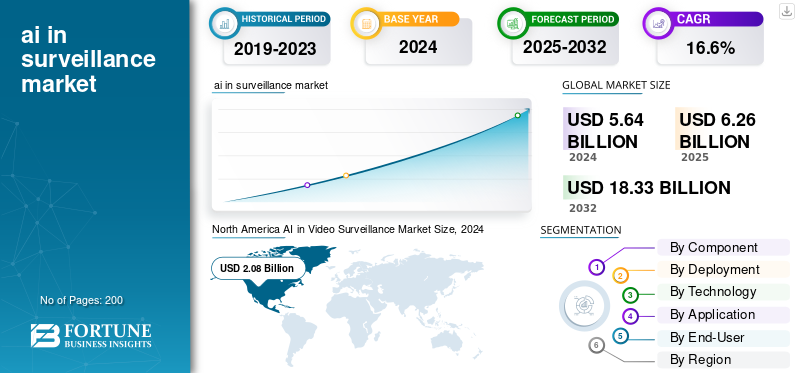
The global AI in video surveillance market size was valued at USD 6.26 billion in 2025 and is projected to grow from USD 7.04 billion in 2026 to USD 26.90 billion by 2034, exhibiting a CAGR of 18.2% during the forecast period. North America dominated the AI in video surveillance market with a market share of 37.22% in 2025.
AI in video surveillance refers to the revenue generated from AI cameras and software that utilize artificial intelligence to assess video data to aid in the monitoring of objects, behaviors, or events, and to assist with any decisions made in a specific environment through video analytics. The systems used to analyze video data with AI will include technologies such as computer vision, deep learning, and edge analytics, which enable the system to automatically identify objects in the video data captured, providing increased overall security, effective operations, and situational awareness of the location. The market growth is driven by the increasing demand for intelligent, real-time monitoring systems that enhance security, operational efficiency, and decision-making capabilities across both public and private sectors.
Furthermore, many key players operating in the market comprise Hikvision Digital Technology Co., Ltd., Zhejiang Dahua Technology Co., Ltd., Axis Communications AB, Motorola Solutions, Inc., and Robert Bosch GmbH. These players are focusing on forming strategic partnerships with technology providers, system integrators, and smart city developers to strengthen their market presence.
Download Free sample to learn more about this report.
AI in Video Surveillance Market KEY TAKEAWAYS
 Market Size & Forecast
- 2025 Market Size: USD 6.26 billion
- 2026 Market Size: USD 7.04 billion
- 2034 Forecast Market Size: USD 26.90 billion
- CAGR: 18.2% from 2026–2034
 Market Share
- North America dominated the market with a 37.22% share in 2025.
- Software segment is projected to grow at a CAGR of 21.7%.
- Cloud segment is projected to grow at a CAGR of 24.6%.
 Key Regional Highlights
North America
North America USD 2.33 billion in 2025. Strong adoption of AI surveillance across public safety, healthcare, transport, and critical infrastructure.
Europe
Europe USD 1.22 billion in 2026. Rising AI surveillance adoption supported by privacy regulations and demand for real-time monitoring systems.
Asia Pacific
Asia Pacific USD 2.32 billion in 2026. Rapid urbanization, smart city projects, and strong government investment in AI surveillance driving growth.
U.S.
U.S. USD 2.05 billion in 2026. High investment in AI video analytics and large-scale deployment across government and commercial sectors.
Japan
Japan USD 0.25 billion in 2026. Expanding AI surveillance adoption in smart infrastructure and public safety applications.
Read More

IMPACT OF GENERATIVE AI
Rising Use of Generative AI Models to Enhance Video Surveillance Capabilities
Generative AI is having a beneficial effect on the market by increasing the amount of analytic information available and how quickly large amounts of video data can be analyzed, summarized, and interpreted in real time. Generative AI models are increasingly being used by organizations to provide automated video summaries, detect anomalies, create reports, and enable intelligent searches of video data taken from surveillance systems. With these models using broad-based, scalable data to process, companies and public sector organizations have increased concerns about data privacy, model accuracy, and regulatory compliance. For instance,
- In April 2025, Axis Communications released its global AI in video surveillance study, based on more than 5,800 respondents across 68 countries. It found that 62% of partners view AI and generative AI as one of the most significant trends shaping the industry.
Generative AI is further driving the development of next generation surveillance platforms where the use of edge AI, cloud-based analytics, and data from multiple sensors result in a fully integrated picture of a given situation. This has enabled organizations to move toward investment in AI-ready, scalable infrastructure that supports both real-time analytic functions and advanced AI model deployment.
AI IN VIDEO SURVEILLANCE MARKET TRENDS
Integration of Edge AI to Enhance the Capabilities of Video Surveillance Systems
The hype surrounding edge AI has recently increased in the market. Edge AI is reinventing the way video footage is processed and analyzed by moving from a central server and utilizing AI algorithms to run on the camera or on a connected device near the camera. With this approach, video data can be analyzed in real-time and events such as intrusion, object recognition, and abnormal behavior can be recognized much more quickly. For instance,
- In December 2024, Hanwha Vision stated that generative AI is accelerating the development of edge AI It added that edge AI cameras will evolve into intelligent agents capable of understanding situations and generating real-time alerts.
In addition, new semiconductor technology and AI processor innovations are driving the development of surveillance devices that can use edge computing. Companies are releasing intelligent cameras containing onboard AI chips capable of performing sophisticated analytics directly on the camera. The expected outcome of these new technologies will be to create next-generation surveillance systems that are easier to scale, more efficient, and responsive. For instance,
- In June 2024, ONVIF announced the formation of its Semantic Metadata Working Group. The initiative aims to create a standardized framework for describing objects and events across video surveillance systems.
MARKET DYNAMICS
MARKET DRIVERS
Download Free sample to learn more about this report.
Soaring Demand for Proactive Security and Real-Time Threat Detection to Drive the Market Growth
There are increasing security risks at commercial properties, transportation hubs, and public infrastructure, which is driving the demand for modern surveillance technologies and propelling AI in video surveillance market growth. Night vision systems record video footage for later police investigation. Artificial intelligence surveillance systems can automatically identify suspicious activity and unusual behavior as they happen. This makes it possible for businesses to quickly respond to incidents and improve total situational awareness and security in complex situations. For instance,
- In April 2025, Axis Communications reported that 62% of channel partners identified AI and generative AI as the most influential technologies shaping the future of the video surveillance industry.
Many companies have begun utilizing artificial intelligence-driven analytics to manage the increasing amount of digital video data produced by today's surveillance systems. Large facilities such as airports, industrial plants, and distribution centers utilize thousands of cameras. Therefore, using human eyes to monitor these videos on a daily basis would be inefficient. Using AI tools allows for the automated detection of abnormal behaviors and patterns, ranking of alerts by priority, and reduction of false positives. These types of technologies increase the overall efficiency of operations.
MARKET RESTRAINTS
Data Privacy Regulations and Ethical Concerns May Limit the Adoption of AI Surveillance
A significant obstacle to the implementation of AI-based surveillance systems is privacy issues. Many AI surveillance systems use facial recognition or biometric data to identify people, which requires the collection and processing of sensitive information from private individuals. This creates concerns about the misuse of data, unwarranted surveillance, or violations of civil liberties. For instance,
- In August 2024, the European Commission confirmed that the EU Artificial Intelligence Act includes strict restrictions on real-time biometric surveillance in public spaces.
Furthermore, organizations using these types of AI surveillance systems must also follow a wide range of regulatory frameworks and data protection legislation. Companies must establish a privacy-by-design policy, have adequate data security measures, and have a transparent governance structure. Compliance with these additional policies results in increased costs and can delay market adoption.
MARKET OPPORTUNITIES
Increasing Deployment of Cloud Based Video Surveillance Platforms to Create Growth Opportunities
Surveillance systems that are operated through the cloud are becoming increasingly popular among organizations that need scalable and flexible solutions to improve security operations. In contrast to traditional on-premise systems, cloud-based platforms provide centralized monitoring and allow for remote access and easy integration with AI powered analytic tools. With these advanced capabilities, organizations are able to use fewer resources to manage surveillance infrastructure that is distributed across multiple locations. For instance,
- In December 2024, Genetec reported that 43% of organizations prefer hybrid cloud for video surveillance. The company highlighted its role in balancing scalability and control.
The use of artificial intelligence (AI) to analyze data from surveillance systems enhances the overall capabilities of cloud-based surveillance systems. Organizations can perform centralized video analysis, conduct intelligent searches, and automate the detection of events across multiple locations when using cloud-powered solutions. As more companies implement a cloud-first strategy, it is anticipated that cloud-based surveillance systems will push massive growth.
Segmentation Analysis
By Component
AI Cameras Segment Led the Market owing to the Rising Adoption of Intelligent Surveillance Systems
Based on component, the market is bifurcated into AI cameras and software.
The AI cameras segment accounted for the largest market share in 2025. This is owing to the increasing deployment of intelligent surveillance hardware with built-in AI capabilities such as real-time object detection, facial recognition, and anomaly analysis across public safety, commercial, and industrial applications. Furthermore, the adoption of edge AI technology has led to more rapid processing times, which ultimately has created faster responses to actions happening in real-time.
The software segment is anticipated to expand at the highest CAGR of 21.7% over the forecast period. This is owing to organizations increasingly adopting advanced video analytics, cloud-based surveillance platforms, and AI-driven automation tools to generate real-time insights from existing camera infrastructure.
By Deployment
Rising Data Security Requirements to Drive On-Premises Segment Growth
Based on deployment, the market is divided into on-premises, cloud, and hybrid.
The on-premises segment accounted for the largest market share in 2025. Many organizations, including government, defense, critical infrastructure, and industrial facilities require enhanced control over data security, system access, and surveillance operations, driving the dominance of the segment. Additionally, on-premises solutions offer low latency, real-time processing, and compliance with stringent data privacy laws and regulations associated with high security applications.
The cloud segment is anticipated to grow at the highest CAGR of 24.6% over the forecast period. This is owing to the increasing demand for scalable remote monitoring, centralized video analytics, lower infrastructure costs, and seamless integration of AI-driven surveillance across multi-site environments.
By Technology
Increasing Adoption of Intelligent Video Analytics to Drive Computer Vision Segment Growth
Based on technology, the market is categorized into computer vision, deep learning, edge AI, cloud analytics, and others (multi-modal sensors).
The computer vision segment is anticipated to account for the largest market share, as it forms the core technology layer for AI video surveillance, enabling object tracking, motion detection, facial recognition, and scene analysis. Additionally, as computer vision is used across multiple applications, including intrusion detection, traffic monitoring, crowd analytics, and industrial surveillance, it was the most frequently deployed technology by end users.
The deep learning segment is anticipated to grow at the highest CAGR of 23.6% over the forecast period. This is owing to its ability to deliver higher accuracy in facial recognition, behavior analysis, anomaly detection, and predictive analytics across increasingly complex surveillance environments.
By Application
Surging Need for Real-Time Threat Detection to Drive Intrusion Detection Segment Growth
Based on application, the market is divided into intrusion detection, facial recognition, vehicle/number plate recognition, crowd analytics, retail analytics, industrial infrastructure monitoring, and others (smoke detection).
The intrusion detection segment is anticipated to account for the largest AI in video surveillance market share. This is owing to its widespread use as a core security application across government facilities, commercial buildings, industrial sites, and critical infrastructure. Its ability to provide real-time alerts, perimeter monitoring, and automated threat identification made it a primary adoption area for AI-enabled video surveillance systems.
The crowd analytics segment is anticipated to grow at the highest CAGR of 21.6% over the forecast period. This is owing to an increasing demand for real-time crowd monitoring, public safety management, and behavioral analysis across smart cities, transportation hubs, stadiums, and large public venues.
By End-User
To know how our report can help streamline your business, Speak to Analyst
Increasing Public Safety Investments to Impel Government & Public Facilities Segment Growth
Based on end-user, the market is classified into government & public facilities, commercial, industrial, military & defense, and others (transportation).
The government & public facilities segment captured a dominating market share in 2025. This is owing to the rapid adoption by state and local governments of AI enabled surveillance systems for public safety, smart city management, traffic management, and protecting critical infrastructure. Additionally, continued governmental investments in real-time threat detection systems, facial recognition systems, crowds monitoring & integration, and command-and-control systems helped drive revenue for the segment.
The commercial segment is anticipated to grow at the highest CAGR of 21.7% during the forecast period. This is owing to the increasing adoption of AI-enabled video surveillance for retail analytics, workplace monitoring, customer behavior analysis, asset protection, and operational efficiency across offices, retail stores, hospitality, and commercial complexes.
AI in Video Surveillance Market Regional Outlook
By geography, the market is categorized into North America, South America, Europe, the Middle East & Africa, and Asia Pacific.
North America
North America AI in Video Surveillance Market Size, 2025 (USD Billion)
To get more information on the regional analysis of this market, Download Free sample
North America held the largest market share in 2024, valuing at USD 2.08 billion, and also maintained the leading share in 2025, with a value of USD 2.33 billion. The North America market is expected to expand owing to the widespread acceptance of AI-based surveillance technologies in the sectors of government, commercial, healthcare, transportation and critical infrastructure. In addition to being supported by an advanced digital infrastructure and a large amount of money spent on security-related technologies and numerous prominent companies providing AI surveillance and video analytics, North America has continuously innovated and deployed advanced systems. For instance,
- In March 2025, Genetec announced that the City of Brampton, Ontario, selected its solutions to support a new public safety initiative, including the deployment of 200 AutoVu SharpV license plate recognition cameras at major intersections.
These factors play a significant role in fueling the regional market growth.
U.S. AI in Video Surveillance Market
Based on North America’s strong contribution and the U.S. dominance within the region, the U.S. market can be analytically approximated at around USD 2.05 billion in 2026, accounting for roughly 29.1% of global sales.
To know how our report can help streamline your business, Speak to Analyst
Europe
The Europe market is projected to record a CAGR of 18.2% over the analysis period and reach a valuation of USD 1.22 billion by 2026. The regional market is expanding owing to the rising adoption of AI-enabled surveillance across public infrastructure, commercial facilities, transportation, and industrial sites, supported by the increasing demand for real-time monitoring and operational intelligence. The segment growth is also shaped by strong data privacy and AI governance requirements, which are encouraging the adoption of secure, compliant, and privacy-focused surveillance solutions. For instance,
- In February 2025, the Port of Tyne, Gorilla Technology, and BT announced an alliance to deploy AI video analytics to improve safety and operational visibility.
U.K. AI in Video Surveillance Market
The U.K. market is estimated to reach around USD 0.16 billion in 2026, representing roughly 2.3% of global revenues.
Germany AI in Video Surveillance Market
The Germany market is projected to reach approximately USD 0.20 billion in 2026, equivalent to around 2.8% of global sales.
Asia Pacific
The Asia Pacific market is estimated to reach USD 2.32 billion in 2026 and is expected to grow at the highest CAGR of 20.6% during the forecast period. Rapid urbanization, large-scale smart city initiatives, and widespread use of AI-enabled surveillance systems in public safety, transportation, and critical infrastructure projects will spur the Asia Pacific market growth. Strong government investments, expanding digital infrastructure, and rising adoption of AI video analytics in commercial and industrial sectors, especially in China, India, Japan, and Southeast Asia, support this expansion. For instance,
- In April 2025, the Uttar Pradesh government deployed Staqu’s AI-powered JARVIS video analytics platform at the Vindhyachal Temple and corridor project in India to improve surveillance, facial recognition, crowd management, and unusual activity detection.
China AI in Video Surveillance Market
The China market is projected to be one of the largest worldwide, with 2026 revenues estimated to touch around USD 0.95 billion, representing roughly 13.5% of global revenues. The market is being fueled by the sizeable amount of money invested by the government into smart city infrastructure, massive rollouts of AI-enabled public surveillance systems, and the considerable number of manufacturers and technology providers in China who provide AI surveillance.
Japan AI in Video Surveillance Market
The Japan market is estimated to reach around USD 0.25 billion in 2026, accounting for roughly 3.6% of global sales.
India AI in Video Surveillance Market
The India market is estimated to hit around USD 0.34 billion in 2026, accounting for roughly 4.8% of global revenues.
South America
South America is expected to witness moderate growth during the forecast period. The regional market is set to reach a valuation of USD 0.32 billion in 2026. This is owing to increasing investments in public safety modernization, urban surveillance infrastructure, and AI-enabled monitoring systems across major cities and transportation networks. In South America, the Brazil market is set to reach a value of USD 0.17 billion in 2026.
Middle East and Africa
The Middle East and Africa is estimated to reach USD 0.54 billion in 2026 and expected to grow at a prominent rate in the coming years. This is owing to the higher levels of investment into smart city development, infrastructure security and AI-based public surveillance projects throughout countries such as the UAE and Saudi Arabia. Due to government-supported digital transformation projects as well as an increasing number of cities adopting intelligent surveillance for urban safety, transport management and major infrastructure projects, there is also a growing trend for intelligent monitoring solutions to assist with these development projects. In the Middle East & Africa, the GCC is set to reach a value of USD 0.22 billion in 2026.
COMPETITIVE LANDSCAPE
Key Industry Players
Focus on Expanding AI Capabilities and Strategic Partnerships by Key Players to Strengthen their Standing
The global market holds a semi-consolidated market structure, with prominent players such as Hikvision Digital Technology Co., Ltd., Zhejiang Dahua Technology Co., Ltd., Axis Communications AB, Motorola Solutions, Inc., and Robert Bosch GmbH holding significant positions. These companies are driving market growth through continuous investments in artificial intelligence integration, real-time processing capabilities, and advanced video analytics. Advancements in technologies such as edge AI, deep learning, and computer vision are enabling enhanced video surveillance applications, improved functionality, and seamless interaction between cameras, cloud systems, and user devices, for both consumer and enterprise applications.
Other notable players in the global market include Genetec Inc., Hanwha Vision Co., Ltd., Milestone Systems A/S, Verkada Inc., and Eagle Eye Networks, Inc. These companies are increasingly focusing on enhancing product usability, improving AI-based software analytics, and expanding their cloud-based surveillance solutions to meet the rising demand. Strategic investments in AI software ecosystems, edge computing, and partnerships for distribution and branding, alongside expansion into new regional markets, are expected to strengthen their market positioning. Continuous innovation in areas such as generative AI integration, real-time video analytics, and advanced detection algorithms is anticipated to drive sustained growth in the market throughout the forecast period.
LIST OF KEY AI IN VIDEO SURVEILLANCE COMPANIES PROFILED
- Hangzhou Hikvision Digital Technology Co., Ltd. (China)
- Axis Communications AB (Sweden)
- Zhejiang Dahua Technology Co., Ltd. (China)
- Motorola Solutions, Inc. (U.S.)
- Robert Bosch GmbH (Germany)
- Genetec Inc. (Canada)
- Hanwha Vision Co., Ltd. (South Korea)
- Milestone Systems A/S (Denmark)
- Verkada Inc. (U.S.)
- Eagle Eye Networks, Inc. (U.S.)
KEY INDUSTRY DEVELOPMENTS
- January 2026: Motorola introduced enhanced AI-powered security capabilities, including Avigilon Visual Alerts with conversational interfaces for custom on-premise event detection. This advancement expands surveillance use cases beyond perimeter security by enabling proactive monitoring of safety, compliance, and operational risks across large sites.
- September 2025: Axis Communication unveiled new AI-powered cameras and radar-integrated solutions at GSX (Global Security Exchange) 2025 to expand its intelligent surveillance portfolio. These solutions strengthen multi-sensor detection capabilities and improve situational awareness, particularly in complex environments requiring accurate, real-time monitoring and threat detection.
- August 2025: Zhejiang Dahua Technology Co., Ltd. released DSS Professional V8.7 with enhanced AI-powered capabilities and expanded ecosystem integrations for centralized security management. This upgrade improves operational efficiency by simplifying complex surveillance workflows and enabling more advanced analytics across enterprise and city-level deployments.
- July 2025: Hikvision launched the AcuSeek NVR powered by large-scale AI models, enabling natural-language-based video search across surveillance footage. This development significantly improves forensic investigations by allowing faster, more accurate retrieval of relevant data, thereby enhancing operational efficiency and reducing manual effort in complex monitoring environments.
- May 2025: Milestone Systems announced updates across XProtect, BriefCam, and Arcules to enhance video management, AI-powered analytics, and cloud video security capabilities. These upgrades improved operational workflows, analytics performance, and enterprise scalability, strengthening Milestone’s integrated software ecosystem for modern surveillance environments.
- March 2025: Motorola Solutions expanded its Avigilon security suite with new features, including Alta SOS and natural-language-defined complex event detection. This development improves emergency response coordination and strengthens enterprise security operations by enabling faster, more contextual identification of critical incidents.
- January 2025: Axis Communication AB introduced AI-powered free-text search in AXIS Camera Station Pro, enabling users to retrieve video footage using natural language queries. This development enhances investigation efficiency by simplifying search processes, reducing manual effort, and enabling faster analysis of large volumes of surveillance data.
REPORT COVERAGE
The global AI in video surveillance market analysis includes a comprehensive study of the market size and forecast by all the market segments included in the report. It includes details on the market dynamics and trends expected to drive the market over the forecast period. It provides information on key aspects, including an overview of technological advancements, pipeline candidates, the regulatory environment, and product launches. Additionally, it details partnerships, mergers, and acquisitions, as well as key industry developments and prevalence by key regions. The global market research report also provides a detailed competitive landscape with information on the market share and profiles of key operating players.
Request for Customization to gain extensive market insights.
Report Scope & Segmentation
| ATTRIBUTE | DETAILS |
| Study Period | 2021-2034 |
| Base Year | 2025 |
| Estimated Year | 2026 |
| Forecast Period | 2026-2034 |
| Historical Period | 2021-2024 |
| Growth Rate | CAGR of 18.2% from 2026-2034 |
| Unit | Value (USD Billion) |
| Segmentation | By Component, Deployment, Technology, Application, End-User, and Region |
| By Component |
|
| By Deployment |
|
| By Technology |
|
| By Application |
|
| By End-User |
|
| By Region |
|
Frequently Asked Questions
According to Fortune Business Insights, the global market value stood at USD 6.26 billion in 2025 and is projected to reach USD 26.90 billion by 2034.
In 2025, the market value stood at USD 2.33 billion.
The market is growing at a CAGR of 18.2% during the forecast period of 2026-2034.
By technology, the computer vision segment is expected to lead the market.
The growing demand for proactive security and real-time threat detections are key factors driving the market expansion.
Hangzhou Hikvision Digital Technology Co., Ltd., Zhejiang Dahua Technology Co., Ltd., Axis Communications AB, Motorola Solutions, Inc., and Robert Bosch GmbH are the major players in the global market.
North America dominated the market in 2025.



- 2021-2034
- 2025
- 2021-2024
- 150
-
(Offer valid till 30th Sep 2026)
Get 30-60 hrs Free Customization
Expand Regional and Country Coverage, Segments Analysis, Company Profiles, Competitive Benchmarking, and End-user Insights.




















Related Reports
-
US +1 833 909 2966 ( Toll Free )
-
Get In Touch With Us