AI Model Risk Management Market Size, Share & Industry Analysis, By Deployment (Cloud, On-premises, and Hybrid), By Risk Management Function (AI Model Inventory & Governance, Model Validation & Testing, Risk Control & Model Monitoring, and Regulatory Compliance, Audit & Reporting), By Industry (BFSI, IT & Telecom, Retail, Healthcare, Manufacturing, and Others), and Regional Forecast, 2026 – 2034
 Download Free Sample
AI MODEL RISK MANAGEMENT MARKET SIZE AND FUTURE OUTLOOK
 Listen to Audio Version
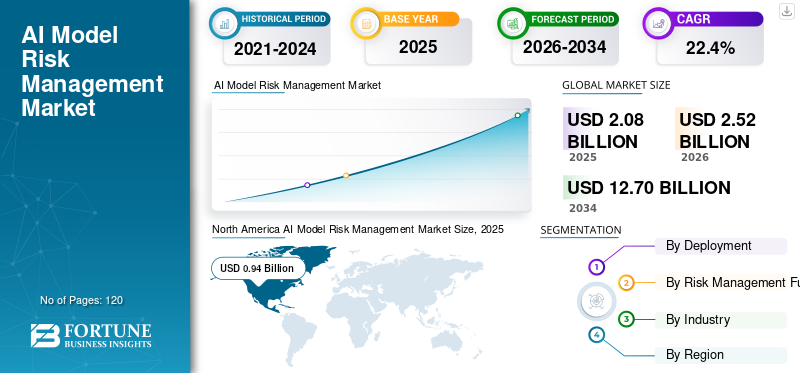
The global AI model risk management market size was valued at USD 2.08 billion in 2025 and is projected to grow from USD 2.52 billion in 2026 to USD 12.70 billion by 2034, exhibiting a CAGR of 22.4% during the forecast period. North America dominated the ai model risk management market with a market share of 45.19% in 2025.
AI model risk management (MRM) consists of techniques and processes aimed to identify, assess, verify, supervise, and manage the risks connected to AI models during their lifecycle. The main goal of this service is to ensure that AI models are correct and transparent, comply with regulations, are safe and secure, and are compliant with the rules and regulations of the organization.
The development of this industry is determined by the wide application of AI in different companies and growing demands for regulations related to models’ transparency and validation.
Furthermore, many key market players, such as IBM Corporation, Microsoft Corporation, Alphabet, Inc. (Google LLC), ServiceNow, Inc., and SAS Institute Inc., operating in the market, are focusing on product innovation and strategic partnerships to expand AI governance capabilities, integrate model validation and monitoring tools, and strengthen their presence across regulated industries.
Download Free sample to learn more about this report.
IMPACT OF GENERATIVE AI
Expansion of Generative AI Adoption Accelerating Demand for Generative AI Risk Management Solutions
Generative AI is leading a significant enlargement of the market, owing to its complex models deployed at businesses all over the world. Although traditional predictive models were used without the added risks of generating wrong content or harmful information and were relatively safe, generative AI brings additional risks such as risks caused by incorrect generation, bias, data privacy, and intellectual property. The mentioned risks lead to higher demand for model inventory, pre-deployment testing, red teaming, continuous monitoring of outputs, and automated compliance reporting. Furthermore, generative AI requires organizations to regulate models and applications developed by different cloud service providers and model suppliers. Thus, organizations increase their investments into dedicated governance platforms that can manage both traditional and generative Artificial Intelligence systems. For instance,
- In May 2024, IBM announced the expansion of its watsonx portfolio on AWS and planned integration between IBM watsonx.governance and Amazon SageMaker to help organizations manage risks associated with machine learning and generative AI models.
Thus, this factor fuels the AI model risk management market growth in the coming years.
AI MODEL RISK MANAGEMENT MARKET TRENDS
Increasing Adoption of AI Governance Standards Fuels Market Growth
Organizations are increasingly formulating AI governance programs in accordance with relevant frameworks such as ISO/IEC 42001 and the NIST AI Risk Management Framework for defined and standardized controls in accountability, transparency, risk assessment, and perpetual supervision. ISO/IEC 42001 provides a systematic approach of management systems in governing the AI risks and opportunities in an organization. This growing acceptance of standards has increased the need for AI risk assessment, model inventory, validation workflows, control documentation, monitoring as well as audit-ready reporting.
Organizations are employed to use the certification and standards alignment to ensure regulatory readiness and gain confidence from customers, regulators, and business partners. This in turn has enabled the vendors to offer software and consulting solutions aimed at standards mapping, evidence collection, readiness for certification, and continuous compliance with the ISO standards. For instance,
- In March 2026, BSI reported that 26% of organizations were already taking steps to align with ISO/IEC 42001, while 62% of global business leaders expected to increase their AI investments over the following 12 months.
MARKET DYNAMICS
MARKET DRIVERS
Download Free sample to learn more about this report.
Rapid Growth in Enterprise Model Portfolios Drives Market Growth
Enterprises are deploying increasing numbers of machine learning models, generative AI applications, third-party foundation models, and autonomous agents across multiple business functions. With the increase of portfolios, tracking becomes ineffective in helping to find ownership, approval status, and risk category of models as well as to collect documentation and regulatory proof of usage. The existence of models and agencies in different cloud, on-premises, and third-party environments complicates the validation and oversight of AI models even further. That results in the demand for centralized AI inventories, automatic governance processes, constant monitoring of AI usage, and portfolio-level reports of risk. However, companies that expand their network of AI model portfolio will inevitably spend much money on AI model risk management platforms and services. For instance,
- In May 2025, ServiceNow launched AI Control Tower, a centralized platform designed to govern, manage, secure, and measure any enterprise AI agent, model, or workflow, including third-party AI assets.
| Rank | Market Drivers | Expected Impact on Market Growth | Estimated Gross Market Growth Contribution (USD Billion) |
Impact: 2026-2028 | Impact: 2029-2031 | Impact: 2032-2034 |
|---|---|---|---|---|---|---|
| 1 | Rapid expansion of enterprise AI model portfolios and production deployments | High | 3.05 | High | High | High |
| 2 | Increasing financial and operational exposure arising from inaccurate or failed AI models | High | 2.55 | High | High | High |
| 3 | Growing decentralized AI development and shadow AI usage across business functions | Medium-High | 2.10 | Medium-High | High | High |
| 4 | Rising enterprise dependence on third-party foundation models, APIs, and embedded AI systems | Medium-High | 1.85 | Medium | Medium-High | High |
| 5 | Frequent model degradation caused by data drift, behavioral changes, and evolving operating conditions | Medium-High | 1.70 | Medium | High | High |
| 6 | Others (Increasing board-level accountability for AI-related financial, operational, and reputational outcomes, etc.) | Medium | 1.60 | Medium | Medium-High | Medium-High |
| Total Gross Growth Contribution | 12.85 | |||||
MARKET RESTRAINTS
High Implementation and Integration Costs May Hinder Market Growth
AI model risk management platforms require substantial investment in software licenses, consulting, customization, data preparation, and employee training. The organizations must spend time integrating these systems into numerous disorganized model development tools, governmental processes, cloud systems, and data architectures. Besides, extra costs result from managing the model inventory, defining limits for risks, and verifying controls. Hence, smaller companies might defer the launch of such developments as the expected return does not cover the costs immediately.
| Rank | Market Restraint | Expected Impact on Market Growth | Estimated Reduction in Market Size (USD Billion) | Impact: 2026-2028 | Impact: 2029-2031 | Impact: 2032-2034 |
|---|---|---|---|---|---|---|
| 1 | High implementation, integration, customization, and ongoing operating costs | High | 0.95 | High | Medium-High | Medium |
| 2 | Lack of standardized model-risk metrics, thresholds, and validation methodologies | Medium-High | 0.72 | High | Medium-High | Medium |
| 3 | Technical difficulty in evaluating and monitoring non-deterministic generative and agentic AI systems | Medium-High | 0.58 | Medium-High | Medium-High | Medium |
| 4 | Others (Fragmented ownership of AI risk across data science, legal, compliance, cybersecurity, and business teams, etc.) | Medium | 0.42 | Medium | Low-Medium | Low |
| Total Market Reduction | 2.67 | |||||
MARKET OPPORTUNITIES
Rising Expansion across High-Risk Industries Creates New Opportunities for Market Growth
The adoption of artificial intelligence is increasing in many sectors, such as banking and financial services, healthcare, government, critical infrastructure, employment, and other sectors where technology failure can endanger safety, financial outcomes, or even basic rights of individuals. The demands of these sectors require stricter procedures of model validation, explanation, and human oversight and involvement in the process and even documentation and audit trail for work done.
According to the EU AI Act, high-risk AI applications can be applied only if the necessary obligations related to risk assessment, quality of data, traceability, efficiency of AI models, cybersecurity, and human involvement have been fulfilled. As a consequence, different industry-specific model risk management applications and independent validation services can come into being. Also, there will appear opportunities for automation of compliance processes and post-deployment monitoring solutions. Regular demands for model reassessments, incident reporting, and regulatory updates create further revenue opportunities for the market in the long run. For instance,
- In January 2026, ServiceNow and Anthropic announced a partnership to integrate Claude models into ServiceNow’s governed AI platform for mission-critical workflows, including healthcare and life sciences applications.
Segmentation Analysis
By Deployment
Cloud Segment’s Ability to Achieve Scalability in Deployment and Provide Centralized Model Governance Led to its Dominance in Market
Based on deployment, the market is categorized into cloud, on-premises, and hybrid.
Cloud segment accounted for the largest market share in 2025 and is expected to grow at the highest CAGR of 25.5% during the forecast period. The growth is driven by its ability to achieve scalability in deployment, provide centralized model governance, allow for faster updates, and integrate with various AI development environments. Its subscription-based pricing, in addition to the minimal infrastructure requirements, provides model monitoring, validation, and compliance functionalities to a wider audience.
Hybrid segment is anticipated to grow at a moderate CAGR of 23.3% over the forecast period. As regulated enterprises seek cloud scalability while retaining on-premises control over sensitive models and data, although higher integration complexity limits faster adoption.
By Risk Management Function
Foundational Role across Both Traditional and Generative AI Systems Led to Dominance of AI Model Inventory & Governance Segment
Based on risk management function, the market is divided into AI model inventory & governance, model validation & testing, risk control & model monitoring, and regulatory compliance, audit & reporting.
AI model inventory & governance segment held largest market share in 2025. As organizations require centralized visibility into model ownership, documentation, risk classification, approval status, and lifecycle activities before implementing advanced controls. Its foundational role across both traditional and generative AI systems makes it a priority investment for enterprises establishing formal AI risk management frameworks.
Risk control & model monitoring segment is anticipated to grow at the highest CAGR of 24.9% over the forecast period. As enterprises increasingly require continuous detection of model drift, performance degradation, harmful outputs, and emerging compliance risks across production AI systems.
To know how our report can help streamline your business, Speak to Analyst
By Industry
Extensive Use of AI in Financial Decision-Making Boosted BFSI Segmental Dominance
Based on industry, the market is classified into BFSI, IT & telecom, retail, healthcare, manufacturing, and others (government, energy & utilities, etc.).
BFSI segment witnessed a dominating market share in 2025. This is owing to its wide deployment of artificial intelligence models for credit assessment, fraud detection, underwriting, trading, pricing, and regulatory conformity. Stringent requirements of model validation, substantial financial risk arising from inaccurate decisions, and an existing model risk management framework have helped boost adoption among banks and insurance firms.
Healthcare segment is anticipated to grow at the highest CAGR of 25.4% during the forecast period. This is owing to the rising use of AI in diagnostics, medical imaging, clinical decision support, and drug discovery increases the need for rigorous validation, explainability, patient-safety controls, and continuous model monitoring.
AI Model Risk Management Market Regional Outlook
By geography, the market is categorized into North America, South America, Europe, the Middle East & Africa, and Asia Pacific.
North America
North America AI Model Risk Management Market Size, 2025 (USD Billion)
To get more information on the regional analysis of this market, Download Free sample
North America held the largest AI model risk management market share in 2024, valuing at USD 0.79 billion, and also maintained the leading share in 2025, with USD 0.94 billion. The market growth is owing to large number of AI developers, cloud suppliers, financial bodies, and AI governance suppliers present there especially in the U.S. Also, due to large capital injection into business AI projects and early usage of model validation and control tools, demand for AI model risk control was increased in the region. The volume of private investment in AI in the U.S. amounted to USD 109.1 billion in 2024, which was noticeably higher than investment volumes in other major countries. For instance,
- In June 2025, IBM introduced new integrations between watsonx.governance and Guardium AI Security to provide enterprises with a unified view of risks across generative and agentic AI systems.
U.S. AI Model Risk Management Market
Based on North America’s strong contribution and the U.S. dominance within the region, the U.S. market can be analytically approximated at around USD 0.87 billion in 2026, accounting for roughly 34.5% of global sales.
To know how our report can help streamline your business, Speak to Analyst
Europe
In Europe, the market is projected to record a growth rate of 21.6% in the coming years, which is the fourth highest among all regions, and is set to reach a valuation of USD 0.63 billion by 2026. The growth can be attributed to the EU AI Act and its requirement for enhanced management of risk, documentation, awareness, human supervision, and continuous observation of risky AI systems. Increasing use of ISO/IEC 42001 and expanding market for AI implementation in finance, health, manufacturing, government, and other compliant industries is driving the needs for governance, provided validation, monitoring, and auditing services.
U.K. AI Model Risk Management Market
The U.K. market is estimated at around USD 0.15 billion in 2026, representing roughly 6.0% of global revenues.
Germany AI Model Risk Management Market
Germany’s market is projected to reach approximately USD 0.14 billion in 2026, equivalent to around 5.6% of global sales.
Asia Pacific
Asia Pacific region is estimated to reach USD 0.57 billion in 2026 and is expected to grow at the highest CAGR of 25.6% during the forecast period. This is owing to the swift increase of enterprise AI adoption in China, India, Japan, South Korea, Singapore, Australia, and Southeast Asia. This leads to increasing demand for model validation, governance, monitoring, and risk controls in the region. The rise of government-led AI safety initiatives, data residency requirements, and AI deployment in areas including banking and telecommunications has also been boosting demand for compliant AI model risk management solutions. For instance,
- In June 2025, Telkom Indonesia partnered with IBM to develop a sovereign AI platform using IBM watsonx for Indonesian enterprises. The platform supports responsible AI development through transparency, bias mitigation, and data privacy with local data-residency requirements.
China AI Model Risk Management Market
China’s market is projected to be one of the largest globally, with 2026 revenues estimated at around USD 0.14 billion, representing roughly 5.6% of global sales. This is owing to the rapid expansion of its AI industry and stronger government emphasis on full-lifecycle risk classification, safety assessment, monitoring, and governance of increasingly deployed enterprise AI models.
Japan AI Model Risk Management Market
The Japanese market is estimated at around USD 0.11 billion in 2026, accounting for roughly 4.4% of global revenues.
India AI Model Risk Management Market
The Indian market is estimated at around USD 0.07 billion in 2026, accounting for roughly 2.8% of global revenues.
South America
South America is expected to witness moderate growth in this market during the forecast period. The market is set to reach a valuation of USD 0.08 billion in 2026. This is owing to increasing AI adoption across banking, telecommunications, retail, and public services, alongside emerging governance frameworks and major initiatives such as Brazil’s AI plan, which is increasing demand for model validation, monitoring, and compliance solutions.
Brazil AI Model Risk Management Market
The Brazilian market is set to reach a value of USD 0.04 billion in 2026.
Middle East & Africa
Middle East & Africa is estimated to reach USD 0.10 billion in 2026 and expected to grow at a prominent growth rate in the coming years. The market growth in the region is spurred by governmental plans on artificial intelligence, improvements in the digital sphere, development of cloud-based systems, and an increase in the use of artificial intelligence in fields such as banking, telecom, medicine, and public services, especially in Gulf Cooperation Countries.
GCC AI Model Risk Management Market
The GCC market is set to reach a value of USD 0.03 billion in 2026.
COMPETITIVE LANDSCAPE
Key Industry Players
Focus on Expanding Integrated AI Governance and Model Monitoring Capabilities by Key Players to Strengthen Market Share
The global AI model risk management market holds a semi-consolidated market structure, with prominent players such as IBM Corporation, Microsoft Corporation, Alphabet, Inc. (Google LLC), ServiceNow, Inc., and SAS Institute Inc. holding significant positions. These companies are investing in integrated platforms that combine AI model inventory, validation, risk assessment, continuous monitoring, explainability, policy enforcement, and regulatory reporting to support enterprise-wide AI governance.
Other notable players in the global market include DataRobot, Inc., ModelOp, Inc., Credo AI, Holistic AI, and ValidMind Inc. These companies are strengthening their market positioning through strategic partnerships, cloud ecosystem integrations, product innovation, and the development of specialized governance solutions for generative AI, agentic AI, and regulated industries, which are expected to accelerate market adoption over the forecast period.
LIST OF KEY AI MODEL RISK MANAGEMENT COMPANIES PROFILED IN REPORT
- IBM Corporation (U.S.)
- Microsoft Corporation (U.S.)
- Alphabet, Inc. (Google LLC) (U.S.)
- ServiceNow, Inc. (U.S.)
- SAS Institute Inc. (U.S.)
- DataRobot, Inc. (U.S.)
- ModelOp, Inc. (U.S.)
- Credo AI (U.S.)
- Holistic AI (U.K.)
- ValidMind Inc. (U.S.)
KEY INDUSTRY DEVELOPMENTS
- August 2025: ModelOp partnered with Angularis.ai to provide AI Governance-as-a-Service for growing and medium-sized enterprises. The joint offering combines ModelOp’s governance platform with a virtual AI risk team to automate model oversight, regulatory alignment, policy enforcement, and lifecycle governance.
- May 2025: DataRobot expanded its collaboration with NVIDIA through inclusion in the NVIDIA Enterprise AI Factory validated design, enabling enterprises to develop, deploy, monitor, and govern AI agents across on-premises and private-cloud infrastructure.
- May 2025: Microsoft introduced major Azure AI Foundry enhancements, including Foundry Observability for continuous evaluation, tracing, real-time monitoring, diagnostics, and production alerts. The release also added automated agent evaluation, AI red teaming, guardrails, and integrations with Microsoft Purview, Credo AI, and Saidot for regulatory and governance oversight.
- April 2025: Box and IBM expanded their partnership to integrate Box AI with IBM watsonx, while Box adopted watsonx.governance for AI model lifecycle management. The platform supports model monitoring, regulatory guardrails, risk management, compliance, and auditability from development through production.
- November 2024: ServiceNow introduced new generative AI and governance capabilities, including an AI Governance offering, a unified AI inventory data model, and Now Assist Guardian. The capabilities provide model visibility, responsible AI guardrails and risk controls across AI models and applications.
- June 2024: Google Cloud introduced a re-architected Vertex AI Model Monitoring solution capable of monitoring models hosted on Vertex AI, external infrastructure, hybrid environments, and multiple clouds.
- April 2024: SAS launched AI model cards and AI Governance Advisory services to improve model transparency, oversight, and risk management.
REPORT COVERAGE
The global AI model risk management market analysis includes a comprehensive study of the market size & forecast by all the market segments included in the report. It includes details on the market dynamics and market trends expected to drive the market over the forecast period. It provides information on key aspects, including an overview of technological advancements, pipeline candidates, the regulatory environment, and product launches. Additionally, it details partnerships, mergers & acquisitions, as well as key industry developments. The global market research report also provides a detailed competitive landscape with information on the market share and profiles of key operating players.
Request for Customization to gain extensive market insights.
Report Scope & Segmentation
| ATTRIBUTE | DETAILS |
| Study Period | 2021-2034 |
| Base Year | 2025 |
| Estimated Year | 2026 |
| Forecast Period | 2026-2034 |
| Historical Period | 2021-2024 |
| Growth Rate | CAGR of 22.4% from 2026-2034 |
| Unit | Value (USD Billion) |
| Segmentation | By Deployment, Risk Management Function, Industry, and Region |
| By Deployment |
|
| By Risk Management Function |
|
| By Industry |
|
| By Region |
|
Frequently Asked Questions
According to Fortune Business Insights, the global market value stood at USD 2.08 billion in 2025 and is projected to reach USD 12.70 billion by 2034.
The market is growing at a CAGR of 22.4% during the forecast period of 2026-2034.
In 2025, the North America’s market value stood at USD 0.94 billion.
By risk management function, AI model inventory & governance segment led the market.
Rapid growth in enterprise model portfolios drives market growth.
IBM Corporation, Microsoft Corporation, Alphabet, Inc. (Google LLC), ServiceNow, Inc., and SAS Institute Inc. are the major players in the global market.
North America held the largest market share in 2025.



- 2021-2034
- 2025
- 2021-2024
- 120
Get 30-60 hrs Free Customization
Expand Regional and Country Coverage, Segments Analysis, Company Profiles, Competitive Benchmarking, and End-user Insights.




















Related Reports
-
US +1 833 909 2966 ( Toll Free )
-
Get In Touch With Us