Immune Health Supplements Market Size, Share & Industry Analysis, By Ingredient Type (Vitamins, Minerals, Herbal Botanical Extracts, Probiotics, Amino Acids, Omega-3 Fatty Acids, Others), By Form (Soft Gels/Capsules, Tablets, Powder, Liquids, and Others), By Source Type (Plant Based, Animal Based), By Distribution Channel (Pharmacies and Drug Stores, Hypermarket/Supermarket, Online Stores, Specialty Store, Others) and Regional Forecast, 2026-2034
 Download Free Sample
 KEY MARKET INSIGHTS
 Listen to Audio Version
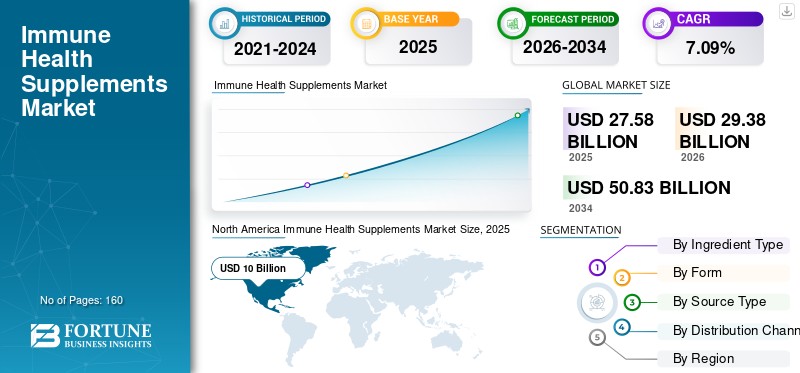
The global immune health supplements market size was valued at USD 27.58 billion in 2025. The market is projected to grow from USD 29.38 billion in 2026 to USD 50.83 billion by 2034, exhibiting a CAGR of 7.09% during the forecast period. North America dominated the immune health supplements market with a market share of 36.25% in 2025.
The immune system involves a diverse group of cells that execute important immunity-enhancing functions all through the body. A healthy diet is the best way to maintain a strong immune system. Nevertheless, nutritional supplements are a useful and easy way to ensure that all the nutritional needs are met.
The use of prebiotics and probiotics may also influence the immune system’s response. Factors such as growing awareness related to health issues and changing lifestyles, coupled with an upsurge in the weight management program are likely to fuel the market growth. For Instance, consumers are looking for added benefits or protection from their daily foods and beverages. According to research published in Natural Products Expo, 65% of U.S. customers now look for supplementary functional benefits from food and beverages. This, in turn, is likely to propel the demand for immune health supplements in the forecast period.
To boost immunity and overall health amid the COVID-19 pandemic, customers are gradually looking for efficient products that they believe might increase immunity and the body’s defense capability. With health being one of the highest priorities for consumers, immunity health supplement manufacturers are choosing ingredients that would offer clinically proven benefits. Key ingredients used to manufacture health supplements such as elderberry, button mushrooms, omega-3 fatty acids, and probiotics are in high demand from manufacturers. Moreover, research & development activities on immune health supplements are constantly growing to make highly effective nutritional supplements for boosting one’s immunity.
The COVID-19 pandemic had a huge positive impact on the market as consumers were actively looking for immunity boosters to dodge any kind of infectious disease. Immunity boosters such as vitamins, herbal extracts, minerals, and omega-3 fatty acids supplements experienced huge demand. The world was affected by the COVID-19 pandemic, so the demand was surging universally and exponentially. But, the key challenge would be forming a proper supply chain network to certify the systematic distribution of products.
Positively, COVID-19 and social distancing measures have caused consumers to reconsider their well-being, which was reflected in their purchase priorities. According to the Nutrition Business Journal, not surprisingly, the purchase of immune supplements in April 2020 surged significantly. Some of the statistics stated by the journal include: 17 out of the top 20 vitamin type products are immune-related, 57% of the top 100 fastest emerging vitamin products are vitamin C, and elderberry ranks as one of the topmost products in the immunity-boosting space.
Download Free sample to learn more about this report.
Immune Health Supplements Market Key Takeaways
 Global Market Size & Forecast
- 2025 Market Size: USD 27.58 billion
- 2026 Market Size: USD 29.38 billion
- 2034 Forecast Market Size: USD 50.83 billion
- CAGR: 7.09% from 2026–2034
 Market Share
- North America dominated the immune health supplements market with a 36.25% share in 2025.
- The tablet segment is projected to account for 33.55% of the market in 2026.
- The plant-based segment is expected to hold a dominant 64.85% share in 2026.
 Key Regional Highlights
North America
North America led the global market with revenue of USD 10.00 billion in 2025 and is projected to reach USD 10.66 billion in 2026.
Asia Pacific
Asia Pacific accounted for USD 8.57 billion in 2025, representing 31.06% of the global market.
Europe
Europe generated USD 7.33 billion in 2025 and is expected to grow to USD 7.81 billion in 2026.
U.S.
The immune health supplements market is projected to reach USD 8.77 billion by 2026.
Japan
The market is projected to reach USD 1.77 billion by 2026.
Read More

Immune Health Supplements Market Trends
Clean Label Trend is on Rise and will Drive Market Growth
Companies are progressively under pressure to improve the profile of their health supplements products with the growing awareness about supplements amongst consumers. Not only are consumers demanding products that would include natural and minimally processed ingredients, but they also need transparency about where those ingredients are coming from. Organic and non-GMO ingredients are speedily gaining momentum globally, due to several health benefits linked with these products. Henceforth, companies in this market are also including organic and non-GMO ingredients in their immunity health supplements to inspire consumers. This trend has positively swayed the demand for organic products, further making a potentially advantageous market set-up for organic and non-GMO immune health supplements.
Furthermore, several industry players are collaborating to introduce organic health supplements to strengthen immunity.
- For instance, in November 2022, NutriLeads BV launched organic variants of BeniCaros, an immune health ingredient suitable for incorporation into foods, beverages, and supplements. BeniCaros stands out for its environmentally friendly, consumer-friendly, and clean label attributes.
- Similarly, in March 2022, Stem & Root introduced BeniCaros, a plant-based immune ingredient with a clean label, developed in collaboration with NutriLeads BV.
Download Free sample to learn more about this report.
Immune Health Supplements Market Growth Factors
Growing Awareness Regarding Self-care and Well Being to Fuel Demand
Globally, millions of customers are taking immunity boosters for maintaining their good health. There is a rising interest in personal fitness and thus, it is creating a high demand for immune-boosting products with vitamins and herbal extracts, probiotics, and others. In addition, seasonal health issues including the flu virus have driven the customers’ interest in immune health supplements and are assisting to drive the sales of immunity supplements. For instance, In the U.S., people are more conscious about the wellbeing of their children and hence, they spend dollars to supplement their nutrition. Factors such as surging awareness, increasing consumption of immunity-boosting supplements, and rising disposable incomes are likely to impel the market growth.
Furthermore, physicians and consumers are becoming more aware that the immune system plays a vital role in critical areas of health that helps to diminish other chronic health issues. As per researchers, nearly every area of health is affected by the immune system. It includes the digestive system, brain, and cardiovascular system. Since our systems are challenged each day and not only during the seasonal flu, the overall demand for immune boosters will propel the market growth in the near future. For instance, Embria has financed multiple clinical research studies presenting EpiCor performing as a multivitamin to demonstrate and balance the immune system offering year-round benefits.
In addition, the rising prevalence of lifestyle diseases, such as diabetes and obesity, has prompted individuals to seek ways to bolster their immune systems to prevent illness. As a result, there is a growing market for immune health supplements that offer targeted support for these conditions.
Innovation and Formulation of New Immunity Boosters to Drive Market Growth
Innovation has been a stable part for manufacturers in the progression of the immune supplement business, as well as in opportunities and business expansion. New product launches with several health benefits are increasing the demand for innovative immunity supplement products. Besides, factors such as a surge in the usage of traditional and new ingredients for supplement manufacturing are responsible for the growth of new innovative immunity boosters. The high risk of infectious diseases has also created a buzz in the development of state-of-the-art and new immune health supplements.
Furthermore, owing to the development of nanotechnology, companies are capable of producing their best innovation for boosting supplements. This would further upsurge the supply side with better formulations of supplements having higher benefits. Thus, it is creating a high demand for immunity supplements.
- For instance, in December 2022, Herbalife Nutrition unveiled its latest product, Immunoturmeric, in the Asia Pacific region. This addition bolstered the company’s portfolio of nutritional supplements to support a robust and healthy immune system.
- Similarly, in February 2019, Swisse, an Australian wellness company, announced the launch of its new product Vitamin C and Manuka honey chewing tablets. The product contains lemon and acerola cherry extract which helps in supporting the immune system.
RESTRAINING FACTORS
Adverse Effects Related to Immunity Health Supplements to Limit Adoption
Although vitamins and supplements can help fill in the gaps in one’s diet, the finest way to take these essential nutrients is to get them straight from food. But, some of the supplements may show adverse effects, particularly when taken before surgery or when combined with other medicines. Immunity health supplements can also cause problems for those who have certain health conditions. In addition, the effects of many supplements haven’t been tested in children, pregnant women, and other groups.
Similarly, safety and efficacy concerns persist despite the popularity of immunosupplement products. In particular, some supplements can cause side effects when administered at higher doses or combined with another supplement. Safety concerns can undermine consumer trust and reduce the desire to purchase immune health supplements. There is extensive promotion of the potential advantages, with comparatively less recognition of their possible harmful effects. Also, most emergency department visits are associated with adverse effects from dietary supplements.
Moreover, these supplements are regulated as foods, and not as drugs. The Food and Drug Administration doesn’t assess the quality of supplements or evaluate their effects on the body. There are no requirements that the dietary supplements packaging list show potential adverse effects, nor are there standards for the determined pill size. Thus, it is creating a high risk for the elderly population. All the aforementioned factors are anticipated to inhibit the immune health supplements market growth.
Immune Health Supplements Market Segmentation Analysis
By Ingredient Type Analysis
Wider Consumption of Vitamin Supplements to Aid Growth of This Segment
On the basis of the ingredient type, the market has been segmented into vitamins, minerals, herbal extracts, probiotics, Omega-3 fatty acids, amino acids, and others. The vitamins segment hold a dominant share of 31.70% the market in 2026. The dominance is due to the growing consumption of vitamin supplements. The omega- 3 fatty acids segment is projected to register a higher CAGR by 2028 due to the increasing number of new product launches which are rich in omega-3 fatty acids. It is also widely accessible in liquid and tonic forms.
Besides, the herbal extract segment is expected to grow on account of its growing demand and utilization in several foods. In addition, as consumers increasingly look for natural ingredients that are effective and healthy, there is a high demand for botanicals derived from herbal extracts.
To know how our report can help streamline your business, Speak to Analyst
However, the probiotics segment is expected to grow at a significant CAGR during the forecast period due to the rising inclination to fortify food products with natural additives. Probiotics are predicted to be a game-changer in the supplements industry. Factors such as rising investments, mergers and acquisitions, government initiatives, surging consciousness toward probiotics, and robust market growth opportunities in emerging countries are likely to drive the segment.
By Form Analysis
Tablets Segment Dominated the Market in 2023 Backed by Their Cost-effective Nature
Based on form, the market is segmented into soft gels/capsules, tablets, powder, liquids, and others. Globally, the tablet segment is poised to account for 33.55% of the market share in 2026, followed by the capsules segment. Factors such as high shelf life, easy affordability, and convenient packaging are anticipated to surge the demand for capsule and tablet supplements. In addition, the dosage is well defined in tablets and capsules and thus, they are preferred over the other forms such as powder, liquid, and more.
Furthermore, the liquids segment is projected to grow at a significant CAGR during the forecast period. The growth of this segment is mainly attributed to the several advantages offered by this dosage form.
- For instance, as per the data provided by Aguulp in 2022, Liquid probiotics work faster and can be absorbed in a few minutes compared to other dosage forms.
By Source Type Analysis
Plant-based Segment to Register a Higher CAGR during the Forecast Period
In terms of the source type, the market is segmented into plant-based and animal-based. The plant-based segment is expected to have a dominant share of 64.85% in 2026. Though that doesn't mean that there aren’t enough sales for animal-based supplements. The demand for vegetarian products is greater in comparison to animal-based products owing to the dominance of vitamins in the field of plant-based immune supplements. Moreover, the impact of COVID-19 has strengthened the demand for vitamin C in the form of gummies and chewables from cranberry, elderberry, and some other fruits, which have further fostered the growth of the segment. However, the growing preference and supported health benefits are influencing the penetration level of animal-based ingredients in the market.
By Distribution Channels Analysis
Hypermarkets/supermarkets Segment to Grow Steadily in the Near Future
Based on distribution channels, the market has been segmented into hypermarket/supermarket, pharmacies & drug stores, online stores, specialty stores, and others. The pharmacies and drug stores segment is projected to lead the market with a 43.73% share in 2026 and is expected to retain its position during the forecast period. Hypermarkets/supermarkets are the most preferred outlets after pharmacies and drug stores. In countries such as Indonesia, India, and Brazil, people are buying supplements from supermarkets, contributing to the overall revenue generation.
Specialty stores entail organic and natural retail outlets. With the rising vegan public, organic chains and natural food stores are in focus and thus, driving the product demand. They assist as a tool to promote and cite the products in the market. Besides, the online channel segment has gained traction post the hasty internet penetration and progressions in e-commerce shopping sites. The segment is anticipated to become the second-fastest-growing distribution channel in the supplements industry.
REGIONAL INSIGHTS
North America Immune Health Supplements Market Size, 2025 (USD Billion)
To get more information on the regional analysis of this market, Download Free sample
North America
North America maintained a strong presence in the global market, reaching USD 10 billion in 2025, accounting for 36.25% share, and is expected to reach USD 10.66 billion in 2026. The strong dominance of this region can be attributed to the rising prevalence of lifestyle-related diseases such as obesity and diabetes, along with growing awareness surrounding self-wellness and preventive healthcare. Additionally, higher disposable income levels and the widespread adoption of dietary supplements have further supported market expansion across the region. The U.S. market is projected to reach USD 8.77 billion by 2026.
Asia Pacific
The Asia Pacific market accounted for USD 8.57 billion in 2025, representing 31.06% of the global industry, and is expected to reach USD 9.16 billion in 2026. Asia Pacific emerged as the second-leading region, witnessing remarkable growth in the sale of immunity booster products. This growth is driven by factors such as rapid urbanization, increasing health consciousness among consumers, and continuously evolving lifestyles. Moreover, heightened focus on preventive healthcare significantly accelerated demand in the region. For instance, in March 2020, an article published in the Indian Express highlighted a surge in bulk production of immunity boosters such as vitamin C, vitamin D, zinc-based products, and elderberry, primarily due to the COVID-19 outbreak. The Japan market is projected to reach USD 1.77 billion by 2026, the China market is projected to reach USD 2.25 billion by 2026, and the India market is projected to reach USD 2.04 billion by 2026.
Europe
In 2025, Europe generated USD 7.33 billion, contributing 26.56% to global market revenue, and is projected to grow to USD 7.81 billion in 2026. The immune health supplements market in Europe is anticipated to grow at a significant CAGR during the forecast period. This growth is largely supported by the rapidly aging population and the increasing prevalence of chronic diseases across the region. In addition, strong investments by key market players in product innovation, research, and distribution networks are expected to further boost the demand for immune health supplements in Europe. The UK market is projected to reach USD 1.86 billion by 2026, while the German market is projected to reach USD 1.21 billion by 2026.
Latin America and the Middle East & Africa
In 2025, the Middle East & Africa region represented USD 0.87 billion, accounting for 3.16% of the worldwide market, and is projected to grow to USD 0.91 billion in 2026. Latin America and the Middle East & Africa accounted for a comparatively lower market share, mainly due to the presence of a large underpenetrated consumer base. Limited awareness regarding immune health supplements and lower adoption rates have restrained market growth in these regions. However, improving healthcare infrastructure and rising health awareness are expected to create growth opportunities over the coming years. Latin America contributed 2.97% to the global market in 2025, with a valuation of USD 0.82 billion, and is projected to reach USD 0.85 billion in 2026.
List of Key Companies in Immune Health Supplements Market
Key Companies Focus on Scientific Research to Intensify Competition
The market is consolidated owing to the strong product portfolio and remarkable distribution network of major companies in developed and emerging countries. The global market share is highly competitive with a substantial number of major players. Several clinically proven formulations and ongoing scientific research are the major distinguishing factors in the market that can significantly increase the level of investment. Furthermore, factors including innovations, competitive landscape, research, availability of substitutes, and rigorous regulations from standard bodies can further strengthen the market dynamics. For instance, in May 2020, TB12, a health and wellness company based in the U.S., announced the launch of Protect, an immunity blend supplement prepared from clinically studied ingredients.
LIST OF KEY COMPANIES PROFILED:
- Herbalife Nutrition (U.S.)
- Nutramax Laboratories (U.S.)
- BioGaia (Sweden)
- Blackmores Limited (Australia)
- Glanbia, Plc (Ireland)
- Royal DSM (Netherlands)
- Alticor Inc. (Amway) (U.S.)
- USANA Health Sciences (U.S.)
- Bayer AG (Germany)
- NOW Foods (U.S.)
- Pfizer (U.S.)
KEY INDUSTRY DEVELOPMENTS:
- March 2023 – Goli Nutrition Inc. introduced the first 3-in-1 pre+post+probiotics gastrointestinal product of its kind worldwide.
- October 2021 – Aenova introduced a novel softgel capsule formulation designed to release probiotics specifically in the gut.
- April 2020 – Esperer Onco Nutrition Pvt. Ltd., a Mumbai-based startup, announced a significant amount of fundraising from Zenfold Ventures. Esperer is a pioneer in bringing a comprehensive nutritional portfolio to oncology. The company focuses on using these funds to expand its reach to the U.S. and the European markets. It would also build a world-class talent pool.
- April 2020 – Royal DSM, a global science-based company in nutrition, health, and sustainable living, announced the completion of its acquisition of Glycom, a leading supplier of Human Milk Oligosaccharides (HMOs). With the help of this acquisition, DSM focuses to continue its leadership in the Early Life Nutrition and Dietary Supplement space.
REPORT COVERAGE
The global immune health supplements market research report provides a detailed industry analysis and focuses on key aspects such as leading companies, product types, and leading applications of the product. Besides this, it offers insights into the key market trends and highlights key industry developments. In addition to the aforementioned factors, the report encompasses several factors that have contributed to the growth rate of the market over recent years.
Request for Customization to gain extensive market insights.
Report Scope & Segmentation
|
ATTRIBUTE |
DETAILS |
|
Study Period |
2021-2034 |
|
Base Year |
2025 |
|
Estimated Year |
2026 |
|
Forecast Period |
2026-2034 |
|
Historical Period |
2021-2024 |
|
Growth Rate |
CAGR of 7.09% from 2026-2034 |
|
Unit |
Value (USD Billion) |
|
Segmentation |
By Ingredient Type
|
|
By Form
|
|
|
By Source Type
|
|
|
By Distribution Channel
|
|
|
By Geography
|
Frequently Asked Questions
Fortune Business Insights says that the global market size was USD 27.58 billion in 2025 and is projected to reach USD 50.83 billion by 2034.
In 2025, the North American market value stood at USD 10 billion.
Registering a CAGR of 7.09%, the market will exhibit steady growth over the forecast period (2026-2034).
The vitamin supplement segment is expected to be the leading segment in this market during the forecast period.
The growing awareness pertaining to wellness and health by several market players is the major factor driving the growth of the market.
Herbalife Nutrition, BioGaia, Blackmores Limited, and Glanbia, Plc. are the major players in the global market.
North America dominated the market in terms of share in 2025.
The launch of innovative products with healthy ingredients by market players is expected to drive the adoption.



- 2021-2034
- 2025
- 2021-2024
- 160
Get 30-60 hrs Free Customization
Expand Regional and Country Coverage, Segments Analysis, Company Profiles, Competitive Benchmarking, and End-user Insights.













.webp)






-
US +1 833 909 2966 ( Toll Free )
-
Get In Touch With Us