Air Taxi Market Size, Share & Industry Analysis, By Offering (Hardware, Software, and Services), By Technology (Fully Autonomous, Semi-Autonomous, and Manual), By Propulsion Type (Parallel Hybrid, Electric, Turboshaft, Turboelectric, and Others), By Aircraft Type (Multicopter, Side-By-Side Aircraft, Tiltwing Aircraft, Tiltrotor Aircraft, and Others), By Range Outlook (Intercity and Intracity), and Regional Forecast, 2026-2034
 Download Free Sample
KEY MARKET INSIGHTS
 Listen to Audio Version
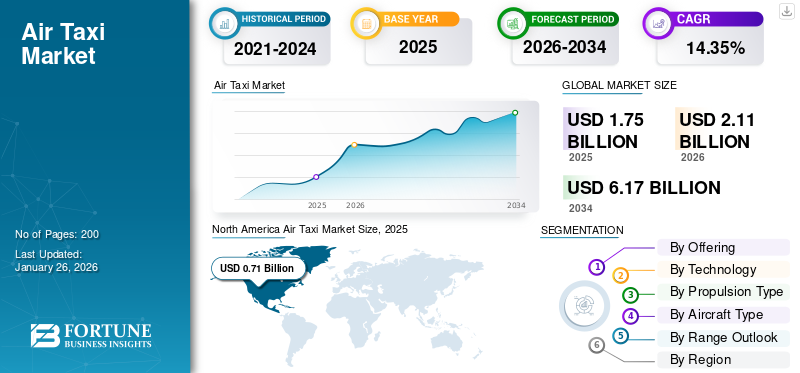
The global air taxi market size was valued at USD 1.75 billion in 2025. The market is projected to grow from USD 2.11 billion in 2026 to USD 6.17 billion by 2034, exhibiting a CAGR of 14.35% during the forecast period. North America dominated the air taxi market with a market share of 40.42% in 2025.
An air taxi is a compact aircraft designed to carry passengers, cargo, or mail over short distances. Air taxis belong to the Advanced Air Mobility (AAM) sector, which leverages cutting-edge technologies for flights that can be requested on demand. They can facilitate brief travel between commercial flights and private aircraft. It can also serve purposes such as delivery services, medical evacuations, tourism, and agricultural needs. The market is poised for significant growth, driven by urbanization, technological advancements, and increasing demand for efficient transportation solutions.
Download Free sample to learn more about this report.
AIR TAXI MARKET KEY TAKEAWAYS
 Global Market Size & Forecast
- 2025 Market Size: USD 1.75 billion
- 2026 Market Size: USD 2.11 billion
- 2034 Forecast Market Size: USD 6.17 billion
- CAGR: 14.35% from 2026–2034
 Market Share
- North America dominated the air taxi market with a 40.42% share in 2025.
- The Electric segment is expected to witness the fastest growth during the forecast period.
- The Intercity segment is projected to be the fastest-growing application segment.
 Key Regional Highlights
North America
The market was valued at USD 0.71 billion in 2025 and is projected to reach USD 0.85 billion in 2026.
Europe
The market generated USD 0.52 billion in 2025 and is expected to reach USD 0.63 billion in 2026.
Asia Pacific
The market accounted for USD 0.43 billion in 2025 and is projected to reach USD 0.52 billion in 2026.
U.S.
FAA support and eVTOL investments drive strong market growth.
Japan
Urban transport demand and innovation support market growth.
Read More

MARKET DYNAMICS
AIR TAXI MARKET TRENDS
Electric Air Taxis Providing Zero Carbon Emissions is the Emerging Trend in the Market
The rising global apprehension regarding climate change and the necessity to diminish carbon emissions has resulted in an escalating demand for sustainable transportation alternatives. Electric flying taxis, which produce zero carbon emissions during their operation, are considered as an eco-friendly substitute for conventional fossil fuel-powered vehicles. This characteristic attracts individuals and communities seeking greener transportation solutions, consequently propelling market expansion.
The progress of electric propulsion technology in aviation is advancing swiftly. As battery technology continues to improve, flight ranges are extended, and charging infrastructure becomes increasingly prevalent, the feasibility and practicality of electric flying taxis are enhanced. Technological innovations stimulate air taxi market growth by improving the performance, efficiency, and reliability of electric aircraft, rendering them more attractive to both operators and customers.
MARKET DRIVERS
Rapid Urbanization and Increasing Road Congestion Boost Air Taxi Demand
Escalating road congestion resulting from urban growth and the rising number of vehicles has created a need for alternative modes of transportation. Air taxis offer a solution to navigate around traffic, which reduces travel durations and enhances efficiency. The rapid growth of cities has heightened the demand for quicker and more effective mobility solutions in heavily populated areas. Air taxis fulfil this requirement by facilitating direct travel over short distances. Governments across the globe are promoting the development of air taxis through regulatory initiatives, trial programs, and investments in infrastructure. For instance, the FAA's Urban Air Mobility (UAM) Concept of Operations outlines a strategy for incorporating air taxis into the national airspace.
- For instance, in January 2025, to alleviate traffic congestion in metropolitan areas such as Delhi, Mumbai, and Pune, the government intends to launch a domestically developed air taxi service, with test flights scheduled to commence by 2026, announced by the Union Civil Aviation Minister.
MARKET RESTRAINTS
Challenges in the Development of Air Taxi Infrastructure Hamper Market Growth
Establishing vertiports, which serve as hubs for landing, takeoff, and maintenance, poses a considerable challenge. Site selection and construction are complicated by factors such as the availability of space, proximity to areas with high demand, and the need to integrate into pre-existing urban infrastructure. The infrastructure for air taxis must meet rigorous aviation safety regulations.
For instance, vertiports must provide obstacle-free zones and comply with physical design standards that correspond to the dimensions of eVTOL aircraft. The regulatory frameworks governing the integration of air taxis into urban airspace are still in development, which hampers the progress of infrastructure deployment. To facilitate seamless travel, air taxis must connect with other transportation systems modes, such as ride-sharing or public transit.
This necessitates collaboration among various stakeholders and the creation of additional infrastructure for transferring passengers. Constructing and expanding vertiport networks requires a substantial capital investment. Early operational phases struggle to realize economies of scale, which makes the development of infrastructure expensive.
MARKET OPPORTUNITIES
Air Taxi Industry Offers Vast Opportunities Across Urban Mobility, Technology Integration, and Environmental Sustainability
Air taxis play a vital role in Urban Air Mobility (UAM), providing quicker, traffic-free travel within cities and between urban centers. This is in line with smart city initiatives worldwide, paving the way for the integration of air taxis into urban infrastructure. The advancement of autonomous air taxis will lower operational expenses and enhance scalability, making services widely available.
Air taxis tackle last-mile delivery issues for both passengers and packages, especially in overcrowded urban areas or remote regions with poor infrastructure. This opens up new possibilities in the logistics and e-commerce industries. The transition to electric air taxis supports global sustainability objectives by minimizing emissions compared to conventional transportation options. This positions air taxis as an environmentally friendly alternative, appealing to both regulatory bodies and environmentally conscious consumers.
Download Free sample to learn more about this report.
Segmentation Analysis
By Offering
Growing Technological Advancements and Innovative Solutions for Air Taxi to Foster Software Segment Growth
Based on the offering, the air taxi market is classified into hardware, software, and services.
The software segment is estimated to be the fastest-growing segment of the global market, driven by innovative software solutions and technological advancements. As regulatory frameworks evolve and consumer demand increases, air taxi companies are poised to expand their operations globally and transform urban mobility.
- For instance, in June 2024, Joby developed ElevateOS, a comprehensive software suite for on-demand air taxi operations. This system includes pilot tools, operations management, and a consumer-facing app similar to ride-hailing platforms.
By Technology
Increasing Need to Optimize Routes and Decrease Travel Times to Augment Fully Autonomous Segment Expansion
Based on technology, the market is divided into fully autonomous, semi-autonomous, and manual.
The fully autonomous segment is estimated to be the fastest-growing during the forecast period of 2025-2032. Advances in AI, machine learning, and sensor technologies are enabling the development of fully autonomous air taxis. Companies such as Joby Aviation and Lilium are investing heavily in autonomous propulsion systems to improve safety and reduce operational costs. Moreover, autonomous air taxis can optimize routes and reduce travel times, making them more efficient than traditional transportation methods. This efficiency will drive demand and growth in the market.
By Propulsion Type
Electric Segment to Take the Lead Due to Growing Focus on Efficient and Sustainable Urban Mobility
Based on propulsion type, the market is segmented into parallel hybrid, electric, turboshaft, turboelectric, and others.
The electric segment is estimated to be the fastest-growing segment during the forecast period. The electric air taxi market is poised for significant growth, driven by technological advancements, environmental benefits, and supportive regulatory frameworks. As urbanization increases and traffic congestion worsens, electric air taxis are emerging as a promising solution for efficient and sustainable urban mobility. Electric air taxis offer a more environmentally friendly alternative to traditional fossil fuel-based transportation, aligning with global sustainability goals. This aspect attracts both regulatory support and eco-conscious consumers.
By Aircraft Type
Emergence of Infrastructure and Regulatory Frameworks to Make Multicopter Segment Dominant
Based on aircraft type, the market is segmented into multicopter, side-by-side aircraft, tiltwing aircraft, tiltrotor aircraft, and others.
The multicopter segment is estimated to be the fastest-growing segment during the forecast period. Multicopter air taxis are experiencing rapid growth due to technological advancements, urbanization, and increasing demand for sustainable mobility solutions. As infrastructure and regulatory frameworks evolve, multicopters are poised to play a central role in transforming urban air mobility. Furthermore, it aligns with global sustainability goals by reducing emissions compared to traditional fossil fuel-based transportation methods, driving the potential air taxi market share.
By Range Outlook
Intercity Segment to Grow Significantly Owing to Technological Advancements
The market has been categorized into intercity and intracity transportation based on range outlook.
The intercity portion of the global urban air mobility sector is expected to experience the most significant growth, attributed to technological advancements that have rendered urban air mobility a feasible option. These aircraft are also designed with technology that enables them to carry 2 to 4 passengers along with 20 to 40 kg of luggage over distances ranging from 50 to 250 kilometers. Furthermore, these intercity aircraft reduce travel times between two cities by half. They represent the sole form of high-speed transportation that does not require extensive infrastructure. Consequently, due to these attributes, the demand for intercity aircraft is anticipated to surge, potentially accelerating the growth of this sub-market segment during the analysis period.
During the analysis period, the intracity sub-segment is projected to grow at a lucrative rate and capture the largest market share. The expansion of the intracity segment within urban air mobility is expected to be driven by critical factors such as a significant rise in traffic congestion in the world's most populated cities. For instance, New York, Munich, Rio de Janeiro, and Bengaluru are experiencing increased congestion due to population growth and migration from rural areas. As a result, major airlines globally have started to implement UAMs for intracity services.
Air Taxi Market Regional Outlook
By region, the market is categorized into North America, Europe, Asia Pacific, Middle East, and the Rest of the World.
North America
North America Air Taxi Market Size, 2025 (USD Billion)
To get more information on the regional analysis of this market, Download Free sample
North America dominated the market with a valuation of USD 0.71 billion in 2025 and is projected to reach USD 0.85 billion in 2026. North America dominated the global market share in 2025. The market is poised for substantial growth, driven by technological advancements, regulatory support, and consumer interest. Addressing infrastructure and public acceptance challenges will be crucial for realizing the full potential of this market.
The U.S. stands at the forefront of the air taxi industry, thanks to its highly developed aviation infrastructure and a robust consumer interest. The advancement of air traffic control systems and continual investments in electric Vertical Takeoff and Landing (eVTOL) technology are fueling this growth. Companies such as Joby Aviation and Wisk Aero are leading the charge in offering air taxi services in the area. The FAA's Urban Air Mobility (UAM) Concept of Operations lays out a framework for incorporating air taxis into the national airspace, thereby enabling market growth.
Europe
The Europe region captured 29.81% of the global market in 2025, generating USD 0.52 billion in revenue, and is projected to reach USD 0.63 billion in 2026. The European market is emerging as a key player in the global Urban Air Mobility (UAM) sector driven by eVTOL manufacturers such as Lilium GmbH (Germany), Volocopter GmbH (Germany), and so on, which are pioneering advanced air taxi designs. Companies such as Airbus are actively developing electric air taxis, such as the CityAirbus NextGen, emphasizing sustainability and efficiency. European governments are actively supporting UAM initiatives through funding and regulatory frameworks.
- For instance, The European Union Aviation Safety Agency (EASA) has implemented specific certification standards for eVTOL aircraft.
- Countries such as Germany and France are investing in vertiport infrastructure to facilitate air taxi operations.
Asia Pacific
Asia Pacific maintained a strong presence in the global market, reaching USD 0.43 billion in 2025, accounting for 24.71% share, and is expected to reach USD 0.52 billion in 2026. The Asia Pacific region is emerging as a significant growth area for the market, driven by rapid urbanization, increasing traffic congestion, and rising disposable incomes. Asia Pacific is home to 55-60% of the world's population, with major cities such as Tokyo, Shanghai, India, and China experiencing severe traffic congestion. Air taxis offer a faster and more efficient alternative to ground transportation, addressing these challenges effectively. Furthermore, emerging economies such as China, India, and Southeast Asian nations are witnessing rapid economic growth. This has led to higher disposable incomes, enabling a growing middle class to adopt premium transportation options such as air taxis.
- Emerging countries such as China are at the forefront of funding UAM infrastructure, whereas Japan and South Korea are emphasizing the establishment of regulatory frameworks to facilitate commercial rollout.
- India holds considerable potential owing to its expanding middle class and government-supported initiatives for smart city developments.
Middle East
The Middle East, especially nations such as UAE and Saudi Arabia, is becoming a key center for the development of air taxis. This expansion is fueled by supportive government initiatives, advancements in technology, and a rising need for effective urban transportation solutions. UAE is pushing forward the air taxi industry through supportive policies and partnerships with leading companies such as Archer Aviation. This entails investments in vertiport facilities and pilot training programs.
- Saudi Arabia is also improving its taxi services, including ride-hailing, by refining regulations and boosting workforce involvement.
- The flourishing tourism sector in the Middle East, particularly in UAE and Saudi Arabia, offers opportunities for air taxis to act as premium transport options for visitors and business professionals.
Rest of the World
Rapid urbanization in cities such as Brazil, Mexico City, and Argentina has led to severe traffic congestion. Latin America’s rich tourism industry provides opportunities for air taxis to serve as premium services for sightseeing and airport transfers. Many African countries face transportation challenges due to poor road infrastructure and vast distances between urban centers. Air taxis can provide efficient connectivity. Countries such as South Africa, Kenya, and Nigeria are seeing growth in urbanization and economic development, creating demand for innovative mobility solutions.
- Anglealign Technology is planning to enter the Brazilian market with two brands – Angel Aligners and Self (owned through the acquisition of Aditek).
COMPETITIVE LANDSCAPE
Key Industry Players
Ongoing Advancements in Technology and the Launch of Innovative Products by Leading Firms Have Led to Their Prevailing Presence in the Market
The air taxi market is characterized by a mix of established aerospace companies and innovative startups, creating a dynamic competitive landscape. The market is highly competitive, with key players in the market focusing on technological innovation, strategic partnerships, and regulatory compliance. As the market evolves, companies will need to adapt to changing consumer demands and regulatory frameworks to maintain a competitive edge.
The air taxi industry is somewhat consolidated, with a mix of established aerospace firms and emerging startups in competition. The potential for new competitors entering the market is moderate due to significant research and development expenses and the need for specialized technical knowledge. Businesses are forming alliances strategically to boost operational effectiveness and adhere to regulations. There is a strong emphasis on sustainable technologies such as electric vertical takeoff and landing vehicles (eVTOLs) and autonomous systems to enhance safety and efficiency. Firms are collaborating closely with regulatory agencies to ensure compliance and smooth market entry.
- For instance, in April 2024, Wisk Aero, a subsidiary of Boeing, made significant progress toward eventually launching autonomous air taxis by passing an important regulatory milestone with the Federal Aviation Administration, as reported first by Axios.
LIST OF KEY AIR TAXI COMPANIES PROFILED
- Airbus (Netherlands)
- Uber Technologies Inc. (U.S.)
- Dassault Systèmes (France)
- Hyundai Motor Company (South Korea)
- Wisk Aero (U.S.)
- Volocopter GmbH (Germany)
- Sarla-Aviation Private Limited (India)
- Joby Aviation (U.S.)
- Archer Aviation Inc. (U.S.)
- BETA Technologies (U.S.)
KEY INDUSTRY DEVELOPMENTS
- January 2025: Sarla Aviation, an aerospace startup located in Bengaluru, revealed its prototype air taxi, Shunya, during the Bharat Mobility Global Expo, highlighting its ambition to transform urban transportation with electric flying taxis by 2028. With the ability to reach speeds of 250 km/h and designed for short-distance journeys of 20-30 km, Shunya intends to reduce travel times in crowded urban environments significantly.
- January 2025: Aerospace firm 47G has reached an agreement with an air taxi provider, while lawmakers in Utah are looking to allocate USD 1 million for a committee focused on 'spaceport exploration.' Officials indicate that this is aimed at positioning the state as a frontrunner in technology ahead of the 2034 Olympics.
- December 2024: Abu Dhabi and Archer revealed a partnership with various stakeholders to initiate the first commercial electric air taxi services. This agreement makes Archer the inaugural company in Abu Dhabi to set up manufacturing facilities. The Abu Dhabi Investment Office (ADIO) will support the timely and safe introduction of commercial eVTOL operations in Abu Dhabi.
- November 2024: Toyota and Joby successfully conducted their inaugural air taxi flight in Japan. The flight occurred at Toyota's site in Shizuoka and signifies Joby’s first international demonstration flight. This follows the announcement of Toyota’s additional investment of USD 500 million to aid in the certification and commercial production of Joby’s aircraft.
- June 2024: The aviation ministry initiated the urban air mobility project by establishing multiple technical committees to facilitate the launch of India’s first air taxi by 2026, as previously intended. The committees created by the DGCA will outline the pathway for the roll-out of air taxis across the country, beginning with Delhi-NCR, Mumbai, and Bengaluru by 2026.
REPORT COVERAGE
The global air taxi market analysis provides market size & forecast by all the segments included in the report. It includes details on the market dynamics and global market trends expected to drive the market growth in the forecast period. It offers information on the prevalence of malocclusion in key regions/countries, key industry developments, new product launches, details on partnerships, mergers & acquisitions, and the number of orthodontists in key countries. The report covers a detailed competitive landscape with information on the market share and profiles of key players.
Request for Customization to gain extensive market insights.
Report Scope & Segmentation
|
ATTRIBUTE |
DETAILS |
|
Study Period |
2021-2034 |
|
Base Year |
2025 |
|
Estimated Year |
2026 |
|
Forecast Period |
2026-2034 |
|
Historical Period |
2021-2024 |
|
Growth Rate |
CAGR of 14.35% from 2026-2034 |
|
Unit |
Value (USD Billion) |
|
Segmentation |
By Offering
|
|
By Technology
|
|
|
By Propulsion Type
|
|
|
By Aircraft Type
|
|
|
By Range Outlook
|
|
|
By Region
|
Frequently Asked Questions
Fortune Business Insights says that the global market value stood at USD 1.75 billion in 2025 and is projected to reach USD 6.17 billion by 2034.
In 2025, the market value stood at USD 0.71 billion.
The market is expected to exhibit a CAGR of 14.35% during the forecast period of 2026-2034.
The fully autonomous segment led the market by technology.
Rapid urbanization and increasing road congestion fuel market growth.
Wisk Aero, Airbus, Dassault Systèmes, Joby Aviation, and Hyundai Motor Company are the top players in the market.
North America dominated the market in 2025.
The air taxi market is experiencing rapid growth driven by technological advancements, urbanization, regulatory support, and increasing demand for sustainable mobility solutions.



- 2021-2034
- 2025
- 2021-2024
- 200
Get 30-60 hrs Free Customization
Expand Regional and Country Coverage, Segments Analysis, Company Profiles, Competitive Benchmarking, and End-user Insights.




















Related Reports
-
US +1 833 909 2966 ( Toll Free )
-
Get In Touch With Us