Aircraft Fairing Market Size, Share & Industry Analysis by Platform (Commercial, Military, Regional, and General Aviation), By Application (Fuselage, Engine, Control Surfaces, Radars and Antenna, and Landing Gear), By Material (Aluminum, Composite, and Alloys), and Regional Forecast, 2026-2034
 Download Free Sample
Aircraft Fairings Market Size and Industry Overview
 Listen to Audio Version
The global aircraft fairings market size was valued at USD 2.46 billion in 2025 and is projected to grow from USD 2.66 billion in 2026 to USD 4.92 billion by 2034, exhibiting a CAGR of 8.00% during the forecast period. North America dominated the aircraft fairings market, with a 38.3% market share in 2025. The industry growth is driven by aerodynamic efficiency requirements, fleet modernization programs, composite material adoption, fuel cost optimization priorities, and sustained aircraft production across commercial and defense aviation platforms.
An aircraft fairing is a structure that reduces drag and produces a smooth outline on the aircraft surfaces, which is intended to delay boundary layer separation. Fairings' primary functions are to cover spaces and gaps between aircraft parts to reduce both form drag and interference drag while improving appearance. The pod-like structure under an airplane's wings is a flap track fairing used in every aircraft in different dimensions and shapes. For Instance, Boeing and Airbus aircraft use similar flap fairings, while McDonnell Douglas aircraft, in particular, have unique vertical fairings that house the hydraulic actuators. Aircraft fairings are generally made of aluminum or composite materials to reduce aircraft weight.
Aircraft fairing market size growth is supported by rising aircraft production rates, sustained maintenance, repair, and overhaul activity, and increasing adoption of advanced composite materials. Narrowbody and widebody aircraft programs drive volume demand, while military and special-mission platforms contribute higher specification requirements. Fairings play a central role in drag reduction and structural integration, aligning directly with airline cost reduction priorities.
Aircraft fairing market share remains concentrated among established aerospace suppliers with certified manufacturing capabilities and long-term original equipment manufacturer relationships. However, competitive intensity is increasing as tier-two suppliers expand composite fabrication capacity and invest in automated manufacturing processes. This shift supports incremental supply diversification while maintaining stringent quality standards.
Aircraft fairing market trends indicate an accelerating transition from metallic structures toward lightweight composites and hybrid material solutions. Additive manufacturing, digital design optimization, and modular fairing architectures are increasingly adopted to reduce lead times and improve maintainability. Sustainability considerations also influence material selection and production methods.
Aircraft fairing market growth is expected to remain steady through the forecast period, supported by global air traffic recovery, defense procurement, and aftermarket demand. Regional growth patterns vary, but fairings remain essential to aircraft efficiency, safety, and regulatory compliance. The market outlook reflects stable demand underpinned by long aircraft lifecycles and continuous performance optimization requirements. Supplier investment in certification, tooling, and digital engineering reinforces long-term competitiveness and supports consistent delivery performance across diverse aircraft programs globally during ongoing fleet expansion and replacement cycles over the period.
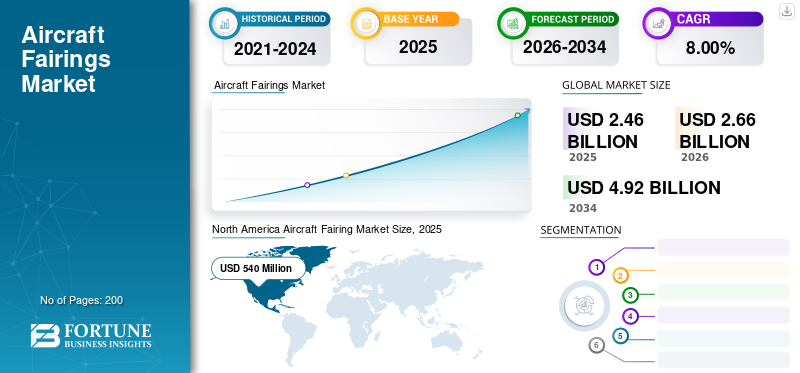
Download Free sample to learn more about this report.
Aircraft Fairings Market Key Takeaways
 Market Size & Forecast
- 2025 Market Size: USD 2.46 Billion
- 2026 Market Size: USD 2.66 Billion
- 2034 Forecast Market Size: USD 4.92 Billion
- CAGR: 8.00% from 2026–2034
 Market Share
- North America dominated the aircraft fairings market with a 38.3% share in 2025.
- The commercial platform segment dominated the market.
- The composite material segment held the largest market share.
 Key Regional Highlights
North America
North America accounted for USD 540.0 million in market revenue in 2025 and held the largest regional market share.
Asia Pacific
Asia Pacific is expected to witness the fastest market growth, supported by expanding aircraft fleets and rising demand for composite fairings.
Europe
Europe is projected to record steady growth, driven by strong aerospace manufacturing capabilities and fleet modernization programs.
U.S.
The U.S. market is supported by commercial aircraft production, defense modernization, and extensive MRO activities.
Japan
Japan is expected to witness steady growth, driven by precision manufacturing, composite material adoption, and collaboration with global aircraft manufacturers.
Read More

Aircraft Fairings Market Trends
Download Free sample to learn more about this report.
Embracing 3D Printing for Aircraft Components and Parts to Augment Growth
Aerospace 3D printing is the simplest way to fabricate advanced composite and 3D printed metal parts from on-demand MRO and spare parts in commercial aviation to innovation in Urban Air Mobility. The aerospace industry leaders improve responsiveness to rapidly shifting supply chains and labor availability with additive manufacturing. In 2019, the aviation industry contributed approximately 16% of 3D printing’s USD 4.9 billion global revenues. For instance,
- In November 2021, Materialize and Proponent announced a partnership that will expand the profile of 3D printing in aerospace aftermarket supply chains. Proponent delivers traditional distribution services to airlines, MROs, and OEMs and offers an innovative product portfolio. The company delivers 54 million parts per year to close to 6,000 aerospace clients through its reach in over 100 countries. These companies offer aftermarket parts such as engines, airframes, cabin interiors, and cockpits.
- North America witnessed aircraft fairing market growth from USD 641.9 Million in 2019 to USD 540 Million in 2020.
Lightweight material adoption defines current aircraft fairing market trends. Manufacturers increasingly replace aluminum with composite and hybrid structures to reduce mass and improve efficiency. This trend aligns with airline fuel optimization priorities.
Advanced manufacturing techniques are gaining traction. Automated fiber placement, resin transfer molding, and additive manufacturing improve consistency and reduce waste. These methods support scalable production and shorter lead times. Digital engineering is reshaping design processes. Computational fluid dynamics and digital twins enable precise aerodynamic optimization and virtual testing. This reduces physical prototyping requirements and accelerates certification preparation.
Modular fairing architectures are becoming more common. Modular designs simplify maintenance, replacement, and upgrades. This improves aircraft availability and lowers lifecycle costs for operators. Noise reduction integration represents another trend. Fairings increasingly incorporate acoustic treatments to support compliance with airport noise regulations. This is particularly relevant for engine and landing gear applications.
Market Drivers
Increased Demand for Composite Aerostructures to Boost Market
Weight has always been of primary concern to aero-structures engineers who select high-strength-to-weight ratio materials to meet payload requirements with short runway performance necessities. Any reduction in airframe weight provides relief to energy consumption. The rising demand for lightweight aerostructures such as doors, control surfaces, and fairings across the globe is the key factor responsible for the aircraft fairing market growth during the forecast period. For instance,
- In April 2021, Airbus planned to enhance its aerostructures assembly value chain across its industrial supply chain and focus on the prime business of aerostructures assembly. Airbus also planned to create two aerostructures assembly companies.
Rising Procurement of Lightweight Aircraft to Boost Market Growth
The rising acquisition of aircraft grew due to better attributes and improved fuel efficiency. Moreover, with the rising fleet expansion demand and the growth of low-cost carriers, the market has witnessed a surge in the commercial aircraft sector, which is supporting the surge in product demand. Moreover, the rising adoption of military trainer and fighter aircraft by various governments to expand defense competency is also likely to aid the market's growth.
- In December 2021, Boeing and 777 Partners received an order for an additional 30 737 MAX fuel-efficient, single-aisle jets. This new order is expected to expand the portfolio of 777 Partners to a total of 68,737 MAXs
Aircraft production growth is the primary driver of the aircraft fairing market. Rising global air travel demand supports sustained narrowbody and widebody manufacturing programs. Each aircraft requires multiple fairings across the fuselage, engine, and landing gear systems, creating recurring demand.
Fuel efficiency imperatives further accelerate adoption. Fairings reduce aerodynamic drag, lower fuel burn, and improve overall aircraft performance. Airlines prioritize incremental efficiency gains to manage operating costs and emissions compliance. This directly elevates fairing design importance. Defense modernization also drives demand. Military aircraft require specialized fairings to protect sensors, radar systems, and mission equipment. Increased defense budgets support the procurement of advanced platforms with higher specification fairing requirements.
Material innovation reinforces growth. Composite fairings offer weight reduction, corrosion resistance, and design flexibility compared to traditional metallic structures. Manufacturers increasingly adopt composites to meet performance targets and certification standards. Aftermarket activity provides additional momentum. Aging fleets require replacement and repair of fairings due to wear, damage, or upgrades. Maintenance, repair, and overhaul providers sustain steady demand independent of new aircraft deliveries.
Market Restraints
Backlogs in Aircraft Orders May Hinder Market Growth
Accumulated orders with aircraft manufacturers are a major attribute that is accountable for impediments in contracted aircraft deliveries. Other than delayed orders, the impact of the coronavirus in early 2020 was a pivotal restraint for the entire aviation industry as it was afflicted with order cancellations, setbacks in aircraft deliveries, and remarkable losses. These factors triggered a decline in global commercial aircraft deliveries that accounted for 723 aircraft, 42% than 2019 and 55.3% compared to 2018. This decline registered as the second consecutive year that faced a decrease in aircraft deliveries.
- In December 2020, Embraer, a dominant player, reported that Embraer Commercial Aviation registered a 75% reduction in aircraft deliveries from 2020 to 2021, comparatively.
High manufacturing complexity restrains the aircraft fairing market. Fairings require precise aerodynamic shaping, tight tolerances, and certification compliance. These requirements increase development timelines and production costs.
Material cost volatility presents another constraint. Composite materials and specialized alloys are subject to pricing fluctuations and supply availability risks. This affects cost planning for suppliers and original equipment manufacturers.
Certification and regulatory processes also limit flexibility. Fairings must meet stringent airworthiness, fire resistance, and durability standards. Any design modification requires extensive testing and approval, slowing innovation cycles. Supply chain disruptions pose ongoing challenges. Fairing production depends on specialized tooling, skilled labor, and long lead-time materials. Disruptions can delay aircraft assembly and aftermarket support.
Market Opportunities
Fleet expansion presents a significant opportunity within the aircraft fairing market. Rising aircraft deliveries across commercial and regional segments increase demand for original equipment fairings. High production rates create long-term supply visibility. Aftermarket services offer additional upside. Airlines and maintenance providers require replacement fairings for damage repair, upgrades, and lifecycle extension. Customized aftermarket solutions support recurring revenue streams.
Defense procurement creates a strategic opportunity. New military aircraft programs require advanced fairings for sensors, radars, and mission systems. Higher specification requirements support premium pricing and technology differentiation. Material innovation provides growth potential. Development of recyclable composites and advanced alloys enables performance improvements while addressing sustainability objectives. Suppliers that lead material qualification gain a competitive advantage.
Digital manufacturing investment creates efficiency gains. Automation, data integration, and predictive quality systems reduce costs and improve margins. These capabilities support scalable growth. Emerging markets offer incremental opportunity. Aircraft fleet growth in Asia-Pacific, the Middle East, and Latin America supports demand for both original equipment and aftermarket fairings. Local production partnerships further expand addressable opportunities.
Segmentation Analysis
The aircraft fairing market is structured around aircraft platform requirements, functional application areas, and material selection strategies. Segmentation dynamics reflect how aircraft manufacturers and operators balance aerodynamic performance, weight optimization, certification complexity, and lifecycle cost considerations. These trends determine value concentration, supplier positioning, and long-term aircraft fairing market growth trajectories across civil and defense aviation programs.
By Platform Analysis
To know how our report can help streamline your business, Speak to Analyst
Commercial Segment to Dominate Market in 2020
Based on platform, this market is segmented into commercial, military, regional, and general aviation.
Commercial Aircraft
The commercial segment held a dominant share in 2020. However, the commercial segment has made great advancements and developed significantly. The commercial segment is expected to rule the market during the forecast, owing to the rise in procurement of modern-generation aircraft. Modern airplanes are lightweight and have prioritized passenger comfort.
- The Military segment is expected to hold a 12.3% share in 2020.
Commercial aviation represents the largest demand segment within the aircraft fairing market. Narrowbody and widebody aircraft programs require extensive fairing integration across fuselage joints, engine nacelles, wing-body interfaces, and landing gear assemblies. Airlines prioritize fuel efficiency and noise reduction, elevating the role of fairings in drag minimization. High production volumes create stable demand, while fleet commonality supports standardized designs. Commercial aircraft dominate the aircraft fairing market size due to scale and continuous replacement cycles driven by high utilization rates.
Military Aircraft
The military aircraft segment is anticipated to grow at the highest CAGR in the near future. The rapid growth of the segment can be attributed to the increasing procurement of multi-role, combat, and transport aircraft. Moreover, high military budgets in developed and developing economies are major factors responsible for segment growth during the forecast period.
Military platforms demand specialized fairings designed to protect sensors, weapons interfaces, radar systems, and mission equipment. These fairings often require enhanced durability, electromagnetic compatibility, and low observability features. Adoption behavior reflects defense modernization priorities and mission-specific customization. Although volumes are lower than commercial programs, higher specification requirements contribute disproportionately to aircraft fairing market share in value terms. Long program lifecycles and retrofit activity sustain recurring demand.
Regional Aircraft
Regional aircraft fairing demand is driven by fleet renewal and route optimization strategies. Operators focus on efficiency and operating cost reduction, emphasizing lightweight fairing solutions. Production volumes are smaller, but steady replacement cycles and growing regional connectivity support consistent demand. Suppliers serving this segment benefit from design reuse and cost-efficient manufacturing approaches.
General Aviation
General aviation represents a smaller but diverse segment. Fairings support performance improvement, noise control, and system protection across business jets and private aircraft. Demand is fragmented and often customization-driven. While contributing modestly to the aircraft fairing market size, this segment supports innovation in lightweight materials and rapid manufacturing methods.
By Application Analysis
Advancements in Structural Components to Compel Fuselage Segment to Dominate Market in 2020
The market is segmented by application into fuselage, engine, control surfaces, radars and antennas, and landing gear.
Fuselage Fairings
The fuselage segment held the highest market share in 2020 and is expected to perform the same during the forecast, with the highest CAGR. This growth is attributed to advancements in structural parts and components with less weight and more efficiency.
Fuselage fairings account for a substantial share of demand due to their role in smoothing airflow between structural interfaces. These fairings reduce drag at junctions between fuselage sections, wings, and tail assemblies. Adoption is universal across aircraft platforms. Design complexity and aerodynamic sensitivity make this application strategically important for fuel efficiency optimization.
Engine Fairings
Engine fairings include nacelles, inlet lips, and exhaust components designed to streamline airflow and reduce noise. These fairings must withstand high thermal and mechanical loads. Demand is driven by engine efficiency improvements and emissions regulations. Engine fairings command a higher value due to material requirements and certification complexity, contributing significantly to the aircraft fairing market share.
Control Surfaces Fairings
Fairings associated with control surfaces improve aerodynamic smoothness around hinges, actuators, and gaps. These components support performance consistency and reduce turbulence. Adoption is standard across all aircraft categories. While smaller in size, their cumulative volume supports steady market demand.
Radars and Antenna Fairings
Radar and antenna fairings, often referred to as radomes, protect sensitive avionics while maintaining signal transparency. Demand is strongest in military and advanced commercial aircraft. These fairings require specialized materials and precise manufacturing. Their strategic importance and technical complexity support premium pricing and value concentration within the aircraft fairing market.
Landing Gear Fairings
The landing gear segment is one of the emerging segments due to the adoption of lighter and more robust landing gear. The players involved in the production business are manufacturing strong and lighter landing gear without compromising its functions, operations, performance, safety, and maintenance requirements. Thus, higher growth numbers are expected during the forecast period.
Landing gear fairings reduce drag and noise during flight phases when gear is deployed. Adoption is driven by regulatory pressure and efficiency improvement initiatives. These fairings must balance aerodynamic benefit with structural robustness. Growth is supported by retrofit programs and noise compliance upgrades.
By Material Analysis
Composite Segment to Rule Market Due to Exceptional Properties
Based on material, the market is segmented into aluminum, composite, and alloys.
Composite Materials
The composite segment held the most significant market share in 2020. The rising demand for lightweight and fuel-efficient aerostructures, power plants, and other global systems is one of the major factors responsible for the segment's growth during the forecast period. Moreover, the key companies involved in this market derive a significant share of their revenue from selling composite parts and components.
Composite fairings represent the fastest-growing material segment. Carbon fiber and glass fiber composites offer superior strength-to-weight ratios, corrosion resistance, and design flexibility. Adoption is driven by fuel efficiency targets and lifecycle cost considerations. Composite fairings increasingly dominate new aircraft programs, reinforcing their role in aircraft fairing market growth. Suppliers investing in composite certification and automation gain a competitive advantage.
Aluminum
The aluminum segment is estimated to witness sluggish growth. This decline is attributed to decreased demand for metal aero structures due to their high operating and maintenance costs. Aluminum fairings remain widely used due to established manufacturing processes and cost efficiency. Adoption persists in applications where weight sensitivity is lower or where legacy designs dominate. However, aluminum’s share is gradually declining as composite alternatives gain traction. Aluminum still contributes meaningfully to the aircraft fairing market size, particularly in aftermarket and regional aircraft applications.
Alloys
Advanced alloys, including titanium-based solutions, are used in high-stress or high-temperature applications. These materials offer durability and performance advantages but involve higher costs. Adoption is selective and application-specific. Alloys support niche requirements within the aircraft fairing market, particularly in engine and military applications.
REGIONAL INSIGHTS
North America Aircraft Fairing Market Size, 2025 (USD Million)
To get more information on the regional analysis of this market, Download Free sample
The global market is segmented into North America, Europe, Asia Pacific, and the Rest of the World.
North America Aircraft Fairing Market Analysis:
North America represents a major aircraft fairing market supported by strong commercial aircraft production, defense procurement, and aftermarket activity. Aircraft manufacturers emphasize aerodynamic efficiency and lightweight structures. High adoption of composite fairings and advanced manufacturing supports demand. Sustained fleet utilization and ongoing maintenance requirements reinforce stable aircraft fairing market growth across commercial, military, and general aviation programs regionally.
North America's market value stood at USD 540.0 million in 2020. This large share is due to several prominent players, such as the Boeing Company and Malibu Aerospace. Additionally, the market growth in the region is due to the increasing use of aircraft for air travel and cargo operations. Known airline operators and cargo operators such as Delta, American Airlines, FedEx, and UPS hold the majority. In addition, the region has vast assembly lines for all-sized aircraft for different applications.
United States Aircraft Fairing Market:
The United States aircraft fairing market is driven by large commercial aircraft programs, defense modernization, and extensive maintenance, repair, and overhaul activity. Aircraft manufacturers and suppliers invest in composite fairing solutions to improve efficiency and meet regulatory standards. Strong domestic supply chains and certification expertise support continued aircraft fairing market size expansion across original equipment and aftermarket channels nationwide.
Europe Aircraft Fairing Market Analysis:
The European aircraft fairing market benefits from strong aerospace manufacturing capabilities and fleet renewal programs. Aircraft manufacturers emphasize fuel efficiency, noise reduction, and sustainability. Composite material adoption is widespread across commercial and defense platforms. Regulatory alignment and cross-border production networks support consistent aircraft fairing market growth throughout the region’s integrated aerospace ecosystem and long-term aircraft development initiatives.
The European aircraft fairing market will grow moderately due to dominant players and OEMs such as Leonardo Spa, Saab AB, and Airbus. These companies hold a major share in the aerostructure market. Thus, higher growth numbers are anticipated in the forthcoming years.
Germany Aircraft Fairing Market:
Germany plays a significant role in the European aircraft fairing market through advanced engineering, materials expertise, and component manufacturing. Suppliers focus on precision composite fairings for commercial and defense aircraft. Strong integration with original equipment manufacturers supports stable demand. Investment in automation and quality systems sustains aircraft fairing market share growth aligned with efficiency and reliability priorities.
United Kingdom Aircraft Fairing Market:
The United Kingdom aircraft fairing market is supported by aerospace manufacturing strength and defense aviation programs. Suppliers provide advanced fairings for engines, radars, and fuselage applications. Focus on lightweight materials and digital design to enhance competitiveness. Ongoing investment in aerospace innovation supports steady aircraft fairing market growth across commercial, military, and specialized aviation platforms.
Asia-Pacific Aircraft Fairing Market Analysis:
Asia-Pacific represents the fastest-growing aircraft fairing market, driven by expanding aircraft fleets and rising air travel demand. Aircraft manufacturers and maintenance providers increase the adoption of composite fairings to improve efficiency. Regional production growth and aftermarket demand support aircraft fairing market size expansion across commercial, regional, and defense aircraft programs serving domestic and international operators.
The market in the Asia Pacific region will hold a substantial growth rate during the forecast period. Emerging countries, such as China and Japan, are expected to occupy the major market share in this region. The Indian aviation industry is witnessing a rapidly expanding commercial aviation sector, and will witness the fastest-growing aerostructures market, including fairings and other control surfaces, over the same period.
Japan Aircraft Fairing Market:
Japan's aircraft fairing market emphasizes precision manufacturing, lightweight structures, and quality compliance. Suppliers focus on composite fairings for commercial and defense aircraft applications. Strong collaboration with global aircraft manufacturers supports demand stability. Continuous investment in advanced materials and process optimization sustains aircraft fairing market growth aligned with performance and reliability requirements.
China Aircraft Fairing Market:
China’s aircraft fairing market is driven by rapid aircraft fleet expansion and domestic aerospace development programs. Manufacturers increase production of composite fairings to support indigenous aircraft platforms. Strong government support and supply chain localization accelerate capacity growth. These factors contribute to rising aircraft fairing market share and expanding participation in global aerospace supply networks.
Latin America Aircraft Fairing Market Analysis:
Latin America shows moderate aircraft fairing market growth supported by fleet expansion and maintenance demand. Airlines prioritize efficiency upgrades and fairing replacement during overhaul cycles. Limited local manufacturing increases reliance on imports, but regional maintenance activity sustains steady demand. Long-term aircraft utilization trends support incremental aircraft fairing market growth across commercial aviation operators.
Middle East & Africa Aircraft Fairing Market Analysis:
The Middle East and Africa aircraft fairing market is driven by airline fleet expansion and heavy maintenance activity. Operators invest in aerodynamic upgrades and replacement fairings to improve efficiency. Limited manufacturing presence increases dependence on global suppliers. Continued aircraft utilization and defense procurement support gradual aircraft fairing market growth across the region.
Aircraft Fairing Industry Competitive Landscape:
Key Players Are Focused on Providing Lightweight Aircraft Fairings and Other Structural Parts
The competitive landscape of the market depicts the domination of selected players such as Boeing, Airbus, and Strata Manufacturing. These companies design and develop advanced aerostructures, including fairings, control surfaces, and other structural components. Moreover, these companies are expanding their geographic reach in Asian countries. For instance, in February 2021, Boeing announced that it would be adding a new production line at the Hyderabad facility of its joint venture with the Tata Group, Tata Boeing Aerospace Limited (TBAL), to manufacture complex vertical fins for 737-MAX family aircraft.
The aircraft fairing industry's competitive landscape is characterized by a concentrated group of established aerospace component manufacturers supported by a network of specialized composite fabricators and tier-two suppliers. Competition is shaped by certification capability, manufacturing precision, and long-term integration with aircraft original equipment manufacturers. Entry barriers remain high due to stringent airworthiness standards and qualification requirements.
Leading suppliers hold a significant aircraft fairing market share through multi-program participation across commercial, military, and regional aircraft platforms. These companies benefit from long production cycles, high switching costs, and embedded positions within aircraft development programs. Their portfolios typically span fuselage, engine, landing gear, and radome fairings, enabling cross-platform scale efficiencies.
Mid-sized and emerging suppliers increasingly compete through composite specialization and automation. Investment in advanced materials, automated fiber placement, and digital quality control improves cost competitiveness and lead times. These firms often secure work packages for specific fairing assemblies or aftermarket replacements rather than full platform coverage.
Strategic partnerships are central to competitive positioning. Collaboration with aircraft manufacturers, engine producers, and maintenance providers supports early design involvement and lifecycle service opportunities. Joint ventures and long-term supply agreements enhance capacity planning and risk sharing.
Competitive differentiation increasingly depends on material innovation, manufacturing efficiency, and aftermarket responsiveness. Suppliers capable of delivering lightweight, modular, and easily maintainable fairing solutions gain an advantage. Overall, the aircraft fairing market favors technically credible suppliers with proven certification records, scalable production, and strong integration across global aerospace value chains.
List of Top Aircraft Fairings Companies:
- Malibu Aerospace (U.S.)
- FACC AG (Austria)
- Daher (France)
- NORDAM (U.S.)
- Airbus (France)
- Boeing (U.S.)
- Avcorp (Canada)
- Barnes Group (U.S.)
- Royal Engineered Composites (U.S.)
- Fiber Dynamics Inc. (U.S.)
- FDC Composites (Canada)
- Kaman Aero systems (U.S.)
- SAAB AB (Sweden)
- Lockheed Martin (U.S.)
- Shin Maywa (Japan)
- Strata Manufacturing (UAE)
Latest Aircraft Fairing Industry Developments:
- January 2024: Spirit AeroSystems expanded composite fairing production capacity to support higher narrowbody aircraft output, strengthening supply reliability through automated composite manufacturing capabilities.
- April 2024: GKN Aerospace introduced an advanced composite radome fairing solution, targeting improved signal transparency using optimized material layup and precision fabrication technologies.
- August 2024: Daher enhanced its aircraft fairing manufacturing processes by integrating digital inspection systems, aiming to improve quality assurance through real-time production monitoring capabilities.
- February 2025: Triumph Group secured a long-term agreement to supply engine and fuselage fairings for a next-generation aircraft program, supporting efficiency objectives using lightweight composite structures.
- June 2025: FACC invested in expanded fairing assembly facilities to support increased aftermarket demand, enabling faster turnaround through modular design and automated finishing technologies.
REPORT COVERAGE
The market research report provides a detailed analysis of the market and focuses on critical aspects such as leading companies, product types, and leading product applications. It also offers insights into market trends and highlights key industry developments. In addition to the factors mentioned above, the report encompasses several factors that have contributed to the market's growth in recent years.
Report Scope & Segmentation
|
ATTRIBUTE |
DETAILS |
|
Study Period |
2021-2034 |
|
Base Year |
2025 |
|
Estimated Year |
2026 |
|
Forecast Period |
2026-2034 |
|
Historical Period |
2021-2024 |
|
Unit |
Value (USD Billion) |
|
Segmentation |
By Platform
|
|
By Application
|
|
|
By Material
|
|
|
By Geography
|
Frequently Asked Questions
According to Fortune Business Insights, the global aircraft fairings market size was USD 1.41 billion in 2020 and is projected to grow from USD 1.46 billion in 2021 to USD 2.60 billion by 2028, exhibiting a CAGR of 8.59% during the forecast period.
The market will exhibit steady growth of 8.59% during the forecast period (2021-2028).
Aircraft fairings are aerodynamic structures designed to reduce drag, cover gaps between aircraft parts, and enhance fuel efficiency. They are used in fuselages, engines, landing gear, control surfaces, and antenna housings across commercial, military, and regional aircraft.
North America dominates the aircraft fairings market with a 38.3% share in 2020, driven by major OEMs like Boeing, Malibu Aerospace, and strong commercial aviation and cargo operations in the United States.
The key materials used are composites, aluminum, and alloys. Composite materials lead the market due to their lightweight properties, high strength-to-weight ratio, and fuel efficiency benefits in modern aircraft manufacturing.
Key growth drivers include increased passenger air traffic, rising demand for fuel-efficient lightweight composites, growth in low-cost carriers, and military aircraft procurement programs in emerging economies.
The commercial aircraft segment holds the largest share, supported by high production volumes of passenger aircraft, expansion of airline fleets, and growing demand for fuel efficiency and aerodynamics in modern aircraft designs.
Major trends include adoption of 3D printing for fairing components, use of advanced composite materials, development of multifunctional fairings with integrated sensors, and expansion of aftermarket MRO services for aerostructures.
Leading companies include Boeing, Airbus, Malibu Aerospace, Strata Manufacturing, FACC AG, Daher, Lockheed Martin, and SAAB AB. These companies focus on lightweight composite solutions, advanced aerostructure design, and global supply chain expansion.
The market is expected to reach USD 2.60 billion by 2028, fueled by rising aircraft deliveries, increased defense spending, technological advancements in composite fairings, and expansion of aviation in Asia Pacific and the Middle East.



- 2021-2034
- 2025
- 2021-2024
- 200
Get 30-60 hrs Free Customization
Expand Regional and Country Coverage, Segments Analysis, Company Profiles, Competitive Benchmarking, and End-user Insights.




















Related Reports
-
US +1 833 909 2966 ( Toll Free )
-
Get In Touch With Us