Airport Digital Twin Technology Market Size, Share & Industry Analysis, By Component (Software/Platform, Hardware & Data Capture Infrastructure & Services), By Airport Area (Airside, Terminal, Landside/Curbside, Facilities & Total Airport Operations), By Technology (BIM/GIS & Common Data Environment, IoT & Edge Data Capture, AI/ML, Simulation, Cloud/Data Lake, AR/VR/MR Visualization, and Cybersecurity & Data Governance), By Application (Airside Operations, Asset Management & Maintenance, Passenger Flow & Terminal Operations, Security & Emergency), & Regional Forecast, 2026-2034
 Download Free Sample
Airport Digital Twin Technology Market Size and Future Outlook
 Listen to Audio Version
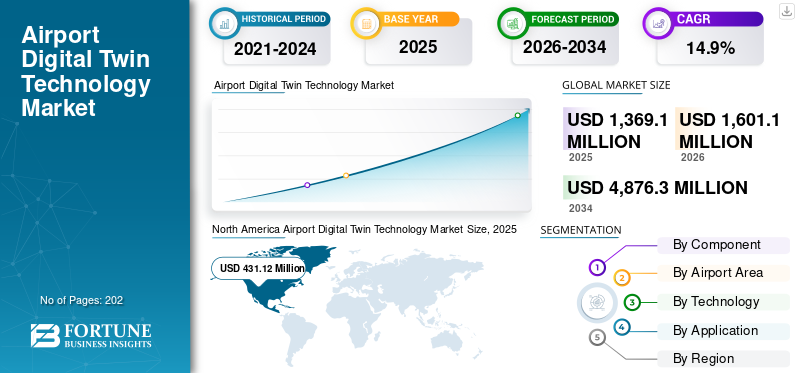
The global airport digital twin technology market size was valued at USD 1,369.1 million in 2025. The market is projected to grow from USD 1,601.1 million in 2026 to USD 4,876.3 million by 2034, exhibiting a CAGR of 14.9% during the forecast period. North America dominated the airport digital twin technology market with a market share of 31.49% in 2025.
The airport digital twin technology market is gaining traction as airport operators globally seek intelligent, data-driven approaches to managing complex, increasingly congested infrastructure. A digital twin creates a dynamic virtual replica of an airport's physical assets, operational systems, and passenger flows, enabling real-time monitoring, simulations, and predictive decision-making. Airports are deploying these platforms to optimize terminal operations, improve asset maintenance, enhance safety management, and elevate the passenger experience. The convergence of Internet of Things sensors, artificial intelligence, building information modeling, and cloud computing is making digital twins more accessible and impactful. Both greenfield airport developments and legacy hub expansions are embracing this technology to build smarter, more resilient aviation infrastructure.
Key players in the market include Siemens AG, SITA, Thales Group, Dassault Systèmes, Bentley Systems, Esri, Autodesk Inc., Hexagon AB, Veovo, and Honeywell International Inc. These companies compete through the sophistication of their simulation and modeling engines, depth of real-time IoT and operational data integration, interoperability with existing airport management systems, and the scalability of their platforms from single terminals to entire multi-airport networks. Competitive differentiation is further driven by capabilities in AI-powered predictive analytics, cybersecurity frameworks for critical infrastructure, and specialized domain expertise in airside operations, baggage handling, energy management, and passenger flow optimization tailored to the unique demands of civil aviation environments.
Download Free sample to learn more about this report.
Airport Digital Twin Technology Market Key Takeaways
 Global Market Size & Forecast
- 2025 Market Size: USD 1,369.1 million
- 2026 Market Size: USD 1,601.1 million
- 2034 Forecast Market Size: USD 4,876.3 million
- CAGR: 14.9% from 2026–2034
 Market Share
- North America dominated the airport digital twin technology market with a 31.49% share in 2025.
- Software/platform segment held the largest market share in 2025 due to rising demand for integrated digital solutions.
- Airside segment dominated in 2025, driven by the need for runway optimization and turnaround efficiency.
 Key Regional Highlights
North America
North America reached USD 431.12 million in 2025, leading the market with strong digital aviation investments.
Europe
Europe is projected to reach USD 470.6 million in 2026, driven by smart airport and sustainability initiatives.
Asia Pacific
Asia Pacific is expected to grow at a 15.8% CAGR, reaching USD 427.6 million in 2026.
U.S.
Market estimated at USD 434.4 million in 2026, supported by airport modernization efforts.
Japan
Market estimated at USD 61.1 million in 2026, driven by digital airport transformation.
Read More

AIRPORT DIGITAL TWIN TECHNOLOGY MARKET TRENDS
Integration of AI and Real-Time IoT Data to Evolve Digital Twins into Autonomous Decision Support Tools
The most prominent trend in the market is the evolution of digital twins from static visualization platforms into AI-augmented, real-time operational intelligence systems. Airports are embedding dense networks of IoT sensors across runways, gates, baggage systems, and utilities, feeding continuous data streams into twin environments that can autonomously detect anomalies, simulate disruption scenarios, and recommend corrective actions. Machine learning models trained on historical operational data are enhancing predictive maintenance capabilities, reducing unplanned asset downtime. The integration of digital twins with air traffic management and airline operational control systems is further blurring the boundary between infrastructure management and flight operations, creating a unified operational picture.
MARKET DYNAMICS
MARKET DRIVERS
Download Free sample to learn more about this report.
Rising Operational Complexity and Demand for Predictive Infrastructure Management at Major Hubs Fuel Market Growth
Growing passenger volumes, fleet diversification, and tightening operational efficiency mandates are compelling major airport operators to adopt digital twin technologies as foundational management tools. Traditional reactive maintenance and manual scheduling approaches are proving inadequate for the complexity of modern hub airports, which handle thousands of daily aircraft movements. Digital twins address this by enabling continuous asset health monitoring, simulation-based capacity planning, and scenario modeling for disruption management. Regulatory pressure to improve safety compliance documentation and emergency preparedness is further accelerating adoption, as digital twins provide auditable, real-time operational records. The financial case is reinforced by demonstrable reductions in maintenance costs, gate turnaround times, and energy consumption achievable through predictive twin-enabled operations. All these factors are boosting the airport digital twin technology market growth.
MARKET RESTRAINTS
High Implementation Costs and Data Integration Complexity across Legacy Airport Systems Limit Market Growth
The primary restraints limiting faster adoption of airport digital twin technology are the substantial upfront investment requirements and the formidable challenge of integrating digital twin platforms with the heterogeneous legacy systems prevalent in established airports. Many major hubs operate aging infrastructure management, baggage, and passenger processing systems that were not designed for open data exchange, requiring costly middleware development and phased migration strategies. Smaller regional airports often lack the capital budgets and in-house technical expertise needed to implement and sustain enterprise-grade digital twin deployments. Data governance concerns, including ownership, privacy, and the security of operationally sensitive information flowing through twin environments, also impose additional compliance costs that can slow procurement decisions.
MARKET OPPORTUNITIES
Expansion of Digital Twin Adoption in Airport Infrastructure Development Creates New Market Growth Opportunities
A compelling market opportunity lies in the rapid expansion of airport infrastructure underway across Asia Pacific, the Middle East & Africa, and Latin America, where governments are investing heavily in new capacity to meet surging aviation demand. These greenfield and major brownfield projects offer an ideal environment for embedding digital twin frameworks from the design phase, enabling a fully data-driven operational model from inception rather than costly retrofitting. Additionally, the drive toward net-zero airports is creating demand for digital twin capabilities focused on energy management, carbon footprint simulation, and sustainability reporting. Smart city integration initiatives are also generating interest in connecting airport digital twins with wider urban mobility and utility infrastructure platforms.
MARKET CHALLENGES
Ensuring Cybersecurity Resilience and Data Governance in Highly Connected Airport Twin Environments are Key Market Challenges
As airport digital twins aggregate vast quantities of real-time operational, infrastructure, and passenger data across interconnected systems, cybersecurity has emerged as a critical market challenge. The expanded digital attack surface created by IoT sensor networks, cloud connectivity, and third-party integrations exposes airports to heightened risks of data breaches, ransomware, and operational disruption through cyber intrusion. Regulatory frameworks governing critical national infrastructure are imposing stringent cybersecurity standards that digital twin deployments must satisfy, adding compliance complexity. Establishing clear data governance protocols, including defining ownership boundaries between airport operators, airlines, technology vendors, and government agencies, remains contentious. These challenges demand continuous security investment and robust incident response planning embedded within digital twin architectures from the outset.
Segmentation Analysis
By Component
Rising Complexity of Airport Operations Fueled Software/Platform Segment Growth
Based on component, the market is segmented into software/platform, hardware & data capture infrastructure, and services.
The software/platform segment held the largest market share in 2025. As airports contend with growing passenger throughput, multi-system interdependencies, and real-time decision requirements, demand for sophisticated software and platform solutions is accelerating. Digital twin platforms serve as the unifying intelligence layer, integrating data from sensors, operational systems, and external sources, enabling airport operators to monitor, simulate, and dynamically optimize performance. The increasing shift toward cloud-native, AI-augmented platforms with open APIs further positions software as the primary value driver in airport digital twin deployments.
The services segment is anticipated to rise with a CAGR of 14.9% over the forecast period.
By Airport Area
Intensifying Pressure to Maximize Runway Utilization and Minimize Ground Delays Boosted Airside Segment Growth
Based on airport area, the market is segmented into airside, terminal, landside/curbside, facilities & utilities, and enterprise/total airport operations.
In 2025, the airside segment dominated the global market. Airside operations are among the most time-critical and safety-sensitive domains in airport management, making them a primary focus of digital twin investment. Real-time virtual modeling of runways, taxiways, aprons, and ground support equipment enables operators to identify bottlenecks, simulate traffic scenarios, and prevent conflicts before they materialize. Growing air traffic volumes and the financial penalties associated with ground delays are compelling airports to deploy airside digital twin capabilities as essential tools for throughput optimization and safety assurance.
The enterprise/total airport operations segment is projected to grow at a CAGR of 16.2% over the forecast period.
To know how our report can help streamline your business, Speak to Analyst
By Technology
Accelerating Airport Infrastructure Expansion to Boost BIM/GIS & Common Data Environment Segment Growth
Based on technology, the market is segmented into BIM/GIS & common data environment, IoT & edge data capture, AI/ML, simulation & optimization, cloud/data lake & integration middleware, AR/VR/MR visualization, and cybersecurity & data governance.
The BIM/GIS & common data environment segment is anticipated to witness a dominating airport digital twin technology market share over the forecast period 2026-2034. Large-scale airport construction and renovation projects are generating substantial demand for BIM and GIS-integrated common data environments that provide a single source of truth across design, construction, and operational phases. These technologies underpin the spatial intelligence layer of airport digital twins, enabling precise asset tracking, infrastructure planning, and regulatory compliance documentation. The push toward sustainable airport design, combined with the need to manage aging infrastructure intelligently, is reinforcing the adoption of BIM/GIS-enabled digital twin frameworks among airport developers and operators globally.
The AI/ML, simulation & optimization segment is projected to grow at a high CAGR of 15.8% over the forecast period.
By Application
Mounting Airline Pressure to Reduce Turnaround Times Fueled Airside Operations & Turnaround Optimization Segment Growth
Based on application, the market is segmented into airside operations & turnaround optimization, predictive asset management & maintenance, passenger flow & terminal operations, safety, security & emergency response, and others.
The airside operations & turnaround optimization segment dominated the market share in 2025. Aircraft turnaround efficiency directly impacts airline punctuality, operational costs, and airport capacity utilization, making this segment a high-priority investment area. Digital twin solutions for turnaround optimization provide real-time visibility into ground handling, fuel servicing, crew positioning, and boarding sequences, enabling proactive coordination among all stakeholders. As low-cost carriers expand and hub airports face congestion, the ability to shave minutes off turnaround cycles through data-driven simulation and predictive alerting delivers measurable financial and operational benefits, sustaining strong demand growth.
The predictive asset management & maintenance segment is projected to grow at a CAGR of 15.3% during the study period.
Airport Digital Twin Technology Market Regional Outlook
By geography, the market is categorized into North America, Europe, Asia Pacific, and the Rest of the World.
North America
North America Airport Digital Twin Technology Market Size, 2025 (USD Million)
To get more information on the regional analysis of this market, Download Free sample
North America held the dominant share in 2024, valued at USD 361.70 million, and also maintained the leading share in 2025, with USD 431.12 million. North America leads digital twin adoption, driven by established aviation infrastructure, significant technology investment capacity, and stringent FAA safety and efficiency mandates that compel major hub airports to modernize operational management through intelligent digital platforms.
U.S. Airport Digital Twin Technology Market
Given North America’s strong contribution and the U.S. dominance in the region, the U.S. market can be estimated at around USD 434.4 million in 2026, representing a roughly 14.5% CAGR over the forecast period. The U.S. market is driven by the need to modernize aging hub airport infrastructure, improve FAA compliance reporting, and enhance resilience against weather-related disruptions, with leading airports deploying digital twin platforms to optimize capacity and reduce operational costs.
Europe
Europe is estimated to reach USD 470.6 million in 2026 and secure the position of the second-largest region in the market. Ambitious net-zero airport commitments are propelling Europe's market, EU digital infrastructure directives, and the dense network of international hub airports that are actively investing in data-driven operations, sustainability tracking, and passenger experience enhancement through digital twin technologies.
U.K. Airport Digital Twin Technology Market
The U.K. market in 2026 is estimated at around USD 103.2 million, representing a roughly 14.8% CAGR over the forecast period. The U.K.'s demand is anchored by capacity-constrained major airports pursuing digital twin deployments to maximize the efficiency of existing infrastructure, comply with evolving CAA regulations, and meet ambitious net-zero aviation targets set by the government and airport operators.
Germany Airport Digital Twin Technology Market
Germany’s market is projected to reach approximately USD 93.0 million in 2026. Germany's strong engineering culture and Lufthansa hub significance are driving digital twin adoption, with Frankfurt and Munich airports investing in platform-based operational intelligence to manage high traffic density, improve punctuality, and advance sustainability certification goals.
Asia Pacific
Asia Pacific is projected to record a CAGR of 15.8% during the forecast period, the highest among all regions, and to reach a valuation of USD 427.6 million in 2026. Asia Pacific represents the fastest-growing regional market, fueled by unprecedented greenfield airport construction across China, India, and Southeast Asia, where digital twin frameworks are being embedded from inception to manage rapidly scaling passenger volumes and complex multi-terminal environments.
China Airport Digital Twin Technology Market
China’s market is projected to be one of the largest in Asia Pacific, with 2026 revenues estimated at around USD 147.7 million. China's aggressive airport expansion program and government-mandated smart airport initiatives are driving widespread adoption of digital twins, with state-backed funding accelerating deployment across newly constructed mega-airports designed to accommodate surging domestic and international aviation demand.
Japan Airport Digital Twin Technology Market
The Japanese market in 2026 is estimated at around USD 61.1 million, accounting for roughly 14.2% of the CAGR during the forecast period. Japan's demand is shaped by the need to upgrade constrained Tokyo and Osaka airport facilities ahead of continued international traffic growth, with operators leveraging digital twin platforms for precise slot management, disaster resilience planning, and post-pandemic operational recovery optimization.
India Airport Digital Twin Technology Market
The Indian market in 2026 is estimated at around USD 80.0 million. India's booming aviation sector, coupled with the government's UDAN regional connectivity scheme and multiple greenfield airport projects, is creating strong demand for digital twin technology as operators seek scalable, cost-efficient platforms to manage rapid capacity growth intelligently.
Rest of the World
The rest of the world includes the Middle East & Africa and Latin America. These regions are expected to witness moderate growth in this market space during the forecast period. The Middle East & Africa and Latin America markets are set to reach valuations of USD 135.3 million and USD 64.5 million, respectively, in 2026. The Middle East, driven by Gulf state mega-airport projects, alongside emerging African and Latin American aviation hubs, is generating rising demand as governments invest in world-class airport infrastructure and seek intelligent management platforms to maximize returns on capital-intensive developments.
COMPETITIVE LANDSCAPE
Key Industry Players
Key Players Focus on Unified Airport Data Platforms, AI-Driven Simulation, and Real-Time Asset Intelligence to Boost Market Growth
The airport digital twin technology market is being strengthened by key players that are shifting airports from static infrastructure models toward live, data-driven operating environments. Companies such as Siemens AG, SITA, Thales Group, Dassault Systèmes, Bentley Systems, Esri, Autodesk, Hexagon, Veovo, and Honeywell are focusing on integrated digital platforms, BIM/GIS-based asset twins, AI-enabled simulation, IoT data capture, cybersecurity, passenger-flow analytics, and airport operations control systems. Siemens is promoting the airport digital twin as a central data ecosystem that brings infrastructure and operational data into a unified “one truth” view, while SITA is positioning digital twins as the future interface for airport operations control, connecting aircraft movements, passenger queues, escalators, curbside traffic, and other live airport functions.
LIST OF KEY AIRPORT DIGITAL TWIN TECHNOLOGY COMPANIES PROFILED
- Siemens AG (Germany)
- SITA (Switzerland)
- Thales Group (France)
- Dassault Systèmes (France)
- Bentley Systems (U.S.)
- Esri (U.S.)
- Autodesk, Inc. (U.S.)
- Hexagon AB (Sweden)
- Veovo (New Zealand)
- Honeywell International Inc. (U.S.)
KEY INDUSTRY DEVELOPMENTS
- April 2026: The National Aerospace Research & Technology Park (NARTP) announced a partnership with the Digital Twin Consortium to develop multi-agent AI digital twins for aviation. This project includes AMD edge HPC and Rowan University DEHub to focus on on-premise AI for air traffic management, cybersecurity, and autonomy.
- November 2025: Vienna Airport entered into a strategic partnership with the Nemetschek Group to deploy advanced digital twin solutions for infrastructure, unifying BIM-based models with live operational data for asset management.
- August 2025: IBM and NASA unveiled Surya, an open-source AI digital twin of the Sun designed to enhance space weather prediction. Trained on nine years of data from NASA's Solar Dynamics Observatory, Surya enables more accurate forecasting of solar flares and eruptions, providing up to two hours of warning, double the time offered by current systems.
- June 2025: Siemens introduced its NX Immersive Designer software paired with Sony’s XR headset at the Paris Air Show. This technology enables aerospace manufacturers to design, review, and edit 3D CAD models in a virtual environment, with early applications showing potential to reduce production costs by as much as 50%.
- December 2024: GMR Airports launched an AI-powered digital twin platform at Rajiv Gandhi International Airport in Hyderabad. The system powers a new Airport Predictive Operations Centre (APOC) that integrates airside, landside, and terminal data.
REPORT COVERAGE
The airport digital twin technology market research provides a detailed analysis of emerging trends and rapidly adopted technologies across key regions. The report outlines key drivers of market growth and challenges to expansion, delivering a detailed overview of the maritime industry landscape. The study highlights recent advancements to boost industry insights and support stakeholders in making well-informed decisions.
Request for Customization to gain extensive market insights.
Report Scope & Segmentation
| ATTRIBUTE | DETAILS |
| Study Period | 2021-2034 |
| Base Year | 2025 |
| Estimated Year | 2026 |
| Forecast Period | 2026-2034 |
| Historical Period | 2021-2024 |
| Growth Rate | CAGR of 14.9% from 2026 to 2034 |
| Unit | Value (USD Million) |
| Segmentation | By Component, By Airport Area, By Technology, By Application, and Region |
| By Component |
|
| By Airport Area |
|
| By Technology |
|
| By Application |
|
| By Region |
|
Frequently Asked Questions
According to Fortune Business Insights, the global market value stood at USD 1,369.1 million in 2025 and is projected to reach USD 4,876.3 million by 2034.
In 2025, the market value of North America stood at USD 431.12 million.
The market is expected to exhibit a CAGR of 14.9% during the forecast period of 2026-2034.
By component, the software/platform segment dominated the market.
Rising operational complexity and demand for predictive infrastructure management at major hubs are driving the market growth.
Siemens AG, SITA, Thales Group, Dassault Systèmes, Bentley Systems, and Esri are a few major players in the global market.
North America dominated the market in 2025.



- 2021-2034
- 2025
- 2021-2024
- 202
Get 30-60 hrs Free Customization
Expand Regional and Country Coverage, Segments Analysis, Company Profiles, Competitive Benchmarking, and End-user Insights.




















-
US +1 833 909 2966 ( Toll Free )
-
Get In Touch With Us