Airport EV Charging Stations Market Size, Share & Industry Analysis, By Charging Level (Level 1 Charging, Level 2 Charging & Level 3/DC Fast Charging), By Charging Capacity (Below 22 kW, 22 kW to 50 kW, 51 kW to 150 kW, 151 kW to 350 kW & Above 350 kW), By Airport Area (Terminal & Passenger Parking Areas, Airside Operations Area, Ground Support Equipment Depot, Logistics Zone), By Charger Type (AC Charging, DC Fast Charging, Ultra-Fast Charging, Wireless/Inductive Charging, Pantograph/Overhead Charging Systems & Battery Swapping/Mobile Charging Units), and Regional Forecast, 2026-2034
 Download Free Sample
Airport EV Charging Stations Market Size and Future Outlook
 Listen to Audio Version
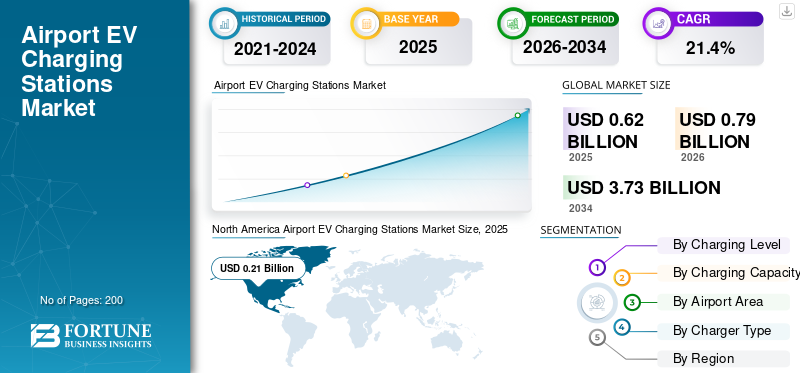
The global airport EV charging stations market size was valued at USD 0.62 billion in 2025. The market is projected to grow from USD 0.79 billion in 2026 to USD 3.73 billion by 2034, exhibiting a CAGR of 21.4% during the forecast period.
Airport EV charging stations encompass a wide range of charging solutions, from standard Level 2 systems to high-power DC fast chargers, catering to diverse airport stakeholders including passengers, ground handlers, and airport operators committed to achieving net-zero targets. The market is experiencing significant growth as airports across the globe transition toward sustainable and electrified ground transportation ecosystems. Driven by the global push for decarbonization, regulatory mandates on carbon emissions, and the rapid adoption of electric vehicles among ground support equipment, airline fleets, and passenger vehicles, airports are increasingly deploying EV charging infrastructure across terminals, parking facilities, and operational zones.
Key players in the market include ChargePoint, ABB E-mobility, Siemens eMobility, Schneider Electric, and Eaton. These companies compete through advanced charging technology portfolios, scalable infrastructure solutions, interoperable network platforms, and high-power fast-charging capabilities. Their strategies encompass smart energy management integration, cloud-based monitoring systems, fleet and passenger vehicle compatibility, and customized airport-grade installations tailored for terminal zones, ground support equipment depots, parking structures, and airside operational environments.
Download Free sample to learn more about this report.
Airport EV Charging Stations Market Key Takeaways
 Global Market Size & Forecast
- 2025 Market Size: USD 0.62 billion
- 2026 Market Size: USD 0.79 billion
- 2034 Forecast Market Size: USD 3.73 billion
- CAGR: 21.4% from 2026–2034
 Market Share
- North America dominated the market with a 33.87% share, valued at USD 0.21 billion in 2025.
- Level 2 Charging segment dominated the market in 2025, driven by rising passenger EV adoption.
- AC Charging Stations segment dominated the market in 2025, owing to cost-effective and scalable deployment.
 Key Regional Highlights
North America
The market reached USD 0.21 billion in 2025, driven by airport electrification and high EV adoption.
Asia Pacific
The market is projected to reach USD 0.22 billion by 2026, driven by airport expansion and EV mandates.
Europe
The market is projected to reach USD 0.24 billion by 2026, supported by EU decarbonization and airport sustainability initiatives.
U.S.
The market is projected to reach USD 0.23 billion by 2026, driven by federal EV infrastructure funding.
Japan
The market is projected to reach USD 0.04 billion by 2026, supported by airport modernization and EV adoption.
Read More

AIRPORT EV CHARGING STATIONS MARKET TRENDS
Smart and Integrated EV Charging Infrastructure is Reshaping Airport Energy Ecosystems
A defining trend in the market is the integration of smart charging technologies with airport energy management systems. Airports are increasingly adopting IoT-enabled chargers, real-time load balancing, and cloud-based monitoring platforms to optimize energy consumption across expansive terminal and parking zones. The convergence of renewable energy sources such as solar canopies with EV charging infrastructure is gaining momentum, enabling airports to reduce grid dependency. Additionally, vehicle-to-grid technology is emerging as a forward-looking trend, allowing airports to leverage parked EVs as distributed energy assets while advancing their broader sustainability and operational efficiency goals.
MARKET DYNAMICS
MARKET DRIVERS
Download Free sample to learn more about this report.
Stringent Emission Regulations and Airport Sustainability Mandates are Driving Market Growth
Increasingly stringent government regulations targeting carbon neutrality and the decarbonization of aviation ground operations are compelling airport authorities to prioritize EV charging infrastructure investment. International bodies, including ICAO and the European Union, have established binding emission reduction frameworks that directly influence airport operational policies. Airports seeking certifications such as ACI's Airport Carbon Accreditation are incentivized to electrify passenger and ground fleet vehicles. These regulatory pressures, combined with airline sustainability commitments and public environmental accountability, are reinforcing EV charging deployment as a core component of modern airport infrastructure development and long-term capital planning strategies.
MARKET RESTRAINTS
High Infrastructure Installation Costs and Grid Capacity Limitations Restrict Market Expansion
The airport EV charging stations market growth is restrained by the substantial capital expenditure associated with installing high-power charging infrastructure across large, complex airport environments. Grid upgrades, underground cabling, transformer installations, and compliance with aviation-grade safety standards substantially elevate deployment costs compared to conventional commercial charging environments. Older airports with legacy electrical infrastructure face particular challenges in accommodating the high energy demands of fast-charging stations. Additionally, utility grid constraints in certain regions limit the simultaneous operation of multiple high-power chargers, creating bottlenecks that deter large-scale rollouts and extend return-on-investment timelines for airport operators and charging network providers.
MARKET OPPORTUNITIES
Electrification of Ground Support Equipment Unlocks Substantial Growth Potential
A transformative opportunity in the market lies in the accelerating electrification of ground support equipment, including baggage tugs, pushback tractors, and service vehicles that operate continuously within airport environments. As major international airports commit to net-zero ground operations, the demand for dedicated high-power charging depots tailored for fleet vehicles is expanding rapidly. Emerging markets across Asia Pacific, the Middle East, and Latin America present greenfield opportunities as new airport infrastructure projects incorporate EV charging by design. Public-private partnerships and airport concession models are further unlocking investment pathways for charging network operators to establish long-term revenue-generating infrastructure.
MARKET CHALLENGES
Operational Complexity and Standardization Gaps Hinder Seamless EV Charging Integration at Airports
One of the key challenges in the market is the lack of universal charging standards and interoperability protocols across diverse vehicle types operating within airport environments, including passenger cars, electric ground support equipment, and electric airside vehicles. Coordinating charging schedules across high-traffic, time-sensitive airport operations without disrupting passenger flow or ground handling activities presents significant logistical complexity. Cybersecurity vulnerabilities in networked charging systems also raise concerns for airport operators managing critical infrastructure. Furthermore, the diverse procurement processes and regulatory frameworks across international airports slow the adoption of standardized solutions, complicating deployment for multinational charging infrastructure providers.
Segmentation Analysis
By Charging Level
Level 2 Charging Segment Led Market Due to Rising Passenger EV Adoption and Airport Dwell Time
Based on charging level, the market is segmented into level 1 charging, level 2 charging, and level 3/DC fast charging.
The level 2 charging segment accounted for the largest airport EV charging stations market share in 2025. Demand for the Level 2 charging is rising as airports recognize the suitability of mid-speed charging for passenger vehicles parked in terminal and long-stay facilities during extended dwell periods. Level 2 stations offer a practical and cost-efficient solution for travelers seeking partial or full charges, supporting widespread EV adoption in airport passenger ecosystems.
The level 3/DC fast charging segment is anticipated to rise with a CAGR of 21.9% over the forecast period.
To know how our report can help streamline your business, Speak to Analyst
By Charging Capacity
Widespread Compatibility Requirements and Cost Efficiency Boosted Below 22 kW Segment Growth
Based on charging capacity, the market is segmented into below 22 kW, 22 kW to 50 kW, 51 kW to 150 kW, 151 kW to 350 kW, and above 350 kW.
In 2025, the below 22 kW segment dominated the global market, as it offers an accessible and grid-friendly solution for passenger parking areas and light fleet vehicles. Its lower power requirements reduce infrastructure costs and grid stress, making it the preferred choice for airports in early electrification phases or facilities with constrained electrical capacity and budget considerations.
The above 350 kW segment is projected to grow at a CAGR of 25.7% over the forecast period.
By Airport Area
Terminal & Passenger Parking Areas Segment to Lead Market Due to High Passenger Vehicle Volumes and Extended Parking Durations
Based on airport area, the market is segmented into terminal & passenger parking areas, airside operations area, ground support equipment depot, cargo & logistics zone, and rental car & fleet operations area.
The terminal & passenger parking areas segment is anticipated to witness a dominating market share over the forecast period 2026-2034, as these zones concentrate the highest volumes of privately owned EVs requiring charging during flight durations. Airports are prioritizing this segment to enhance passenger experience, meet sustainability targets, and generate ancillary revenue through paid charging services integrated into smart parking management platforms.
The ground support equipment depot segment is projected to grow at a high CAGR of 22.3% over the forecast period.
By Charger Type
Rapid Adoption of Electric Passenger and Fleet Vehicles Fueled AC Charging Stations Segment Growth
Based on charger type, the market is segmented into AC charging stations, DC fast charging stations, ultra-fast charging stations, wireless/inductive charging stations, pantograph/overhead charging systems, and battery swapping/mobile charging units.
AC charging stations dominated the market share in 2025 due to their cost-effectiveness, simpler installation requirements, and compatibility with a broad range of passenger EVs and light electric ground vehicles. AC chargers serve as the backbone of airport-wide charging networks, enabling scalable deployment across parking decks, rental car facilities, and employee vehicle zones.
Wireless/inductive charging stations are projected to grow at a CAGR of 25.4% during the forecast period.
Airport EV Charging Stations Market Regional Outlook
By geography, the market is categorized into North America, Europe, Asia Pacific, and the Rest of the World.
North America
North America Airport EV Charging Stations Market Size, 2025 (USD Billion)
To get more information on the regional analysis of this market, Download Free sample
North America held the dominant share in 2024, valuing at USD 0.16 billion, and also maintained the leading share in 2025, with USD 0.21 billion. North America leads the market, driven by federal sustainability initiatives, major airport electrification programs, and high EV penetration rates accelerating infrastructure deployment across commercial and international airports.
U.S. Airport EV Charging Stations Market
Based on North America’s strong contribution and the U.S. dominance within the region, the U.S. market can be analytically approximated at around USD 0.23 billion in 2026, representing roughly 20.8% CAGR over the forecast period. The U.S. drives significant market growth through federal EV infrastructure funding, major hub airport electrification commitments, and strong ChargePoint and EVgo network expansions across passenger and ground support vehicle charging facilities.
Europe
Europe is estimated to reach USD 0.24 billion in 2026 and secure the position of second-largest region in the market. Europe demonstrates strong market demand supported by binding EU decarbonization regulations, aggressive airport carbon neutrality targets, and well-established EV adoption ecosystems incentivizing comprehensive charging infrastructure investments across regional and international airports.
U.K. Airport EV Charging Stations Market
The U.K. market size in 2026 is estimated at around USD 0.05 billion, representing roughly 20.9% CAGR over the forecast period. The U.K. market benefits from government net-zero aviation roadmaps, bp pulse and Shell Recharge Solutions network growth, and major airports including Heathrow actively deploying passenger and fleet EV charging infrastructure.
Germany Airport EV Charging Stations Market
Germany’s market is projected to reach approximately USD 0.06 billion in 2026. Germany's demand is supported by Siemens eMobility leadership, robust EV adoption rates, stringent EU emission standards, and Frankfurt and Munich airports investing in scalable smart charging ecosystems integrated with renewable energy sources.
Asia Pacific
Asia Pacific is projected to record a CAGR of 22.1% during the forecast period, which is the highest among all regions, and reach a valuation of USD 0.22 billion in 2026. Asia Pacific is the fastest-growing region, propelled by large-scale airport expansion projects, government EV mandates in China, Japan, and India, and increasing air passenger traffic necessitating sustainable ground transportation infrastructure development.
China Airport EV Charging Stations Market
China’s market is projected to be one of the largest in Asia Pacific, with 2026 revenues estimated at around USD 0.11 billion. China dominates Asia Pacific demand through state-mandated EV policies, massive airport infrastructure investment, and rapid electrification of ground support equipment fleets across Beijing, Shanghai, and other major international airport hubs.
Japan Airport EV Charging Stations Market
The Japan market size in 2026 is estimated at around USD 0.04 billion, accounting for roughly 21.1% of CAGR during the forecast period. Japan's market grows steadily, driven by government EV promotion policies, Narita and Haneda airport modernization efforts, and increasing adoption of electric ground handling vehicles supported by energy-efficient charging technologies.
India Airport EV Charging Stations Market
The Indian market in 2026 is estimated at around USD 0.03 billion. India's market is emerging rapidly with new greenfield smart city airports incorporating EV charging by design, government FAME scheme incentives, and rising domestic EV adoption accelerating infrastructure deployment across major metropolitan airports.
Rest of the World
The rest of the world include Middle East & Africa and Latin America. These regions are expected to witness moderate growth in this market space during the forecast period. The Middle East & Africa and Latin America markets are set to reach a valuation of USD 0.04 billion and USD 0.03 billion in 2026. The rest of the world market is gradually expanding as Middle Eastern, Latin American, and African airports incorporate EV charging within new greenfield airport developments and modernization initiatives aligned with national sustainability frameworks.
COMPETITIVE LANDSCAPE
Key Industry Players
Leading Companies Focus on Smart Charging Networks, High-Power Infrastructure, and Fleet Electrification to Boost Market Growth
The airport EV charging stations market is being strengthened by leading companies that are shifting airport charging infrastructure from basic parking-based charging points toward integrated, high-power, software-managed, and fleet-oriented energy systems. Companies such as ChargePoint, ABB E-mobility, Siemens eMobility, Schneider Electric, and Eaton are focusing on AC chargers, DC fast chargers, ultra-fast charging hubs, cloud-based charger management platforms, load balancing, renewable energy integration, and fleet charging solutions for airport parking, shuttle buses, rental car fleets, cargo vehicles, and electric ground support equipment. Siemens eMobility is supporting airport electrification through integrated charging and electrical infrastructure solutions, while bp pulse is expanding high-speed public charging hubs at airport locations such as Christchurch Airport. Meanwhile, Servotech Renewable and ChargeZone are strengthening airport-linked charging infrastructure in India through large-scale DC fast charging deployments near and inside major airport ecosystems. These strategies are helping airports reduce emissions, support electric fleet conversion, improve passenger charging convenience, and move from fragmented charger installations toward scalable, digitally managed airport energy infrastructure.
LIST OF KEY AIRPORT EV CHARGING STATION COMPANIES PROFILED
- ChargePoint (U.S.)
- ABB E-mobility (Switzerland)
- Siemens eMobility (Germany)
- Schneider Electric (France)
- Eaton (Ireland)
- Blink Charging (U.S.)
- bp pulse (U.K.)
- Shell Recharge Solutions (U.K.)
- Kempower (Finland)
- EVgo (U.S.)
KEY INDUSTRY DEVELOPMENTS
- June 2026: ChargeZone launched India’s largest EV charging hub at Kempegowda International Airport in Bengaluru, deploying more than 150 charging points, including 30 DC fast chargers, with total installed capacity of over 10 MW. The integrated charging facility is designed to serve both electric four-wheelers and electric buses, supported by smart energy distribution and solar-assisted power infrastructure to improve operational efficiency and sustainability.
- November 2025: bp pulse inaugurated its first Gigahub™ in New Zealand at Christchurch Airport, strengthening the region’s airport EV charging infrastructure. The facility includes a combination of 150 kW and 300 kW ultra-fast chargers and is partially supported by renewable energy sources.
- July 2025: The Airports Authority of India approved Efuel under a strategic utility framework to support the rapid and standardized deployment of EV charging stations across AAI-operated airports. The approval positioned Efuel to scale airport EV charging infrastructure through a more streamlined and uniform rollout model.
- June 2025: Bangalore International Airport awarded Servotech Renewable a contract to deploy a 2.4 MW airside EV charging hub. The project covered the installation of ten ultra-fast 240 kW DC chargers and included a five-year maintenance agreement, strengthening the airport’s charging infrastructure for airside electric mobility operations.
- May 2023: Siemens eMobility introduced the latest version of its VersiCharge AC Series EV chargers for commercial and residential applications. The updated charger enhances operational control by enabling integration with building management systems, allowing operators to monitor charger performance, manage usage, and make real-time system adjustments.
REPORT COVERAGE
The airport EV charging station market report outlines key drivers of market growth and challenges to expansion, delivering a detailed overview of the maritime industry landscape. The research offers a detailed analysis of emerging trends and rapidly adopted technologies in the industry across key regions. The study highlights recent advancements to boost industry insights and support stakeholders in making well-informed decisions.
Request for Customization to gain extensive market insights.
Report Scope & Segmentation
| ATTRIBUTE | DETAILS |
| Study Period | 2021-2034 |
| Base Year | 2025 |
| Estimated Year | 2026 |
| Forecast Period | 2026-2034 |
| Historical Period | 2021-2024 |
| Growth Rate | CAGR of 21.4% from 2026 to 2034 |
| Unit | Value (USD Billion) |
| Segmentation | By Charging Level, By Charging Capacity, By Airport Area, By Charger Type, and Region |
| By Charging Level |
|
| By Charging Capacity |
|
| By Airport Area |
|
| By Charger Type |
|
| By Region |
|
Frequently Asked Questions
According to Fortune Business Insights, the global market value stood at USD 0.62 billion in 2025 and is projected to reach USD 3.73 billion by 2034.
In 2025, the market value in North America stood at USD 0.21 billion.
The market is expected to exhibit a CAGR of 21.4% during the forecast period of 2026-2034.
By charging level, the level 2 charging segment dominated the market.
Stringent emission regulations and airport sustainability mandates are driving market growth.
ChargePoint, ABB E-mobility, Siemens eMobility, Schneider Electric, and Eaton are few major players in the global market.
North America dominated the market in 2025



- 2021-2034
- 2025
- 2021-2024
- 200
Get 30-60 hrs Free Customization
Expand Regional and Country Coverage, Segments Analysis, Company Profiles, Competitive Benchmarking, and End-user Insights.




















Related Reports
-
US +1 833 909 2966 ( Toll Free )
-
Get In Touch With Us