Airport Food and Beverage Market Size, Share & Industry Analysis, By Airport Type (International Airports, Domestic Airports, and Regional Airports), By Location (Pre-Security/Landside Area, Departure Area, Arrival Area, and Airport Lounges), By Service Model (Dine-In Service, Takeaway Service, Mobile Ordering & Pick-Up, Self-Service Kiosks, and Delivery-to-Gate Service), By Outlet Type (Quick Service Restaurants, Full-Service Restaurants, Cafés & Coffee Shops, Bars & Pubs, Grab-and-Go/Convenience Stores, and Airport Lounges & Premium Dining Outlets) and Regional Forecast, 2026-2034
 Download Free Sample
Airport Food and Beverage Market Size and Future Outlook
 Listen to Audio Version
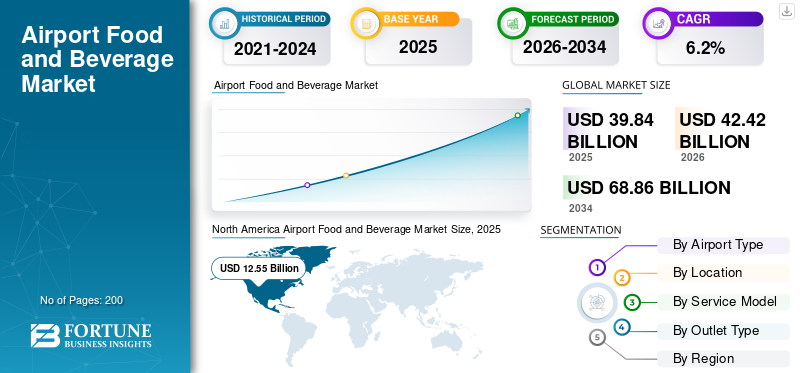
The airport food and beverage market size was valued at USD 39.84 billion in 2025. The market is projected to grow from USD 42.42 billion in 2026 to USD 68.86 billion by 2034, exhibiting a CAGR of 6.2% during the forecast period.
The market has witnessed robust growth driven by rising air passenger traffic and evolving consumer preferences for quality dining experiences. Growth is underpinned by increased investments in airport infrastructure, the proliferation of international travel, and a strong focus on enhancing passenger satisfaction through diversified food and beverage offerings. Airports have increasingly evolved beyond transit hubs into microcosms of commerce and culinary experience, with food and beverage now recognized as a significant component of airport non-aeronautical activities. The market encompasses quick service restaurants, full-service restaurants, cafés, bars, grab-and-go outlets, and specialty concepts, spanning both landside and airside locations across domestic and international terminals worldwide.
Key players in the market include SSP Group plc, HMSHost, Lagardère Travel Retail SAS, Areas S.A.U., and Paradies Lagardère. These companies compete through expansive multi-brand concession portfolios, premium and localized dining concepts, digital ordering and mobile-first platforms, strategic airport contract acquisitions, and integrated grab-and-go and full-service formats tailored for domestic terminals, international hubs, landside areas, and post-security airside zones serving leisure, business, and transit travelers globally.
Download Free sample to learn more about this report.
Airport Food and Beverage Market Key Takeaways
 Global Market Size & Forecast
- 2025 Market Size: USD 39.84 billion
- 2026 Market Size: USD 42.42 billion
- 2034 Forecast Market Size: USD 68.86 billion
- CAGR: 6.2% from 2026–2034
 Market Share
- North America dominated the market in 2025 with a market size of USD 12.55 billion.
- International airports accounted for the largest market share in 2025.
- Post-security/airside area held the dominant market share in 2025.
 Key Regional Highlights
North America
North America maintained its leading position in 2025, with a market valuation of USD 12.55 billion.
Europe
Europe is expected to reach USD 11.65 billion in 2026 and rank as the third-largest regional market.
Asia Pacific
Asia Pacific is projected to record the fastest regional CAGR of 6.8% and reach USD 13.01 billion in 2026.
U.S.
The U.S. market is analytically estimated at around USD 11.50 billion in 2026, supported by strong passenger volumes and airport food and beverage demand.
Japan
The Japan market is estimated at approximately USD 2.26 billion in 2026, with continued growth supported by international travel and airport infrastructure development.
Read More

AIRPORT FOOD AND BEVERAGE MARKET TRENDS
Digitalization and Premiumization are Redefining Airport Dining Experience
Technology is rapidly reshaping the food and beverage landscape across airports, with digitalization playing a pivotal role. Passengers increasingly want to be in control, driving demand for self-ordering kiosks, AI-powered recommendations, and mobile ordering apps. Technology-driven solutions such as self-service kiosks and mobile ordering apps are enhancing customer convenience and reducing wait times, particularly appealing in busy airport environments where time efficiency is paramount. Furthermore, the integration of digital payment systems is streamlining transactions, offering seamless experiences for tech-savvy travelers. Simultaneously, premiumization is accelerating as airports partner with celebrity chefs and artisanal brands to elevate terminal dining beyond functional necessity into a memorable travel experience.
MARKET DYNAMICS
MARKET DRIVERS
Download Free sample to learn more about this report.
Surging Global Air Passenger Traffic is Fueling Sustained Demand for In-Terminal Food and Beverage Services
One of the primary drivers for the airport food and beverage market growth is the rising volume of air passenger traffic. The increase in traveler numbers is mainly due to higher disposable incomes, which allow more frequent leisure and business trips, thereby boosting demand for air travel. By enhancing the dining options available within airports, food and beverage services contribute to a better overall travel experience, encouraging passengers to spend more time and money inside terminals. Longer dwell times, driven by modern security procedures and flight delays, give passengers more opportunities to eat, creating natural dining windows that operators are strategically capitalizing on. This sustained traffic growth ensures a growing and captive consumer base across all terminal zones globally.
MARKET RESTRAINTS
High Operating Costs and Labor Shortages Constrain Profitability Across Airport Food and Beverage Operators
Labor shortages in the hospitality and food service sector remain a major restraint across North America and Western Europe, with vacancy rates at airport F&B outlets running significantly above pre-pandemic levels, necessitating costly recruitment programs and productivity-offsetting wage increases. Rising minimum wage legislation in major markets directly pressures the labor cost structures of QSR and café formats that are highly labor-intensive. High operating costs, stringent regulatory requirements, and complex supply chain logistics present significant challenges for food and beverage operators. The need to maintain consistent quality, safety, and compliance standards across diverse locations adds to operational complexity. These structural cost pressures compress margins and limit the ability of operators to invest in innovation and experiential upgrades.
MARKET OPPORTUNITIES
Greenfield Airport Expansion and Emerging Markets Unlock New Market Opportunities
Rapid airport infrastructure expansion and the digital transformation of concession operations through mobile ordering, AI management, and delivery platforms are creating new market opportunities. Asia Pacific is the fastest-growing region, with significant expansion expected as air travel demand surges across China, India, Southeast Asia, and Australia, driven by rapid urbanization, rising disposable incomes, and government investments in airport infrastructure. Emerging economies across Middle East, Latin America, and Africa are constructing new international terminals at pace, offering concessionaires greenfield entry points to establish premium, technology-enabled food and beverage concepts with long-term concession contracts.
MARKET CHALLENGES
Geopolitical Volatility and Competitive Disruption Are Challenges Market Expansion
Geopolitical disruptions, including renewed airline capacity reductions on key international routes due to conflict, sanctions, or public health incidents, represent a persistent tail risk for market revenues, as demonstrated by significant route suspensions affecting European and Middle Eastern travel corridors. Structural competition from airlines expanding their in-flight food and beverage offerings and from hotel F&B outlets in airport-adjacent locations further erodes the captive advantage traditionally enjoyed by terminal concessionaires. Economic uncertainties, fluctuating passenger volumes, and geopolitical tensions can disrupt market dynamics, affecting both demand and profitability. The competitive pressure from external food delivery platforms and alternative dining options outside the airport environment poses a threat to traditional revenue streams, demanding continuous innovation and adaptation.
Segmentation Analysis
By Airport Type
Rising International Travel Volumes and Higher Passenger Spending Drives International Airports Segment Dominance
Based on airport type, the market is segmented into international airports, domestic airports, and regional airports.
The international airports segment accounted for the largest market share in 2025. International airports attract high-spending, long-haul travelers with extended dwell times, creating ideal conditions for diversified food and beverage consumption. Additionally, high passenger volumes, extended layovers, and greater spending on duty-free and luxury retail products compared to domestic terminals also promotes segment growth. International terminals command premium concession contracts and support a broader mix of full-service restaurants, specialty bars, and grab-and-go concepts simultaneously.
The domestic airports segment is anticipated to rise with a CAGR of 6.3% over the forecast period.
To know how our report can help streamline your business, Speak to Analyst
By Location
Captive Passenger Audiences and Longer Pre-Boarding Wait Times Leads to Dominance of Post-Security/Airside Area Segment
Based on location, the market is segmented into pre-security/landside area, post-security/airside area, departure area, arrival area, and airport lounges.
In 2025, the post-security/airside area segment dominated the global market. Airside food and beverage outlets, located beyond security checkpoints and accessible only to ticketed passengers. Airside outlets benefit from captive audiences, duty-free pricing advantages, and higher average transaction values. Airside areas contribute higher airport retail sales due to higher passenger dwell time. This structural captivity makes airside the most commercially valuable zone for concessionaires, enabling premium pricing and higher per-transaction revenues than landside equivalents.
The airport lounges segment is projected to grow at a CAGR of 7.4% over the forecast period.
By Service Model
Time-Constrained Travelers Seeking Convenience and Speed are Propelling Demand for Takeaway Service
Based on service model, the market is segmented into dine-in service, takeaway service, mobile ordering & pick-up, self-service kiosks, and delivery-to-gate service.
The takeaway service segment is anticipated to hold highest airport food and beverage market share over the forecast period. The segment is rising steadily, primarily due to the increasing demand for quick-service solutions among time-pressured passengers. Most of travelers prefer quick meals or beverages during transit. Grab-and-go stations and pre-order digital platforms are expanding rapidly across terminals, enabling passengers to collect meals immediately before boarding, reducing wait times and enhancing satisfaction while driving higher transaction volumes for operators during peak departure windows.
The delivery-to-gate service segment is projected to grow at a high CAGR of 9.0% over the forecast period.
By Outlet Type
Record Passenger Volumes and Airport Infrastructure Upgrades are Fueling Quick Service Restaurants Segment Dominance
Based on outlet type, the market is segmented into quick service restaurants, full-service restaurants, cafés & coffee shops, bars & pubs, grab-and-go/convenience stores, and airport lounges & premium dining outlets.
The quick service restaurants segment dominated the segmental market share in 2025. This emerges as a dominant force in airport dining, appealing to time-conscious travelers with its quick service and familiar offerings. According to the International Air Transport Association (IATA), U.S. airlines carried 876 million passengers in 2024, reflecting a 5.2% year-on-year growth driven by the strong domestic market, fueling the demand for quick service restaurants within airport facilities. Airports such as LaGuardia Airport Terminal B, Los Angeles International Airport Terminal 1, and Chicago O'Hare Airport Terminal 5 have enhanced their food and beverage offerings by opening new QSR restaurants. QSRs remain the backbone of airport F&B concession models globally due to their operational scalability and high throughput efficiency.
In addition, airport lounges & premium dining outlets are projected to grow at a CAGR of 8.0% during the study period.
Airport Food and Beverage Market Regional Outlook
By geography, the market is categorized into North America, Europe, Asia Pacific, and Rest of the World.
North America
North America Airport Food and Beverage Market Size, 2025 (USD Billion)
To get more information on the regional analysis of this market, Download Free sample
North America held the dominant share in 2024, valuing at USD 11.53 billion, and also maintained the leading share in 2025, with USD 12.55 billion. This is driven by the extensive U.S. domestic aviation network, significant terminal renovation programs, and growing consumer demand for locally sourced and premium dining concepts.
U.S. Airport Food and Beverage Market
Based on North America’s strong contribution, the U.S. market can be analytically approximated at around USD 11.50 billion in 2026, representing roughly 5.6% CAGR of the forecast period. The U.S. airport food and beverage market is growing rapidly, driven by longer passenger dwell times, premium dining upgrades, and digital ordering technologies.
Europe
Europe is estimated to reach USD 11.65 billion in 2026 and secure the position of third largest region in the market. Europe represents a mature and competitive market. Major hubs such as London Heathrow, Paris Charles de Gaulle, and Frankfurt Airport are renowned for their extensive food and beverage offerings, with emphasis on quality, sustainability, and regional authenticity shaping concession strategies.
U.K. Airport Food and Beverage Market
The U.K. market in 2026 is estimated at around USD 2.55 billion, representing roughly 6.3% CAGR during the forecast period. Major international airports including London Heathrow are developing new business areas to boost non-aeronautical income through food and beverage outlets, which constitute a large portion of their expansion projects.
Germany Airport Food and Beverage Market
Germany’s market is projected to reach approximately USD 2.39 billion in 2026. According to the Airports Council International Europe, the European airports managed 2.5 billion passengers during 2024, with airports including Frankfurt investing in diversified dining concepts encompassing premium coffee chains, fast-casual brands, and regional offerings.
Asia Pacific
Asia Pacific is projected to record a CAGR of 6.8% during the forecast period, which is the highest among all regions, and reach a valuation of USD 13.01 billion by 2026. Asia Pacific is the fastest growing market, driven by massive airport infrastructure expansion in China and India, rapidly growing middle-class air traveler populations, and aggressive concession contract wins by regional operators.
China Airport Food and Beverage Market
China’s market is projected to be one of the largest in Asia Pacific, with 2026 revenues estimated at around USD 5.40 billion. China is a key driver of Asia Pacific's airport F&B growth, with airports increasingly focusing on diverse, culturally relevant food and beverage options blending international brands with local culinary traditions and digital innovation.
Japan Airport Food and Beverage Market
The Japan market share in 2026 is estimated at around USD 2.26 billion, accounting for roughly 5.9% of CAGR during the forecast period. Japan contributes to Asia Pacific's fastest-growing regional market status, as expanding air travel demand and airport infrastructure investments support rising passenger spending on in-terminal dining and beverage services.
India Airport Food and Beverage Market
The India market in 2026 is estimated at around USD 1.65 billion. India is emerging as a significant growth market, with companies such as SSP Group entering strategic partnerships to expand food and lounge service operations at new metro and tier-2 airports, tapping into rapidly growing domestic and international travel demand.
Rest of the World
The rest of the world include Middle East & Africa and Latin America. These regions are expected to witness moderate growth in this market space during the forecast period. The Middle East & Africa and Latin America market is set to reach a valuation of USD 3.15 billion and USD 1.31 billion in 2026. The Middle East & Africa are experiencing rapid growth driven by the expansion of major transit hubs such as Dubai International and Hamad International, while Latin America is poised for growth as air travel infrastructure improves and international tourism rebounds.
COMPETITIVE LANDSCAPE
Key Industry Players
Key Players Focus on Premium Dining, Digital Ordering, and Airport Concession Expansion to Sustain Competition
The airport food and beverage market is being strengthened by key players that are shifting airport dining from basic terminal foodservice toward experience-led, digitally enabled, and premium passenger-focused retail ecosystems. Companies such as SSP Group, Avolta/HMSHost, Lagardère Travel Retail, Areas, Delaware North, and Paradies Lagardère are expanding airport F&B portfolios through multi-brand concession contracts, localized restaurant concepts, grab-and-go formats, premium lounges, self-service kiosks, mobile ordering, and high-throughput quick-service outlets. Lagardère Travel Retail is reinforcing its airport dining presence through new food and beverage outlets at Jorge Chávez International Airport in Lima, while McDonald’s is strengthening high-volume airport QSR operations through its large-format restaurant at Palma de Mallorca Airport, supported by digital kiosks and multiple production lines. SSP Group is also expanding across European airports with branded cafés, quick-service concepts, and travel-focused dining formats that improve passenger choice and terminal commercial yield. Meanwhile, Avolta/HMSHost, Areas, Delaware North, and Paradies Lagardère are focusing on long-term airport concession partnerships, local brand integration, premium passenger experiences, and operational efficiency, helping shift the market from traditional food courts toward higher-spend, convenience-led, and digitally integrated airport dining models.
LIST OF KEY AIRPORT FOOD AND BEVERAGE COMPANIES PROFILED
- SSP Group plc (U.K.)
- HMSHost (Switzerland)
- Lagardère Travel Retail SAS (France)
- Areas S.A.U. (Spain)
- Paradies Lagardère (U.S.)
- Delaware North Companies, Inc. (U.S.)
- OTG Management (U.S.)
- Concessions International, LLC (U.S.)
- Plaza Premium Group (Hong Kong)
- Emirates Leisure Retail LLC (UAE)
KEY INDUSTRY DEVELOPMENTS
- June 2025: Lagardère Travel Retail strengthened its airport foodservice footprint in Latin America by opening 13 new food and beverage outlets at the new terminal of Jorge Chávez International Airport in Lima, Peru. The expansion covers a 35,500-square-foot dining area and includes premium restaurant concepts and specialty café brands designed to improve passenger dining options.
- May 2025: McDonald’s Corporation increased its presence in the airport F&B segment by opening Europe’s largest McDonald’s outlet at Palma de Mallorca Airport. The restaurant spans more than 10,000 square feet and is equipped with digital ordering kiosks and multiple production lines to handle high passenger volumes during peak travel periods.
- April 2025: SSP Group plc expanded its airport food and beverage operations in Europe by introducing new outlets at Sofia International Airport, including Starbucks and Camden Food Co. The development, carried out in partnership with SOF Connect, supports the airport’s broader effort to upgrade passenger dining services and improve retail infrastructure.
REPORT COVERGAE
This research offers a detailed analysis of emerging trends and rapidly adopted technologies in the industry across key regions. The report outlines key drivers of market growth and challenges to expansion, delivering a detailed overview of the maritime industry landscape. The study highlights recent advancements to boost industry insights and support stakeholders in making well-informed decisions.
Request for Customization to gain extensive market insights.
Report Scope & Segmentation
| ATTRIBUTE | DETAILS |
| Study Period | 2021-2034 |
| Base Year | 2025 |
| Estimated Year | 2026 |
| Forecast Period | 2026-2034 |
| Historical Period | 2021-2024 |
| Growth Rate | CAGR of 6.2% from 2026-2034 |
| Unit | Value (USD Billion) |
| Segmentation | By Airport Type, By Location, By Service Model, By Outlet Type and Region |
| By Airport Type |
|
| By Location |
|
| By Service Model |
|
| By Outlet Type |
|
| By Region |
|
Frequently Asked Questions
According to Fortune Business Insights, the global market value stood at USD 39.84 billion in 2025 and is projected to reach USD 68.86 billion by 2034.
In 2025, the North America market value stood at USD 12.55 billion.
The market is expected to exhibit a CAGR of 6.2% during the forecast period of 2026-2034.
By airport type, international airports segment is expected to dominate the market.
Surging global air passenger traffic is fueling sustained demand for in-terminal food and beverage services.
SSP Group plc, HMSHost, Lagardère Travel Retail SAS, Areas S.A.U., and Paradies Lagardère are few major players in the global market.
North America dominated the market in 2025.



- 2021-2034
- 2025
- 2021-2024
- 200
Get 30-60 hrs Free Customization
Expand Regional and Country Coverage, Segments Analysis, Company Profiles, Competitive Benchmarking, and End-user Insights.



















Related Reports
-
US +1 833 909 2966 ( Toll Free )
-
Get In Touch With Us