Airport Lounge Market Size, Share & Industry Analysis, By Airport Type (Domestic and International), By Terminal (Single Terminal & Multi-Terminal), By Ownership (Fully Owned & Operated, Management Contract, Franchise, & Others), By Access (Ticket/Cabin Entitlement, Paid Access, Membership Access, Card Benefit Access, & Corporate Access), By Lounge Format (Standard Lounge, Premium/Flagship Lounge, First-Class Lounge, & Others), By Services (Food & Beverage, Hygiene & Comfort, Sleep & Recovery, Business & Productivity, Entertainment, & Others), and Regional Forecast, 2026-2034
 Download Free Sample
(Offer valid till 15th Oct 2026)

Airport Lounge Market Size and Regional Outlook
 Listen to Audio Version
The global airport lounge market size was valued at USD 19.77 billion in 2025. The market is projected to grow from USD 21.79 billion in 2026 to USD 63.36 billion by 2034, exhibiting a CAGR of 14.27% during the forecast period. North America dominated the airport lounge market with a market share of 33.18% in 2025.
The international airport lounge market comprises upmarket areas within airport terminals that offer enhanced passenger lounge experiences through facilities such as comfortable seating, fine dining, fast Wi-Fi, showers, and quiet areas for work. These lounges are mainly targeted at business class passengers, first-class passengers, frequent flyers, and those who have access through credit card schemes or pay-per-use facilities. They are used by airlines, airports, and third-party operators as revenue streams to enhance customer satisfaction and loyalty.
The main drivers of growth are the increasing number of high-net-worth individuals, who are demanding wellness-oriented facilities such as spas and nap pods; technological enhancements, such as app access and virtual reality entertainment; and the emerging markets of India and China. Membership and independent lounges are also growing in popularity due to airline partnerships, loyalty programs, and collaborations with financial institutions.
Key players in the market include Delta Air Lines, Swissport International AG, American Express Company, Emirates Group, and Qantas Airways. Independent key players such as Lounge Key and Priority Pass are market leaders in the payment and membership categories, with a focus on global networks.
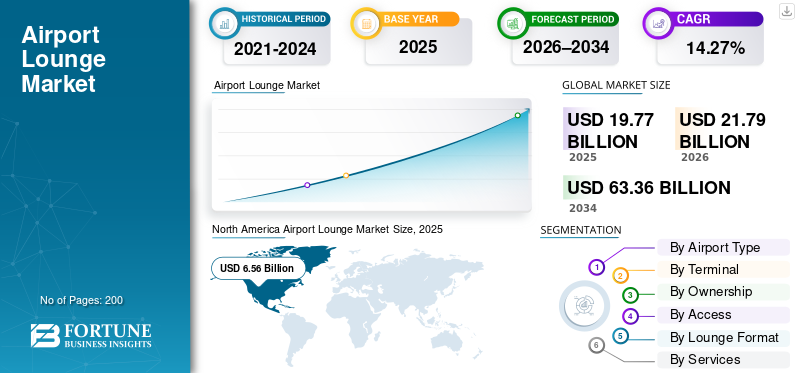
Download Free sample to learn more about this report.
Airport Lounge Market Key Takeaways
 Global Market Size & Forecast
- 2025 Market Size: USD 19.77 billion
- 2026 Market Size: USD 21.79 billion
- 2034 Forecast Market Size: USD 63.36 billion
- CAGR: 14.27% from 2026-2034
 Market Share
- North America dominated the airport lounge market with a 33.18% share in 2025.
- The domestic segment accounted for a 47.90% market share in 2025.
- The multi-terminal segment held a 63.91% market share in 2025.
 Key Regional Highlights
North America
North America was valued at USD 6.56 billion in 2025 and is projected to reach USD 7.14 billion in 2026.
Europe
Europe was valued at USD 4.63 billion in 2025 and is projected to witness the highest CAGR of 14.98% during the forecast period.
Asia Pacific
Asia Pacific reached USD 5.50 billion in 2025, driven by investments in aviation infrastructure and growing regional air travel.
U.S.
The market was valued at USD 5.95 billion in 2025 and is projected to grow at a CAGR of 12.15% during the forecast period.
Japan
The market was valued at USD 0.69 million in 2025 and is projected to grow at a CAGR of 13.62% during the forecast period.
Read More

Airport Lounge Market Trends
Growing Digital Access and Automation Drives Market Growth
Biometric and app-based seamless entry systems eliminate physical tickets, speeding up entry and enabling predictive occupancy management for dynamic pricing. IoT sensors optimize energy consumption in HVAC and lighting, meeting net-zero airport commitments while reducing OPEX (Operational Expenditure) by up to 20%. AI chatbots manage real-time reservations and feedback, allowing staff to focus on high-touch service delivery. High-speed Wi-Fi 6E enables VR workspaces and serves remote professionals during layovers. Contactless payments and robotic bartending improve perceptions of hygiene in the post-pandemic era.
- For instance, in January 2025, the Port Authority of New York & New Jersey initiated its JFK Terminal 6 project, with an additional 10 gates and modern lounges, scheduled to open in 2026 with an emphasis on sustainability. This project improves capacity and passenger movement with its new master plan.
Download Free sample to learn more about this report.
Market Dynamics
MARKET DRIVERS
Surge in Premium Travel Demand, Economic and Network Expansion Drives Market Growth
The growing number of air passengers globally, especially in the high-yielding business and leisure classes, is driving the use of airport lounges as passengers seek comfort during long layovers and in congested terminals. The growing affluent population in emerging markets shows increased expenditure on experiential travel, including the use of airport lounges for their unique dining, work, and wellness facilities.
Airline loyalty programs and credit card collaborations make the facilities more accessible, encouraging repeat business and financial sustainability through subscription lounge services. Airport lounge developments at major hubs such as Dubai International Airport and Singapore Changi Airport are integrated into revenue-generating infrastructure, reflecting the International Air Transport Association (IATA) 's growth projections for the aviation industry.
- For instance, in December 2025, American Airlines announced that it is set to renovate its Admirals Club lounge in Concourse D at Ronald Reagan Washington National Airport, with work commencing in early 2026. Upgrades remain operational in other lounges in Concourses C and E.
MARKET RESTRAINTS
Cost Pressures and Overcrowding Can Hamper the Market Growth
Higher operating expenses, such as real estate costs for prime airport sites and 24/7 operations staffing, squeeze margins for lounge providers amid fluctuating fuel prices that affect airlines’ budgets. Overcrowding undermines exclusivity, as lounge access has been expanded through third-party lounge networks such as Priority Pass, watering down the value proposition for high-end customers who value privacy. Barriers to entry, such as strict airport security requirements and post-COVID health regulations, drive up compliance costs with little corresponding revenue growth. Economic downturns hit discretionary spending on lounges, with the leisure business being most affected during recessions. This is expected to hinder the airport lounge market growth in the coming years.
MARKET OPPORTUNITIES
Emerging Market Penetration and Tech-Enabled Personalization Create Growth Opportunities
The rapid urbanization in the Asian Pacific and Middle Eastern regions makes secondary airports Greenfield sites for the development of lounge offerings, capitalizing on regional business travelers. Hybrid work models increase layover times, underscoring the need for extended-stay lounges with nap pods and virtual office space. Collaborations with wellness brands bring spa-integrated lounges, leveraging health-conscious millennials entering the upscale travel market. Government-backed sustainable aviation fuel (SAF) schemes facilitate eco-lounge certifications, appealing to ESG-driven companies. Airport retail collaborations, such as lounge-based shopping rewards, drive synergies. Digital nomad visas in countries such as the UAE drive lounge engagement in transit hubs.
- For instance, in December 2025, the West Gate Expansion and West Infill facilities at Austin-Bergstrom International Airport will be opened in 2026, including new lounges as part of the terminal expansion.
MARKET CHALLENGES
Sustainability Imperatives and Cybersecurity and Service Equity Hinder Market Growth
The net-zero emissions goal mandates the electrification of lounge operations, posing a challenge for lounge operators due to the high cost of solar integration and EV charging. The diversion of waste from landfills requires circular-economy sourcing for F&B, which is a challenge in remote airports. Water conservation in shower facilities is a challenge during peak hours in water-scarce airports. Biodiversity effects associated with airport expansion call for green zones in lounges.
SEGMENTATION ANALYSIS
By Airport Type
International Segment to Lead Market Due to Premium Cabin Proportion
Based on the airport type, the market is divided into domestic and international.
The international segment is projected to be the fastest-growing, with the highest CAGR of 15.24% during the forecast period. The growth is driven by long-haul connectivity, the proportion of premium cabins, the use of alliance/partner lounges, or the willingness to pay for higher levels of experience while staying for a lengthy period.
The domestic segment holds a 47.90% market share and is expected to rise at a 13.13% CAGR during the forecast period.
By Terminal
Rising Number of Small and Domestic Airports to Boost Single Terminal Segment Growth
Based on the terminal, the market is divided into single terminal and multi-terminal.
The single terminal segment is estimated to be the fastest-growing, with a 14.48% CAGR during the forecast period. The growth is facilitated through rapid upgrade cycles at secondary airports, the opening of new lounges in unserved terminals, and modular lounge developments that occur more quickly than traditional full-scale hub airport expansions.
The multi-terminal segment holds a 63.91% market share and is expected to rise at a 14.15% CAGR during the forecast period.
By Ownership
Increasing Demand for Joint Venture Businesses in Domestic and International Airports to Propel Segmental Growth
Based on the ownership, the market is divided into fully owned & operated, management contract, franchise, joint venture, and white-label.
The joint venture segment is projected to be the fastest-growing, with the highest CAGR of 15.93% during the forecast period, as airports, airlines, and contract lounges share capital and expenditure risks to scale their lounge real estate.
The white-label segment holds a 37.03% market share and is expected to rise at a 12.16% CAGR during the forecast period.
By Access
Significant Growth in High Net Worth Individuals to Boost Paid Access Segment Growth
Based on the access, the market is divided into ticket/cabin entitlement, paid access, membership access, card benefit access, and corporate access.
The paid access segment is estimated to be the fastest-growing, with the highest CAGR of 16.62% during 2026–2034. The pre-booking/time slot system, dynamic pricing, exploitation of overflow revenue during peak hours, and the overall willingness of consumers to pay for convenience due to terminal congestion.
The ticket/cabin entitlement segment holds a 36.15% market share and is expected to rise at a 13.03% CAGR during the forecast period.
By Lounge Format
Rising Need for Monetizable Privacy, Guaranteed Seating, Upscale Dining to Foster Private Suites/Cabanas Segmental Growth
Based on the lounge format, the market is divided into standard lounge, premium/flagship lounge, first-class lounge, business-class lounge, and private suites/cabanas.
The private suites/cabanas segment is estimated to be the fastest-growing, with the highest CAGR of 16.87% during the forecast period. The growth is attributed to monetizable privacy, guaranteed seating, upscale dining, and the economics of upselling even when operating with capacity restrictions.
The standard lounge segment holds a 37.19% market share and is expected to rise at a 14.33% CAGR during the forecast period.
To know how our report can help streamline your business, Speak to Analyst
By Services
Increasing Wellness Services Across International Airport Among Premium Passengers to Bolster Segmental Growth
Based on the services, the market is divided into food & beverage, hygiene & comfort, sleep & recovery, business & productivity, entertainment, wellness, retail & partner services, and others.
The wellness segment is projected to be the fastest-growing, with a 17.44% CAGR during the forecast period. The growth accelerates as lounges compete through differentiated experiences (spas, recovery rooms, showers, calm areas) that will support premium pricing and tiering.
The food & beverage segment holds a 39.75% market share and is expected to rise at a 13.44% CAGR during the forecast period.
Airport Lounge Market Regional Outlook
By geography, the market is categorized into Europe, North America, Asia Pacific, the Middle East & Africa, and Latin America.
North America
North America Airport Lounge Market Size, 2025 (USD Billion)
To get more information on the regional analysis of this market, Download Free sample
North America held the dominant airport lounge market share in 2025, valued at USD 6.56 billion, and is anticipated to maintain the leading share in 2026, valued at USD 7.14 billion. The dominance through mature premium travel ecosystems, high business class penetration rates, high speed internet, Wi-Fi, and a large number of airline loyalty program integrations in hubs such as Atlanta Hartsfield-Jackson International Airport and Dallas Fort Worth International Airport.
U.S. Airport Lounge Market
Given North America’s strong contribution and the U.S. dominance within the region, the U.S. market was valued at USD 5.95 billion in 2025 and is estimated to grow at a CAGR of 12.15% during the forecast period.
Europe
Europe is projected to grow at the second-fastest rate, with the highest CAGR of 14.98% during the forecast period. The market was valued at USD 4.63 billion in 2025. The growth is supported by EU Single Aviation Market policies to open up routes and boost premium demand within Europe at Frankfurt, Amsterdam Schiphol, and Paris CDG airports, among others
U.K. Airport Lounge Market
The U.K. market in 2025 was valued at USD 0.85 million and is estimated to rise at a 16.34% CAGR during the forecast period.
Germany Airport Lounge Market
The Germany market in 2025 was valued at USD 0.77 million and is estimated to rise at a 13.53% CAGR during the forecast period.
Rest of Europe Airport Lounge Market
The Rest of Europe market in 2025 was valued at USD 1.45 million and is estimated to rise at a 14.50% CAGR during the forecast period.
Asia Pacific
Asia Pacific was valued at USD 5.50 billion in 2025 and ranked third in the market. Explosive investments in aviation infrastructure and intra-regional business travel experience in China, India, and Southeast Asia propel the market growth.
China Airport Lounge Market
The China market in 2025 was valued at USD 1.47 million and is estimated to rise at a 15.46% CAGR during the forecast period.
India Airport Lounge Market
The India market in 2025 was valued at USD 0.90 million and is estimated to rise at a 18.78% CAGR during the forecast period.
Japan Airport Lounge Market
The Japan market in 2025 was valued at USD 0.69 million and is estimated to rise at a 13.62% CAGR during the forecast period.
Middle East & Africa and Latin America
The Latin America and Middle East & Africa regions are expected to witness moderate growth in this market space during the forecast period. The Latin America market was valued at USD 0.99 billion in 2025. The Middle East & Africa market was valued at USD 2.07 billion in 2025.
Brazil Airport Lounge Market
The Brazil market in 2025 was valued at USD 0.44 million and is estimated to rise at a 10.37% CAGR during the forecast period.
Gulf Countries Airport Lounge Market
The Gulf Countries market in 2025 was valued at USD 0.76 million and is estimated to rise at a 15.03% CAGR during the forecast period.
COMPETITIVE LANDSCAPE
Key Industry Players
Growing High-Yield Airline Passengers Drives Market Growth
The global airport lounge industry is highly competitive and fragmented, with a large number of players. The market is still dominated by airline-operated lounges due to brand loyalty and exclusivity, while independent lounges are growing by offering flexible membership terms.
A few large market leaders leverage their size to obtain the best gate-side positioning and consistent service quality, making it difficult for new entrants to compete on cost-effectiveness. The key differentiating factor for lounges is the premium travelers' experience, such as wellness and technology-enabled personalization, which demands constant capital investment to maintain an occupancy rate above 70%.
LIST OF KEY AIRPORT LOUNGE COMPANIES PROFILED
- DreamFolks Services Limited (India)
- Swissport International AG (Switzerland)
- NO1 LOUNGES (LHR) LTD (U.K.)
- American Express Company (U.S.)
- Deutsche Lufthansa AG (Germany)
- Delta Air Lines, Inc. (U.S.)
- British Airways Plc (U.K.)
- Société Air France (France)
- Singapore Airlines Limited (Singapore)
- Cathay Pacific Airways Limited (Hong Kong)
- Qatar Airways Group Q.C.S.C. (Qatar)
- Japan Airlines Co., Ltd. (Japan)
- The Emirates Group (UAE)
- Turkish Airlines Inc. (Turkey)
- Qantas Airways Limited (Australia)
KEY INDUSTRY DEVELOPMENTS
- February 2026: Air India Limited launched The Maharaja Lounge® at Delhi International Airport Terminal 3, spanning 16,000 sq. ft. with capacity for nearly 300 guests across Business and First Class sections. The strategic objective was to strengthen premium ground services during its airline transformation. Capabilities involved/Technologies included high-speed connectivity, charging points, sleep suites, private workspaces, and airport lounge hospitality.
- April 2026: Plaza Premium Group expanded its U.S. presence by opening Plaza Premium First® and Plaza Premium Lounge at Dallas Fort Worth International Airport Terminal D. The strategic objective was to establish a broader North American airport hospitality presence. Capabilities involved/Technologies included high-speed Wi-Fi, charging stations, tableside ordering, shower facilities, and premium airport lounge services.
- April 2026: Changi Airport Group (Singapore) Pte. Ltd. announced development of a new private terminal at Singapore Changi Airport, jointly operated with Plaza Premium Group and scheduled for mid-2027 opening. The strategic objective was to provide personalized premium passenger services. Capabilities involved/Technologies included private suites, bespoke dining, deluxe lounges, seamless transfers, and integrated airport lounge hospitality.
- January 2026: Austin-Bergstrom International Airport entered into 10-year use agreements with Southwest Airlines, Delta, American Airlines, United Airlines, and Alaska Airlines for expansion projects that included 30 new gates and new airline-operated lounges
- January 2026: Capital One obtained a lease to operate a concession in its largest lounge of 14,000 sq ft, located on the mezzanine Concourse A expansion in Charlotte Douglas International Airport.
- July 2025: Miami-Dade County put out an RFP for a 13,793 sq ft common use lounge near gate E7 in Concourse E, with proposals due soon and a likely award in January or February 2026.
- June 2025: The Port of Seattle finished an addition of 52,000 sq ft of space in the A Concourse for the Delta One and Sky Club lounges. The project serves to facilitate international arrival operations and increase lounge seating through a Tenant Reimbursement Agreement.
- May 2025: PCL Construction Services was contracted as a general contractor by the Port of Seattle for a shared-use lounge of 14,000 sq ft in the A Concourse of the Seattle-Tacoma International Airport.
REPORT COVERAGE
The global airport lounge market share analysis includes a comprehensive study of the market size & forecast across all market segments covered in the report. It includes details on the market dynamics and the global airport lounge market trend expected to drive the market over the forecast period. It provides information on key aspects, including technological advancements, pipeline candidates, the regulatory environment, and product launches. Additionally, it details partnerships, mergers & acquisitions, and key industry developments, as well as their prevalence by key regions. The global market research report also provides a detailed competitive landscape, including market share and profiles of key operating players.
Request for Customization to gain extensive market insights.
Report Scope & Segmentation
|
ATTRIBUTE |
DETAILS |
|
Study Period |
2021-2034 |
|
Base Year |
2025 |
|
Estimated Year |
2026 |
|
Forecast Period |
2026-2034 |
|
Historical Period |
2021-2024 |
|
Growth Rate |
CAGR of 14.27% from 2026 to 2034 |
|
Unit |
USD (Billion) |
|
Segmentation |
By Airport Type · Domestic · International By Terminal · Single Terminal · Multi-Terminal By Ownership · Fully Owned & Operated · Management Contract · Franchise · Joint Venture · White-Label By Access · Ticket/Cabin Entitlement · Paid Access · Membership Access · Card Benefit Access · Corporate Access By Lounge Format · Standard Lounge · Premium/Flagship Lounge · First-Class Lounge · Business-Class Lounge · Private Suites/Cabanas By Services · Food & Beverage · Hygiene & Comfort · Sleep & Recovery · Business & Productivity · Entertainment · Wellness · Retail & Partner Services · Others By Region North America (By Airport Type, By Terminal, By Ownership, By Access, By Lounge Format, By Services, By Country) · U.S. (By Airport Type) · Canada (By Airport Type) Europe (By Airport Type, By Terminal, By Ownership, By Access, By Lounge Format, By Services, By Country) · U.K. (By Airport Type) · Germany (By Airport Type) · France (By Airport Type) · Nordic Countries (By Airport Type) · Eastern Europe (By Airport Type) · Rest of Europe (By Airport Type) Asia Pacific (By Airport Type, By Terminal, By Ownership, By Access, By Lounge Format, By Services, By Country) · China (By Airport Type) · India (By Airport Type) · Japan (By Airport Type) · South Korea (By Airport Type) · Southeast Asia (By Airport Type) · Rest of Asia Pacific (By Airport Type) Middle East & Africa (By Airport Type, By Terminal, By Ownership, By Access, By Lounge Format, By Services, By Country) · Gulf Countries (By Airport Type) · Israel (By Airport Type) · Iran (By Airport Type) · North Africa (By Airport Type) · South Africa (By Airport Type) · Rest of Middle East & Africa (By Airport Type) Latin America (By Airport Type, By Terminal, By Ownership, By Access, By Lounge Format, By Services, By Country) · Brazil (By Airport Type) · Mexico (By Airport Type) · Argentina (By Airport Type) · Rest of Latin America (By Airport Type) |
Frequently Asked Questions
Fortune Business Insights says that the global market value stood at USD 19.77 billion in 2025 and is projected to reach USD 63.36 billion by 2034.
In 2025, the Europe market value stood at USD 4.63 billion.
The market is expected to grow at a CAGR of 14.27% over the forecast period of 2026-2034.
By airport type, the international segment is expected to hold the highest CAGR over the forecast period.
Surge in premium travel demand, economic and network expansion drive the market growth.
Delta Air Lines, Swissport International AG, American Express Company, Emirates Group, and Qantas Airways are the key players in the market.
North America dominated the market in 2025.



- 2021-2034
- 2025
- 2021-2024
- 200
-
(Offer valid till 15th Oct 2026)
Get 30-60 hrs Free Customization
Expand Regional and Country Coverage, Segments Analysis, Company Profiles, Competitive Benchmarking, and End-user Insights.




















-
US +1 833 909 2966 ( Toll Free )
-
Get In Touch With Us