Airport Security Market Size, Share and Industry Analysis, by Security Type (Access Control, Cyber security, Perimeter Security, Screening, Surveillance, and Others), By System (Metal Detectors, Fiber Optic Perimeter Intrusion, Backscatter X-Ray Systems, Cabin Baggage Screening Systems, and Others), By Airport Model (Airport 2.0, Airport 3.0, and Airport 4.0), By Airport Class (Class A, Class B, and Class C), and Regional Forecast, 2026-2034
 Download Free Sample
Airport Security Market Size and Industry Overview
 Listen to Audio Version
The global airport security market size was valued at USD 17.31 billion in 2025. The market is projected to grow from USD 19.02 billion in 2026 to USD 40.48 billion by 2034, exhibiting a CAGR of 9.90% during the forecast period. Asia Pacific dominated the airport security market with a market share of 35.44% in 2025.
Airport security systems are equipment used in security checks at airports. They play a crucial role in preventing airports from threats such as terrorists, smugglers, and thieves. Airport management has to implement stringent guidelines provided by the respective governments of countries and aviation organizations. A series of aircraft hijacking cases between 1969 and 1971 and the 9/11 terrorist attack in 2001 have compelled airport authorities to redesign the security norms for airports and the safety of fleets.
One of the major challenges in airport security is identifying how to increase security measures while minimizing passengers' inconvenience. Airport security systems and equipment providers worldwide are focusing on research and development activities to develop user-friendly systems that increase airport and passenger security.
Growing demand for air travel and rising cyber-security attacks at airports are expected to propel the market's growth. However, high initial costs involved in the design and development of security systems and components, and issues related to the maintenance of these systems and interoperability are expected to hamper the overall growth of the airport security market.
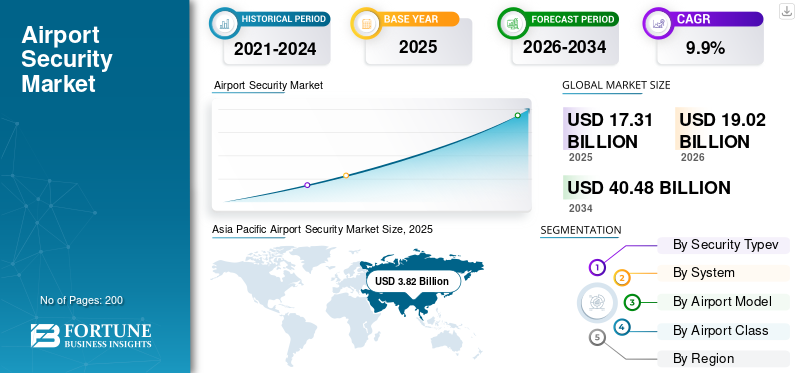
Download Free sample to learn more about this report.
Airport Security Market Key Takeaways
 Global Market Size & Forecast
- 2025 Market Size: USD 17.31 Billion
- 2026 Market Size: USD 19.02 Billion
- 2034 Forecast Market Size: USD 40.48 Billion
- CAGR: 9.90% from 2026–2034
 Market Share
- Asia Pacific dominated the airport security market with a 35.44% share in 2025.
- Surveillance systems held the largest market share in 2025.
- Cybersecurity accounted for 30.12% of the market in 2025.
 Key Regional Highlights
Asia Pacific
Asia Pacific reached USD 3.82 billion in 2025 and is projected to register the highest CAGR.
Europe
Europe held the second-largest market share in 2025.
North America
North America witnessed strong growth driven by airport modernization initiatives.
U.S.
Market growth is supported by TSA investments and advanced airport security deployments.
Japan
Airport security demand is driven by technological advancements and smart airport initiatives.
Read More

Download Free sample to learn more about this report.
Airport Security Market TRENDS
Use of Computerized Tomography (CT) Walkways in Baggage Handling at Airports to Propel the Market Growth
Computerized tomography, or CT Scanners, is generally associated with head injuries. The technology is also useful for searching for liquids or dangerous goods in baggage entering the airplane. Due to the noisiness and large size of the scanners, their use has been restricted to only check-in luggage. This system is located away from crowded areas to avoid disruption to passengers at airports. However, recent advancements in security technologies have reduced the size and sound associated with CT scanners. Asia Pacific witnessed a growth from USD 3.48 Billion in 2018 to USD 3.82 Billion in 2019.
The concept of CT walkways is replacing the current conveyor belt security system for carry-on luggage. This system can detect any questionable items carried by passengers or in their luggage without removing bags, shoes, and belts during the inspection. This will simplify the scanning process and will lead to less operational time at airports.
Implementation of Biometrics at Airports Improves the Operations Efficiency of Airport
Facial recognition technology is becoming increasingly popular in international airports as well as domestic airports across the globe. This technology eliminates paper and conventional data recording systems and provides a better boarding experience. This technology was mainly used for check-in and exit checks, presently the advanced technology has been adopted by individual airports for boarding processes. The self-service solution offers a user-friendly experience while also enabling high-level automated security checks at airports.
In 2019, Brisbane Airport implemented the Smart Path biometric technology with Air New Zealand passengers, the first to trial the seamless boarding experience. Post the success of the trial of the technology, the Government of Australia has announced plans to automate over 90% of air travel processing by the end of 2020.
MARKET DRIVERS
Growing Air Passenger Travel to Boost the Market
The growing commercial aviation sector and the rising preference of people to air travel across the globe are expected to boost the airport security system market growth during the forecast period. According to the International Air Transport Association, an additional 44% of air passenger traffic is expected to come from China and India in the next 10 years. Moreover, Asia Pacific is expected to be the fastest-growing region for air passenger travel in the next 10 years. Airport authorities are upgrading their conventional security systems to automatic systems to improve the overall efficiency of the boarding process at the airport. Thus, this will propel the growth opportunity of the market.
Rising Cyber-Security Attacks at Airports Are Expected to Propel the Growth of the Market
Cyber-security is one of the growing concerns for the aviation industry. Over the years, airports across the globe have become highly dependent on critical information and communications systems to run operations, deliver passenger services, and maintain communications with respective services. However, this heavy reliance on technology has also increased the airport’s exposure to various forms of threats, such as cyberattacks. The rising number and level of sophistication of cyber-attacks against airport security globally have prompted airports to invest more in cybersecurity to safeguard operations and protect passengers. Thus, this factor will propel the growth of the airport security system market.
MARKET RESTRAINT
High Costs Associated with Airport Security Systems and Components to Hinder Growth
Advanced and automated security systems simplify the process of boarding at airports. However, huge costs are involved in the design, development, and implementation of these systems into the airports of any country. They require a combination of various subsystems and electronic components to provide real-time data to the airport authority. The development, launch, and maintenance of these systems are costly. Due to the high cost of these systems and required services, the airport authorities prefer to outsource the security services to third-party service providers such as Securitas AB, G4S Plc, and others. Therefore, both, the cost and time required for the development and deployment of these systems prove to be a hindrance to the growth of the market across the globe.
SEGMENTATION ANALYSIS
By Security Type Analysis
To know how our report can help streamline your business, Speak to Analyst
High Demand for Cyber Security Propel the Growth of Airport Security Market
Based on the security type, the market is classified into access control, cybersecurity, perimeter security, screening, surveillance, and others. The cybersecurity segment is expected to be the fastest-growing segment during the forecast period due to the rise in demand for the safety of crucial aviation-related data and an increase in demand for services related to cybersecurity. However, the surveillance systems segment was the largest in 2025, owing to the huge investment in surveillance by countries such as the U.S., China, and India.
- The cybersecurity segment is expected to hold a 30.12% share in 2025.
By System Analysis
High Demand for Backscatter X-Ray Systems Segment Propel the Growth of Airport Security Market
Based on the system, the market is classified into metal detectors, fiber optic perimeter intrusion, backscatter x-ray systems, cabin baggage screening systems, and others. The backscatter x-ray systems segment is expected to be the fastest-growing segment during the forecast period due to a rise in demand for the safety of passengers and luggage security at airports. Whereas, the metal detectors segment was the largest in 2019. The rise in the threat of infectious diseases such as COVID-19 may lead to an increase in demand for airport thermal scanning devices and other electronic security devices in the airport security market during the forecast period to 2027.
By Airport Model Analysis
Increase in Demand for Smart Airport Will Boost the Growth of the Market
Based on the airport model, the market is segmented into airport 2.0, airport 3.0, and airport 4.0. Among these, the airport 4.0 segment is expected to be the fastest-growing segment in the market during the forecast period. Airport 4.0 focuses on connectivity and real-time information by connecting all stakeholders in an integrated digital ecosystem. This growth is attributed to the increasing demand for smart and green airports across the globe and high demand for Internet of Things (IoT)-based systems and equipment, whereas the airport 2.0 segment was the largest in 2025.
By Airport Class Analysis
Increase in Demand for Customization in Airport Security Services to Boost the Market
The market is divided into class A, class B, and class C based on airport class. Among these, the class C segment is expected to be the fastest-growing segment during the forecast period. This growth is attributed to the increasing demand for installing technologically advanced systems at airports and for customizing systems worldwide, whereas the class B segment was the largest segment in 2025.
REGIONAL ANALYSIS
Asia Pacific Airport Security Market Size, 2025 (USD Billion)
To get more information on the regional analysis of this market, Download Free sample
Asia-Pacific
As per our research, Asia-Pacific is estimated to hold the largest market share with a value of USD 3.82 billion in 2025 and is also expected to be the fastest-growing region during the forecast period. The region is expected to witness strong growth in the market during the forecast period, owing to the significant rise in air traffic in countries such as China, Singapore, and India. The region is anticipated to witness a robust growth rate during the forecast period.
Europe
Europe held the second-largest market share in 2025 owing to the high investment in upgrading conventional systems with technologically advanced security systems and the rising demand for smart and green airports in the upcoming years.
North America
In North America, the U.S. has invested in modernizing its airport systems in recent years. In addition to this, the presence of key manufacturers such as Honeywell International Inc., FLIR Systems, and Raytheon Technologies and the governing agency such as the Transportation Security Administration (TSA) is driving the market growth in the U.S. Moreover, the presence of the biggest international airport, named, Hartsfield-Jackson Atlanta International Airport (ATL) airport will propel the growth of the market. In Canada, the rising adoption of autonomous security systems by the Canadian Army is boosting the market growth in the region.
Middle East and Africa
Furthermore, the market in the Middle East and Africa is anticipated to rise at a significant CAGR, owing to the significant number of security systems suppliers and distributors in this region. Similarly, increasing investment in domestic airports in the UAE and Saudi Arabia is expected to drive the market in the Middle East and Africa.
KEY INDUSTRY PLAYERS
Technologically Advanced Security Systems to Propel the Market
The competitive landscape of this market depicts the domination of selected players such as Thales Group, Honeywell International Inc., FLIR Systems, among others. These companies are focusing on designing and developing advanced autonomous security solutions. Moreover, these companies are expanding their geographic reach in Asian countries in the near future.
LIST OF KEY PLAYERS PROFILED:
- American Science and Engineering Inc, (The U.S.)
- Axis Communication AB (Sweden)
- FLIR Systems (The U.S.)
- Hitachi Limited (Japan)
- Honeywell International Inc. (The U.S.)
- L3Harris Technologies Inc. (The U.S.)
- Raytheon Technologies (The U.S.)
- Robert Bosch GmbH (Germany)
- Siemens AG (Germany)
- Smiths Detection Inc. (The U.K)
- Thales Group (France)
- Westminster Group Plc. (The U.K)
KEY INDUSTRY DEVELOPMENTS:
- January 2020 – Heathrow Airport had a contract with Thales Group subsidiary Aveillant. The company will provide an anti-drone product to avoid flight disruption from rogue drones. The system was tested and deployed at the London airport as part of wider anti-drone efforts managed by systems integrator Operational Solutions.
- June 2017 – Bahrain’s Ministry of Transportation and Telecommunications had an agreement with Thales Group and SITA. to provide the security and operations management system for Bahrain International Airport.
REPORT COVERAGE
The airport security market report offers qualitative and quantitative insights into the market and detailed analyses of market size and growth rate for the market's segments.
The report also elaborates on market dynamics, emerging trends, and the competitive landscape. Key insights offered in the report include the adoption of advanced technology, recent industry developments such as partnerships, mergers, and acquisitions, a consolidated SWOT analysis of key players, Porter’s five forces analysis, business strategies of leading market players, and macro and micro-economic indicators.
Request for Customization to gain extensive market insights.
Reports Scope & Segmentation
|
SEGMENTATION |
DETAILS |
|
Study Period |
2021-2034 |
|
Base Year |
2025 |
|
Forecast Period |
2026-2034 |
|
Historical Period |
2021-2024 |
|
Unit |
Value (USD Billion) |
|
By Security Type |
|
|
By System |
|
|
By Airport Model |
|
|
By Airport Class |
|
|
By Region |
|
Frequently Asked Questions
According to Fortune Business Insights, the global airport security market size was valued at USD 17.31 billion in 2025 and is projected to reach USD 40.48 billion by 2034, exhibiting a CAGR of 9.9% during the forecast period.
The market is driven by increasing global air travel, growing concerns over cybersecurity threats, and the demand for automated and smart airport systems to enhance passenger experience and safety.
The global airport security market is expected to grow at a Compound Annual Growth Rate (CAGR) of 9.9% from 2026 to 2034.
In the market, some of the key players are L3Harris Technologies Inc., Honeywell International Inc., and Thales Group.
Advanced technologies such as computerized tomography (CT) scanners, biometric facial recognition, AI-powered surveillance, and IoT-based smart security systems are revolutionizing airport security operations.
The market is segmented by security type (access control, cybersecurity, perimeter security, screening, surveillance), system type (metal detectors, x-ray systems, fiber optic sensors), airport model (2.0, 3.0, 4.0), and airport class (A, B, C).
Asia Pacific held the largest market share in 2025, driven by rapid infrastructure development and rising air passenger traffic in countries like China, India, and Singapore.
The cybersecurity segment is expected to be the fastest-growing due to the increasing need to protect sensitive aviation data and mitigate risks of cyberattacks on airport operations.
Major challenges include the high costs of deployment, maintenance complexity, and interoperability issues between legacy and modern security systems.
AI enhances airport security by enabling predictive threat analysis, real-time surveillance, automated anomaly detection, and efficient data processing to support faster decision-making.



- 2021-2034
- 2025
- 2021-2024
- 200
Get 30-60 hrs Free Customization
Expand Regional and Country Coverage, Segments Analysis, Company Profiles, Competitive Benchmarking, and End-user Insights.




















Related Reports
-
US +1 833 909 2966 ( Toll Free )
-
Get In Touch With Us