Airport Shuttle Buses Market Size, Share & Industry Analysis, By Propulsion Type (ICE and Electric), By Service Type (Terminal–City Shuttle, Inter-Terminal/Parking Shuttle, and Hotel/Staff Shuttle), By Seating Capacity (Below 25, 26-40, and Above 40), and Regional Forecast, 2026-2034
 Download Free Sample
(Offer valid till 31st Oct 2026)

Airport Shuttle Buses Market Size and Future Outlook
 Listen to Audio Version
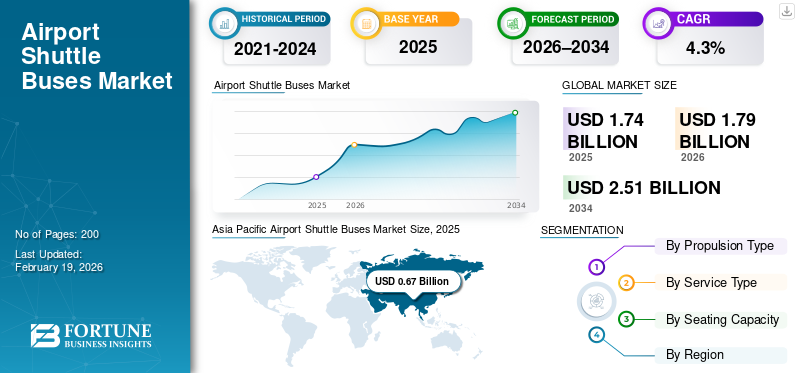
The global airport shuttle buses market size was valued at USD 1.74 billion in 2025. The market is projected to grow from USD 1.79 billion in 2026 to USD 2.51 billion by 2034, exhibiting a CAGR of 4.3% during the forecast period. Asia Pacific dominated the airport shuttle buses market with a market share of 38.51% in 2025.
The airport shuttle buses market comprises vehicles and shuttle bus services designed to transport passengers between airports and nearby locations such as hotels, city centers, and transit hubs. It includes scheduled and on-demand shuttles, operated by public and private providers, emphasizing convenience, cost-efficiency, and connectivity.
Key market drivers include rising air passenger traffic, airport infrastructure expansion, growing demand for cost-effective ground transport, growth in tourism, urbanization, and increasing preference for shared and sustainable mobility solutions.
Major players in the market include Daimler, Volvo Group, BYD, MAN Truck & Bus, and Scania, competing through fleet electrification, fuel efficiency, passenger comfort, smart fleet management, and compliance with stringent emission and safety standards.
Download Free sample to learn more about this report.
Airport Shuttle Buses Market Key Takeaways
 Global Market Size & Forecast
- 2025 Market Size: USD 1.74 billion
- 2026 Market Size: USD 1.79 billion
- 2034 Forecast Market Size: USD 2.51 billion
- CAGR: 4.3% from 2026–2034
 Market Share
- Asia Pacific dominated the market with a 38.51% share in 2025.
- ICE segment held the largest market share due to established fueling infrastructure and operational reliability.
- Inter-terminal/Parking Shuttle segment dominated the market, driven by high-frequency airport operations.
 Key Regional Highlights
North America
Strong airport infrastructure and fleet modernization continue to support steady market growth.
Asia Pacific
The market reached USD 0.67 billion in 2025, driven by airport expansion and rising air passenger traffic.
Europe
Growth is supported by fleet electrification and strict emission regulations across major airports.
U.S.
The market reached USD 0.28 billion in 2025, fueled by shuttle fleet upgrades and electrification initiatives.
Japan
Growing airport modernization and increasing air travel continue to support market growth.
Read More

AIRPORT SHUTTLE BUSES MARKET TRENDS
Integration of Smart Fleet Management and Connected Technologies as a Key Trend
Digitalization is emerging as a major trend in the market, with operators increasingly adopting smart fleet management systems. Technologies such as GPS tracking, real-time passenger information, predictive maintenance, and data analytics are improving operational efficiency and service reliability. Connected systems enable optimized routing, reduced idle time, and better coordination with flight schedules. Integration with airport mobility platforms and mobile applications enhances passenger convenience by providing live updates and seamless ticketing. These technologies also support compliance with safety and performance standards. As airports focus on enhancing passenger experience while lowering operational costs, the adoption of connected and intelligent shuttle solutions is becoming a defining market trend.
- In October 2024, Telematics-driven real-time shuttle tracking and performance monitoring was highlighted as an operational priority for shuttle fleets, enabling visibility into vehicle location, idling, driver behavior, and maintenance alerts.
MARKET DYNAMICS
MARKET DRIVERS
Rising Air Passenger Traffic and Airport Capacity Expansion to Drive Shuttle Demand
Growing global air passenger volumes are pushing airports to expand terminals, runways, and ancillary infrastructure. This expansion increases the need for efficient landside transportation to manage passenger flow between terminals, parking areas, hotels, and nearby transit hubs. Airport shuttle buses offer a cost-effective, high-capacity solution compared to taxis and ride-hailing services. As airports prioritize reducing congestion and improving passenger experience, rising demand for reliable and frequent shuttle transportation services continue to rise. Emerging economies, in particular, are witnessing new airport developments and regional connectivity programs, further supporting shuttle bus adoption. Increased focus on multimodal integration also strengthens the role of shuttle buses in connecting airports with rail and metro networks, reinforcing their importance in modern airport mobility ecosystems.
- In February 2025, Pune Airport’s AeroMall added an additional 40-seater shuttle bus to move arriving passengers from the terminal to the cab pick-up point, taking the shuttle count to three reflecting rising passenger-flow needs at expanded terminal ecosystems.
Download Free sample to learn more about this report.
MARKET RESTRAINTS
Competition from Ride-Hailing, Taxis, and On-Demand Mobility to Restrain Shuttle Adoption
The growing availability of ride-hailing platforms, taxis, and app-based mobility services is limiting the adoption of airport shuttle buses in several regions. These services offer door-to-door convenience, flexible routing, and shorter wait times, which are especially attractive to business travelers and small groups. Dynamic pricing and promotional offers further enhance their competitiveness. In contrast, shuttle buses operate on fixed routes and schedules, which may not align with individual passenger preferences. At airports with strong ride-hailing integration, shuttle services face pressure on ridership and pricing. This competitive landscape can reduce shuttle utilization rates and slow fleet investments, particularly at smaller airports with lower passenger volumes.
MARKET OPPORTUNITIES
Electrification of Airport Ground Transport to Create New Growth Opportunities
The global push toward decarburization is creating strong opportunities for electric airport shuttle buses. Airports are increasingly adopting sustainability goals, aiming to reduce carbon emissions and noise pollution within airport premises. Electric shuttles align well with fixed routes and predictable schedules, making them operationally efficient. Governments and local authorities are also offering incentives, subsidies, and favorable regulations to encourage adoption of zero-emission vehicles. Advancements in battery technology, fast charging, and energy management systems are improving vehicle range and reducing downtime. As airports position themselves as green infrastructure hubs, investments in electric shuttle fleets present long-term cost savings and branding benefits, opening new revenue and partnership opportunities for manufacturers and operators.
MARKET CHALLENGES
Operational Complexity and Traffic Congestion Within Airport Zones as a Key Challenge
Managing shuttle operations within busy airport environments presents a significant challenge. High traffic density, strict security protocols, and limited curbside access can disrupt shuttle schedules and reduce service efficiency. Peak travel hours, flight delays, and seasonal traffic surges further complicate fleet deployment and resource planning. Coordination with multiple stakeholders, including airport authorities, ground handlers, and security agencies, adds operational complexity. Additionally, ensuring consistent service quality across multiple routes and terminals requires advanced planning and skilled workforce management. Failure to address these challenges can lead to passenger dissatisfaction and increased operating costs, making efficient shuttle operations a critical yet demanding aspect of airport mobility management.
Segmentation Analysis
By Propulsion Type
Established Infrastructure and Proven Reliability to Sustain ICE Segment Dominance
Based on propulsion type, the market is classified into ICE and electric.
The ICE segment holds the largest airport shuttle buses market share due to widespread fueling infrastructure, proven operational reliability, and lower upfront costs. Most airports globally already support diesel and CNG fleets, enabling seamless deployment and maintenance. ICE shuttles offer longer range, faster refueling, and high load-handling capability, making them suitable for continuous operations and peak-hour demand. Fleet operators also benefit from established service networks and predictable lifecycle costs, reinforcing ICE dominance across developed and emerging airport hubs.
Electric shuttle buses are the fastest-growing segment, expanding at a CAGR of 5.9% over the forecast period. Growth is driven by airport decarburization goals, government incentives, and suitability of electric buses for fixed, short-distance routes with predictable schedules and centralized charging infrastructure.
By Service Type
High Frequency Operations and Critical Landside Connectivity to Drive Inter-Terminal/Parking Shuttle Dominance
In terms of service type, the market is categorized into terminal–city shuttle, inter-terminal/ parking shuttle, and hotel/staff shuttle.
The inter-terminal/parking shuttle segment dominates the market due to its essential role in ensuring seamless passenger movement within airport premises. These shuttles operate at high frequencies on fixed routes, connecting terminals, parking lots, rental car centers, and transit stations. Continuous passenger flow, mandatory availability, and airport-controlled operations ensure consistent utilization throughout the day. Large international airports with multiple terminals rely heavily on these services to manage congestion, enhance passenger convenience, and maintain operational efficiency, sustaining long-term demand and regular fleet replacement.
Hotel/staff shuttle services represent the second-largest segment, growing steadily with airport-area hospitality expansion and increasing reliance on centralized staff transportation option. The segment is projected to grow at a CAGR of 4.2% over the forecast period, supported by cost-efficient employee mobility solutions and rising off-airport accommodation capacity.
To know how our report can help streamline your business, Speak to Analyst
By Seating Capacity
Balanced Capacity and Operational Flexibility to Drive 26–40 Seating Capacity Segment Dominance
Based on seating capacity, the market is segmented into below 25, 26-40, and above 40.
The 26–40 seating capacity segment dominates the market as it offers an optimal balance between passenger capacity, maneuverability, and operating efficiency. These buses are well-suited for high-frequency airport routes such as inter-terminal and parking shuttles, where steady passenger volumes must be managed without excessive vehicle size. Operators favor this segment for its lower operating costs compared to large buses, ease of navigation within constrained airport roadways, and compatibility with both ICE and electric powertrains, ensuring broad adoption across small and large airports.
The above-40 seating capacity segment is the fastest-growing, expanding at a CAGR of 5.1%, driven by rising passenger traffic at large international hubs and demand for high-capacity shuttles during peak travel periods.
Airport Shuttle Buses Market Regional Outlook
By geography, the market is categorized into Europe, North America, Asia Pacific, and the rest of the world.
Asia Pacific
Asia Pacific Airport Shuttle Buses Market Size, 2025 (USD Billion)
To get more information on the regional analysis of this market, Download Free sample
Asia Pacific dominates and is the fastest-growing airport shuttle buses market, driven by large-scale airport construction, terminal expansions, and surging air passenger traffic across China, India, and Southeast Asia. Government-led aviation infrastructure investments and regional connectivity programs are accelerating shuttle deployment for inter-terminal and parking operations. Growing tourism, rising middle-class air travel, and increasing focus on organized airport mobility further support demand. The region is projected to grow at the highest CAGR over the forecast period, supported by fleet modernization and gradual adoption of electric shuttle buses.
China Airport Shuttle Buses Market
The market in 2025 was valued around USD 0.36 billion. Rapid airport infrastructure growth, high passenger traffic, and government support for electric and hybrid shuttle fleets are accelerating market expansion across major city-pair airports.
India Airport Shuttle Buses Market
The Indian market in 2025 was valued around USD 0.17 billion. Rising air travel demand, new airport projects, and sustainable transport policies are driving adoption of modern shuttle solutions, especially electric fleets in large metropolitan hubs.
North America
North America holds the second-largest market share, supported by well-established airport infrastructure and consistent passenger traffic across the U.S. and Canada. Demand is primarily driven by fleet replacement, regulatory compliance, and gradual electrification of airport ground transport. Large hub airports continue investing in parking and inter-terminal shuttles to improve passenger experience. The presence of major OEMs and technology providers also supports adoption of connected and low-emission shuttle solutions. The market is expected to grow at a steady CAGR of 4.6% over the forecast period, reflecting maturity and incremental upgrades.
U.S. Airport Shuttle Buses Market
The U.S. market in 2025 was valued around USD 0.28 billion. Mature airport networks, electrification efforts, and focus on passenger experience drive shuttle fleet upgrades and service expansions, while sustainability targets boost electric bus adoption.
Europe
Europe represents the third-largest market, driven by strict emission regulations, strong sustainability mandates, and advanced public transport integration. Airports across Western and Northern Europe are actively transitioning toward electric and low-emission shuttle fleets to meet carbon reduction targets. High passenger expectations for punctuality and comfort further support investments in modern shuttle systems. However, slower airport capacity expansion compared to Asia Pacific limits rapid volume growth. Airport shuttle buses market growth is characterized by fleet modernization, technology upgrades, and compliance-driven investments rather than new capacity additions.
Germany Airport Shuttle Buses Market
The Germany market in 2025 was valued around USD 0.08 billion. Strong public transport integration, environmental regulations, and electrification initiatives support steady growth in shuttle operations across major international airports.
Rest of the World
The rest of the world market, encompassing the Middle East, Latin America, and Africa, is witnessing gradual growth driven by new airport developments and rising tourism. Major international hubs in the Middle East are investing in large-scale terminals and high-capacity shuttle services. In Latin America and Africa, modernization of existing airports and increasing regional air connectivity are supporting shuttle adoption. While budget constraints and uneven infrastructure slow large-scale deployment, long-term growth opportunities remain strong as aviation ecosystems continue to mature.
COMPETITIVE LANDSCAPE
Key Industry Players
Established Bus OEMs, Electric Vehicle Specialists, and Mobility Solution Providers Strengthening Competitiveness in Market
The airport shuttle buses market is dominated by established commercial vehicle manufacturers and electric bus specialists such as Daimler, Volvo Group, BYD, MAN Truck & Bus, Scania, Yutong, and Solaris. These players leverage strong manufacturing capabilities, global service networks, and long-standing relationships with airport authorities and fleet operators. Their offerings span ICE, hybrid, and fully electric shuttle buses, supported by customized configurations for inter-terminal, parking, and staff transport applications.
Key participants are increasingly differentiating through vehicle electrification, energy-efficient drivetrains, and integration of smart fleet management, telematics, and passenger information systems. Strategic collaborations with airports, charging infrastructure providers, and technology firms enable turnkey mobility solutions. Additionally, geographic expansion, local assembly, and aftersales service optimization remain central to strengthening competitive positioning.
LIST OF KEY AIRPORT SHUTTLE BUSES MARKET COMPANIES PROFILED IN REPORT
- COBUS Industries (Germany)
- Zhengzhou Yutong Group Co., Ltd. (Yutong) (China)
- TAM-Europe (Slovenia)
- New Flyer Industries (Canada)
- Motor Coach Industries (MCI) (U.S.)
- ENC (ElDorado National (U.S.)
- Glaval Bus (Forest River) (U.S.)
- ABC Companies (U.S.)
- Xinfa Airport Equipment Ltd. (China)
- Sanatan Bus Body Builders Pvt. Ltd. (India)
KEY INDUSTRY DEVELOPMENTS
- January 2026: BYD announced support for airport fleet electrification programs globally, emphasizing zero-emission shuttle solutions and partnerships with major airports.
- December 2025: BYD ADL Enviro200EV electric buses introduced at Glasgow Airport car park shuttle service, replacing diesel models.
- October 2025: Teesside International Airport announced a world-first driverless shuttle bus trial, testing eight-seat autonomous vehicles between terminals as part of a broader airport mobility innovation initiative.
- September 2025: Volvo’s e-mobility production expansion plant was inaugurated in partnership with MCV, aimed at scaling electric buses for regional markets.
- August 2025: Bangalore’s BMTC launched 85 fully electric AC buses servicing key routes including transfers to Kempegowda International Airport.
- August 2025: Teesside International Airport unveiled world’s first driverless airport bus trial for terminal transfers, using an eight-seater autonomous shuttle developed through Aurrigo, targeting operational readiness by 2026.
- May 2025: BYD expanded electric shuttle bus deployments at Oakland International Airport, electrifying landing passenger transport with new battery-electric K9MD shuttle buses to improve sustainability and reduce operational emissions at one of California’s busiest airports.
REPORT COVERAGE
Request for Customization to gain extensive market insights.
Report Scope & Segmentation
|
ATTRIBUTE |
DETAILS |
|
Study Period |
2021-2034 |
|
Base Year |
2025 |
|
Estimated Year |
2026 |
|
Forecast Period |
2026-2034 |
|
Historical Period |
2021-2024 |
|
Growth Rate |
CAGR of 4.3% from 2026-2034 |
|
Unit |
Value (USD Billion) |
|
Segmentation |
By Propulsion Type, By Service Type, By Seating Capacity, and By Region |
|
By Propulsion Type |
· ICE · Electric |
|
By Service Type |
· Terminal–City Shuttle · Inter-Terminal/Parking Shuttle · Hotel/Staff Shuttle |
|
By Seating Capacity |
· Below 25 · 26-40 · Above 40 |
|
By Region |
· North America (By Propulsion Type, By Service Type, By Seating Capacity, and by Country) o U.S. (By Propulsion Type) o Canada (By Propulsion Type) o Mexico (By Propulsion Type) · Europe (By Propulsion Type, By Service Type, By Seating Capacity, and by Country) o Germany (By Propulsion Type) o U.K. (By Propulsion Type) o France (By Propulsion Type) o Rest of Europe (By Propulsion Type) · Asia Pacific (By Propulsion Type, By Service Type, By Seating Capacity, and by Country) o China (By Propulsion Type) o Japan (By Propulsion Type) o India (By Propulsion Type) o Rest of Asia Pacific (By Propulsion Type) · Rest of the World (By Propulsion Type, By Service Type, By Seating Capacity, and by Country) |
Frequently Asked Questions
Fortune Business Insights says that the global market value stood at USD 1.74 billion in 2025 and is projected to reach USD 2.51 billion by 2034.
In 2025, the Asia Pacifics market value stood at USD 0.67 billion.
The market is expected to exhibit a CAGR of 4.3% during the forecast period of 2026-2034
The ICE segment led the market by propulsion type.
Rising air passenger traffic and airport capacity expansion to drive the market.
Asia Pacific held the largest market share in 2025.



- 2021-2034
- 2025
- 2021-2024
- 200
-
(Offer valid till 31st Oct 2026)
Get 30-60 hrs Free Customization
Expand Regional and Country Coverage, Segments Analysis, Company Profiles, Competitive Benchmarking, and End-user Insights.




















Related Reports
-
US +1 833 909 2966 ( Toll Free )
-
Get In Touch With Us