Smart Fleet Management Market Size, Share & Industry Analysis, By Vehicle Type (Passenger Car (Hatchback/Sedan and SUV) and Commercial Vehicle (LCV and HCV)), By Application (Operation Management, Driver Management, Vehicle Tracking System, and Others), By End User (Retail & E-commerce, Car Rental, Oil & Gas, and Others), and Regional Forecast, 2026-2034
 Download Free Sample
(Offer valid till 30th Sep 2026)

Smart Fleet Management Market Size and Future Outlook
 Listen to Audio Version
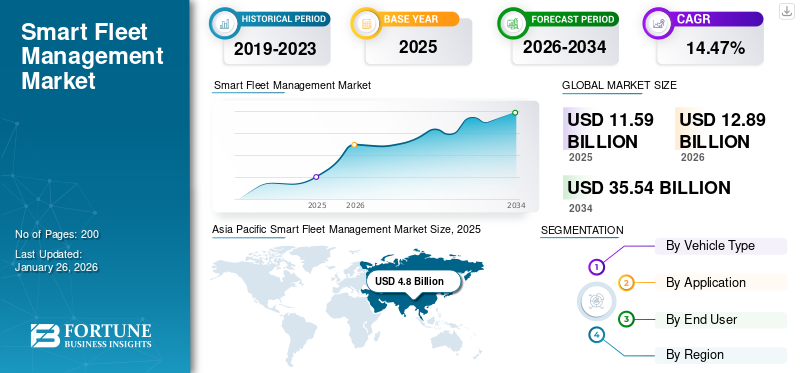
The global smart fleet management market size was valued at USD 11.59 billion in 2025 and is projected to grow from USD 12.89 billion in 2026 to USD 35.54 billion by 2034, exhibiting a CAGR of 13.52% during the forecast period. Asia Pacific dominated the global market with a share of 41.46% in 2025.
Smart fleet management refers to the comprehensive use of advanced technologies and integrated solutions designed to optimize, monitor, and manage vehicle fleets efficiently and safely. It is a technologically advanced approach compared to traditional fleet management. It uses real-time data, telematics, GPS tracking, Internet of Things (IoT), cloud computing, big data analytics, and artificial intelligence to improve operational efficiency, reduce costs, improve driver safety, and ensure regulatory compliance.
The market growth is driven by increasing urbanization, traffic congestion, government regulations on transport safety and emissions, rising demand for operational efficiency, and the expanding size of commercial fleets globally.
The market is highly competitive and fragmented, featuring a mix of global technology market players, automotive suppliers, telematics providers, and specialized fleet management solutions. Leading companies operating in the market include Robert Bosch., Continental AG, and Verizon Connect.
Download Free sample to learn more about this report.
Smart Fleet Management Market Takeaways
 Market Size & Forecast
- 2025 Market Size: USD 11.59 billion
- 2026 Market Size: USD 12.89 billion
- 2034 Forecast Market Size: USD 35.54 billion
- CAGR: 13.52% from 2026–2034
 Market Share
- Asia Pacific dominated the smart fleet management market with a 41.46% share in 2025.
- The commercial vehicle segment is projected to account for a 55.01% market share in 2026.
- The driver management segment is projected to hold a 35.07% share in 2026.
 Key Regional Highlights
Asia Pacific
Asia Pacific captured a 41.46% share in 2025, valued at USD 4.8 billion, and is projected to reach USD 5.37 billion in 2026.
Europe
Europe accounted for USD 3.77 billion in 2025 and is anticipated to witness a CAGR of 14.71% during the forecast period.
North America
North America held a 21.29% share in 2025, valued at USD 2.47 billion, and is expected to reach USD 2.72 billion in 2026.
U.S.
U.S. Market projected to reach USD 2.31 billion by 2026.
Japan
Japan Market projected to reach USD 0.6 billion by 2026.
Read More

Smart Fleet Management Market Trends
Download Free sample to learn more about this report.
Rising Adoption of Autonomous Vehicles to Positively Influence Market Growth
The automotive industry is undergoing a transformative shift toward automation, driven by advancements in technology, changing consumer preferences, and the demand for efficient logistics and transportation solutions. With advancements in artificial intelligence and machine learning, autonomous fleet solutions are becoming a feasible reality. Companies are investing in autonomous vehicles and driver-assist technologies, aiming to enhance safety while reducing operational costs. The implementation of an SFM system in an autonomous vehicle includes real-time monitoring, improved customer experience, data-driven decision-making, automated fleet operations, and predictive maintenance. Thus, the rising adoption of autonomous vehicles drives significant growth during the forecast period.
For instance, in May 2023, Robert Bosch GmbH and PlusAI, Inc. introduced driver-assist truck tech at the Advanced Clean Transportation Expo. The companies are collaborating to develop and deploy advanced driver assistance features in commercial vehicles.
Market Dynamics
Market Drivers
Growth of E-commerce and Logistics Sectors to Augment Market Growth
The rapid expansion of e-commerce and last-mile delivery services increase demand for efficient fleet operations with real-time visibility, route optimization, and timely deliveries, driving the adoption of smart fleet management. The growth of e-commerce directly impacts logistics and supply chain management. Rapid delivery options, such as same-day and next-day delivery, have become essential service components. These demands compel logistics companies to enhance their operational efficiency, reduce costs, and improve customer satisfaction through faster service. Thus, the rising growth of the e-commerce and logistics sectors drives the smart fleet management market growth during the forecast period.
For instance, in December 2024, My TVS introduced Hypermart, a quick-commerce solution for auto parts distribution. This model will enable the rapid delivery of auto parts within 1-2 hours, a first for India’s automotive aftermarket. The company is already running 14 dark stores in Tamil Nadu and Karnataka.
Market Restraints
High Initial Investment and Cost Concerns Hamper Market Growth
High initial investment and ongoing cost concerns are major restraining factors for the market. The deployment of smart fleet management systems often requires significant upfront capital for advanced hardware, software, and integration. Many fleet operators, especially small and medium-sized enterprises, are deterred by these high initial costs and ongoing maintenance expenses. However, strategies such as phased implementation, leveraging open-source and cloud technologies, and vendor negotiations can help mitigate these costs and encourage wider adoption.
Market Opportunities
Increasing Demand for Connected and Real-Time Fleet Monitoring Boosts Market Demand
The growing need for real-time vehicle tracking, driver performance monitoring, and route optimization drives the adoption of IoT and telematics-based solutions. Fleet operators benefit from enhanced safety, reduced fuel consumption, and improved delivery efficiency, fueling the growth of the market.
For instance, in March 2024, Canadian auto insurance companies called a few customers to install anti-theft tracking devices. Insurance companies are trying to reduce auto theft, and tracking devices help recover stolen vehicles, especially in Ontario.
Market Challenges
Data Privacy, Security, and Cybersecurity Risks May Hamper Market Growth
Smart fleet management systems rely heavily on collecting, transmitting, and analyzing vast amounts of sensitive data, including vehicle locations, driver behavior, cargo details, and operational metrics. While this data enables significant operational benefits, it also introduces substantial data privacy, security, and cybersecurity risks that restrain market growth. Telematics and fleet management systems gather extensive data about vehicles, drivers, routes, and cargo. If this information falls into the wrong hands due to inadequate security, it can lead to serious consequences such as financial loss, theft, and operational disruption. Unauthorized access to fleet data can compromise business confidentiality and expose the personal information of drivers, raising privacy concerns.
Segmentation Analysis
By Vehicle Type
Integration of Advanced Technologies in Commercial Vehicles to Drive the Segment Growth
On the basis of vehicle type, the market is segmented into passenger car and commercial vehicle.
The commercial vehicle segment is projected to dominate the market with a share of 55.01% in 2026. This growth is fueled by the integration of advanced technologies (telematics, IoT, AI), the need for real-time tracking, operational optimization, regulatory compliance, and cost reduction. These factors are especially critical for businesses managing large fleets of commercial vehicles.
For instance, in December 2024, Continental AG announced the sale of Zonar, a fleet management provider, to GPS Trackit. Continental AG also focused on developing software-defined vehicle solutions and showcased them at CES 2025, highlighting the use of AI and cloud-based technologies for enhanced vehicle experiences.
The passenger car segment held a significant market share in 2024. The rising sales and production of passenger cars globally are major factors fueling the growth of the market.
By Application
Rising Adoption of ADAS (Advanced Driver Assistance Systems) in Driver Management Systems to Fuel Market Growth
Based on application, the market is divided into operation management, driver management, vehicle tracking system, and others.
The driver management segment is projected to dominate the market with a share of 35.07% in 2026. Segmental growth is attributed to the rising adoption of ADAS (Advanced Driver Assistance Systems). ADAS technologies, including features such as adaptive cruise control, lane departure warnings, blind spot detection, and automatic emergency braking, significantly enhance driver and vehicle safety. This development drives market growth. This segment is expected to capture 35% of the market share in 2025.
The vehicle tracking system segment held a significant market share owing to the rising demand for fleet management and optimization. Businesses in logistics, transportation, and delivery increasingly rely on vehicle tracking systems for real-time tracking, route optimization, fuel efficiency monitoring, and predictive maintenance. These capabilities lead to significant cost savings and improved operational productivity. This segment is anticipated to exhibit a CAGR of 13.81% during the forecast period.
By End User
Rising Demand for Last Mile Delivery and Logistic Optimization to Fuel Retail & E-Commerce Segment Growth
Based on end user, the market is divided into retail & e-commerce, car rental, oil & gas, and others.
The retail & e-commerce segment held the largest share of the market. Retailers and e-commerce platforms depend on smart fleet management for delivery transparency, fuel efficiency, and predictive maintenance. The rising demand for last-mile delivery drives the demand for smart fleet management. This segment is likely to hold 36% of the market share in 2025.
For instance, in April 2025, Aramex signed an agreement with Shipsy. This agreement reflects Aramex's commitment to enhancing its last-mile delivery capabilities, increasing operational efficiency, expanding service offerings, using advanced technologies, and ensuring customer service excellence. This collaboration will enable the roll-out of new services, improve productivity, and drive greater customer satisfaction.
The car rental segment is projected to dominate the market with a share of 34.68% in 2026. The segmental growth is attributed to the expansion of shared mobility services, including car rentals, leasing, and ride-sharing, which has increased the demand for advanced fleet management systems. The growing consumer preference for renting over vehicle ownership, especially in urban areas, is prompting rental service providers to adopt smart fleet technologies for a competitive advantage. The segment is expected to exhibit a CAGR of 14.85% during the forecast period.
To know how our report can help streamline your business, Speak to Analyst
Smart Fleet Management Market Regional Outlook
The global market regions are segmented into North America, Europe, Asia Pacific, and the rest of the world. Asia Pacific dominated the global market in 2024.
Asia Pacific
Asia Pacific Smart Fleet Management Market Size, 2025 (USD Billion)
To get more information on the regional analysis of this market, Download Free sample
The Asia Pacific region captured 41.46% of the global market in 2025, generating USD 4.8 billion in revenue, and is projected to reach USD 5.37 billion in 2026. The region, led by China, India, Japan, and South Korea, has one of the largest automotive markets globally. The rising demand for logistics and transportation services, combined with rising urbanization, creates significant opportunities for smart fleet management solutions. The regional market value in 2024 was USD 4.33 billion, and in 2023, the market value led the region by USD 3.90 billion. The market value in China is expected to be USD 3.26 billion in 2026.
On the other hand, India is projecting to hit USD 0.49 billion and Japan is likely to hold USD 0.6 billion in 2026.
For instance, in April 2025, FedEx announced that it had deployed an additional 13 Tata Ace electric vehicles in Mumbai for last-mile delivery services. The additional vehicles bring FedEx’s total number of EVs in operation across Indian cities to 59 and align with the company’s goal to achieve carbon-neutral operations globally by 2040.
Europe
Europe is anticipated to be the second-largest region with a value of USD 3.77 billion in 2025, exhibiting a CAGR of 14.71% during the forecast period. Europe holds a substantial share of the market, driven by stringent emission regulations and a strong presence of major automotive manufacturers. Governments are incentivizing the adoption of Electric Vehicles (EVs) and eco-friendly practices within the logistics sector, presenting a large opportunity for smart fleet technologies that promote sustainable operations. The market value in U.K. is expected to be USD 0.56 billion in 2026.
On the other hand, Germany is projecting to hit USD 0.81 billion in 2026 and France is likely to hold USD 0.47 billion in 2025.
North America
North America contributed approximately USD 2.47 billion to the global market in 2025, accounting for 21.29% share, and is expected to reach USD 2.72 billion in 2026. In North America, the U.S. and Canada, lead the smart fleet management market, fueled by advanced technological infrastructure and a significant adoption of IoT (Internet of Things) devices. In the U.S., increased demand for operational efficiency drives the market growth. The U.S. market size is expected to hit USD 2.31 billion in 2026.
Rest of the World
The Middle East & Africa region presents unique challenges and opportunities for the smart fleet management market. Furthermore, UAE and South Africa are beginning to embrace smart technologies in fleet management, driven by demand for urbanization and growing transportation. The rest of the world is anticipated to be the fourth-largest market with a size of USD 0.55 billion in 2025.
Competitive Landscape
Key Industry Players
Leading Market Players are Emphasizing the Integration of Advanced Technologies to Gain Competitive Advantage
Leading companies operating in the market include Robert Bosch., Continental AG, and Verizon Connect.
Smart fleet management incorporates technologies such as the Internet of Things (IoT), Artificial Intelligence (AI), big data analytics, and cloud computing to foster real-time tracking, predictive maintenance, route optimization, compliance management, and fuel consumption monitoring.
Verizon Connect offers one of the most comprehensive fleet management platforms available, integrating telematics, driver safety, and maintenance management into a single solution. Their advanced analytics capabilities allow businesses to make data-informed decisions. Verizon Connect also emphasizes compliance and provides tools to help companies adhere to regulatory requirements.
List of Key Smart Fleet Management Companies Profiled:
- Continental AG (Germany)
- Verizon (U.S.)
- Element-Arval Global Alliance (France)
- Omnitracs, LLC. (U.S.)
- ARI Fleet Management (U.S.)
- Trimble transportation (U.S.)
- Wheels (U.S.)
- Geotab Inc (Canada)
- Robert Bosch GmbH (Germany)
- Teletrac Navman (U.S.)
Key Industry Developments
- February 2025: Platform Science completed its acquisition of Trimble’s global transportation telematics business units. As part of the transaction, Trimble becomes a shareholder in Platform Science and joins its board of directors. This collaboration aims to expand the Virtual Vehicle platform, offering fleets a broader range of telematics and fleet management solutions.
- December 2024: Continental sold Zonar, its smart fleet management division, to GPS Trackit. This move aligns with Continental's strategy to focus on core automotive strengths and streamline operations. Zonar, established in 2001 and based in Seattle, specializes in AI-driven fleet solutions for various industries.
- September 2024: Powerfleet acquired Fleet Complete in a USD 200 million deal, creating a leading fleet management entity with over 2.6 million subscribers and an estimated combined revenue exceeding USD 400 million. The acquisition enhances Powerfleet's presence in North America, Australia, and Europe, scales its Unity platform with 600,000 new subscribers, and opens cross-selling opportunities through Fleet Complete’s relationships with major U.S. and Canadian telecommunications carriers.
- April 2024: Motive officially announced its expansion in Mexico. The company provides an integrated suite of physical security, driver safety, fleet management, and equipment monitoring solutions. Motive has supported businesses based in the U.S. that have operations in Mexico.
- August 2023: Omnitracs announced the completion of its acquisition of the assets of Shaw Tracking, a subsidiary of Shaw Communications Inc. and the leading fleet management solutions provider in Canada. Shaw Tracking has been the exclusive Canadian partner of Omnitracs fleet management solutions for over 25 years. The company distributed a wide range of world-class solutions, including GPS vehicle tracking products, fleet management software, and other value-added software applications, which will now be integrated into the broader Omnitracs’ product solutions portfolio.
Report Coverage
The global smart fleet management market research report analyzes the market in-depth and highlights crucial aspects such as prominent companies, market segmentation, competitive landscape, and technology adoption. Besides, it provides insights into market trends and highlights significant industry developments. In addition to the aspects mentioned earlier, it encompasses several factors contributing to the market’s growth over recent years.
Request for Customization to gain extensive market insights.
Report Scope & Segmentation
|
ATTRIBUTE |
DETAILS |
|
Study Period |
2021-2034 |
|
Base Year |
2025 |
|
Forecast Period |
2026-2034 |
|
Historical Period |
2021-2024 |
|
Growth Rate |
CAGR of 13.52% from 2026 to 2034 |
|
Unit |
Value (USD Billion) |
|
Segmentation |
By Vehicle Type
By Application
By End User
By Region
|
Frequently Asked Questions
Fortune Business Insights says that the market size was at USD 11.59 billion in 2025 and is anticipated to record a valuation of USD 35.54 billion by 2034.
The market will exhibit a CAGR of 13.52% over the forecast period of 2026-2034.
By vehicle type, the commercial vehicle segment dominated the market in 2026.
Growth of the e-commerce and logistics sectors is expected to augment market growth.
Leading companies operating in the market include Robert Bosch., Continental AG, and Verizon Connect.
Asia Pacific dominated the global market in 2025.



- 2021-2034
- 2025
- 2021-2024
- 200
-
(Offer valid till 30th Sep 2026)
Get 30-60 hrs Free Customization
Expand Regional and Country Coverage, Segments Analysis, Company Profiles, Competitive Benchmarking, and End-user Insights.




















-
US +1 833 909 2966 ( Toll Free )
-
Get In Touch With Us