Allulose Market Size, Share & Industry Analysis, By Form (Powder, Crystal, and Liquid), By Application (Food [Bakery, Confectionery, Dairy & Frozen Desserts, and Others], Beverages, Pharmaceuticals, and Others), and Regional Forecast, 2026-2034
 Download Free Sample
(Offer valid till 30th Sep 2026)

Allulose Market Overview
 Listen to Audio Version
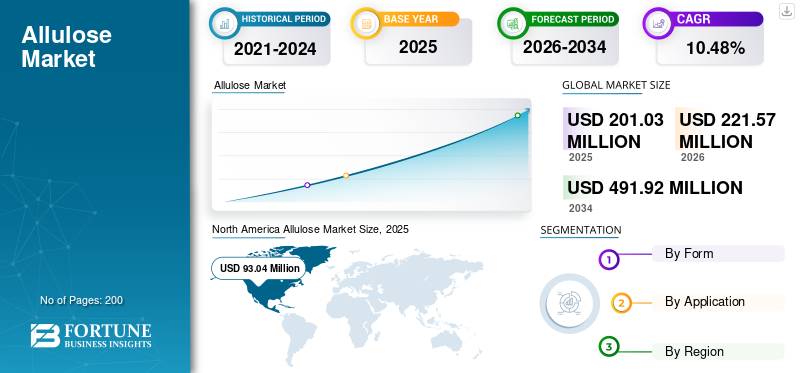
The global allulose market size was valued at USD 201.03 million in 2025. The market is projected to grow from USD 221.57 million in 2026 to USD 491.92 million by 2034, exhibiting a CAGR of 10.48% during the forecast period. North America dominated the allulose market with a market share of 46.28% in 2025.
Allulose, a rare sugar with nearly zero calories and minimal glycemic impact, is increasingly being adopted as a functional sweetener across food, beverage, and pharmaceutical applications. It offers a similar taste and texture to sucrose while enabling traditional sugar reduction without compromising sensory attributes. Available in multiple forms such as powder, crystal, and liquid, allulose is highly versatile and suitable for a wide range of industrial formulations, including bakery, dairy, beverages, and nutraceutical products.
The market growth is primarily driven by the increasing shift toward sugar reduction, expansion of functional food manufacturing, and the rising demand for clean-label ingredients. Additionally, regulatory approvals in key markets such as the U.S., where allulose is generally recognized as safe (GRAS), and parts of Asia have accelerated commercialization. Leading companies, including Cargill Inc., Ingredion Inc., Tate & Lyle PLC, CJ CheilJedang, and Samyang Corporation, are focusing on capacity expansion, product innovation, and strategic partnerships with food manufacturers to strengthen market presence.
Download Free sample to learn more about this report.
Allulose Market KEY TAKEAWAYS
 Market Size & Forecast
- 2025 Market Size: USD 201.03 million
- 2026 Market Size: USD 221.57 million
- 2034 Forecast Market Size: USD 491.92 million
- CAGR: 10.48% from 2026–2034
 Market Share
- North America dominated the allulose market with a 46.28% share in 2025.
- The liquid segment is projected to grow at the fastest CAGR of 11.35% during 2026–2034.
- The beverages segment is expected to grow at the fastest CAGR of 11.46% during 2026–2034.
 Key Regional Highlights
North America
North America was valued at USD 93.04 million in 2025 and is projected to reach USD 221.08 million by 2034, growing at a CAGR of 10.12%.
North America
Europe was valued at USD 19.22 million in 2025 and is expected to reach USD 51.21 million by 2034, registering a CAGR of 11.53%.
Asia Pacific
Asia Pacific reached USD 76.52 million in 2025 and is forecast to grow to USD 193.26 million by 2034 at a CAGR of 10.87%.
U.S.
U.S. The market was valued at USD 85.21 million in 2025, supported by favorable FDA labeling regulations and increasing product launches in beverages and snacks.
Japan
Japan Rising demand for low-calorie sweeteners and growing adoption of sugar-reduction ingredients are supporting steady allulose market growth.
Read More

Allulose Market Trends
Growing Consumer Inclination toward Ketogenic, Diabetic-friendly, and Low-carb Diets to Shape Industry Trends
The rising adoption of ketogenic and low-carbohydrate eating patterns is strengthening the commercial relevance of allulose, as consumers following these diets actively seek sweetening solutions that help reduce sugar and net carbohydrate intake without compromising taste, bulk, or baking performance.
Unlike many conventional sweeteners, allulose fits well into keto-oriented product development as it delivers sugar-like functionality in applications such as bars, bakery products, confectionery, and tabletop sweeteners. This allows brands to position products around low-carb and reduced-sugar claims while still meeting sensory expectations. This is pushing ingredient suppliers and food brands to incorporate product usage across mainstream wellness and lifestyle nutrition categories.
- According to the International Food Information Council 2024 Food & Health Survey, 54% of Americans said that they had followed a specific eating pattern or diet in the past year, including 7% following low-carb and 4% following ketogenic or high-fat diets. The FDA guidance also continues to allow allulose to be counted at 0.4 calories per gram and excluded from declared total and added sugars on U.S. labels.
MARKET DYNAMICS
Market Drivers
Download Free sample to learn more about this report.
Growing Obesity and Diabetes Burden to Strengthen Demand for Better-for-You Sugar Alternatives
The growing incidence of obesity worldwide is pushing food and beverage companies to intensify reformulation toward reduced-sugar and better-for-you sweetening systems, as excess body weight is increasingly linked with long-term cardiometabolic risk and greater scrutiny of high-sugar diets. This is strengthening the demand for alternatives such as allulose products that can help manufacturers lower calorie load while maintaining sweetness, texture, and label competitiveness in mainstream packaged foods and beverages. The expanding global diabetes burden is accelerating the demand for low-glycemic sugar alternatives, as consumers, healthcare stakeholders, and food manufacturers increasingly prioritize ingredients that have minimal impact on blood glucose management without significantly compromising taste or formulation performance. This is creating a favorable environment for sugar substitutes positioned for diabetic-friendly, low-sugar, and metabolic-health-oriented product development, favoring allulose market growth.
- The International Diabetes Federation estimated that globally 589 million adults aged 20 –79 years were living with diabetes in 2024 and this figure is projected to rise to 853 million by 2050.
Market Restraints
High Production Cost and Regulatory Disparity across Regions to Restrict Global Market Expansion
The high production cost associated with rare sugars such as allulose is a significant barrier to large-scale commercialization, as the enzymatic conversion processes, purification requirements, and limited economies of scale result in substantially higher input and processing costs compared to conventional sugars such as sucrose and high-fructose corn syrup. This cost differential restricts the widespread adoption among price-sensitive food manufacturers, particularly in emerging markets where cost competitiveness is a critical purchasing factor.
Furthermore, the lack of uniform regulatory approval across key global markets is restricting the global market expansion, as different countries maintain varying classifications, labeling requirements, and safety assessments for rare sugars. This regulatory fragmentation creates complexity for multinational manufacturers, increasing compliance costs and delaying product launches in regions where approval is still pending or unclear.
- While allulose is approved as a food ingredient in markets such as the U.S., Japan, South Korea, and Mexico, it remains unapproved or restricted in regions such as the European Union, limiting its global market accessibility.
Market Opportunities
Soaring Product Adoption in Foodservice and Quick Service Restaurants (QSRs) to Offer Potential Growth Opportunities
The rapid expansion of foodservice and quick-service restaurant (QSR) channels is creating strong growth opportunities for allulose, as these outlets increasingly focus on menu reformulation, catering to the growing consumer demand for low-calorie, reduced-sugar, and “better-for-you” offerings without compromising taste and convenience. QSR chains are integrating alternative sweeteners into high-volume menu categories such as beverages, desserts, and sauces, where sugar reduction is a priority but sensory attributes such as mouthfeel, browning, and taste profile must be preserved. These are areas where allulose offers functional advantages over traditional sweeteners. The increasing dominance of beverage categories within foodservice and QSR menus is further strengthening market opportunities as carbonated drinks, flavored coffees, ready-to-drink teas, and functional beverages are among the largest contributors to sugar intake and are, therefore, primary targets for sugar reduction strategies.
- For instance, in July 2025, Danger Coffee, founded by biohacker Dave Asprey, promoted allulose as an ideal, "smart swap" sweetener for iced coffee. The brand focuses on mineral-enriched, mold-free coffee and suggests allulose as it offers the taste and texture of sugar without causing the same negative metabolic impacts.
SEGMENTATION ANALYSIS
By Form
Crystal Segment Dominated the Market Due to Close Functional Similarity to Sugar in Food Applications
On the basis of form, the market is segmented into powder, crystal, and liquid.
The crystal segment dominated the global allulose market share, valued at USD 109.13 million in 2025, as it offers a texture, sweetness profile, and handling characteristics close to conventional sugar. It is widely used in bakery, confectionery, tabletop sweeteners, and processed foods where bulk, browning, and mouthfeel are important. Food manufacturers prefer crystalline allulose in formulations requiring sugar replacement without significantly altering product structure or sensory performance. Its broad applicability across mainstream food categories continues to support its leading market position.
The liquid segment is projected to grow at the fastest CAGR of 11.35% during 2026–2034. This is driven by the rising usage in beverages, syrups, dairy applications, and liquid nutritional products where solubility and ease of blending are critical.
To know how our report can help streamline your business, Speak to Analyst
By Application
Food Segment Dominated the Market Due to Broad Usage across Bakery, Confectionery, and Dairy Formulations
Based on application, the market is segmented into food, beverages, pharmaceuticals, and others.
The food segment dominated the market, valued at USD 102.91 million in 2025, owing to the extensive incorporation of allulose across baked goods, confectionery, dairy, and frozen dessert applications. Within food, bakery represented a major sub-segment, reaching USD 31.37 million in 2025, supported by the product’s ability to provide bulk, browning, and sweetness similar to sugar. In 2025, confectionery accounted for USD 26.04 million, while dairy and frozen desserts reached USD 18.86 million, reflecting the increasing use in reduced-sugar product reformulations. The segment continues to benefit from growing manufacturer focus on maintaining taste and texture while lowering sugar content.
The beverages segment is expected to grow at the fastest CAGR of 11.46% during 2026–2034. This is supported by the strong demand for low-calorie carbonated drinks, flavored waters, functional beverages, and ready-to-drink products.
Allulose Market Regional Outlook
Regionally, the market is studied across North America, Europe, Asia Pacific, South America, and the Middle East & Africa.
North America
North America Allulose Market Size, 2025 (USD Million)
To get more information on the regional analysis of this market, Download Free sample
North America dominated the global market and was valued at USD 93.04 million in 2025. The regional market is projected to reach USD 221.08 million by 2034 and is likely to grow at a CAGR of 10.12% over the forecast period. The regional growth is driven by regulatory approvals, strong demand for sugar alternatives, and advanced food processing industries.
U.S. Allulose Market
The U.S. dominates the regional market, valued at USD 85.21 million in 2025, supported by favorable FDA labeling regulations and increasing product launches in beverages and snacks. The market benefits from strong R&D investments and high consumer awareness regarding low-calorie diets.
Europe
Europe was valued at USD 19.22 million in 2025 and is projected to reach USD 51.21 million by 2034, registering a CAGR of 11.53% over the analysis period. Growth is supported by the rising demand for clean-label sweeteners and regulatory developments across the region.
Germany Allulose Market
Germany is valued at approximately USD 3.67 million in 2025, driven by strong demand from the functional food and beverage sector and increasing reformulation efforts by food manufacturers.
U.K. Allulose Market
The U.K. market was valued at around USD 3.43 million in 2025, supported by the rising adoption of sugar alternatives in processed foods and beverages.
Asia Pacific
Asia Pacific was valued at USD 76.52 million in 2025 and is projected to reach USD 193.26 million by 2034, growing at a CAGR of 10.87% over the forecast period. Growth is driven by strong manufacturing capabilities, increasing exports, and rising health awareness.
China Allulose Market
China dominated the region with a value of approximately USD 18.69 million in 2025. This expansion is due to large-scale production capabilities and export-oriented supply chains.
South America and the Middle East & Africa
South America was valued at USD 8.99 million in 2025 and is projected to reach USD 19.71 million by 2034, growing at a CAGR of 9.13% over the forecast period. Growth is driven by increasing processed food consumption and the gradual adoption of alternative sweeteners.
The Middle East & Africa market was valued at USD 3.26 million in 2025 and is projected to reach USD 6.66 million by 2034, expanding at a CAGR of 8.25% over the forecast period. Growth is supported by rising urbanization and increasing demand for imported functional food ingredients.
Brazil Allulose Market
Brazil leads the South American market, valued at approximately USD 2.70 million in 2025, driven by the growing demand for low-calorie products and boosting the food and beverage industry.
COMPETITIVE LANDSCAPE
Key Industry Players
Key Players Focus on Capacity Expansion, Strategic Partnerships, and Commercial Scale-Up to Strengthen Market Position
The global allulose market is moderately consolidated, with leading companies focusing on production scale-up, ingredient innovation, and partnerships with food and beverage manufacturers. Competition is centered on improving cost competitiveness, expanding regional distribution networks, and strengthening application support for reduced-sugar formulations across bakery, beverages, confectionery, and nutritional products. Companies are also investing in process efficiency and rare sugar commercialization to improve margins and accelerate adoption in mainstream food categories.
Key Players in the Allulose Market
|
Rank |
Company Name |
|
1 |
Cargill Inc. |
|
2 |
Ingredion Inc. |
|
3 |
Tate & Lyle PLC |
|
4 |
CJ CheilJedang Corporation |
|
5 |
Samyang Corporation |
List of Key Allulose Companies Profiled
- Cargill Inc. (U.S.)
- Ingredion Inc. (U.S.)
- Tate & Lyle PLC (U.K.)
- CJ CheilJedang (South Korea)
- Samyang Corporation (South Korea)
- Matsutani Chemical Industry Co., Ltd. (Japan)
- Anderson Global Group, LLC (U.S.)
- Bonumose LLC (U.S.)
- Heartland Food Products Group (U.S.)
- Shandong Bailong Chuangyuan Bio-Tech Co., Ltd. (China)
KEY INDUSTRY DEVELOPMENTS
- November 2024: Samyang Corporation secured the first Novel Food approval for allulose from Food Standards Australia New Zealand (FSANZ), enabling sales in Australia and New Zealand. Samyang plans to supply allulose via its B2B brand Nexweet, prioritizing local client partnerships and holding exclusive supplier status initially.
- October 2024: 1-2-Taste India Pvt. Limited became the first company in India to receive approval from the Food Safety and Standards Authority of India (FSSAI) to buy and sell allulose, a natural low‑calorie sweetener. This authorization marks a milestone for the Indian food and beverage sector, as allulose is one of the few “rare sugars” that mimic sucrose in taste and bulk, yet contribute only about 0.2–0.4 calories per gram and have a negligible glycemic impact.
- August 2024: Cargill Inc opened a new blending facility in Pandaan, East Java, Indonesia, to support the demand for “multi‑sensorial” sugar confectionery products in Asia, including formats that use sweeteners such as allulose as part of broader sugar‑reduction and texture‑driven portfolios.
- July 2023: Anderson Advanced Ingredients launched SinClusions, an innovative line of clean-label inclusions designed for sugar-free and low-calorie applications in bakery, confectionery, protein bars, ice cream, and pet nutrition. SinClusions offers functional toppings such as chocolate chips, rainbow sprinkles, glitters, and crisps, all naturally sweetened with allulose or other rare sugars instead of sugar alcohols or artificial sweeteners.
- January 2020: Ingredion Inc. opened its ASTRAEA Allulose production plant in San Juan del Río, Mexico. This facility, first dedicated to allulose in Latin America, produces the low-calorie sweetener in partnership with Matsutani Chemical Industry for markets across the Americas.
REPORT COVERAGE
The global allulose market report analyzes the market in depth and highlights crucial aspects such as global market trends, market dynamics, supply chains, prominent companies, investment in research and development, and end-use. Besides this, the report also provides insights into the global market analysis and highlights significant industry developments.
Request for Customization to gain extensive market insights.
Report Scope & Segmentation
| ATTRIBUTE | DETAILS |
| Study Period | 2021-2034 |
| Base Year | 2025 |
| Estimated Year | 2026 |
| Forecast Period | 2026-2034 |
| Historical Period | 2021-2024 |
| Growth Rate | CAGR of 10.48% from 2026 to 2034 |
| Unit | Value (USD Million) |
|
Segmentation |
By Form
|
|
By Application
|
|
|
By Region
|
Frequently Asked Questions
Fortune Business Insights says that the global market was valued at USD 201.03 million in 2025 and is anticipated to reach USD 491.92 million by 2034.
The global market will exhibit steady growth at a CAGR of 10.48% over the forecast period.
By form, the crystal segment led the market in 2025.
North America held the largest market share in 2025.
Growing obesity and diabetes burden is a key factor strengthening the demand for better-for-you sugar alternatives, driving market growth.
Cargill Inc., Ingredion Inc., Tate & Lyle PLC, CJ CheilJedang, and Samyang Corporation are the leading players in the market.
The growing consumer inclination toward ketogenic, diabetic-friendly, and low-carb diets is a key trend in the market.



- 2021-2034
- 2025
- 2021-2024
- 200
-
(Offer valid till 30th Sep 2026)
Get 30-60 hrs Free Customization
Expand Regional and Country Coverage, Segments Analysis, Company Profiles, Competitive Benchmarking, and End-user Insights.




















Related Reports
-
US +1 833 909 2966 ( Toll Free )
-
Get In Touch With Us